Simple Machines
Prepare for an enlightening exploration with Learning Mole’s “Simple Machines”! In this engaging video, we delve into the fascinating world of basic mechanical devices that have shaped human history and innovation. From levers to pulleys, we’re about to uncover the fundamental principles behind these simple yet powerful tools. Join us as we unravel the secrets of how simple machines make complex tasks easier, showcasing the ingenuity and efficiency of these foundational components. Get ready to embark on a journey of discovery and invention, understanding the role that simple machines play in our everyday lives and technological advancements. It’s a celebration of innovation, engineering, and the remarkable impact of these essential elements that will leave you inspired and intrigued! 🔧⚙️🔩
Transcription for Simple Machines
Please note this transcript is generated automatically and may contain errors.
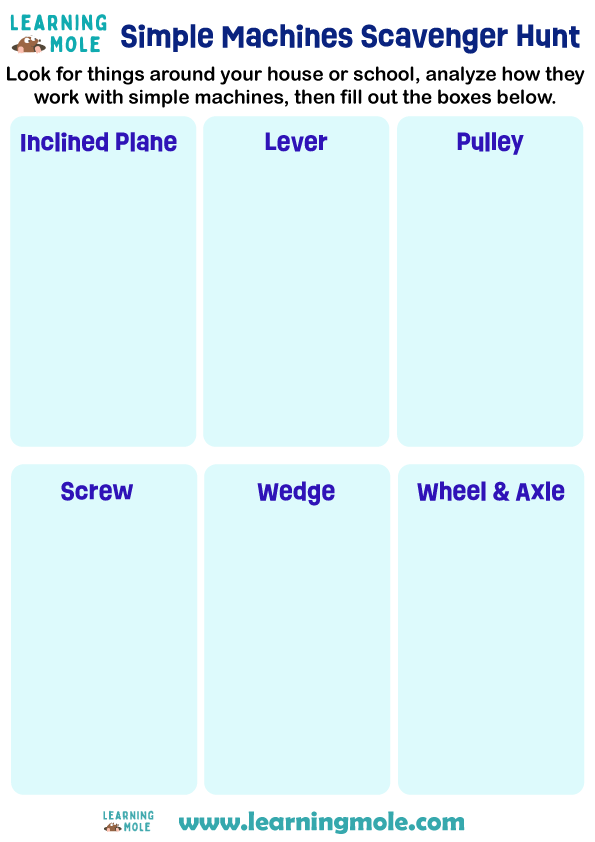
Today we are going to learn five superb facts about simple machines. Fact number one, a leather is a rigid bar that pivots around a fixed point known as the This simple machine operates on the principle of mechanical advantage, allowing you to lift heavier objects with less effort. Picture a seesaw or a crowbar. These are practical examples of levers In a seesaw, the fulcrum is the point in the middle where the plank pivots levers are categorized into three types based on the positions of the fulcrum effort and load.
They’re ubiquitous in daily life, found in tools like scissors and pliers, and even in biological systems, your arms act as levers when you lift objects with your elbow serving as the fulcrum. Fact. Number two, a pulley consists of a wheel with a groove around its edge designed to hold a rope, belt, or cable. Pullies can either change the direction of an applied force or reduce the amount of force needed to lift a load. They are often used in systems like flagpoles lines and welds. Complex pulley systems known as block and tackle are used in machinery like cranes to lift extremely heavy, heavy.
The mechanical advantage increases with the number of pullies used in the system. Fact number three, this machine comprises two circular objects, a larger wheel and a smaller axle connected so that they rotate together. The wheel multiplies, the rotational force torque, making it easier to move or lift objects. This principle is at the heart of various forms of transportation, including cars and bicycles. It’s also found in everyday items like door and pencil sharpeners. The mechanical advantage is determined by the ratio of the radii of the wheel and axle.
Fact number four, an inclined plane is a flat surface set at an angle other than a right angle against a horizontal surface. The incline plane reduces the amount of force required to lift an object to a certain height. Instead of lifting the object vertically, you can push or pull it up the incline surface. This is the principle behind ramps used for loading heavy goods onto truck or providing wheelchair access to buildings. The mechanical advantage is calculated by the length of the incline divided by the vertical height.
Fact number five, a screw is an inclined plane wrapped around a cylindrical or conical core. When you rotate a screw, it converts rotational force into linear force moving along its axis. This is useful in a myriad of applications from fastening materials together to lifting heavy objects. A wedge, on the other hand, is essentially a double inclined plane. It either separates materials as in the case of an axe or a knife, or holds them together like a doorstop. The sharper the wedge, the less force is needed to do the work. I hope you enjoyed my five superb facts about simple machines. See you soon.
Simple Machines Scavenger Hunt Activity