
Meteors
Get ready for an astronomical adventure with “Meteors”! This video invites you to explore the captivating world of these celestial fireworks in the night sky. From shooting stars to meteor showers, we’re about to uncover the essential facts and insights that make meteors a mesmerizing natural phenomenon. Join us as we delve into the origin and composition of meteors, understanding their journey from outer space to Earth’s atmosphere. From exploring the difference between meteors, meteoroids, and meteorites to learning about the impact they have on our planet’s surface, we’ll unravel the intricacies of these cosmic travelers. So, prepare to enhance your knowledge and join us on this enlightening journey through the realm of meteors. It’s an exploration that will leave you awe-inspired, appreciating the beauty and wonder of these celestial visitors that light up our skies. ✨🌠🔍
Transcription for Meteors
Please note this transcript is generated automatically and may contain errors.
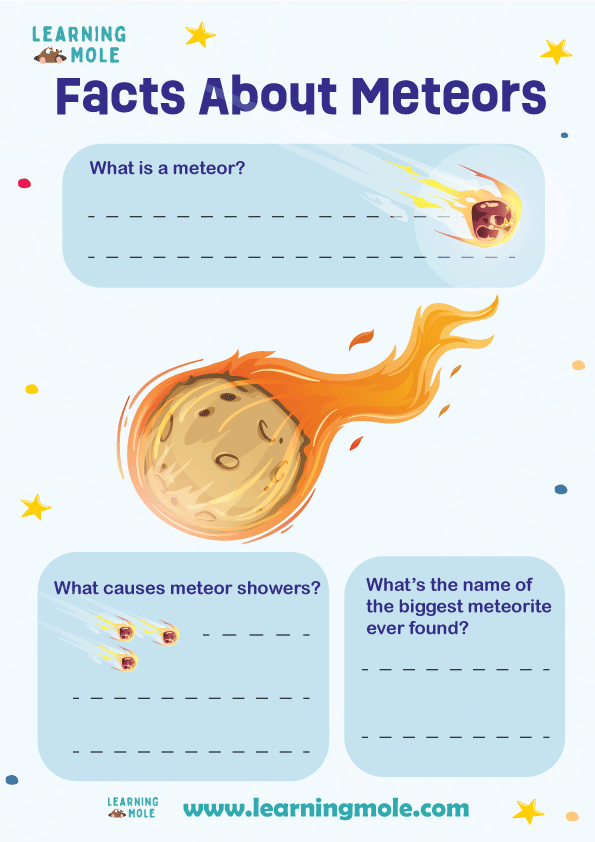
Today we’re going to learn five marvelous facts about meteors fact. Number one a meteoroid is essentially a space rock that can vary in size and shape when meteoroids and to the Earth’s atmosphere. They become known as meteors when this occurs what we can see in the sky is a meteor streak, which is essentially a streak of light in the sky when a meteoroid goes through the Earth’s atmosphere and hits the ground. It is known as a meteorite fact number two, I’ll meet you or shower because when the earth passes through the trail of debris left by a broken Comet or asteroid meteor showers occur a couple of times a year and they’re usually named after a constellation or star that is close to where the meteor shower appears in the sky two of the meteor.
Hours that occur each year are the percentings in August and the gamma needs in December. Every perceived meteor comes from a piece of the Comet Swift Tuttle and his named after the constellation Perseus. It is one of the most important meteor showers of the year the Gama needs originate from the 3,0200 python asteroid and are bright and fast meteors fact number three when you make a wish on a shooting star it is technically our meteor that you’re wishing on meteos are also known as Fireballs which are larger explosions of light and color that can usually last longer than average meteor streak a fireball is brighter than the planet Venus and can have a magnitude of minus three.
Fact number four meteors are usually small in size and some are even dust particles by the time they reach the ground. The biggest meteor on Earth is the hoba meteorite which was found in 1920 by a farmer in Namibia. The Hoda meteorite is 9 foot in length and three foot in height and it has a flat top. The meteorite was given the name Huber because it was discovered on a farm named hobo West the hover meteorite ways over 60 tons, which is equivalent to the weight of nine elephants the meteorites Still Remains in its original spot today.
Fact number five one of the most famous meteor creators is the Barringer meteor crater. The Barringer meteor crater was formed during the Ice Age and is one kilometer wide which is as tall as three. Eiffel Towers stacked on top of one another. The crater is 750 feet deep. You could fit two and a half big bends inside the Barringer meteor. You can visit the Barringer meteor crater site in northern Arizona. I hope you enjoyed my five marvelous meteor facts. See you soon.
