
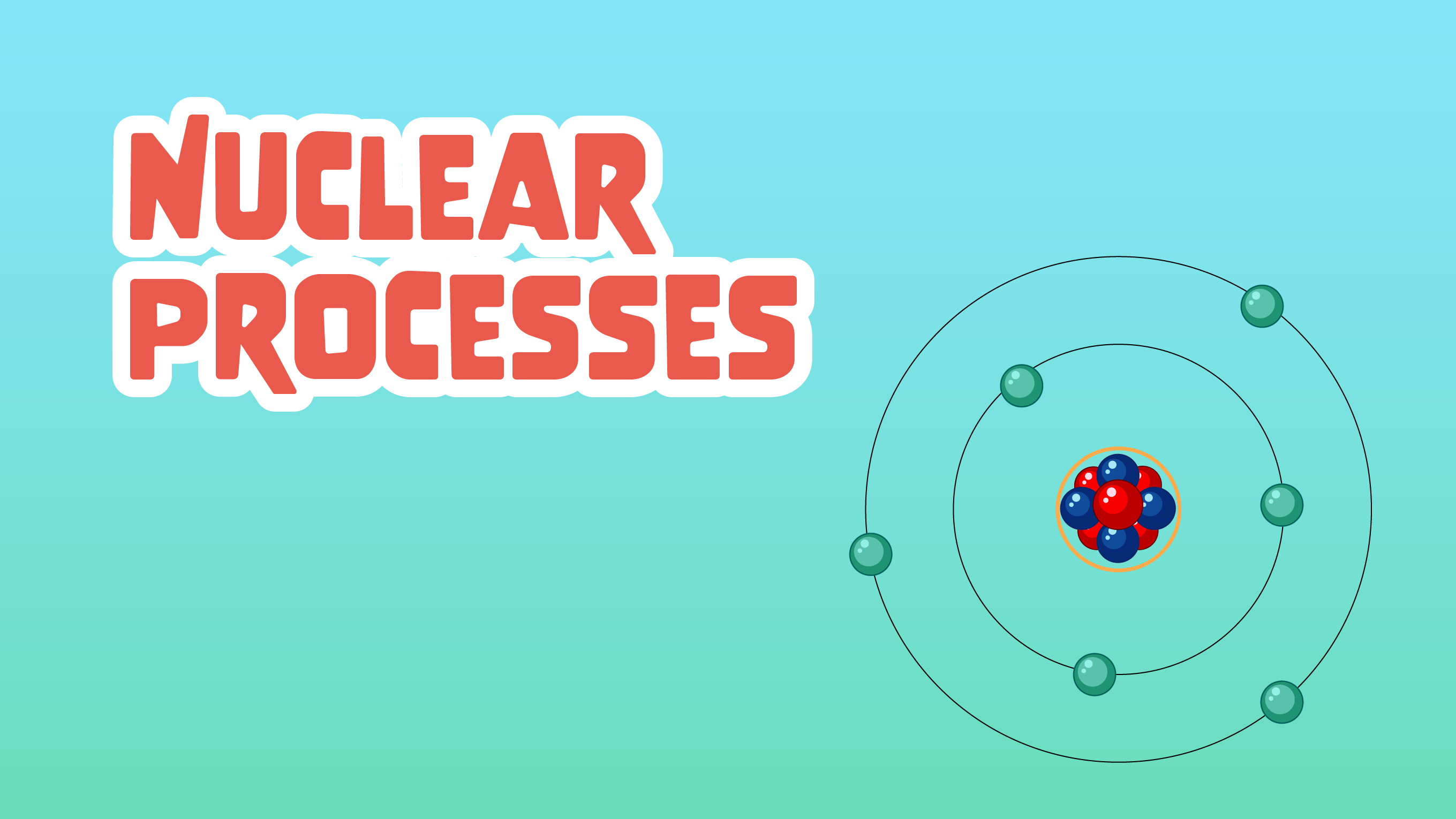
Nuclear Processes

Prepare for a mind-bending exploration into the world of atomic energy with Learning Mole’s “Nuclear Processes”! This video is a captivating journey into the intricate and powerful realm of nuclear processes. From fission to fusion, we’re about to uncover the extraordinary facts that govern the behavior of atomic nuclei, shaping the fundamental forces of our universe. Join us as we unravel the mysteries of nuclear reactions, understanding the transformative power of atomic energy and its applications in science and technology. Get ready to delve into the complexities of nuclear physics, exploring the mechanisms that drive stars, power plants, and the very core of matter itself. It’s a celebration of scientific wonders, technological advancements, and the immense potential of nuclear processes that will leave you with a newfound appreciation for the energy that shapes our world! ⚛️🔥🌌

Transcription for Nuclear Processes

Please note this transcript is generated automatically and may contain errors.

00:02:14 363 words

Today we are going to learn five facts about nuclear processes and energy transformation. Fact number one, the nucleus is the heart of an atom where protons and neutrons live. Protons are like the identity badges telling us which element the atom belongs to. Like hydrogen or helium. Neutrons are the buddies of protons. They hang out together in the nucleus, but don’t change the element’s Identity. Different combinations of protons and neutrons create different versions of the same element known as isotopes. Fact number two, imagine a big nucleus is a heavy suitcase, and fission is like it being dropped and bursting open into smaller pieces with a lot of energy shooting out, scientists figured out how to make this happen by shooting a tiny particle called a neutron at the big nucleus to make it split.

This is how nu nuclear power plants make electricity, but it’s also how atomic bombs work. Fact number three, fusion is like a high five between two small nuclei that come together to form a bigger nucleus releasing a burst of energy. This happens naturally in stars like our sun, where the super hot and tight conditions make the nuclei come together. Scientists are trying to find ways to do this on earth to create a super powerful and clean energy source. Fact number four, some nuclei are like ticking time bombs.

They’re unstable and give off energy and particles to become stable. This process is called radioactive decay. There are different ways nuclei can do this, like kicking out big chunks, transforming a neutron into a proton while shooting out an electron or just releasing energy like a burst of light. Fact number five, when nuclei changed during fission fusion or decay, a little bit of their mass turns into energy and it follows Einstein’s cool equation, E equals mc squared. This equation tells us that even a tiny amount of mass can be converted into a huge amount of energy.

That’s why nuclear reactions are much more powerful compared to chemical reactions like burning wood or fuel. I hope you enjoyed my five facts about nuclear processes and energy transformation. See you soon.

Nuclear Process Activity

Nuclear Process Activity