Hypothesis
Prepare for an insightful exploration of scientific inquiry with Learning Mole’s “Hypothesis”! This video takes you on a captivating journey into the world of hypothesis testing and experimentation, where we uncover the essential role of hypotheses in the scientific method. From formulating educated guesses to designing experiments, we’re about to delve into the intriguing facts that underpin the process of hypothesis generation and evaluation. Join us as we explore the critical thinking behind scientific inquiry, understanding how hypotheses serve as the foundation for scientific discovery and knowledge creation. Get ready to unlock the secrets of hypothesis testing, showcasing how theories are formed and validated through empirical evidence. It’s a celebration of intellectual curiosity, empirical reasoning, and the quest for understanding that will leave you with a deeper appreciation for the scientific process and the pursuit of knowledge! 🧪🔬🤔
Transcription for Hypothesis
Please note this transcript is generated automatically and may contain errors.
Today we are going to learn five facts about forming a hypothesis. Fact number one, A hypothesis is a proposed explanation or prediction for a particular situation or phenomenon. Based on prior knowledge, observations or reasoning, it acts as a starting point for scientific investigation. For instance, if you notice that students seem to be sleepier on rainy days, you might hypothesize that weather affects alertness. The hypothesis serves as a bridge between the known and the unknown, guiding the quest for new knowledge. Fact number two, an effective hypothesis should be testable and measurable.
It should propose a relationship or an effect that can be examined through experimentation or observation. For example, in the hypothesis increasing the amount of sunlight a plant receives will enhance its growth rate. The variables amount of sunlight and growth rate are measurable, and the relationship between them can be tested in a controlled experiment. Fact number three, observations provide the raw material from which hypotheses are formed. When you observe a pattern or a phenomenon, it may spark a question or a prediction. For instance, if you observe that plants near a window seem to grow faster than plants in a dimly lit corner, you might hypothesize that light accelerates plant growth.
These observations act as the foundation upon which hypotheses are built driving the inquiry forward. Fact number four, existing knowledge, whether from personal experiences, educational materials, or previous research, plays a crucial role in formulating a hypothesis. It provides a contextual background that informs the hypothesis. For example, if you’ve learned that certain nutrients are essential for plant growth, you might hypothesize that increasing the nutrient concentration in the soil will lead to taller plants. This melding of new observations with existing knowledge propels the scientific inquiry. Fact number five, hypothesis formation sets the stage for the investigation by defining the focus and the aim of the inquiry once a hypothesis is formulated.
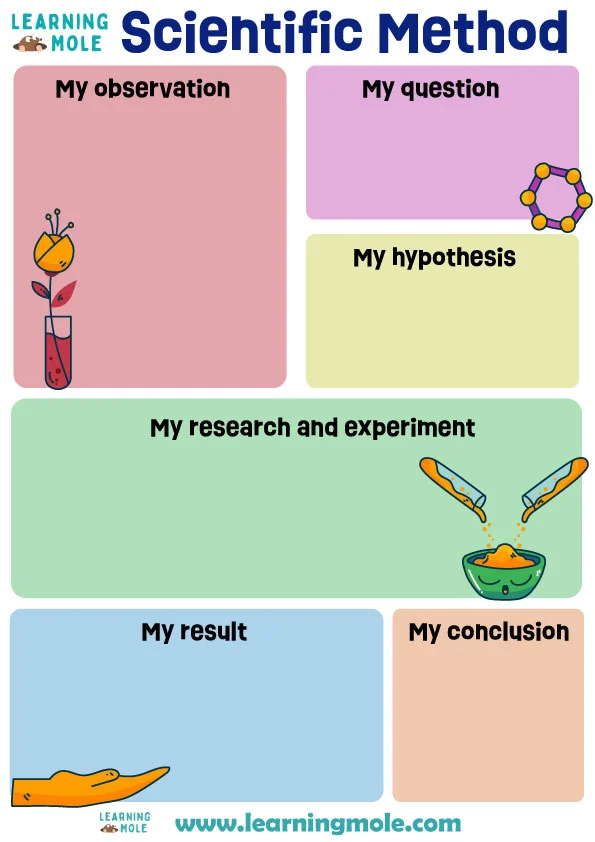
The next steps in the scientific method, designing the experiment, collecting data, analyzing results, and drawing conclusions, follow logically. The hypothesis essentially lays down a pathway for the investigation, providing a clear objective and a framework within which the scientific exploration unfolds. I hope you enjoyed my five facts about a hypothesis. See you soon.
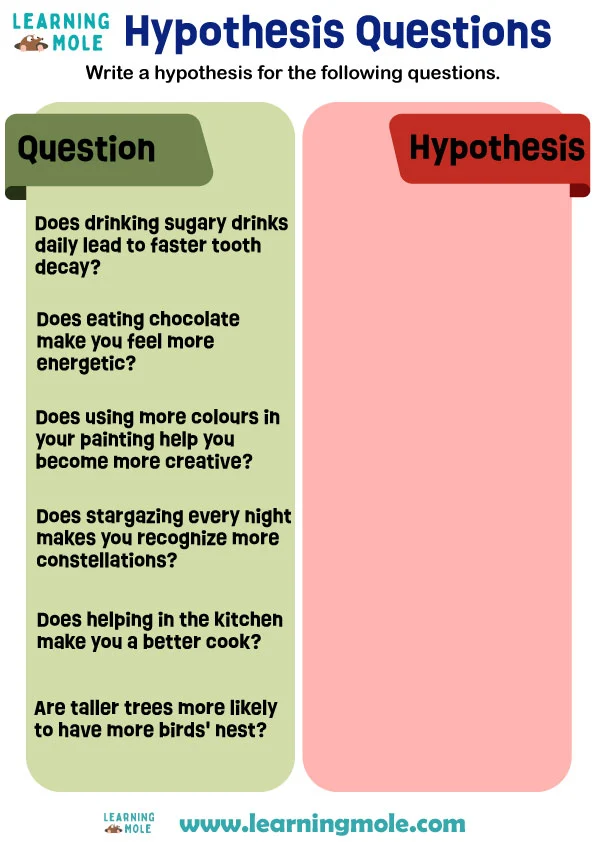
Scientific Method Hypothesis Activity Hypothesis Questions Activity