Lego Math: Enjoy Learning with Lego 3 Genius Games
Table of Contents
LEGO Maths: LEGO is one of the few resources that earns equal enthusiasm from a five-year-old working on number recognition and a ten-year-old wrestling with area and perimeter. That’s not an accident. The physical act of snapping bricks together, counting studs, and building towers maps naturally onto the concrete stage of learning that underpins the UK National Curriculum’s approach to primary maths mastery. When children can hold a concept in their hands, the abstract version makes far more sense later.
LearningMole, the UK educational platform founded by former primary school teacher Michelle Connolly, uses the Concrete-Pictorial-Abstract (CPA) approach across its curriculum-aligned maths resources precisely because this sequence reflects how children genuinely build mathematical understanding. LEGO bricks are ideal CPA tools: they’re standardised, tactile, and everywhere. A 2×4 brick always has eight studs. A row of ten 1×1 bricks always equals one exchange brick. That consistency is what makes them educationally powerful rather than merely entertaining.
This guide provides three classroom-tested LEGO maths games aligned to specific UK National Curriculum objectives, with year group guidance, teacher assessment tips, and home learning adaptations for each one. Whether you’re a KS1 teacher introducing place value or a parent supporting your Year 5 child with geometry, these games offer a ready-to-teach structure that bridges the gap between playful exploration and curriculum mastery.
Why LEGO Works as a Maths Manipulative

LEGO bricks are physical bar models. This connection is consistently overlooked, yet it’s one of the most useful links a primary teacher can make. Bar modelling is a staple of UK maths mastery and White Rose Maths; it represents quantities as rectangular blocks placed side by side or stacked to show part-whole relationships. LEGO bricks do exactly this in three dimensions.
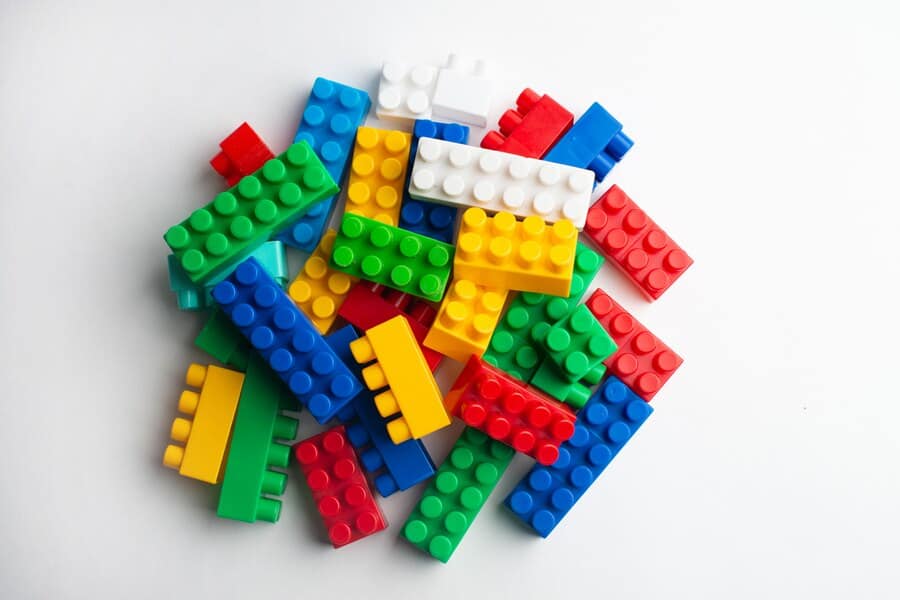
A standard 2×4 brick has eight studs. Place two 1×4 bricks beside it, and you’ve shown that 4 + 4 = 8, demonstrated a part-whole model, and created a visual fraction (each half is one 1×4 brick). Children who have difficulty understanding why a bar model “works” on paper often grasp it immediately when they can physically handle the pieces.
| Standard LEGO Brick | Stud Count | Mathematical Value |
|---|---|---|
| 1×1 brick | 1 stud | 1 unit / ones place |
| 1×2 brick | 2 studs | 2 units |
| 1×4 brick | 4 studs | 4 units / one quarter of 2×4 |
| 2×4 brick | 8 studs | 8 units / 1 whole (fraction work) |
| 2×6 brick | 12 studs | 1 unit/ones place |
| Tower of 10 (1×1 bricks stacked) | 10 units | 1 ten / tens place |
This “brick-to-maths” key is worth printing and laminating for your classroom or keeping visible during home learning sessions. Children who understand the value system can self-differentiate: they’ll choose bigger bricks for harder challenges and smaller ones when they need to count carefully.
“Tactile learning isn’t a nice addition to maths teaching; it’s the foundation. When children can physically move pieces around to show what an equation means, they stop guessing and start understanding. LEGO gives us a manipulative that children already trust.” Michelle Connolly, Founder of LearningMole and former teacher with over 15 years of classroom experience
Game 1: The Place Value Tower Challenge

Year Groups: Year 1 and Year 2 (adaptable to Year 3) National Curriculum Objectives: Recognise the place value of each digit in a two-digit number; identify, represent and estimate numbers using different representations.
Place value is where many children first encounter the idea that position matters in maths. The Place Value Tower Challenge makes this concrete and immediately visible.
How to Play
Each player needs a supply of 1×1 bricks (ones) and pre-built towers of ten 1×1 bricks stacked vertically (tens). Designate two zones on a flat baseplate or table: a tens column and a ones column.
Call out a two-digit number, such as 34. Children build the number by placing three ten-towers in the tens column and four single bricks in the ones column. Once they’ve built it, they read it back: “three tens and four ones, that’s thirty-four.” The physical separation between columns does the work that a written place value chart often struggles to do.
The Exchange Step: This is where the real learning happens. Give children a pile of loose 1×1 bricks and ask them to build 28 using only ones. They’ll count out 28 individual bricks. Now ask: “Can you show me a faster way?” Guide them to exchange ten loose bricks for one ten-tower. They end up with two ten-towers and eight single bricks, and they’ve physically experienced what “exchanging” means, which is the conceptual foundation for column addition and subtraction.
Differentiation
- Lower: Start with single-digit numbers. Use dot stickers on bricks to mark the ones and tens labels, so children can see where each piece belongs.
- Core: Two-digit numbers with exchange (17, 23, 35). Challenge children to build the same number two different ways (e.g. 24 as two ten-towers and four ones, or as 24 individual ones).
- Higher: Introduce a hundred zone. Use a flat 2×6 plate as a hundreds marker. Can they build 124 using ten-towers and ones? Can they explain why ten ten-towers equals one hundred?
Teacher Assessment Tips
Children who genuinely understand place value can build a number, deconstruct it, and rebuild it in a different form while explaining what they’re doing. Watch for children who count individual studs rather than reading the tower as a unit; this tells you the tens concept isn’t yet secure. Ask: “What does this tower mean?” rather than “How many bricks is that?” The distinction in their answers is diagnostic.
Home Learning Adaptation
Parents don’t need a formal lesson for this. Set out two labelled containers, one marked “tens” and one marked “ones”, and ask your child to build today’s date, their age, or a number they choose. The conversation that follows naturally covers place value without any direct teaching required.
Game 2: Fraction Action — The Part-Whole Model

Year Groups: Year 2 to Year 4 National Curriculum Objectives: Recognise, find, name and write fractions of a length, shape, set of objects or quantity; recognise and show equivalent fractions with small denominators.
Fractions are where many children’s confidence first falters, and the reason is almost always the same: they’ve been asked to work with abstract notation before they have any concrete sense of what a fraction physically represents. LEGO solves this.
How to Play
Use a 2×4 brick as “the whole” (eight studs total). This is your reference brick for the session — every fraction you discuss relates back to it.
Ask children to find “one half” of the whole brick. They need to find bricks that, placed together, exactly cover the same eight studs as the 2×4. A 1×4 brick plus another 1×4 brick does exactly this — each 1×4 brick represents one-half. Children can physically place them on top of the 2×4 to verify they cover it completely.
Now ask for “one quarter.” A 1×2 brick covers two studs out of eight — that’s two eighths, not one quarter. Let children try different bricks and discover that two studs out of eight studs means the fraction is 2/8, then guide them to see that 2/8 = 1/4 by finding four 1×2 bricks that together cover the whole 2×4 brick.
| Brick | Studs | Fraction of 2×4 Whole (8 studs) |
|---|---|---|
| 1×1 brick | 1 stud | 1/8 |
| 1×2 brick | 2 studs | 2/8 = 1/4 |
| 1×4 brick | 4 studs | 4/8 = 1/2 |
| Two 1×4 bricks | 8 studs | 8/8 = 1 whole |
The Equivalent Fractions Step
This is the concept that most confuses children on paper. With LEGO, it becomes visual: if two 1×2 bricks cover the same area as one 1×4 brick, then 2/8 and 1/4 must be the same amount. They can see it. The notation is just describing what they’ve already experienced physically.
Differentiation
- Lower (Year 2): Work only with halves and quarters. Use 1×2 bricks as the whole to keep numbers small (four studs total). One stud = one quarter.
- Core (Year 3): Use the 2×4 brick as the whole. Work through halves, quarters, and eighths. Introduce the written fraction notation alongside the physical bricks.
- Higher (Year 4): Challenge children to find thirds using a 2×6 brick (12 studs). A 1×4 brick won’t work exactly, which opens a rich discussion about why fractions aren’t always “neat” and how to express remainders.
Teacher Assessment Tips
Secure understanding means children can name the fraction, write it, and explain it in their own words without the bricks in front of them. A useful check: cover the bricks and ask, “If I have a whole 2×4 brick and I take away one 1×4 brick, what fraction is left?” Children who understand fractions will say “one half.” Children still working procedurally may struggle without the physical pieces.
Game 3: The Area and Perimeter “Stud” Architect

Year Groups: Year 4 and Year 5 National Curriculum Objectives: Find the area of rectilinear shapes by counting squares; measure and calculate the perimeter of a rectilinear figure; distinguish between area and perimeter.
Area and perimeter cause persistent confusion because children hear two new words in close proximity and struggle to attach different meanings to each. The “stud” is the bridge between abstract formula and physical understanding.
How to Play
Give each child a flat LEGO baseplate and a selection of bricks. Their challenge is to build a single-layer rectangular enclosure (a floor plan) using any combination of bricks, then calculate both the area and the perimeter of what they’ve built.
Counting Area: Count every stud that is covered by bricks on the floor plan. Each stud = 1 square unit. This is an area. Children who are used to counting individual squares on grid paper will find this immediately familiar — the stud is the square.
Counting Perimeter: Count only the studs around the outer edge of the shape. Walk around the outside, one stud at a time. This is the perimeter. Many children try to count the corners twice — this becomes visible when you walk them physically around the edge, pointing at each stud as you go.
The “Same Area, Different Perimeter” Discovery: Ask children to build two different shapes using exactly the same number of bricks. A 2×6 rectangle (12 studs of area) and an L-shaped enclosure using the same bricks will have identical areas but different perimeters. Children who see this become naturally curious about why.
Differentiation
- Lower (Year 4): Start with rectangles only. Provide a recording sheet where children draw their floor plan on a grid, count the studs, and fill in “Area = ___ studs. Perimeter = ___ studs.”
- Core (Year 5): Introduce rectilinear shapes (L-shapes, T-shapes). Challenge children to find the shape with the smallest perimeter for a given area — they’ll discover that squares are most efficient.
- Higher: Introduce the formula approach. Can they calculate the area and perimeter of a rectangle without counting every stud? Check using a 4×6 rectangle: 4 × 6 = 24 studs of area; (4 + 6) × 2 = 20 studs of perimeter.
Teacher Assessment Tips
A reliable diagnostic: build a 3×4 rectangle on the board and ask children to write down both the area and perimeter before explaining. Children who confuse them will often give 14 for both (the perimeter), or 12 for both (the area). Seeing their written answer before the discussion shows you exactly what’s happening.
“Children who grasp area and perimeter together almost always had a moment where they could physically trace the edge and count the interior separately. LEGO studs make that distinction tactile rather than abstract, and it sticks.” — Michelle Connolly, Founder of LearningMole and former teacher with over 15 years of classroom experience
Curriculum Mapping: Which Game for Which Year Group

| Genius Game | Year Groups | NC Strand | Assessment Link |
|---|---|---|---|
| Place Value Tower Challenge | Year 1 – Year 3 | Number and Place Value | KS1 SATs: number recognition, place value |
| Fraction Action | Year 2 – Year 4 | Fractions | KS2 SATs: fraction notation, equivalence |
| Stud Architect (Area & Perimeter) | Year 4 – Year 5 | Geometry / Measurement | KS2 SATs: rectilinear area, perimeter |
Classroom Management: Keeping the Focus on Maths
The biggest obstacle to LEGO maths sessions isn’t engagement, it’s children building houses and spaceships instead of place value towers. A few structural choices prevent this.
The Two-Minute Build: At the start of every session, give children two minutes of free building. Set a timer. When it ends, all free builds are dismantled, and the maths bricks go on the table. This addresses the urge to create freely and makes the transition to structured activity much smoother.
Brick Management: Use shallow trays or box lids to contain each child’s working set. Limiting the bricks available limits the temptation to build beyond the task. For place value work, provide only ones and tens. For fractions, provide only the specific bricks on the session’s brick-to-maths key.
Paired Talk: Ask children to explain what they’ve built to a partner before they explain it to you. The act of verbalising forces them to organise their mathematical thinking, and you’ll hear misconceptions surface naturally. Listen in before intervening.
Recording: Keep a simple recording sheet alongside the LEGO work. Children draw their build, write the mathematical statement it represents (e.g. 24 = 2 tens + 4 ones), and explain it in a sentence. This bridges the concrete and abstract stages of the CPA approach and gives you an assessment record.
Teaching Resources and Support
LearningMole’s maths resources are designed to extend what hands-on activities like these start. The primary maths video library covers place value, fractions, and geometry with visual, curriculum-aligned explanations that work well as a follow-up to concrete LEGO sessions, particularly for children who need to see the transition from physical to pictorial to abstract modelled step by step.
For parents supporting home learning, LearningMole’s educational videos provide the pictorial stage of the CPA sequence: children who’ve built fraction models with bricks can watch a video that shows the same concept using drawn bar models and written notation, cementing the link between what they handled and what they’ll see in written maths.
Frequently Asked Questions

What LEGO bricks are best for primary maths activities?
Standard 2×4 and 1×4 bricks in a range of colours work best for most primary maths activities. The 2×4 brick (eight studs) is particularly versatile because it divides cleanly into halves (two lots of 1×4), quarters (four lots of 1×2), and eighths (eight individual 1×1 bricks). A basic LEGO Classic set contains a good mix of these sizes. Avoid small-piece specialist sets; the standard brick range gives you the standardised sizes needed for consistent mathematical work.
How do I teach multiplication using LEGO?
Use LEGO bricks to build multiplication arrays. An array is a rectangular arrangement of objects in equal rows and columns, exactly what a flat baseplate with bricks placed in rows produces. To show 3 × 4, place three rows of four 1×1 bricks. Count the total (12). Now rotate the model 90 degrees: you’ve just shown 4 × 3 = 12, demonstrating commutativity physically. Children who understand that a 3 × 4 array and a 4 × 3 array contain the same number of bricks are well prepared for the Year 4 Multiplication Tables Check, because they can visualise times table facts rather than only reciting them.
Is LEGO Maths suitable for the Year 4 Multiplication Tables Check?
LEGO maths is most valuable in the conceptual preparation stage before the MTC rather than as a direct rehearsal tool. Children who have built and rotated arrays understand why 6 × 7 = 7 × 6, and that understanding reduces the number of separate facts they need to memorise. Once conceptual understanding is in place, speed practice takes less time because children can reason rather than only recall. Use LEGO in Year 3 to build conceptual foundations, then transition to faster recall practice in Year 4.
What age range are these LEGO Maths games suitable for?
The three games in this article are designed for children aged 5 to 11, covering the full range of primary education from Year 1 to Year 6. The Place Value Tower Challenge suits Year 1 and Year 2 (ages 5–7), Fraction Action works well from Year 2 to Year 4 (ages 6–9), and the Stud Architect game targets Year 4 and Year 5 (ages 8–10). Each game includes differentiation options, so they can be adjusted upward or downward within these ranges depending on individual children.
How do I stop children from just building freely during a LEGO maths lesson?
The Two-Minute Build (described in the Classroom Management section above) is the most reliable approach. Give children a short, timed free-build at the start and then a clear signal that the maths bricks are now “maths tools, not toys.” Reducing the brick set to only what’s needed for the task, ones and tens for place value, specific fraction bricks for Fraction Action, also removes the temptation to build beyond the task. Children who know exactly what bricks they have tend to work within the structure rather than around it.
Where can I find LEGO maths worksheets and recording sheets for UK primary schools?
LearningMole provides curriculum-aligned maths resources for UK primary teachers and parents, including materials that bridge hands-on activities and written recording. Printable recording sheets for CPA-based maths activities are particularly useful for LEGO sessions because they give children a structure for documenting what they’ve built and the mathematical statement it represents. Browse LearningMole’s primary maths resources for curriculum-aligned support materials.
How does LEGO Maths connect to White Rose Maths?
White Rose Maths uses the CPA approach and bar modelling as core pedagogical tools, both of which map directly onto LEGO-based activities. The Place Value Tower Challenge aligns with White Rose’s Year 1 and Year 2 place value blocks. Fraction Action reflects the part-whole model used throughout White Rose’s fraction units from Year 2 onwards. If your school uses White Rose Maths, LEGO activities work as a concrete “pre-teaching” or “intervention” tool that gives children the physical foundation the White Rose pictorial stage assumes.
Can children with SEND benefit from LEGO maths activities?
LEGO Maths is well-suited to learners with a range of additional needs. The physical, tactile nature of the activities supports children who find written or purely visual maths difficult to process. The colour-coded nature of LEGO bricks supports visual learners, and the repetitive physical action of building, counting, and dismantling can suit children who benefit from sensory engagement. For children with fine motor difficulties, larger DUPLO-style bricks offer the same mathematical principles at a more manageable scale. Always follow individual pupils’ learning plans when adapting activities.
Conclusion

The three games in this guide share a common thread: they give children something to do with their hands while their minds work on a concept. That isn’t incidental to the learning; it’s the mechanism by which concrete experience becomes mathematical understanding. Children who have physically exchanged ten single bricks for one ten-tower carry that experience into every written column addition they encounter. Children who have covered a 2×4 brick with four 1×2 bricks have a tangible memory to return to when equivalent fractions appear on a worksheet.
The UK National Curriculum’s expectation that children will move through concrete, pictorial, and abstract stages isn’t an optional structure for primary maths — it’s the documented route to genuine mastery. LEGO bricks are, quite simply, excellent curriculum tools that children already know how to use. The teacher’s job is to point the enthusiasm in a mathematical direction.
For further curriculum-aligned maths support, including video resources that model the pictorial and abstract stages of these concepts, explore LearningMole’s primary maths library. Resources are designed by experienced educators and aligned to UK National Curriculum objectives across EYFS, KS1, and KS2.


Leave a Reply