Multiplication Times Tables: 4x Magic Tables

Avatar of Michelle Connolly
Updated on: Educator Review By: Michelle Connolly

Multiplication Times Tables: The 4 times table is a genuine turning point in primary maths. It is the first table where children move beyond simple counting patterns and start to see how multiplication facts build on each other.

Multiplication Times Tables

Once a child grasps that multiplying by four is just doubling twice, an entire bank of number facts becomes accessible with very little extra effort. That is the ‘magic’ behind this table, and it is grounded in real mathematical structure rather than rote learning by itself.

For teachers covering the UK National Curriculum, the 4 times table sits firmly in Year 3 as an introduction and Year 4 as a mastery objective. By the end of Year 4, pupils are expected to recall all multiplication facts up to 12 × 12 fluently, with the Year 4 Multiplication Tables Check (MTC) assessing exactly that. The 4x table is among the most frequently tested, which makes confident instant recall a real priority for both classroom teaching and home learning support.

LearningMole, a UK educational platform founded by former primary teacher Michelle Connolly, has produced curriculum-aligned video resources and teaching materials to support exactly this kind of number fluency. This guide walks through the Double-Double method step by step, introduces the visual pattern that makes the 4 times table easier to remember, and gives parents and teachers the MTC preparation strategies they need.

The 4 Times Table Chart: 1 to 12

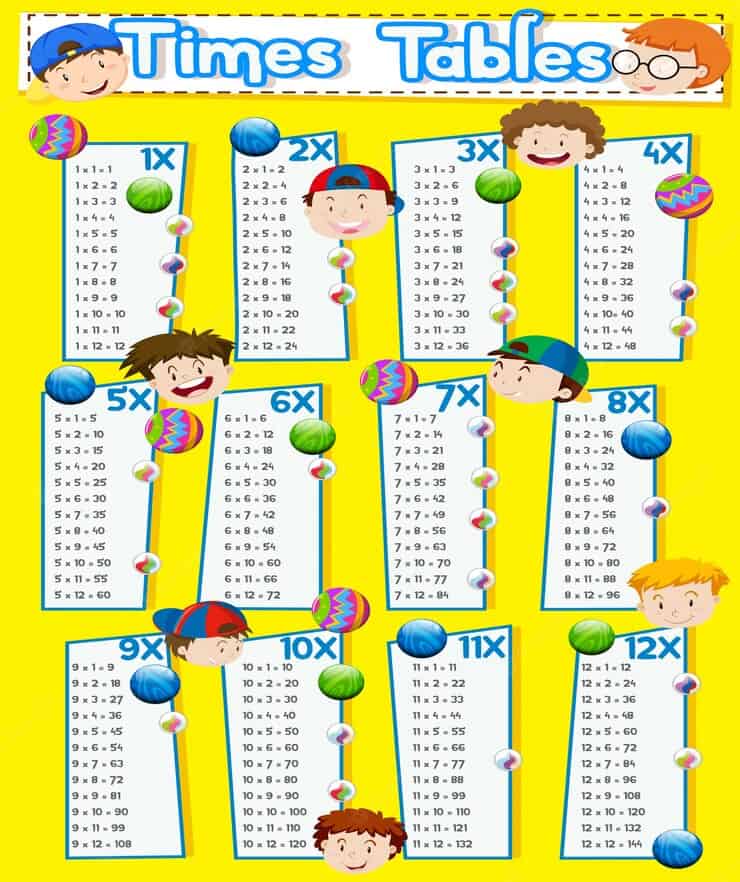
Here is the complete 4x table from 1 to 12 for quick reference. Notice that every result is an even number, and the last digits cycle through just five values: 4, 8, 2, 6, 0. That repeating pattern is the visual key to this table.

Multiplier× 4Result
11 × 44
22 × 48
33 × 412
44 × 416
55 × 420
66 × 424
77 × 428
88 × 432
99 × 436
1010 × 440
1111 × 444
1212 × 448

Print this chart and keep it visible during homework sessions. Once children recognise the last-digit cycle, they can use it as a self-check when practising for the MTC.

Why the 4 Times Table Is Called ‘Magic’

multiplication

The 4 times table earns its ‘magic’ label because it hides a shortcut in plain sight. Every multiple of 4 is also a multiple of 2, which means multiplying by 4 is exactly the same as doubling a number and then doubling it again. Children who are already confident with the 2 times table already know the 4 times table — they just need to see how the two tables connect.

This is not a trick to memorise on top of the table; it is the structure of the table itself. Understanding it builds number fluency rather than just adding another set of facts to hold in memory. When children understand why it works, recall under the six-second time pressure of the MTC becomes much less stressful.

The other magical property is the last-digit pattern. Multiples of 4 always end in 4, 8, 2, 6, or 0 in that repeating order. Children can use this as a built-in error-check: if an answer ends in an odd number, they know immediately that something has gone wrong.

The Double-Double Trick: A Step-by-Step Guide

Multiplication

The Double-Double method transforms the 4 times table into two straightforward halving and doubling steps, both of which children practise constantly throughout KS1 and KS2 maths.

Step 1: Be Confident with the 2 Times Table First

The Double-Double method only works smoothly when the 2 times table is secure. If a child hesitates at 7 × 2, that hesitation doubles when they try to then double the answer again. Spend a session consolidating the 2x table before introducing this method.

Step 2: Double the Number Once (× 2)

Take the number you are multiplying by 4 and double it. That gives you the 2 times table result. For example: 6 × 2 = 12.

Step 3: Double the Answer Again (× 4)

Now double the result from Step 2. That gives you the 4 times table answer. Continuing the example: 12 × 2 = 24, so 6 × 4 = 24.

The table below shows this process across a range of numbers. Use it with children when first introducing the method — ask them to cover the third column and work out the second double themselves.

Starting NumberFirst Double (× 2)Second Double (× 4)
3612
51020
61224
71428
81632
91836
112244
122448

For multi-sensory learners, combine the doubling steps with physical movement: clap once when completing the first double, clap twice when completing the second. This rhythm helps children hold both steps in working memory and is particularly useful for pupils who find purely visual or written methods harder to retain.

The Magic ‘M’ Visual Pattern

Multiplication

There is a second trick that works especially well for visual learners: the last-digit pattern of the 4 times table draws a shape on a number line. The multiples of 4 from 1 × 4 to 10 × 4 end in the digits 4, 8, 2, 6, 0, then 4, 8, 2, 6, 0 again. Write those digits in two rows of five and trace the sequence: the path moves up, then down, then up, then down — an ‘M’ shape.

To use this in the classroom, write the digits 0 to 9 in a column. Circle 4, 8, 2, 6, and 0. Ask children to trace the circled digits with a finger in sequence. After a few repetitions, they will internalise the pattern and can use it to check any answer: does this result end in the right digit for where I am in the sequence?

This approach is particularly helpful for pupils who struggle with rote memorisation but respond well to visual and spatial information. It gives them a working strategy rather than asking them to hold abstract sequences in memory alone. Paired with the Double-Double method, it gives two independent routes to the correct answer.

Preparing for the Year 4 Multiplication Tables Check (MTC)

Addition and Counting On for Kids: 5 Mental Maths Strategies That Work

The MTC requires children to answer 25 multiplication questions in 25 minutes, with a maximum of six seconds per question. That six-second window is tight enough that calculating is too slow; instant recall is what the assessment tests. The 4 times table appears frequently in the check, so confident recall of 4x facts is directly linked to MTC performance.

“The 4 times table is a bridge between early counting and more complex mental arithmetic. Once children can recall 4x facts without pausing to calculate, their confidence across the whole multiplication check shifts noticeably. The Double-Double gives them a reliable route there.” Michelle Connolly, Founder of LearningMole and former teacher with over 15 years of classroom experience

A practical MTC preparation activity called the Six-Second Challenge works well at home and in class. Set a stopwatch for six seconds, call out a 4x fact, and ask the child to answer before the timer sounds. Begin with the easier facts (1 × 4, 2 × 4, 10 × 4) and build up to the harder ones (6 × 4, 7 × 4, 8 × 4). The goal is to shift from calculating the answer using Double-Double to retrieving it automatically.

For teachers, it helps to distinguish between the two stages. In Stage 1, children use the Double-Double method to work out unknown facts and check their accuracy. In Stage 2, repeated low-stakes practice, such as the Six-Second Challenge, moves those facts into automatic recall. Both stages are necessary; skipping Stage 1 produces fragile recall that breaks under pressure.

Linking the 4x table to the 8x table at this point also pays dividends. Because 8 is double 4, children who are secure with 4x facts can use a third doubling step to derive 8x facts. This creates a coherent fact family (2x, 4x, 8x) that is far easier to learn together than separately.

Teaching Resources and Support

multiplication

LearningMole’s curriculum-aligned video resources cover the 4 times table and the wider multiplication tables series, giving teachers and parents ready-made materials that align directly with National Curriculum objectives. The videos use visual demonstrations of the Double-Double method with animations and on-screen counters, making the abstract concrete for primary-aged learners.

For teachers, the most useful shift is thinking in terms of two stages: first, children calculate using Double-Double to verify facts and build familiarity; then, low-stakes repeated practice, such as the Six-Second Challenge, moves those facts into automatic recall. Rushing past Stage 1 is what produces the fragile memory that crumbles under MTC pressure. Spending time on the method, even when children could theoretically memorise faster, builds the number sense that pays off across the whole curriculum.

The LearningMole video below demonstrates multiplication concepts for primary school children. For the full range of times tables videos and printable resources, visit LearningMole’s teaching resources library.

For home learning, parents can reinforce the Double-Double method using everyday objects: folding a piece of paper in half and then in half again shows visually why doubling twice gives four times the original. Sharing out four equal groups of snacks, counting steps in groups of four, and playing the Six-Second Challenge at the kitchen table all build the number fluency that transfers to the MTC.

LearningMole subscription access includes over 1,400 educational videos covering maths, English, science, and more, all aligned with the UK National Curriculum. Subscribe for as little as £1.99 per month to access the full library.

Frequently Asked Questions

Multiplication

How do you learn the 4 times table easily?

The easiest route is the Double-Double method: double the number once, then double the answer again. Because multiplying by 4 is the same as multiplying by 2 twice, children who know their 2 times table already have the tools they need. Pairing this with the last-digit pattern (4, 8, 2, 6, 0 repeating) gives a second way to check answers, which builds confidence quickly.

What is the Double-Double trick?

The Double-Double trick uses the relationship between the 2 times table and the 4 times table. To find 7 × 4, first double 7 to get 14 (that is 7 × 2), then double 14 to get 28 (that is 7 × 4). The process works for any number and is grounded in the mathematical fact that 4 = 2 × 2. Once the two-step process becomes automatic, children transition from calculating to instant recall through repeated practice.

At what age should a child know the 4 times table?

The UK National Curriculum introduces the 4 times table in Year 3 (ages 7 to 8), when children begin to explore multiplication beyond 2, 5, and 10. The expectation is that pupils can recall all tables up to 12 × 12 fluently by the end of Year 4 (ages 8 to 9), when the statutory Multiplication Tables Check takes place. Some children begin working on 4x facts informally in Year 2 as an extension.

Why do all 4 times table results end in even numbers?

Because every multiple of 4 is also a multiple of 2. When you multiply any whole number by 4, you are essentially multiplying it by 2 twice, and any number multiplied by 2 is even. Beyond that, the last digits of the 4 times table cycle through just five values: 4, 8, 2, 6, and 0. This means the last digit can only ever be even, which children can use as a quick error-check when practising.

How can I help a child who struggles with rote memorisation?

Two strategies work well together. First, use the Double-Double method to give the child a working route to the answer rather than asking them to hold 12 separate facts in memory at once. Second, introduce the Magic M visual pattern: write out the last digits of the 4 times table in sequence (4, 8, 2, 6, 0, 4, 8, 2, 6, 0) and trace the shape they make. For multi-sensory learners, adding physical movement, clapping or jumping once for each doubling step, engages auditory and kinaesthetic memory alongside the visual approach.

Where can I find 4x table resources and videos?

LearningMole provides curriculum-aligned multiplication videos and teaching materials for primary school children. Visit LearningMole’s teaching resources library for the full times tables series, or subscribe for full access to over 1,400 educational videos aligned with the UK National Curriculum.

How does the 4 times table connect to the 8 times table?

The connection is a third doubling step. Because 8 = 4 × 2, any 4 times table fact can be doubled to give the corresponding 8 times table fact. For example, 6 × 4 = 24, so 6 × 8 = 48. Teaching the 2x, 4x, and 8x tables together as a doubling family is more efficient than teaching them separately, and it builds the sense of numerical structure that supports fluency across all multiplication facts.

What is the Multiplication Tables Check (MTC), and when does it happen?

The MTC is a statutory assessment for Year 4 pupils in England, introduced by the Department for Education to ensure all children leave primary school with secure multiplication recall. Children answer 25 questions on a screen with a maximum of six seconds per question. The check covers all tables from 2 to 12, with 6x, 7x, 8x, 9x, and 12x appearing most frequently. The assessment takes place in a window during June of Year 4.

Conclusion

Grid Method Multiplication

The 4 times table sits at the heart of KS2 multiplication fluency, and the Double-Double method gives children a principled shortcut that actually builds mathematical understanding rather than bypassing it. When a child sees that 4 is just 2 doubled, and acts on that insight, they are not cheating the learning; they are doing exactly the kind of relational thinking that the National Curriculum is designed to develop. The Magic M last-digit pattern adds a second cognitive route for children who find visual anchors more memorable than procedural steps.

For teachers, the most useful shift is thinking in terms of two stages: first, children calculate using Double-Double to verify facts and build familiarity; then, low-stakes repeated practice, such as the Six-Second Challenge, moves those facts into automatic recall. Rushing past Stage 1 is what produces the fragile memory that crumbles under MTC pressure. Spending time on the method, even when children could theoretically memorise faster, builds the number sense that pays off across the whole curriculum.

Whether you are preparing a Year 4 class for the MTC, supporting a child at home who finds times tables difficult, or simply looking for a more coherent way to teach the 4x table, the approaches in this guide give you a clear structure to work from. LearningMole’s video resources and teaching materials offer further classroom-ready support, all aligned with the UK National Curriculum and designed by educators with genuine primary school experience.

You can also explore the full times tables series: 2x Magic Tables, 3x Magic Tables, 5x Magic Tables, 6x Magic Tables, 7x Magic Tables, 8x Magic Tables, 9x Magic Tables, and 10x Magic Tables.

Leave a Reply

Your email address will not be published. Required fields are marked *