Multiplication Times Tables: 3x Magic Tables
Table of Contents
The 3 times table is often where children move from simple counting to genuine multiplication thinking. Unlike the 2s and 10s, which rely on doubling or adding a zero, the 3x table asks children to build a new mental sequence and spot patterns that carry through to the 6s, 9s, and 12s. Get it right early, and the rest of the multiplication tables become considerably easier.
LearningMole, the UK educational platform founded by former primary teacher Michelle Connolly, has produced curriculum-aligned videos and resources to support exactly this kind of number learning. The 3 times table sits at the heart of the Year 3 multiplication curriculum and comes back every year right through to the Year 4 Multiplication Tables Check (MTC), where children need instant recall of all tables up to 12 x 12. Visual patterns and memory tricks make the difference between children who count laboriously on their fingers and those who can retrieve answers in six seconds.
This guide covers the complete 3x table, the Tic-Tac-Toe grid trick that helps children see the pattern rather than just memorise facts, the sum-of-digits rule for checking larger numbers, specific preparation for the MTC, and multi-sensory strategies for children who find rote learning difficult. Whether you are a teacher planning a times tables lesson or a parent supporting practice at home, the methods here are grounded in UK National Curriculum expectations and real classroom experience.
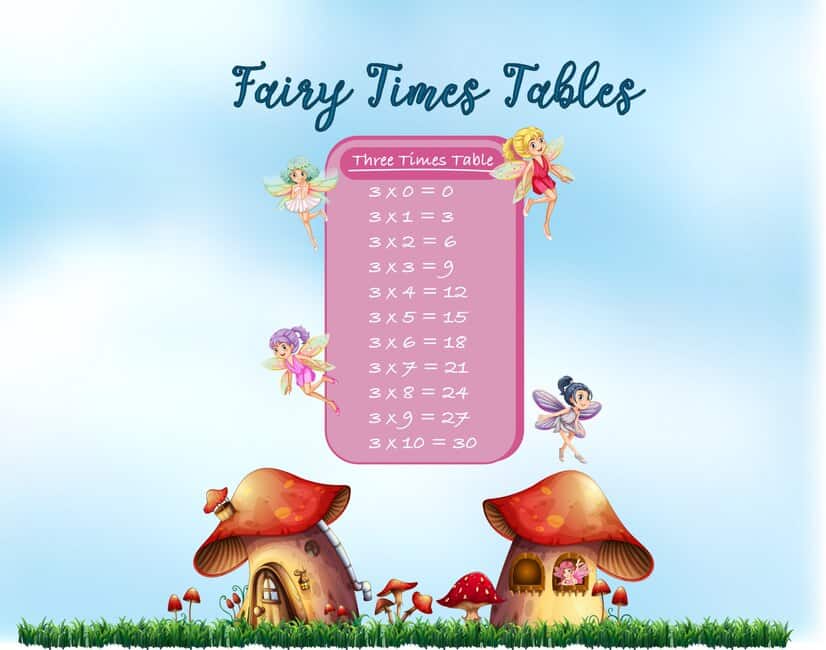
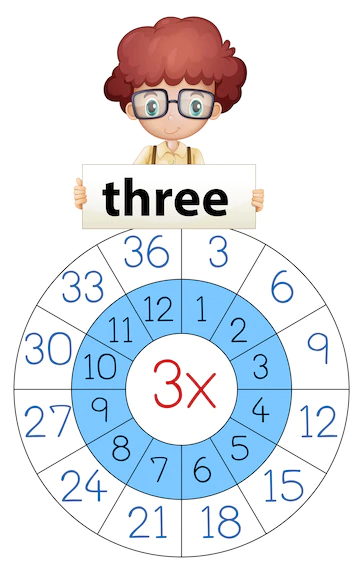
The 3 Times Table: 1 to 12

Children need a clear, reliable reference before pattern work begins. The table below shows all 13 multiplication facts from 3 x 1 to 3 x 12, with a memory tip for each. The tips connect to the sum-of-digits rule explained later in this guide.
| Multiplication | Answer | Memory Tip |
|---|---|---|
| 3 x 1 | 3 | Start of the sequence |
| 3 x 2 | 6 | Double of 3 |
| 3 x 3 | 9 | Digits add to 9 (9) |
| 3 x 4 | 12 | Digits add to 3 (1+2) |
| 3 x 5 | 15 | Digits add to 6 (1+5) |
| 3 x 6 | 18 | Digits add to 9 (1+8) |
| 3 x 7 | 21 | Digits add to 3 (2+1) |
| 3 x 8 | 24 | Digits add to 6 (2+4) |
| 3 x 9 | 27 | Digits add to 9 (2+7) |
| 3 x 10 | 30 | Digits add to 3 (3+0) |
| 3 x 11 | 33 | Digits add to 6 (3+3) |
| 3 x 12 | 36 | Digits add to 9 (3+6) |
Notice how the digit-sum column cycles through 3, 6, 9, 3, 6, 9. This is not a coincidence. It is the core pattern of the 3 times table and the key to checking any answer instantly.
Why the 3 Times Table Has a Hidden Pattern
Every multiple of 3 has digits that add up to 3, 6, or 9. Always. This is one of the most useful patterns in primary maths and it works for numbers far beyond 12 x 3.
Take 27: 2 + 7 = 9. Take 36: 3 + 6 = 9. Take 99: 9 + 9 = 18, then 1 + 8 = 9. Keep adding the digits until you reach a single figure and you will always land on 3, 6, or 9 if the number is in the 3 times table.
“Children who spot number patterns become flexible mathematical thinkers. The 3 times table is a brilliant starting point because the digit-sum rule is visible, checkable, and actually quite surprising when children discover it for themselves.” — Michelle Connolly, Founder of LearningMole and former teacher with over 15 years of classroom experience
Teaching children to notice this pattern before drilling the facts means they have a checking strategy they can use independently. When they write 3 x 8 = 25 and then add 2 + 5 = 7, they know the answer is wrong without needing a teacher to confirm it.
The Tic-Tac-Toe Grid Trick for the 3 Times Table
The Tic-Tac-Toe method (sometimes called the noughts-and-crosses trick) gives children a visual structure for the 3x table from 3 x 1 to 3 x 9. It works by placing the units digits and tens digits of each answer into a 3 x 3 grid. Once the grid is built, the pattern becomes visible rather than arbitrary.
Step 1: Draw the Grid
Draw a standard 3 x 3 grid (nine empty squares arranged in three rows and three columns). This is the same grid used in noughts and crosses.
Step 2: Fill in the Units (Bottom to Top, Left to Right)
Write the units digits of the 3 times table answers (3, 6, 9, 2, 5, 8, 1, 4, 7) starting from the bottom-left square and moving upwards within each column, then moving to the next column. The bottom row will read 1, 4, 7 from left to right. The middle row will read 2, 5, 8. The top row will read 3, 6, 9.
Step 3: Fill in the Tens (Left to Right, Top to Bottom)
Now add the tens digit to each cell. The tens digit starts at 0 for the first three facts (3, 6, 9), then becomes 1 for the next three (12, 15, 18), then 2 for the final three (21, 24, 27). Write the tens digit to the left of the units digit in each cell.
The Big Reveal
Reading the grid from left to right, top to bottom, gives you 3, 6, 9, 12, 15, 18, 21, 24, 27. The grid builds the 3x table through spatial reasoning rather than sequential recitation. Children who struggle to hold a number sequence in memory often find the grid much easier to reconstruct under pressure.
The method extends to 3 x 10, 3 x 11, and 3 x 12 separately: these are 30, 33, and 36. Pointing out that 3 x 10 simply adds a zero, 3 x 11 doubles the digit (33), and 3 x 12 uses the grid total (27) plus one more step (27 + 9 = 36) keeps these three facts accessible.
The Sum-of-Digits Secret Rule

The sum-of-digits rule does something that the Tic-Tac-Toe grid cannot: it lets children check whether any number, however large, belongs to the 3 times table. This is Maths Mastery thinking applied to times tables.
Add the individual digits of any number. If the result is 3, 6, or 9, the number is a multiple of 3. If the result is two digits, add those digits together. Keep going until you have a single figure.
| Number | Sum of Digits | In the 3x Table? |
|---|---|---|
| 12 | 1 + 2 = 3 | Yes |
| 24 | 2 + 4 = 6 | Yes |
| 42 | 4 + 2 = 6 | Yes |
| 99 | 9 + 9 = 18, then 1 + 8 = 9 | Yes |
| 14 | 1 + 4 = 5 | No |
| 25 | 2 + 5 = 7 | No |
This rule is useful well beyond primary school, but it is entirely accessible to Year 3 and Year 4 children once the pattern has been pointed out. Higher-attaining pupils can be challenged to find the largest number they can think of that passes the test.
Preparing for the Year 4 Multiplication Tables Check

The Multiplication Tables Check (MTC) requires children to answer times table questions up to 12 x 12 within six seconds per question. 3 x table questions are among the most commonly included. The six-second window is achievable with instant recall but not with counting-on strategies.
Three steps bridge the gap between knowing the 3x table and passing the MTC. First, children need to stop counting in 3s and start retrieving answers directly. Skip-counting (3, 6, 9, 12…) is useful for understanding, but too slow for the check. Second, children need to practise in random order, not just 3 x 1, 3 x 2, 3 x 3 in sequence, because the MTC presents questions in a random order. Third, children need to practise both 3 x 8 and 8 x 3 forms, since the commutative property is tested in both directions.
Timed flashcard practice and digital tools that randomise questions are the most effective preparation. Start with no time pressure, build familiarity, then gradually introduce a five-second then four-second target. Most children reach six-second recall within two to three weeks of daily practice if the facts are already understood.
Multi-Sensory Strategies for Children Who Find Times Tables Difficult

Some children find visual patterns like the Tic-Tac-Toe grid insufficient on their own. Multi-sensory approaches add physical and auditory reinforcement alongside the visual, which supports learners with dyslexia, dyscalculia, or attention difficulties.
The Rhythm Clap
Count together from 1 to 30, clapping loudly on every multiple of 3 (3, 6, 9, 12…) and speaking quietly for the in-between numbers. This creates a physical rhythm that many children internalise faster than written or visual practice alone. It works well as a whole-class warm-up or as a two-minute home activity.
The 3x Hop
Mark 1 to 30 on the floor using chalk, paper, or tape. Children walk through the sequence and jump on every multiple of 3. The physical movement interrupts passive listening and creates a kinetic memory trace for the sequence. Outdoor sessions using playground chalk are particularly effective.
Colour Coding
Give children a 1-100 number grid and ask them to colour every multiple of 3. The diagonal pattern that emerges is visually memorable and provides an anchor for checking answers. Comparing it with the 6s and 9s grids shows the relationships between tables in a way that helps children remember them together rather than separately.
Teaching Resources and Support

LearningMole’s curriculum-aligned multiplication videos provide step-by-step visual explanations of the 3 times table, supporting both classroom teaching and home learning. The videos are designed to be used alongside hands-on activities rather than as a replacement for them.
For teachers covering multiplication in Year 3 and Year 4, the LearningMole resource library includes printable 3x table grids, Tic-Tac-Toe templates, and multiplication practice sheets aligned with the National Curriculum progression. These materials are designed to reduce planning time while maintaining depth of learning.
Parents supporting times tables practice at home can use the free LearningMole videos on YouTube as a starting point, then reinforce with the Tic-Tac-Toe trick or the sum-of-digits check during everyday conversations. The multiplication resources cover every table from 2 to 12, so children working ahead or catching up can access the full sequence.
For more multiplication support, see the full LearningMole times tables series:
- x2 Magic Tables
- x4 Magic Tables
- x5 Magic Tables
- x6 Magic Tables
- x7 Magic Tables
- x8 Magic Tables
- x9 Magic Tables
- x10 Magic Tables
Frequently Asked Questions

What is the easiest way to learn the 3 times table?
The Tic-Tac-Toe grid trick gives most children a reliable visual structure that works even when memory fails under pressure. Draw the 3 x 3 grid, fill the units digits from bottom-left to top-right (3, 6, 9, 2, 5, 8, 1, 4, 7), then add the tens digits (0 for 3-9, 1 for 12-18, 2 for 21-27). Once children can rebuild the grid independently, they have the full 3x table from 3 x 1 to 3 x 9 without rote memorisation.
What is the sum-of-digits rule for the 3 times table?
Every multiple of 3 has digits that add up to 3, 6, or 9. For example, 24: 2 + 4 = 6. For larger numbers, keep adding until you reach a single digit. If that digit is 3, 6, or 9, the number is in the 3 times table. If it is anything else, it is not. This rule works for numbers of any size and helps children self-check their answers without needing a teacher.
How do you do the Tic-Tac-Toe 3-times-table trick?
Draw a 3 x 3 grid. Starting from the bottom-left square and moving upward through each column, write the units digits of the 3 times table answers: 3, 6, 9 in the left column (bottom to top), 2, 5, 8 in the middle, and 1, 4, 7 on the right. Then add the tens digits: 0 to the top-left group (giving 03, 06, 09), 1 to the middle group (12, 15, 18), and 2 to the right group (21, 24, 27). Read left to right, top to bottom: 3, 6, 9, 12, 15, 18, 21, 24, 27.
At what age should children know the 3 times table?
The 3 times table is introduced in Year 3 (age 7-8) under the UK National Curriculum. Children are expected to know all multiplication and division facts for the 3, 4, and 8 times tables by the end of Year 3. Secure recall is required by the end of Year 4, when children sit the Multiplication Tables Check. Early introduction in Year 2 alongside the 2s and 10s is common but not formally required.
How can I help a child who struggles with multiplication?
Start with understanding rather than memorisation. Children who know that multiplication is repeated addition, and who can see the pattern in a table, learn facts more securely than those who drill without comprehension. The Tic-Tac-Toe grid, the Rhythm Clap, and the sum-of-digits check each offer a different entry point. If a child is stuck on one approach, try another. Mixing visual, auditory, and physical strategies within the same session helps children with dyslexia, dyscalculia, and attention difficulties. LearningMole’s educational videos use visual demonstrations that work well alongside these hands-on activities.
How does the 3 times table connect to the 6 and 9 times tables?
The 6 times table is the 3 times table doubled. If a child knows 3 x 7 = 21, they know 6 x 7 = 42 immediately by doubling. The 9 times table is the 3 times table tripled. These relationships mean that secure knowledge of the 3x table gives children a scaffold for two further tables. Teaching the 3, 6, and 9 tables as a family group rather than in isolation significantly reduces the total number of new facts children need to memorise.
Where can I find 3 times table practice materials?
LearningMole offers free educational videos for times tables practice on YouTube, with curriculum-aligned resources available through the LearningMole subscription. These include printable practice grids, Tic-Tac-Toe templates, and interactive activities for both classroom and home use. The full multiplication series covers every table from 2 to 12, all aligned with the UK National Curriculum requirements for KS2.
What does the Year 4 Multiplication Tables Check involve?
The MTC is a short online assessment taken by Year 4 children in June each year. Children are shown 25 multiplication questions, drawn from all times tables up to 12 x 12, and have six seconds to answer each one. There is no calculator and no time allowed for counting. The check is not a pass/fail test but provides teachers and schools with data on which children need further support. Regular timed practice from Year 3 onwards, using random-order questions, is the most effective preparation.
Conclusion

The 3 times table is more than a list of facts to memorise. It is an introduction to number patterns that run through the entire multiplication curriculum, from the 6s and 9s to divisibility rules that appear in secondary maths. Children who understand the structure of the 3x table rather than just reciting it have a foundation that supports every multiplication they encounter in primary school and beyond.
The methods in this guide work best in combination. Use the Tic-Tac-Toe grid to build visual understanding. Use the sum-of-digits rule to develop self-checking. Use the Rhythm Clap or the 3x Hop for children who need physical reinforcement. Introduce timed practice for MTC preparation once the facts are secure, not before. Children who are rushed into speed drills before they understand the pattern often develop maths anxiety that is harder to address than slow recall.
LearningMole’s multiplication resources support every stage of this process, from first introduction to MTC readiness. Teachers can use the curriculum-aligned videos to introduce or consolidate the 3 times table, and parents can use the same resources to reinforce learning at home. The full times tables series follows the same approach across every table, giving children a consistent framework for multiplication from Year 2 through to Year 6.


Leave a Reply