Multiplication Times Tables- x10 Magic Tables
Table of Contents
Multiplication Times Tables: The 10 times table is the one almost every child in a UK primary school cracks first. Every answer ends in zero, the pattern appears almost immediately, and children feel the satisfaction of seeing it fall into place.
That appeal is real, and it matters for motivation. What matters just as much, though, is what sits beneath the surface: an understanding of place value that will carry children through Year 4’s Multiplication Tables Check (MTC) and far beyond into fractions, decimals, and algebra. LearningMole’s maths resources are built around exactly that connection, giving teachers and parents the tools to turn a quick win into lasting mastery.
Aligned with the UK National Curriculum, the 10 times table first appears formally in Year 2 at KS1, where children are expected to recall and use multiplication facts for the 2, 5, and 10 times tables. By Year 4, full fluency across all tables to 12 × 12 is required for the MTC. Understanding why multiplying by 10 works — not just that it seems to add a zero — is the difference between a child who passes that check and one who runs into trouble when decimals arrive in upper KS2.
This guide covers the x10 table in full, explains the place value shift that makes it work, and gives classroom-tested strategies for teachers and practical activities for parents supporting learning at home. You’ll find the complete 1–12 chart, a note on the most common misconception in KS2 maths teaching, and specific guidance on preparing children for the Year 4 MTC.
The Pattern of 10: Why It’s the Most ‘Magic’ Table

Every answer in the 10 times table ends in zero. This single, consistent pattern is what makes the x10 table the most accessible starting point for multiplication in KS1. Children quickly spot it, and spotting a pattern builds the kind of number sense that underpins all later maths.
Ask children to count in 10s from zero: 10, 20, 30, 40, 50. What they’re doing is building the 10 times table out loud, in sequence, before any formal multiplication notation is introduced. Reception children do this with counting. Year 1 and Year 2 children make the connection to multiplication: 3 groups of 10 is 30, 7 groups of 10 is 70. The ‘zero at the end’ observation is the first step, but it needs to become something more precise before children move up the school.
The pattern works because 10 is the base of our number system. Every time you multiply a whole number by 10, each digit moves one place to the left, and the vacated ones column fills with zero. That is the full explanation. The ‘magic’ is place value.
The Magic Trick: Moving Digits, Not Just Adding Zeros
Why ‘Just Add a Zero’ Can Be Dangerous
Telling children to ‘add a zero’ when multiplying by 10 works for whole numbers. It stops working the moment decimals appear. A child who has only ever memorised the shortcut will confidently write 1.5 × 10 = 1.50 — and not understand why that’s wrong.
| Calculation | Add-a-zero result | Correct answer | Error? |
|---|---|---|---|
| 3 × 10 | 30 | 30 | No |
| 1.5 × 10 | 1.50 (unchanged) | 15 | YES |
| 0.7 × 10 | 0.70 (unchanged) | 7 | YES |
| 12 × 10 | 120 | 120 | No |
This is not a theoretical problem. Decimal multiplication appears in Year 5 and Year 6 of the National Curriculum. A child who never understood the place value mechanism, and only memorised a surface trick, will hit a genuine wall. Catching this early is far easier than correcting it later.
The Place Value Slide: How the Magic Actually Works
The correct explanation uses a place value grid. Every number sits in columns: Hundreds, Tens, Ones. When you multiply by 10, every digit shifts one column to the left. The ones column empties and a zero holds its place.
Classroom Demonstration: The Place Value Slide
- Draw a three-column grid on the board: Hundreds | Tens | Ones.
- Write the digit 5 in the Ones column.
- Ask: ‘What is 5 × 10?’
- Physically move the 5 to the Tens column (slide it left with your finger or an arrow).
- Write 0 in the now-empty Ones column. The number now reads 50.
- Repeat with two-digit numbers: 12 × 10. The 1 moves from Tens to Hundreds; the 2 moves from Ones to Tens; 0 fills Ones. Answer: 120.
- Key question to ask children: ‘What happened to the digit? Where did it go?’
“The ‘add a zero’ shortcut is a trap we set for children without realising it. When fractions and decimals arrive in upper KS2, children who only know the trick hit a wall. Teaching the place value shift from the start, using grids, physical movement, and careful questioning, means that same child handles decimals with confidence in Year 5.” Michelle Connolly, Founder of LearningMole and former teacher with over 15 years of classroom experience
Classroom Activity: The Human Place Value Grid
- Tape three large columns on the floor: Hundreds, Tens, Ones.
- Give a child a number card (e.g. ‘4’) and ask them to stand in the Ones column.
- Call out ‘× 10’ — they jump one column to the left (into Tens).
- Another child holding ‘0’ takes their place in Ones.
- Ask the class: ‘What number are we showing now?’ (40).
- Works brilliantly for kinaesthetic learners and children with dyscalculia or memory difficulties.
- Adapt for SEN learners: use Numicon pieces or 10p coins to make each group of ten physically tangible before the grid activity.
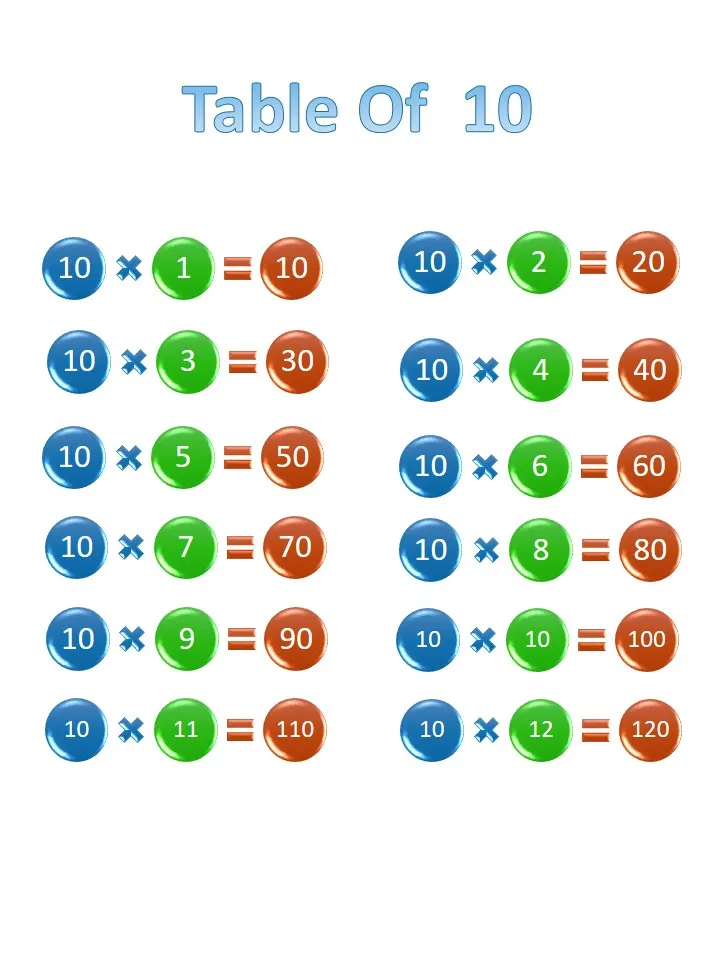
The 10 Times Table Chart: 1 to 12

The UK National Curriculum requires children to know multiplication facts up to 12 × 12 by the end of Year 4. The chart below includes the full 1–12 range, with the place value shift explained for each fact.
| Question | Answer | Place Value Shift |
|---|---|---|
| 1 × 10 | 10 | The 1 moves from Ones to Tens. A 0 holds the Ones place. |
| 2 × 10 | 20 | The 2 moves to the Tens column. Ones = 0. |
| 3 × 10 | 30 | The 3 shifts left. Each group of 10 has 3 sets. |
| 4 × 10 | 40 | The 4 now lives in Tens. You have 4 groups of ten. |
| 5 × 10 | 50 | The 5 slides left. Half of 100. |
| 6 × 10 | 60 | The 6 moves to Tens. Six groups of ten. |
| 7 × 10 | 70 | The 7 shifts. Seven groups of ten. |
| 8 × 10 | 80 | The 8 moves left. Four groups of twenty. |
| 9 × 10 | 90 | The 9 slides. One group short of 100. |
| 10 × 10 | 100 | The 1 moves to Hundreds. Now you need three columns. |
| 11 × 10 | 110 | The 11 shifts: 1 in Hundreds, 1 in Tens, 0 in Ones. |
| 12 × 10 | 120 | The 12 shifts: 1 in Hundreds, 2 in Tens, 0 in Ones. |
Notice that from 10 × 10 onwards, three columns are needed. The digit shifts from the Tens column into the Hundreds column, with zero in both Ones and Tens. This is worth demonstrating explicitly, it shows children that the same rule applies at every scale.
10x Maths in the Real World: Beyond the Classroom

Children absorb multiplication facts more readily when the numbers appear in contexts they recognise. The 10 times table is particularly well-suited to real-world examples because groups of 10 appear everywhere in daily life.
Gaming XP and Levelling Up
Many children who play video games are already multiplying by 10 without knowing it. In games with experience points (XP), scoring systems, or levelling mechanics, points often accumulate in multiples of 10: ‘100 XP per level’, ‘bonus 10x on combo hits’. Ask children to calculate: ‘If each level gives you 30 XP and you multiply your score by 10 on the final boss, what’s the total?’ The maths is the same; the context makes it immediate.
YouTube view counts, subscriber numbers, and likes all scale in tens, hundreds, and thousands. Children who are engaged with digital content already have an intuitive sense of these magnitudes, connecting that to the formal structure of place value is a short and productive step.
Pocket Money and 10p Challenges
Ten pence coins are a natural manipulative for the 10 times table. Three 10p coins is 30p: three groups of ten. Ten 10p coins is £1.00: ten groups of ten. Set a ‘pocket money challenge’: if you save 10p every day for a week, how much do you have? (70p.) For a month? (Roughly £3.00.) These problems tie multiplication to money, a real-world context with built-in stakes for children.
Cooking and measurement offer similar opportunities. A recipe uses 20g of sugar; you want to make 10 batches for a school fair. How much sugar do you need? The calculation (20 × 10 = 200g) is straightforward, but it sits inside a context that makes the answer matter.
Preparing for the Year 4 Multiplication Tables Check

The Multiplication Tables Check (MTC) is a statutory digital assessment introduced by the Department for Education and taken by all Year 4 pupils in England. Children answer 25 questions on-screen in approximately 25 seconds, roughly one second per question, though a 6-second window is given per question to allow for variation.
The 10 times table is among the tables assessed in the MTC. For most children, it should be among their highest-scoring tables. The risk is complacency: children who haven’t achieved secure recall, relying instead on counting on fingers or mentally replaying a rhyme, can lose seconds that cost them marks on harder questions like 7 × 8 or 8 × 9.
Fluency, not just accuracy, is the goal. Fluency means immediate recall without calculation. The best route to fluency in the x10 table is the combination of understanding the place value mechanism and regular, short retrieval practice.
MTC Preparation Tips for the 10 Times Table
- Rapid-fire oral practice: a parent or teacher calls out a question; the child answers immediately. Time the responses over a week and track improvement.
- Flashcard retrieval: both directions. 6 × 10 = ? AND ? × 10 = 60. The MTC tests both orientations.
- Digital practice apps that simulate the 6-second response window help children get comfortable with the pace.
- Prioritise consistent daily practice of 5 minutes over occasional longer sessions, retrieval practice research consistently shows this pattern builds faster recall.
- If a child hesitates on x10 facts, revisit the place value grid to confirm the mechanism is understood before drilling for speed.
The DfE’s guidance on the MTC is available on the gov.uk website. LearningMole’s KS2 maths resources include x10 practice materials designed to build both conceptual understanding and the rapid recall the check requires.
Teaching Resources and Support for x10 Mastery

LearningMole provides curriculum-aligned maths resources covering the full range of times tables from x2 to x12, all designed around the UK National Curriculum progression from KS1 to KS2. The x10 table resources are built to support both initial understanding in Year 2 and fluency practice ahead of the Year 4 MTC.
For teachers, LearningMole’s educational videos demonstrate the place value shift visually, using animated grids and step-by-step walkthroughs that translate directly into classroom explanation. For parents supporting learning at home, the videos provide the same structured approach used in primary schools, so home practice and classroom teaching reinforce each other rather than pulling in different directions.
Explore LearningMole’s KS1 and KS2 maths resources at learningmole.com, or subscribe for full access to over 1,400 curriculum-aligned educational videos. The LearningMole YouTube channel also includes free maths videos covering times tables, place value, and multiplication strategies, a useful starting point before exploring the full subscription library.
Explore the Full Times Tables Series
Each table in the series is explained with the same place value approach, so children build a consistent mental model across all their multiplication facts:
- x2 Magic Tables — the foundation: doubling and even numbers
- x3 Magic Tables — skip counting in threes and odd/even patterns
- x4 Magic Tables — doubling the 2 times table
- x5 Magic Tables — place value shift and the connection to clock faces
- x6 Magic Tables — combining the 2 and 3 times tables
- x7 Magic Tables — the most commonly struggled table in the MTC
- x8 Magic Tables — doubling the 4 times table three times
- x9 Magic Tables — the finger trick and the digital root pattern
Frequently Asked Questions

What is the easiest way to learn the 10 times table?
The most effective starting point is understanding the pattern: every answer ends in zero, and the original digit moves one place to the left in the place value grid. Children who understand that 7 × 10 means ‘the 7 moves to the Tens column, and 0 fills the Ones’ can derive any x10 fact rather than relying on memory alone. Once the pattern is understood, short daily retrieval practice — 5 minutes of rapid-fire questions — builds the automatic recall needed for the Year 4 MTC.
Why do we say ‘add a zero’ when multiplying by 10?
The phrase ‘add a zero’ is a shortcut that describes what the answer looks like for whole numbers, not what is actually happening mathematically. When you multiply a whole number by 10, every digit moves one place to the left in the place value grid, and a zero fills the now-empty ones column. For whole numbers like 4 × 10 = 40, the shortcut appears to work. It fails immediately with decimals: 1.5 × 10 is not 1.50 — it is 15. Teaching the place value shift from the start prevents this misunderstanding from taking root.
Is the 10 times table on the Year 4 Multiplication Tables Check?
Yes. The MTC assesses all times tables from 2 × 2 to 12 × 12, presented as 25 questions in a digital format with a 6-second response window per question. The 10 times table is included and should be one of the more accessible tables for most children. The DfE provides guidance on the MTC on the gov.uk website, including sample questions and the statutory timescales for Year 4 pupils in England.
How do I help a child who is struggling with times tables?
For children who find memory-based recall difficult, including those with dyscalculia or working memory challenges, tactile, concrete approaches are most effective before moving to abstract drill. Try: placing 10p coins in groups to make the groups-of-ten concept physical; using a floor-taped place value grid where children physically move between columns; Numicon pieces arranged in rows of 10. Once the concept is physically understood, connect it to the notation. From there, consistent short retrieval sessions (5 minutes daily rather than 30 minutes weekly) build the recall that written or digital practice alone often doesn’t achieve.
What comes after the 10 times table?
UK primary schools typically introduce the 2, 5, and 10 times tables together in Year 2, as all three have easy-to-spot patterns and connect naturally to counting in twos, fives, and tens. From Year 3 onwards, children extend to the 3, 4, and 8 times tables, then to 6, 7, 9, 11, and 12 in Year 4. The 10 times table’s place value mechanism is a strong foundation for the 100 times table and for understanding decimal place value in Year 5.
Where can I find 10 times table worksheets and practice materials?
LearningMole provides curriculum-aligned times tables resources, including video explanations, practice activities, and supporting materials, as part of its primary maths content. Access the full library at learningmole.com, with subscription plans starting from £1.99 per month for families and teachers. Free videos covering x10 and other times tables are also available on the LearningMole YouTube channel.
At what age should children know their 10 times table?
The UK National Curriculum introduces the 10 times table formally in Year 2 (ages 6–7), alongside the 2 and 5 times tables. By the end of Year 2, children are expected to recall and use multiplication and division facts for these three tables. By the end of Year 4 (ages 8–9), children should have fluent recall of all times tables to 12 × 12, including x10, ready for the statutory Multiplication Tables Check.
How does understanding times tables help with later maths?
Multiplication fluency underpins a significant portion of the KS2 curriculum. Fractions require an understanding of multiples and factors. Long multiplication and division rely on rapid fact recall to free up working memory for the procedure. Percentages, ratio, and proportion all build directly on times table knowledge. Children who reach KS3 without secure multiplication facts spend cognitive effort on recall that should be available for new concepts. The 10 times table specifically is foundational for decimal place value, percentage calculations (10% of any number), and metric conversions.
Mastery, Not Just Memory

The 10 times table is where multiplication begins for most primary school children in the UK, and for good reason. The pattern is clear, the answers are predictable, and early success builds the confidence that carries children into the harder tables. What makes the difference between a child who merely knows the x10 facts and one who truly understands them is the place value explanation: digits shift left, zero holds the place, and the rule works at every scale, including with decimals in Year 5.
Teachers who take 10 minutes to demonstrate the place value grid properly in Year 2 are preventing a common Year 5 misconception before it forms. Parents who use 10p coins, cooking measurements, or game scores to make groups of ten tangible are reinforcing the same concept the classroom is building. LearningMole’s curriculum-aligned videos bring both approaches together, giving children visual, step-by-step explanations they can revisit as many times as they need.
Whether you’re preparing a Year 4 class for the Multiplication Tables Check, supporting a child at home, or revisiting the foundations before moving to harder tables, the x10 guide here gives you the explanation, the chart, the activities, and the context to make it stick. Explore the full LearningMole times tables series to build the same depth of understanding across every table from x2 to x12.


Leave a Reply