Multiplication Times Tables: x7 Magic Tables
Table of Contents
Of all the multiplication tables children tackle in primary school, the 7 times table has a reputation for being the toughest. There’s a reason for that: 7 is a prime number, which means it doesn’t have the tidy doubling or halving shortcuts that make the 2s, 4s, and 8s feel manageable.
At LearningMole, we’ve found that the children who crack the 7s fastest aren’t necessarily the ones who repeat them the most; they’re the ones who first understand the patterns hiding inside them and then move to rapid recall from a position of genuine confidence.
This guide takes a structured approach to the x7 Magic Table. We’ll start with the Tic-Tac-Toe grid trick, a visual scaffold that many UK teachers and parents swear by, and then go further than most resources do. We cover the one-digit countdown pattern, the split-array method using the 5 and 2 times tables children already know, and the specific anchor strategies for 7 × 11 and 7 × 12 that most “magic grid” guides leave out. We also look at how to make the leap from drawing a grid on paper to the 6-second mental recall required in the Year 4 Multiplication Tables Check.
Whether you’re a teacher planning KS2 maths lessons or a parent working through the 7s at home, you’ll find practical strategies here that go beyond memorising a list. The UK National Curriculum expects children to have rapid recall of all multiplication tables up to 12 × 12 by the end of Year 4. The 7 times table is one of the most frequently tested in the MTC, and it responds well to the structured approach below.
Why Is the 7 Times Table the “Final Boss” of Maths?

The 7 times table is genuinely the hardest in the primary curriculum, and children aren’t imagining that difficulty. Unlike the 2s, 5s, and 10s, which have obvious patterns, or the 9s, which have a neat digit-sum trick, the 7s are a prime number with no obvious shortcut visible on the surface. This is worth acknowledging with children, because validating the difficulty reduces maths anxiety and shifts the focus to finding tools that actually work.
The table also sits awkwardly in the learning sequence. By the time children tackle the 7s formally in Year 4, they’ve usually mastered the 2s, 5s, and 10s, and they’re working through the 3s, 4s, 6s, 8s, and 9s at the same time. Multiplication fatigue is real. The good news is that if a child already knows their 5 times and 2 times tables, and most Year 4 children do, they already have everything they need to solve any 7s question. That’s the basis of the split-array method we cover later in this guide.
The Tic-Tac-Toe Magic Grid: Step-by-Step
The Tic-Tac-Toe method, sometimes called the Magic Grid, is a visual tool that lets children generate the 7 times table by filling in a three-by-three grid. It works because of how the digits 1–9 map onto the answers to 7 × 1 through 7 × 9. Here’s how to introduce it in three clear stages.
Stage 1: Draw the Grid and Fill in 1–9
Draw a standard noughts-and-crosses grid (three columns, three rows). Starting from the bottom-left corner and working right, then up a row, write the digits 1 through 9, like a phone keypad in reverse. The bottom row reads 1, 2, 3. The middle row reads 4, 5, 6. The top row reads 7, 8, 9. These are the first digits of the answers.
Stage 2: Add the Tens Digits
Now write a tens digit to the left of each row. The bottom row (ones digits 1, 2, 3) gets a 0, so the answers become 07, 14, 21. Children don’t need to memorise the tens digits separately; they learn to check each grid answer against the previous one by adding 7. The grid’s value is in giving them a spatial tool to visualise and reconstruct the table, not as a mechanical system to follow blindly.
Stage 3: The Completed Magic Table
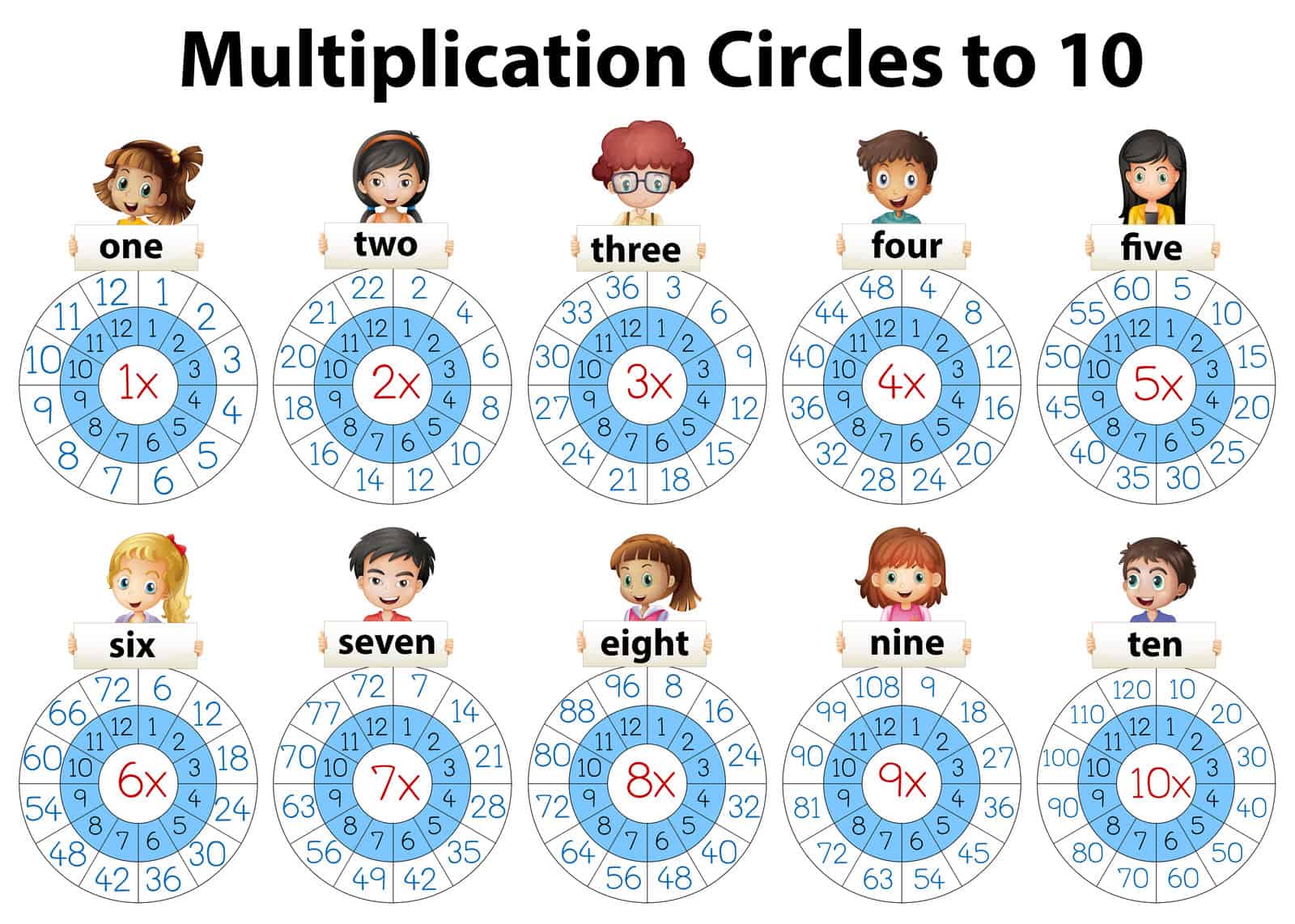
Once the grid is filled, the child has all 9 core answers. The table below shows the full x7 Magic Table with a real-world hook for each answer, which helps fix the facts in memory through context rather than repetition alone.
| Calculation | Answer | Real-world hook |
|---|---|---|
| 7 × 1 | 7 | 1 week = 7 days |
| 7 × 2 | 14 | 2 weeks = 14 days |
| 7 × 3 | 21 | 3 weeks = 21 days |
| 7 × 4 | 28 | 4 weeks in most months |
| 7 × 5 | 35 | 5 weeks = 35 days |
| 7 × 6 | 42 | Answer to life? (42!) |
| 7 × 7 | 49 | 7-a-side football team × 7 |
| 7 × 8 | 56 | 5-6-7-8 (remember the rhyme) |
| 7 × 9 | 63 | Ones digit pattern ends in 3 |
| 7 × 10 | 70 | 10 weeks = 70 days |
| 7 × 11 | 77 | Double the 7 |
| 7 × 12 | 84 | One’s digit pattern ends in 3 |
The “Subtract 3” Countdown Pattern

Once children notice this pattern, it becomes a quick mental check. The ones digits of the 7 times table follow a strict sequence: 7, 4, 1, 8, 5, 2, 9, 6, 3, 0. Each one’s digit is exactly 3 less than the previous one — and when the result would go below zero, it wraps around.
This pattern is genuinely useful during the MTC. If a child knows that 7 × 5 = 35 but blanks on 7 × 6, they can quickly apply “35, subtract 3 from the ones digit: 2, add 7 to the tens: 42” as a mental check. It’s not as fast as instant recall, but it’s faster than drawing a grid during an assessed check.
| 7 × n | Answer | Ones digit | Change from previous |
|---|---|---|---|
| 7 × 1 | 7 | 7 | — |
| 7 × 2 | 14 | 4 | −3 |
| 7 × 3 | 21 | 1 | −3 |
| 7 × 4 | 28 | 8 | −3 (wraps to 8) |
| 7 × 5 | 35 | 5 | −3 |
| 7 × 6 | 42 | 2 | −3 |
| 7 × 7 | 49 | 9 | −3 (wraps to 9) |
| 7 × 8 | 56 | 6 | −3 |
| 7 × 9 | 63 | 3 | −3 |
| 7 × 10 | 70 | 0 | −3 |
The 5 + 2 Split-Array Strategy

This method connects the 7 times table to tables children already know, making it far less daunting. The logic is straightforward: 7 = 5 + 2. So 7 × any number is simply (5 × that number) + (2 × that number). Because children typically know their 5s and 2s early and confidently, this strategy lets them solve any 7s question by combining two familiar tables.
| 7 × n | 5 × n | 2 × n | 5n + 2n | = Answer |
|---|---|---|---|---|
| 7 × 3 | 5 × 3 = 15 | 2 × 3 = 6 | 15 + 6 | 21 |
| 7 × 6 | 5 × 6 = 30 | 2 × 6 = 12 | 30 + 12 | 42 |
| 7 × 7 | 5 × 7 = 35 | 2 × 7 = 14 | 35 + 14 | 49 |
| 7 × 8 | 5 × 8 = 40 | 2 × 8 = 16 | 40 + 16 | 56 |
| 7 × 9 | 5 × 9 = 45 | 2 × 9 = 18 | 45 + 18 | 63 |
In the classroom, this approach links directly to the distributive property of multiplication — a concept that underpins much of KS2 maths. Making that connection explicit gives higher-attaining children a meaningful conceptual bridge, while lower-attaining children benefit from the practical scaffolding without needing the formal vocabulary.
Using “Friendly Numbers” to Solve 7 × 8
The pair 7 × 8 = 56 is the most notoriously forgotten fact in the entire times tables curriculum. A simple mnemonic solves it: 5-6-7-8. Point out that 56 = 7 × 8, and that the four numbers appear in order 5, 6, 7, 8. Children who hear this once rarely forget it. It works because it creates a sequential pattern that’s far more memorable than the isolated fact “56.”
For 7 × 7 = 49, the anchor is equally simple: it’s the only time you square a number in the 7s. “7 squared is 49” is a fact children often enjoy knowing; it sounds more advanced than the surrounding table, and that novelty helps it stick.
Completing the Set: What About 7 × 11 and 7 × 12?

Most Tic-Tac-Toe grid tutorials stop at 7 × 9 = 63. That leaves a gap that matters, because the UK Year 4 MTC includes all tables up to 12 × 12. Children who’ve learned the magic grid but haven’t been taught 7 × 11 and 7 × 12 will hit a wall during the check.
The good news is that these two facts are among the most learnable in the entire times tables set. For 7 × 11: point out that 11 times any single digit simply doubles the digit (7 × 11 = 77). The rule holds all the way up to 9 × 11 = 99, which most children find satisfying. For 7 × 12: use the split strategy. 7 × 12 = (7 × 10) + (7 × 2) = 70 + 14 = 84. Children who already use the split strategy for the core 7s will apply it here naturally.
An alternative anchor for 7 × 12: a school year is typically 38 to 39 teaching weeks, but 84 ÷ 12 = 7 — a calendar connection that works as a memory hook if a child responds to real-world contexts.
Preparing for the UK Year 4 Multiplication Tables Check

The Year 4 MTC is a 25-question online check. Children have 6 seconds to respond to each question. Calculators are not permitted, and there is no time to draw a Tic-Tac-Toe grid mid-check. This is important to explain to children who’ve relied on the grid as a physical tool: the goal is to use the grid to build confidence and understanding, then internalise it so that recall happens without drawing it.
“The grid is a brilliant stepping-stone, but it’s a stepping-stone, not the destination,” explains Michelle Connolly, Founder of LearningMole and former teacher with over 15 years of classroom experience. “Once a child can visualise the grid in their mind and trust their recall, the MTC stops feeling like a test and starts feeling like a demonstration of what they already know.”
The four-stage progression below maps the journey from grid-drawing to 6-second recall.
| Stage | Skill | What it looks like |
|---|---|---|
| 1 – Understanding | Draw the grid correctly | Child can fill a blank Tic-Tac-Toe grid independently |
| 2 – Visualising | Picture the grid mentally | Child closes eyes and describes the grid before answering |
| 3 – Partial recall | Recall anchor facts fast | 7×7=49, 7×8=56 come without hesitation |
| 4 – Full recall | 6-second response | All 7s answered within the MTC time limit |
For children who panic under timed conditions, practising in short bursts, 5 questions at a time with a timer, works better than extended sessions. Anxiety contracts working memory; small successes over multiple sessions build the familiarity that replaces anxiety with confidence.
The Calendar Detective: A Parent-Friendly Activity
Use a physical wall calendar for this activity. Ask your child to find all the dates in a month that are multiples of 7 (7, 14, 21, 28). Once they can do that quickly, increase the challenge: if today is the 3rd, what date is it in exactly 4 weeks? If sports day is on the 28th and today is the 7th, how many weeks until sports day? This grounds the 7 times table in time and dates, a context that’s both meaningful and regularly encountered.
Teaching Resources and Support

LearningMole provides curriculum-aligned maths resources for UK primary schools, covering the full range of multiplication tables in ways that connect visual understanding to rapid recall. Whether you’re a Year 4 teacher planning MTC preparation sessions or a parent working through the 7s at home, LearningMole’s educational videos break down each strategy with clear visual demonstrations suited to primary-aged learners.
Check our LearningMole’s multiplication series. For the full range of multiplication resources, visit LearningMole’s maths resources for KS2.
LearningMole’s multiplication resources are designed to support exactly this kind of structured, confidence-building approach, with curriculum-aligned videos and activities that work for classroom teaching and home learning alike. If you’re working through the full set of times tables, the Magic Tables series covers every table with the same clarity and depth, giving children a consistent visual language across the whole multiplication curriculum.
Related Magic Tables guides: x5 Magic Tables | x6 Magic Tables | x8 Magic Tables | x9 Magic Tables | x10 Magic Tables
Explore our teaching resources | Subscribe for full access from £1.99/month
Frequently Asked Questions

What is the Tic-Tac-Toe trick for the 7 times table?
The Tic-Tac-Toe method uses a three-by-three grid to generate the answers to 7 × 1 through 7 × 9. The digits 1–9 are placed in the grid in reverse phone-keypad order (bottom-left to top-right), giving the ones digits of each answer. Children add the correct tens digit to each row to get the full answer. The grid works as a visual scaffold that children use to reconstruct the 7s when memory fails, before gradually internalising it for rapid recall.
Why do children find the 7 times table so difficult?
The 7 times table is harder than most because 7 is a prime number. It has no factors other than 1 and 7, which means there are no doubling, halving, or digit-sum shortcuts to fall back on. The 2s, 4s, and 8s connect through doubling; the 9s have their digit-sum rule; the 5s align with counting in fives. The 7s don’t connect to anything as neatly, which means children need specific strategies rather than extensions of what they already know. Validating this difficulty, telling children it’s genuinely the hardest one — often reduces anxiety and improves engagement with the strategies.
How can I help my child learn the 7 times table quickly?
Start with the Tic-Tac-Toe grid as a visual tool. Once they can draw and fill it correctly, move to the split strategy: 7 × n = (5 × n) + (2 × n). Anchor the two hardest facts separately: 7 × 8 = 56 using the 5-6-7-8 sequence, and 7 × 7 = 49 as the only square in the table. Use the Calendar Detective activity (counting weeks on a real calendar) to practise in a low-pressure context. Short daily practice of 5–7 questions is more effective than long infrequent sessions.
What is the “5-6-7-8” trick for 7 × 8?
The 5-6-7-8 trick is a mnemonic for the fact 7 × 8 = 56. The four numbers (5, 6, 7, 8) appear in ascending order, making the equation easy to reconstruct: 56 = 7 × 8. It’s one of the most widely used primary maths mnemonics in UK classrooms and works because it creates a sequential pattern that’s far more memorable than the isolated product. Children who learn it once very rarely forget it.
Does the 7 times table have a pattern?
Yes — the ones digits of the 7 times table follow a strict “subtract 3” countdown: 7, 4, 1, 8, 5, 2, 9, 6, 3, 0. Each ones digit is exactly 3 less than the previous one, wrapping around when the subtraction goes below 0. This pattern is useful as a mental check during the Year 4 MTC: if a child knows 7 × 5 = 35 and needs 7 × 6, they can apply the pattern to confirm the ones digit is 2 before calculating the full answer as 42.
Are the 7 times tables required for the Year 4 MTC?
Yes. The Year 4 Multiplication Tables Check covers all tables from 2 to 12, and the 7 times table is included. The DfE’s test framework uses an adaptive algorithm that tends to present the 6s, 7s, 8s, and 12s more frequently because these are statistically the least well-known. Children have 6 seconds per question with no tools or aids. This makes the 7s one of the highest-priority tables to secure before the check.
What are the best resources for teaching the 7 times table?
The most effective classroom resources combine visual scaffolding with pattern-based strategies. Printed Tic-Tac-Toe grids give children a physical tool to practise the layout before visualising it mentally. Flashcards focusing on the hardest facts (7 × 6, 7 × 7, 7 × 8) help once the overall structure is understood. LearningMole’s multiplication video series provides visual demonstrations of each strategy with curriculum-aligned explanations for primary-aged learners, and can be used for whole-class teaching or independent home practice.
How should I differentiate the 7 times table for different learners?
For children who struggle with abstract multiplication, start entirely with the calendar context: 7 days in a week makes 7 × 4 = 28 days immediately concrete. The split strategy works well for children who are more confident with lower tables but anxious about the 7s specifically. For children with higher attainment, introduce the distributive property formally (7n = 5n + 2n) and challenge them to apply the same logic to other combinations. Children who’ve grasped the one-digit pattern can be asked to explain why it works — a useful extension task that deepens understanding without adding complexity.
Building Confidence with the 7 Times Table

The 7 times table doesn’t have to be the sticking point in a child’s multiplication journey. With the right tools, the Tic-Tac-Toe grid as a visual scaffold, the split-array strategy connecting the 7s to the 5s and 2s, the ones-digit countdown pattern as a mental check, and specific anchors for the hardest facts, children can move from frustration to confidence faster than most expect. The key is building genuine understanding before pushing for speed.
The Year 4 MTC is a real and specific target, and preparing children for 6-second recall requires deliberate practice that moves beyond the grid. But that transition is much smoother when children trust the patterns behind the 7s rather than treating each answer as an isolated fact to memorise. The strategies in this guide are designed to make that transition a natural progression, not a leap.


Leave a Reply