Multiplication Times Tables: 2x Magic Tables
Table of Contents
Most children meet the 2 times table in Year 1, yet many are still counting on their fingers in Year 3. The gap between first exposure and genuine instant recall is wider than most parents and teachers expect, and it is rarely fixed by repetition alone. What closes it is understanding: when a child grasps why the 2 times table works the way it does, memorisation follows almost by itself.

LearningMole has worked with primary teachers and families across the UK to develop curriculum-aligned resources that build real number sense rather than just rote answers. The 2x table is the foundation of the entire doubling sequence in the UK National Curriculum; master it properly in Year 2, and you have already done half the groundwork for the 4x and 8x tables. That is the “magic” behind the name, and this guide will show you exactly how to use it.
Whether you are a KS1 teacher planning a sequences lesson, a Year 4 parent helping with Multiplication Tables Check preparation, or a home educator building maths confidence from scratch, the strategies here are grounded in the Concrete-Pictorial-Abstract (CPA) approach recommended across UK primary schools. You will find a reference chart, practical teaching activities, multi-sensory techniques for children who struggle with rote learning, and a direct link to the Year 4 MTC requirement.
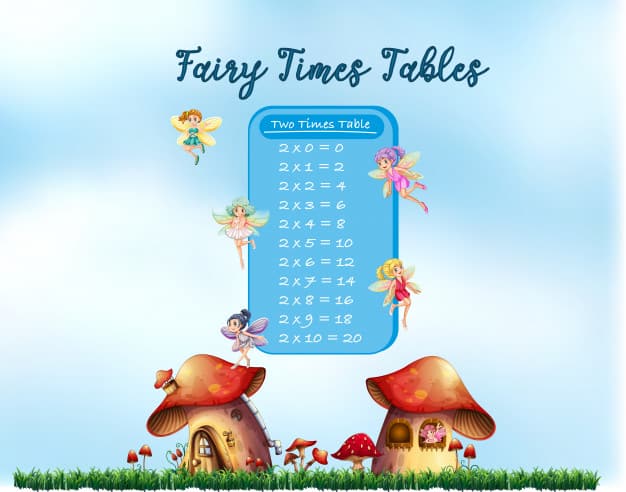
The 2 Times Table Chart: 1 to 12
The chart below is your quick-reference anchor. Pin it up, print it out, or use it as a starting point for the doubling activities in this guide. Children should be able to recall every fact here within 6 seconds by the end of Year 4, that is the statutory requirement for the Multiplication Tables Check.
| Multiplication | Answer | Even Number Pattern |
|---|---|---|
| 1 × 2 | 2 | Even |
| 2 × 2 | 4 | Even |
| 3 × 2 | 6 | Even |
| 4 × 2 | 8 | Even |
| 5 × 2 | 10 | Even |
| 6 × 2 | 12 | Even |
| 7 × 2 | 14 | Even |
| 8 × 2 | 16 | Even |
| 9 × 2 | 18 | Even |
| 10 × 2 | 20 | Even |
| 11 × 2 | 22 | Even |
| 12 × 2 | 24 | Even |
Every answer in the 2 times table is an even number. This is not a coincidence; it is the definition. A multiple of 2 is an even number. Teaching children this relationship early gives them an immediate self-checking tool: if their answer is odd, it cannot be right.
What Makes the 2x Table “Magic”?

The 2 times table is magic because it unlocks three other times tables automatically.
Children who understand doubling do not just learn the 2x table; they are already building the mental scaffolding for the 4x and 8x tables. Every answer in the 4x table is double the matching 2x answer. Every answer in the 8x table is double the 4x answer. This chain, called the doubling sequence, means that a child who can double fluently has a reliable method for three of the twelve times tables before they have been formally taught any of them.
The Doubling Secret
Doubling is how the 2 times table actually works. “2 times 7” means “7, doubled.” “2 times 9” means “9, doubled.” Children who understand this do not need to count up in 2s to find 2 × 8; they split 8 into 4 + 4, double each part, and arrive at 16 almost instantly.
The UK National Curriculum introduces doubling in Year 1 alongside halving. Teachers who explicitly and repeatedly connect this to the 2x table give children a conceptual shortcut that rote table drills cannot provide.
The Even Number Pattern
All multiples of 2 end in 0, 2, 4, 6, or 8. No exceptions. This pattern gives children a checking strategy: look at the last digit of your answer. If it is odd, you have made an error. This works for any multiplication involving 2, whether the child is in Year 2 or Year 6.
Point this out visually. Write the 2x table answers in a column and circle the units digits. The repeating 0, 2, 4, 6, 8 pattern appears immediately. Most children find this genuinely surprising the first time they see it, and surprise is a powerful memory hook.
Three Tricks for Instant Recall

Moving from “counting up in 2s” to instant recall requires more than a poster on the wall. These three strategies address different learning styles and work best when used together over two to three weeks rather than all at once.
The “Magic Key” to the 4x and 8x Tables
Teach this as soon as the 2x table is secure. The logic is simple:
- 3 × 2 = 6 → 3 × 4 = 12 (double it again) → 3 × 8 = 24 (double it again)
- 5 × 2 = 10 → 5 × 4 = 20 → 5 × 8 = 40
- 7 × 2 = 14 → 7 × 4 = 28 → 7 × 8 = 56
Children who see this pattern described as a “magic key” tend to remember it because it feels like a trick rather than a rule. The Master Key Progression table below makes the relationship explicit.
| Starting Number | 2× (Double) | 4× (Double Again) | 8× (Double Again) |
|---|---|---|---|
| 3 | 6 | 12 | 24 |
| 4 | 8 | 16 | 32 |
| 5 | 10 | 20 | 40 |
| 6 | 12 | 24 | 48 |
| 7 | 14 | 28 | 56 |
| 8 | 16 | 32 | 64 |
| 9 | 18 | 36 | 72 |
Using Fingers as a Visual Number Line
Children with a strong spatial sense often respond well to finger-based skip counting. Starting with both hands flat on the table, the child touches each finger in turn and says the multiples of 2 aloud: 2, 4, 6, 8, 10 on one hand; 12, 14, 16, 18, 20 on the other; 22 and 24 using a second pass on the first two fingers. The physical touch creates a kinesthetic anchor that mental repetition alone does not provide.
This works well as a quiet self-checking technique during the Multiplication Tables Check. Practise it before timed assessments so it becomes automatic.
The “Pairs” Mnemonic
Everything in the 2 times table comes in pairs. Socks come in pairs. Shoes come in pairs. Eyes come in pairs. Ears come in pairs. When a child understands that “2 times 5” means “5 pairs of things,” counting pairs of objects from around the house becomes a maths lesson. Five pairs of socks laid out on the floor are 10 socks. Three pairs of gloves are 6 gloves. Six pairs of shoes are 12 shoes.
The “Pairs on the Line” activity, pegging pairs of socks to a washing line while counting, is one of the most effective concrete teaching tools for the 2x table in KS1. It requires no special equipment and takes less than ten minutes.
“Kitchen Cupboard” Maths: Concrete Learning at Home

Children learn multiplication facts most securely when they have handled the numbers physically before meeting them in abstract form. This is the Concrete stage of the CPA approach, and it is where parents can add the most value at home.
You do not need to buy resources. Any small identical objects work: pasta shapes, coins, buttons, building bricks. The task is simple: put 3 pairs of objects on the table. Count them. “Three times two equals six.” Change one pair, count again.
For children who struggle with rote memorisation, including those with dyscalculia or working memory difficulties, multi-sensory approaches make a significant difference. Try these:
- Clapping rhythms while saying multiples of 2 aloud (adds auditory and physical anchors to a visual task)
- Jumping on every even number while counting a number line drawn on paper
- Stamping feet alternately while counting: “left-2, right-4, left-6, right-8”
- Sorting objects into pairs and describing what is happening in full sentences (“I have four pairs, that is eight altogether”)
These “heavy work” techniques, activities that engage large muscle groups, are particularly effective for children who struggle to retain abstract number facts through visual practice alone.
Preparing for the UK Year 4 Multiplication Tables Check

By the end of Year 4, children are expected to recall all multiplication facts up to 12 × 12 instantly. The Multiplication Tables Check (MTC), introduced as a statutory assessment, tests this with a 6-second response window per question.
Six seconds sounds generous. In practice, any child who is still skip-counting rather than retrieving a stored fact will struggle with the harder tables while trying to recall the 2x. The 2x table should be automatically retrieved without any counting strategy by the end of Year 2.
“The 2 times table is the engine room of a child’s mathematical confidence. Children who reach Year 3 without instant 2x recall spend mental energy on basics that should be automatic, leaving less working memory for the harder facts they’re meeting for the first time.” Michelle Connolly, Founder of LearningMole and former primary school teacher with over 15 years of classroom experience
The practical implication for Year 3 teachers and Year 3-4 parents: check 2x recall first, before assuming it is secure. Many children who can recite the 2 times table in sequence stumble when facts are presented in random order. Random-order practice, not sequential chanting, is what builds the retrieval speed the MTC requires.
MTC preparation tips for the 2x table:
- Practise with facts presented in random order from Year 3 onwards
- Time occasional practice to build familiarity with response pressure (but not stress)
- Mix the 2x table with other known tables rather than drilling it in isolation
- Focus any remaining gaps on the facts children find hardest (typically 6 × 2, 7 × 2, 8 × 2)
Teaching Resources and Support

LearningMole provides curriculum-aligned video resources for primary teachers and parents covering the full range of times tables, including multiplication facts, doubling strategies, and maths fluency for KS1 and KS2.
For teachers planning KS1 or KS2 maths lessons, LearningMole’s resources cover the complete multiplication curriculum, from the first introduction of doubling in Year 1 through to MTC preparation in Year 4. The platform offers both free content and subscription access to the full library.
LearningMole has worked with primary teachers and families across the UK to develop curriculum-aligned resources that build real number sense rather than just rote answers. The 2x table is the foundation of the entire doubling sequence in the UK National Curriculum; master it properly in Year 2, and you have already done half the groundwork for the 4x and 8x tables. That is the “magic” behind the name, and this guide will show you exactly how to use it.
The times tables series on LearningMole covers every table from 2x to 12x with the same CPA-grounded approach used in this guide:
- x3 Magic Tables
- x4 Magic Tables
- x5 Magic Tables
- x6 Magic Tables
- x7 Magic Tables
- x8 Magic Tables
- x9 Magic Tables
- x10 Magic Tables
Subscribe to LearningMole for full access to the curriculum-aligned video library
Frequently Asked Questions

What is the easiest way to learn the 2 times table?
The simplest approach is to understand it as doubling. “2 times 7” means “double 7.” Children who know their doubles, 1+1, 2+2, 3+3 and so on, already have every 2x answer they need. If doubles are not secure, practise those first using physical objects or number lines before introducing multiplication notation. Doubles are introduced in Year 1 in the UK National Curriculum, making them accessible even to Reception-age children.
What is the “Magic Key” trick?
Once the 2x table is secure, double every answer to get the 4x table. Double the 4x answers to get the 8x table. For example: 6 × 2 = 12, so 6 × 4 = 24, and 6 × 8 = 48. This means a child who knows the 2x table automatically has a reliable strategy for two more tables, which significantly reduces the total memorisation load before the Year 4 MTC.
Why do all 2 times table answers end in an even number?
Because a multiple of 2 is the definition of an even number. When you multiply any whole number by 2, the result will always end in 0, 2, 4, 6, or 8. This is a useful self-checking rule for children at any stage: if their 2x answer ends in 1, 3, 5, 7, or 9, they have made an error somewhere.
At what age should a child know the 2 times table?
The 2 times table is introduced in Year 1 alongside doubling and halving. Children are expected to recall 2x facts with confidence by the end of Year 2 (age 6–7) in the UK National Curriculum. By Year 4 (age 8–9), the Multiplication Tables Check requires instant retrieval of all facts to 12 × 12, including the 2x table, within a 6-second window per question.
How can I help a child who struggles with rote memorisation?
Start with the Concrete stage: use physical objects arranged in pairs. Move to pictures and visual patterns before introducing written number facts. For children with working memory difficulties or dyscalculia, multi-sensory techniques, clapping rhythms, jumping on multiples, and sorting objects into pairs provide physical anchors that visual repetition alone cannot. Practise random-order recall rather than sequential chanting, which can mask gaps in genuine retrieval.
Where can I find 2 times table resources for Year 2?
LearningMole provides free and subscription-based video resources covering the 2 times table and broader multiplication skills for KS1. The videos use the CPA approach to build understanding before moving to abstract fact recall. Visit LearningMole’s primary maths resources for curriculum-aligned materials.
How does the 2 times table connect to other tables in the UK curriculum?
The 2x table forms one-third of the doubling sequence alongside the 4x and 8x tables. It also connects directly to the 10x table via the 20x relationship and to the 6x table via the 3x doubling pattern. The UK National Curriculum builds times tables knowledge progressively: 2x, 5x, and 10x in Year 2; 3x, 4x, and 8x in Year 3; all tables to 12x by the end of Year 4. A secure 2x table is the starting point for this entire sequence.
Is the 2 times table in the Year 4 Multiplication Tables Check?
Yes. The MTC includes facts from tables 2-12, presented in random order. The 2x table is among the most frequently appearing in practice materials, and because it should be the most automatic, errors on 2x facts during the MTC often signal that the child is still using counting strategies rather than instant retrieval. Random-order timed practice from Year 3 is the most effective preparation.
Conclusion

The 2 times table matters far beyond its own twelve facts. It introduces children to the concept of doubling, provides a checking strategy through the even-number pattern, and lays the foundation for the 4x and 8x tables. Taught well in Year 1 and Year 2, with time spent at the concrete and pictorial stages before moving to abstract recall, it becomes automatic by Year 3, leaving mental space for the harder tables ahead.
For teachers and parents supporting Year 4 MTC preparation, the key question is not whether a child can recite the 2x table in order, but whether they can retrieve individual facts instantly when presented in random order. That shift, from sequential chanting to genuine retrieval, is what separates a child who has learned the 2 times table from one who is ready for the Multiplication Tables Check.
LearningMole’s curriculum-aligned video resources for times tables are designed to support every stage of this journey, from first introduction in Year 1 through to MTC-ready fluency in Year 4. Explore the full multiplication series and the wider primary maths library at learningmole.com.


Leave a Reply