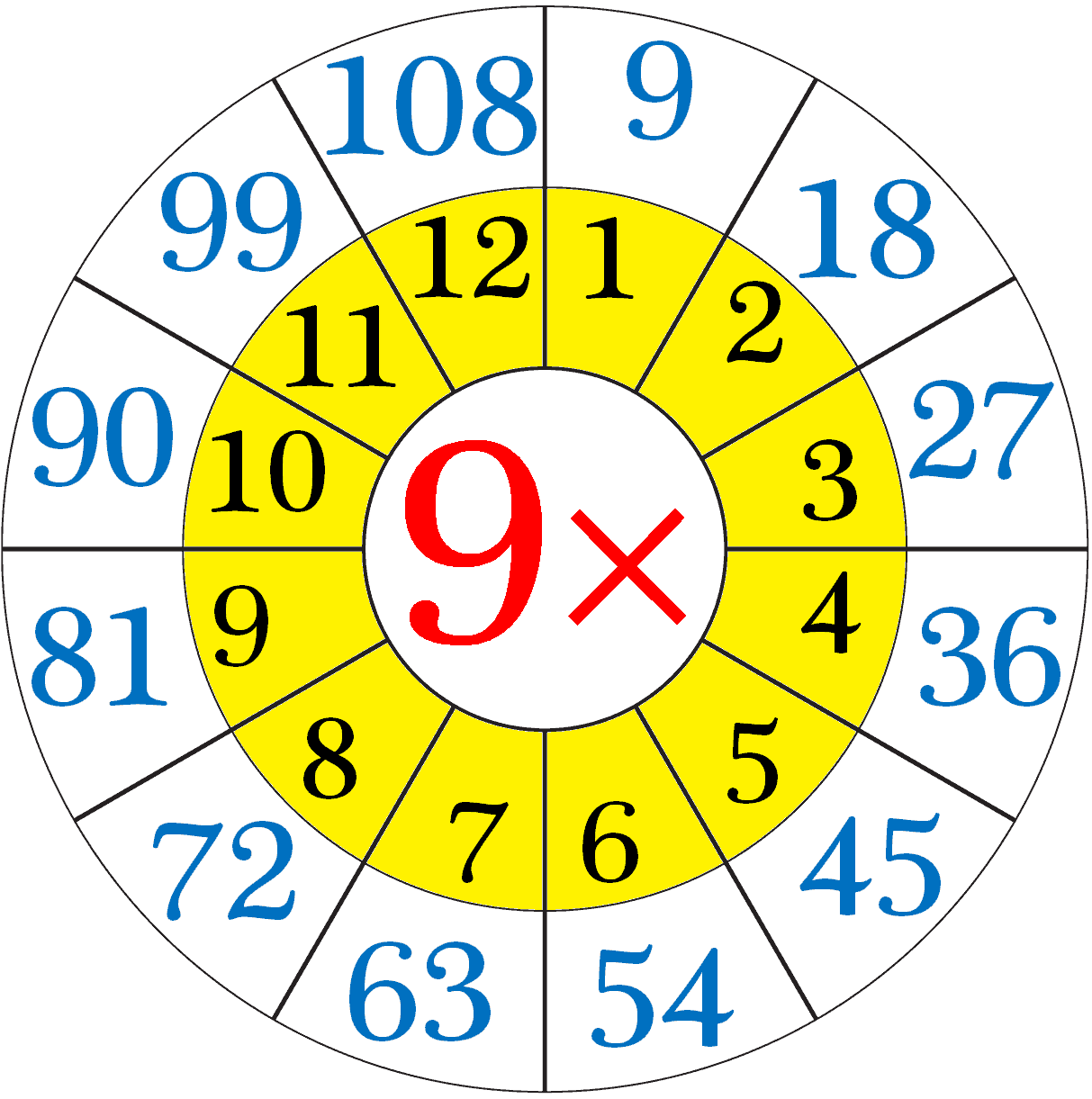
Multiplication Times Tables: x9 Magic Tables
Table of Contents
Multiplication: The 9 times table has a reputation for being tricky, but it holds more genuine mathematical magic than any other table in the primary curriculum. Once children discover its hidden patterns, the answers stop feeling like facts to memorise and start feeling like puzzles they already know how to solve. That shift, from anxious recall to confident pattern-spotting, is exactly what good maths teaching is trying to achieve.
In UK primary schools, the 9 times table sits within the Year 4 expectations of the National Curriculum, and every child must demonstrate rapid recall of all multiplication facts up to 12 x 12 in the Year 4 Multiplication Tables Check (MTC). With a six-second response window per question, children who rely only on counting strategies will struggle under pressure. The patterns and strategies in this guide give pupils a reliable mental safety net, not to replace understanding, but to build it. LearningMole’s curriculum-aligned resources are designed with exactly this balance in mind.
This guide covers the finger trick, the digit sum rule, the 10n minus n mental strategy, and practical classroom activities, alongside specific MTC preparation advice. Whether you’re a KS2 teacher planning a lesson, a parent helping with homework, or a teaching assistant supporting a small group, you’ll find concrete strategies here that go beyond the usual list of facts. For more in the series, the 8 times table guide covers similar ground for a table that trips up even fluent multipliers
Why the 9 Times Table is “Magic”

The 9 times table appears complicated at first glance, but it contains two consistent patterns that make every answer predictable once children know where to look. These aren’t shortcuts; they’re windows into how our base-10 number system works, and understanding them builds the kind of number sense that supports all future maths learning.
The first pattern is the digit sum rule: the digits of every multiple of 9 add up to 9 (or to a number whose digits also add up to 9 for larger multiples). So 9 x 4 = 36, and 3 + 6 = 9. The second is the tens-digit rule: the tens digit of the answer is always one less than the number being multiplied. In 9 x 6 = 54, the tens digit is 5, which is one less than 6. Together, these two rules mean that children who understand the patterns can reconstruct any answer in the table, even if they momentarily blank under pressure.
Helping children spot these rules early changes their relationship with the 9 times table from dread to curiosity. As Michelle Connolly, former primary school teacher with over 15 years of classroom experience and founder of LearningMole, explains: “The 9 times table is one of the best teaching tools in primary maths because it makes the base-10 system visible. When a child realises that the digits always add to 9, they’re not just learning a multiplication fact; they’re seeing how numbers are built. That kind of understanding sticks in a way that rote memory never quite does.”
The Famous 9 Times Table Finger Trick (Step-by-Step)
The finger trick is one of the most effective visual tools in the KS2 maths classroom because it gives children a physical, self-checking method they can use anywhere. It works for 9 x 1 through 9 x 10.
How to use the finger trick:
- Hold both hands out in front of you with all ten fingers extended.
- To calculate 9 x n, fold down the nth finger from the left. For example, for 9 x 3, fold down the third finger.
- The fingers to the left of the folded finger give the tens digit. The rightmost finger gives the units digit.
- For 9 x 3: two fingers to the left, seven to the right. Answer: 27.
- Check: 2 + 7 = 9. The digit sum confirms the answer is correct.
The power of the finger trick is not just that it produces the right answer, it’s that it makes the tens-and-ones structure of the answer visible. Children are physically seeing place value in action. This connects directly to Year 3 and Year 4 curriculum work on place value and helps consolidate understanding rather than bypassing it.
A useful classroom note: the finger trick naturally breaks down for 9 x 10 (no fingers to the right of the folded finger), so it’s worth discussing this briefly. The answer is 90, and 9 + 0 = 9 still holds. This small exception can prompt a useful conversation about what happens when the units digit is zero.
The Digit Sum Pattern at a Glance
| Equation | Answer | Magic check (digits add to 9) |
|---|---|---|
| 9 × 1 | 9 | 9 |
| 9 × 2 | 18 | 1 + 8 = 9 |
| 9 × 3 | 27 | 2 + 7 = 9 |
| 9 × 4 | 36 | 3 + 6 = 9 |
| 9 × 5 | 45 | 4 + 5 = 9 |
| 9 × 6 | 54 | 5 + 4 = 9 |
| 9 × 7 | 63 | 6 + 3 = 9 |
| 9 × 8 | 72 | 7 + 2 = 9 |
| 9 × 9 | 81 | 8 + 1 = 9 |
| 9 × 10 | 90 | 9 + 0 = 9 |
| 9 × 11 | 99 | 9 + 9 = 18 → 1 + 8 = 9 |
| 9 × 12 | 108 | 1 + 0 + 8 = 9 |
Beyond Fingers: The “Minus One” Rule for Tens and Units

Once children are comfortable with the finger trick, it’s worth making the underlying pattern explicit. The tens digit of any 9 times table answer is always 1 less than the multiplicand. This is sometimes called the “minus one” rule.
For 9 x 7: the tens digit is 7 – 1 = 6. The units digit is 9 – 6 = 3. So the answer is 63.
This connects directly to place-value work in Years 3 and 4. Children who understand that any two-digit number can be described by its tens and units, and that in the 9 times table, those two parts always add to 9, have a genuine structural understanding rather than a surface-level trick. It’s also connected to number bonds to 10, a KS1 concept: in 9 x 4 = 36, the units digit 6 is the number bond partner of 4 to make 10.
The 10n Minus n Strategy: Mental Maths Mastery

This is the strategy that most competing articles overlook, and it’s arguably the most mathematically valuable one in this guide. Instead of memorising that 9 x 7 = 63, children who understand this method know that 9 x 7 is the same as (10 x 7) – 7.
The logic is straightforward: 9 is the same as 10 minus 1. So multiplying by 9 is the same as multiplying by 10 and then subtracting the original number. Children who have a secure recall of the 10 times table, which most do by Year 3- can use this to derive any 9 times table answer mentally.
9 x 6: (10 x 6) – 6 = 60 – 6 = 54. 9 x 8: (10 x 8) – 8 = 80 – 8 = 72. 9 x 12: (10 x 12) – 12 = 120 – 12 = 108.
This strategy works for any multiple of 9, not just those in the standard times table, which makes it especially powerful for children aiming for greater depth in KS2 maths. It also connects to the White Rose Maths approach, widely used in UK primary schools, which emphasises understanding over procedural recall. The 10n – n method is the mathematical reason behind the digit sum pattern; once children see that 9 = 10 – 1, the patterns stop being magic and become inevitable.
Comparing the 10 Times Table and the 9 Times Table
| n | 10 × n | 9 × n | Difference |
|---|---|---|---|
| 1 | 10 | 9 | −1 |
| 2 | 20 | 18 | −2 |
| 3 | 30 | 27 | −3 |
| 4 | 40 | 36 | −4 |
| 5 | 50 | 45 | −5 |
| 6 | 60 | 54 | −6 |
| 7 | 70 | 63 | −7 |
| 8 | 80 | 72 | −8 |
| 9 | 90 | 81 | −9 |
| 10 | 100 | 90 | −10 |
| 11 | 110 | 99 | −11 |
| 12 | 120 | 108 | −12 |
Showing children this table makes the 10n – n relationship undeniable. The difference is always exactly n. This is the kind of pattern-spotting activity that the National Curriculum’s “working mathematically” strand specifically calls for.
Preparing for the Year 4 Multiplication Tables Check

Every Year 4 pupil in England sits the Multiplication Tables Check (MTC), an online assessment of 25 questions covering all times tables up to 12 x 12. Children have 6 seconds to answer each question and 3 seconds between questions. The 9 times table appears regularly in the MTC, and the pressure of the timer means that strategies which require lengthy working are not practical.
The finger trick and digit sum patterns are valuable here, but only if children have practised them enough that they’re fast. A child who needs 10 seconds to use the finger trick correctly is no better off than one who has to count up. The goal is to use these patterns as scaffolding during learning, and then to build enough fluency that the answer comes almost automatically, with the pattern as a background check rather than an active process.
Classroom note: Reducing maths anxiety during timed tests One of the most common causes of blanking during timed multiplication tests is anxiety rather than lack of knowledge. Children who have an internal strategy, something to do when the answer doesn’t come immediately, are less likely to freeze. The digit sum check (“the digits add to 9”) gives pupils a quiet way to verify or reconstruct an answer without visible working, which reduces the panic response that timed tests can trigger in children who already find maths stressful.
For children with maths anxiety, framing the 9 times table as “already knowing” the patterns (rather than trying to remember facts) can shift the emotional relationship with the task. LearningMole’s educational videos use this approach, treating mathematical patterns as things to discover rather than facts to absorb.
The 9 Times Table Detective Activity

This classroom or home activity moves children from passively using the patterns to actively investigating them, which is where the understanding really beds in.
What you need: a printed hundred square (or a hand-drawn 10 x 10 grid numbered 1 to 100), coloured pencils.
What to do:
- Ask children to colour every multiple of 9 on the hundred square (9, 18, 27, 36… up to 99).
- Once coloured, ask them what they notice about the pattern. The multiples form a clear diagonal line across the grid.
- Ask children to add the digits of each coloured number. Record the results. What do they find?
- Extend: ask them to predict where 108 would sit if the grid extended. Then check by calculation.
This activity connects times table learning to spatial reasoning and pattern recognition, both of which sit within the National Curriculum’s mathematical reasoning strand. It works well as a starter activity before a direct instruction lesson on the 9 times table, or as an extension for children who have secure recall and need greater depth.
Teaching Resources and Support

LearningMole’s educational video resources include curriculum-aligned maths content designed for UK primary classrooms. The video below demonstrates 9 times table concepts in a child-friendly format that works well as a classroom starter or for home learning reinforcement.
For teachers planning a full multiplication unit, LearningMole’s times tables series covers each table individually with the same pattern-first approach: x2 through to x12. Each article in the series can be used independently or as part of a structured sequence.
Parents supporting learning at home can use these resources alongside the activities in this guide. Children who work with the digit sum pattern at home, checking their answers by adding the digits, build a checking habit that carries into written maths work well beyond times tables.
Frequently Asked Questions

What is the easiest trick for remembering the 9 times table?
The finger trick is the most immediately accessible: hold out both hands, fold down the nth finger, and count the fingers on either side for the tens and units digits. For a purely mental approach, the digit sum rule, which states that all answers have digits adding to 9, lets children self-check any answer. The most mathematically powerful method is the 10n – n strategy: multiply by 10 and subtract the original number. All three methods work together and reinforce each other.
Why do the digits of 9 times table answers always add up to 9?
Because 9 = 10 – 1. When you multiply any number n by 9, you’re doing (10 x n) – n. The result is always one less than a round multiple of 10, which means the tens digit is n – 1 and the units digit is 10 – n. These two digits add to (n – 1) + (10 – n) = 9. The pattern is a direct consequence of the base-10 number system, which is why it also works for 9 x 11 (99: 9 + 9 = 18, then 1 + 8 = 9) and 9 x 12 (108: 1 + 0 + 8 = 9).
How can I help my child pass the Year 4 Multiplication Tables Check for the 9 times table?
The MTC gives children 6 seconds per question. The finger trick alone is too slow at that pace, so the goal is to build enough pattern familiarity that answers come quickly, with the trick available as a backup. Practice little and often, three minutes of timed 9 times table practice three or four times a week is more effective than a single long session. Mixing the 9 times table with other tables (rather than practising it in isolation) also improves the speed of recall. LearningMole’s educational videos support this kind of varied, repeated exposure in an engaging format.
What is the “minus one” rule for the 9 times table?
The minus one rule states that the tens digit of any 9 times table answer is always one less than the number being multiplied. For 9 x 7, the tens digit is 6 (one less than 7). The units digit can then be found by subtracting the tens digit from 9: 9 – 6 = 3. So 9 x 7 = 63. Combined with the digit sum check, this gives children two reliable ways to construct or verify any answer in the table.
At what age should children learn the 9 times table?
The UK National Curriculum expects children to recall multiplication facts for all tables up to 12 x 12 by the end of Year 4 (age 8-9). Introduction to the 9 times table typically happens in Year 3 (age 7-8), with consolidation and timed practice in Year 4. Children who have secure number bonds to 10 and good recall of the 10 times table are well-positioned to learn the 9 times table efficiently, since both underpin the key strategies.
Are there songs or rhymes that help with the 9 times table?
Rhythm-based learning can support memorisation for children who respond well to auditory input. Setting the 9 times table to a familiar tune, or using a call-and-response chant in the classroom, can help with early recall. That said, songs alone are less effective than combining auditory memory with pattern understanding. Children who know both a song and the digit sum rule have two retrieval routes, which makes memory more robust. LearningMole’s video resources use visual and rhythmic elements together for this reason.
Does the digit sum trick work for larger multiples of 9?
Yes — the digit sum pattern continues infinitely. For 9 x 11 = 99: 9 + 9 = 18, then 1 + 8 = 9. For 9 x 15 = 135: 1 + 3 + 5 = 9. For 9 x 100 = 900: 9 + 0 + 0 = 9. The pattern holds because 9’s relationship to 10 – 1 is a property of the number itself, not just of the times table facts children memorise in primary school. Showing children this works beyond 9 x 12 is an excellent, in-depth extension for Year 4 or Year 5 pupils.
Bringing It All Together

The 9 times table rewards children who look for patterns rather than just trying to remember individual facts. The finger trick, the digit sum rule, and the 10n – n strategy are not three separate things to learn — they’re three ways of seeing the same underlying relationship between 9 and the base-10 system. Children who understand that relationship don’t just know the 9 times table; they understand something true about how numbers work.
For teachers, the strategies in this guide work best when they’re introduced in sequence: finger trick first as a concrete visual tool, digit sum second as a self-checking pattern, and 10n – n third as the mental maths bridge. Spread across a couple of weeks with short daily practice, this sequence builds genuine fluency rather than surface recall. The Detective Activity adds investigative reasoning to the mix, which keeps engagement high for children who find straightforward drilling less motivating.
For parents supporting at home, the most useful habit to build is the digit sum check: whenever your child works out a 9 times table answer, ask them to add the digits. It takes five seconds and builds a checking routine that carries forward into all written maths. LearningMole’s series of times table resources covers the complete primary curriculum range, with curriculum-aligned videos and activities for each table. All the other tables in the series — from x2 to x12 — follow the same pattern-first approach, so children who work through the series build a genuinely connected understanding of multiplication rather than a collection of separate facts.
More in the Magic Tables series: x10 Magic Tables | x8 Magic Tables | x7 Magic Tables | x6 Magic Tables | x5 Magic Tables | x4 Magic Tables | x3 Magic Tables | x2 Magic Tables


The 9s hand trick was the one shortcut I actually held onto into adulthood. Lower the finger for the number you’re multiplying by, count the fingers on either side, done. The problem is shortcuts solve recognition, not recall speed. My kid could do the hand trick in 4-5 seconds but couldn’t answer 9×7 cold without it, which meant in word problems and longer multi-step math she was burning mental bandwidth on a basic fact instead of the actual problem. What worked for us was treating the 9s like every other fact: short daily practice with a 3-second threshold, and the shortcut becomes the backup, not the primary path. Magic tricks help kids feel competent on day one, but the fluency only sticks when the answer comes out before the trick does.
Thank you for your thoughtful and insightful contribution to the discussion.