Egypt started a new phase of its history from the Egyptian Revolution1953. The first president of Egypt is Muhammad Najib who became president in June 1953. During the rule of Najib Gamal Abdel Nasser became prime minister.
Gamal Abdel Nasser became president in 1956. There were various incidents during his rule. Egypt passed by challenging and difficult times. There were major occurrences like the nationalization of the Suez Canal Company in 1956. Nasser ruled Egypt until his death in 1970.
The next Egyptian President was Sadat. The most dominant occurrence during his rule was the War of 1973 he launched with Israel. There was a kind of economic construction. Sadat’s regime had some political features as well.
Then Mubarak became the president of Egypt after the assassination of Sadat. During his regime, Egypt’s economy suffered. The government continued to rely heavily on foreign economic aid. The end of his regime was a period of unrest until the January 25 Revolution.
Egypt passed a transition period after Mubarak waiting for an elected government. On June 24 Mohamed Morsi was declared the winner of the presidential election. Egypt underwent hard times during its regime.
Egypt has moved to a new challenging phase which is The June 30 Revolution. There was a deterioration in the public services. People demanded Morsy to resign. There were large protests in the streets. Finally, the head of the Egyptian Armed Forces, Gen. Abdel Fattah al-Sisi declared that the military was ready to intervene to prevent chaos in the country.
Sisi had repeatedly denied having any ambition to stand in the presidential election. Some people saw the country’s best hope for economic and political stability. So he announced that he would resign from the military to run for president.
In May 2014, Former army chief Abdul Fattah al-Sisi won the presidential election. Infrastructure projects, investment in Egypt’s economy, and financial reform provided optimism for economic recovery.
Pyramids- Egypt
The Arab Republic of Egypt (1953-1970)
The Presidency of Gamal Abdel Nasser
Muhammad Naguib, was an older officer who served as the figurehead for the Free Officers and had been president since June 1953. Then, Gamal Abdel Nasser was the president of Egypt from 1956 to his death in 1970. During his presidency, Nasser was responsible for much progress in Egypt.
Nasser gave women the right to vote and built the Aswan High Dam. This change made Egypt a more socialist and modern country. In 1958 Syria and Egypt formed the United Arab Republic. Nasser is seen as one of the most important political figures in modern Arab history and politics.
Under his leadership, Egypt nationalized the Suez Canal and a lot of other industries. This caused an international conflict. At the time, the canal was owned by France and Britain. Britain, France, and Israel tried to take it back by force. Egypt won.
The second international conflict is known as the Six-Day War. In June 1967 war broke out between Israel and Egypt. Israel wiped out almost all of Egypt’s air force and took over the Sinai Peninsula. He wanted to resign after the defeat but people wanted him to continue.
During Nasser’s presidency, Egyptian citizens managed to have housing, education, employment, healthcare, and nourishment, as well as other forms of social welfare.
Egypt was capable of not only offering free education and healthcare to its own citizens but also to the citizens of other Arab and African countries. Nasser remained in office until his death in Cairo on September 28, 1970.
The Presidency of Anwar El-Sadat
Anwar el-Sadat was the president of Egypt from 1970 until 1981. Sadat made Egypt respected for its military strength and political power in the Middle East. On 6 October 1973, Sadat started the October War together with Syria against Israel.
The Egyptian army was very successful at the start of the war, and their advance across the Suez Canal into the Sinai Peninsula surprised Israel and the rest of the world. This success made Sadat a hero in Egypt, and for a time throughout the Arab World.
In 1977 Sadat made a historic visit to the country. He made a speech in front of the Knesset about what he thought was the best way to bring about peace with them. In 1978, after the Camp David Accords, he signed a peace treaty with Israel. Sadat and Begin shared the Nobel peace prize in 1978.
Many Islamists were very angry about the peace treaty. They made plans to take over the Egyptian government. In February 1981, the Egyptian government heard of this plan and arrested many people thought to be part of the plot.
Sadat missed a group of Islamists in the military who were led by Lieutenant Khalid Islambouli. This group assassinated Sadat on 6 October during the victory parade celebrating the crossing into the Sinai Peninsula.
The Presidency of Hosni Mubarak
Hosni Mubarak became the president of Egypt in 1981. Mubarak’s presidency lasted almost thirty years, making him Egypt’s longest-serving ruler since Muhammad Ali Pasha.
He became known for supporting peace in the Middle East. As president, Mubarak worked to improve Egypt’s relations with other Arab countries. He also upheld the peace treaty that Egypt and Israel had agreed to in 1979. Mubarak cracked down on terrorism as well.
In 2005 for the first time, Egypt held an election in which other candidates were allowed to run for president. Mubarak won the 2005 election, but some people claimed it was unfair.
In January 2011 thousands of Egyptians gathered in the streets. They protested unemployment, high prices, and the lack of democracy. They demanded that Mubarak leave office. Mubarak stepped down after 18 days of demonstrations during the Egyptian Revolution of 2011.
On 11 February 2011, former Vice President Omar Suleiman announced that Mubarak and he had resigned as president and vice president respectively and transferred authority to the Supreme Council of the Armed Forces.
Mubarak and his sons were accused of allegations of corruption and abuse of power. On 2 June 2012, an Egyptian court sentenced Mubarak to life imprisonment. On 13 January 2013, Egypt’s Court of Cassation ordered a retrial.
On retrial, Mubarak and his sons were accused of corruption and given prison sentences. Mubarak was imprisoned in a military hospital and his sons were freed on 12 October 2015 by a Cairo court. He was proven unguilty on 2 March 2017 by the Court of Cassation and released on 24 March 2017. Mubarak died on February 25, 2020, in Cairo.
The Presidency of Mohammed Morsi
Mohammed Morsi was elected president of Egypt in 2012. . He was the country’s first democratically elected president. Morsi was officially recognized as the winner of the election on June 24.
As president, Morsi issued a temporary constitutional declaration in November 2012 that his authority as president would not be subject to any form of judicial oversight until a permanent constitution came into effect to avoid the expected dissolution of the second constituent assembly by the opposing judges.
These issues along with complaints of the pursuit of journalists and attacks on nonviolent demonstrators led to the 2012 protests. As part of a compromise, Morsi canceled the decrees except for the part that prevents the courts from dissolving the Constituent Assembly.
Because of the deterioration in the public services, calls for Morsi’s resignation increased in mid-2013. On June 30 huge protests against his rule began around the country. Morsi offered to negotiate with the opposition but refused to resign.
On July 3 the Egyptian military unseated Morsi. It suspended the constitution and created a new interim administration to be led by the head of the Supreme Constitutional Court, Adly Mansour.
Morsi was placed under arrest, along with several other Muslim Brotherhood leaders. Morsi faced separate trials for a variety of offenses. He was sentenced to death. The court ordered a retrial. Morsi remained in prison while the new trial was underway. On June 17, 2019, he collapsed while in court, in Cairo, and was pronounced dead shortly after.
The Presidency of Abdel Fattah El Sisi
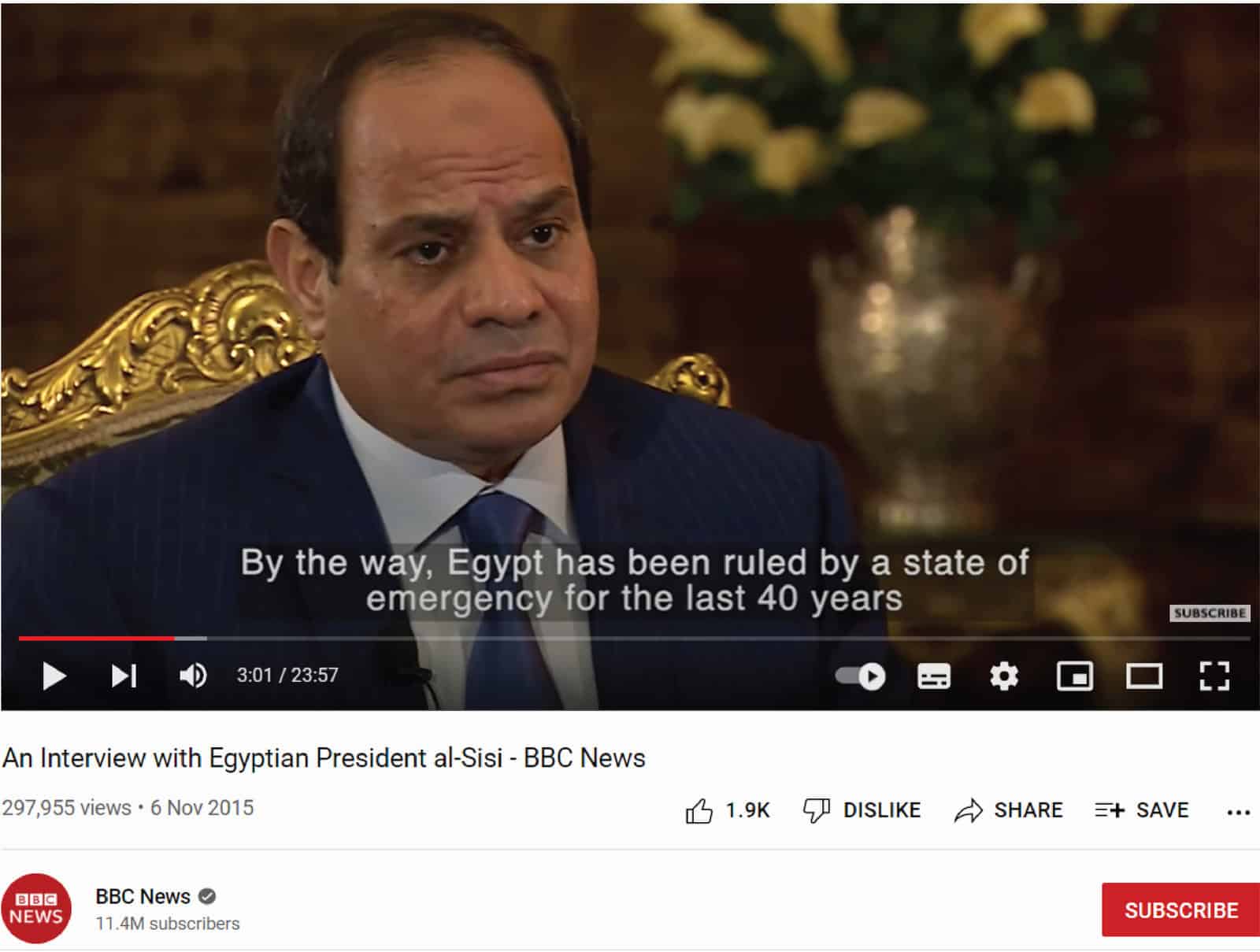
Sisi- Egypt President BBC News
Abdel Fattah Saeed Hussein Khalil el-Sisi is the current president of Egypt since 2014. He was elected to a second term in March 2018. Egypt has witnessed many changes since his presidency.
Infrastructure projects, investment in Egypt’s economy, and financial reform provided hope for economic recovery. One of his biggest projects is the expansion of the Suez Canal. It would double the capacity of the existing canal. The new canal is expected to increase the Suez Canal’s revenues.
President Sisi also introduced the Suez Canal Area Development Project. This project would involve the development of five new seaports in the three provinces surrounding the canal. It also would include seven new tunnels between Sinai and the Egyptian homeland, building a new Ismailia city, huge fish farms, and a technology valley within Ismailia.
President Sisi also started the National Roads Project, which includes building a road network of more than 4,400 kilometers and uses 104 acres of land. He promised many developments and reconstruction campaigns for Egypt to reduce the unemployment rate and increase the poor’s income.
An ambitious plan to build a new city near Cairo to serve as the country’s new capital was announced during the Egypt Economic Development Conference. It is located in the east of Cairo approximately midway between Cairo and Suez. It hasn’t been named yet. It would also help relieve population pressures from the greater Cairo area.
Another positive project is the national goal of eliminating all unsafe slums in two years. The first stage of the project was started on 30 May 2016 containing 11,000 housing units built. The main goal is the construction of 850,000 housing units.
Egypt History Movie List
Since Egypt’s history is one of the most ancient histories worldwide, a lot of movies were produced to represent such a unique history. There are many movies that revolve around Ancient Egypt and other phases whether social or political.
Many writers whether Egyptians or foreigners wrote about the history of Egypt and how marvelous it is. There are various books on different levels that provide information about political and social life in Egypt during different regimes. Here is a list of some of the most famous books:
· Seeker of Knowledge
· History Pockets
· Mysterious of Ancient Egypt Revealed
· The Persistence of Orientalism
· We’re Sailing Down the Nile
· Time Wrap Trio
· Egypt: The Cultures (Lands, People, Cultures)
· 1,000 Facts About Ancient Egypt
The history of Egypt has various aspects and passed through various changes from 1952 to the present time. Egypt underwent changes in all aspects f life from Nasser to Sisi. Egypt passed by ups and downs like 1967 and 2011 than 2013, including one of the keystones in Egypt’s history, the 2011 Egyptian Revolution, but it remains one of the most ancient civilizations all over the world.
Geometric jewellery is an artistic convergence of precise shapes and deliberately crafted angles, blending the mathematical rigour of geometry with the fluidity of design. We see the essence of shape...
Mathematics and nature intertwine in fascinating ways, creating patterns and sequences that delight and educate. As we observe the world around us, we find that counting petals and leaves isn't...
Maths on the farm is not just about profits and yields; it's a fundamental part of daily farm life, especially when it comes to managing livestock. Our days begin with...





Leave a Reply