How Your Nose Works: Ask a class of Year 1 children which body part is used for smelling, and every hand goes up. Ask them what happens between sniffing a lemon and knowing it is a lemon, and the room goes quiet. That gap is the interesting part, and it sits at the heart of the UK National Curriculum requirement that pupils identify, name, draw, and label the basic parts of the human body, and say which part is associated with each sense. LearningMole is a UK educational platform providing curriculum-aligned teaching resources for primary schools, and the human body is one of the topics teachers ask us about most.
The nose does a great deal more than smell. Every breath you take through it is filtered, warmed and moistened before it reaches your lungs. Your two nostrils are almost certainly not working equally hard at this moment. Most of what you call the taste of dinner is arriving through your nose rather than your tongue. And the number of different smells a person can tell apart is one of those figures that scientists genuinely argue about, which makes it a useful entry point for KS2 work on how science checks itself.
This guide covers how the nose works, ten facts worth teaching, where the topic sits in the National Curriculum for KS1 and KS2, and three activities that let children prove the science on themselves in under ten minutes. It is written for primary teachers planning a senses or “animals, including humans” unit, for parents fielding questions at the kitchen table, and for children aged 5 to 11 who want to know why snot exists. If you are teaching the wider topic, our guide to what is inside the human body sets the nose in context alongside the other organs.
How Your Nose Works: The Journey of a Single Sniff
Smell begins with molecules, not with the nose. Anything you can smell is releasing tiny particles into the air, and your nose is a device for catching those particles and turning them into a signal your brain can read. That is the whole process in one sentence, and it is worth saying to children before any anatomy at all, because it explains why a hot pie smells stronger than a cold one.
From Nostril to Olfactory Bulb
Air enters through the nostrils and passes over three curved shelves of bone called turbinates, which sit inside each side of the nose. These shelves are lined with a moisture-resistant material, and they force incoming air to swirl rather than travel in a straight line. That swirling is what gives the air time to be cleaned, warmed and moistened.
Near the roof of the nasal cavity sits a small patch of specialised tissue, the olfactory epithelium. Odour molecules dissolve into the mucus covering this patch and bind to receptors on nerve cells. Those cells send signals up through tiny holes in the skull to the olfactory bulb, which sits underneath the front of the brain. The olfactory bulb passes the signal onwards, and only then does a smell become a smell.
The point children find genuinely surprising is that the nose does not do the smelling. The nose collects; the brain identifies. A useful line for the classroom: your nose is the letterbox, your brain reads the post. Children who have already met the nervous system through our brain facts for kids tend to make this connection quickly.
The Vocabulary Children Need
Primary science leans heavily on precise words, and the nose has a small set worth teaching explicitly. This table gives each term with a child-friendly definition you can put straight onto a knowledge organiser.
Term
Child-friendly definition
Suggested year group
Nostril
One of the two openings at the bottom of the nose
Year 1
Mucus
The sticky liquid that lines the inside of the nose and traps dirt
Year 1 to 2
Cilia
Microscopic hairs that sweep trapped dirt out of the airways
Year 4 to 6
Turbinate
A curved shelf of bone inside the nose that makes air swirl
Year 5 to 6
Receptor
A nerve ending that detects something and sends a message
Year 4 to 6
Olfactory bulb
The part of the brain that receives smell messages from the nose
Year 5 to 6
Nasal cavity
The large air-filled space behind the nose
Year 3 to 4
Teachers often introduce mucus and nostrils in KS1 and hold the rest back for upper KS2. Splitting the list this way keeps Year 1 lessons focused on naming parts, which is what the statutory requirement actually asks for.
10 Surprising Science Facts About Your Nose
These ten facts are ordered from the most useful classroom hook to the quieter ones. Each is written so it can be lifted straight into a lesson starter or a knowledge organiser.
1. Your Nostrils Take Turns
You are mostly breathing through one nostril right now, and it will swap in a few hours. This is called the nasal cycle, and it happens because the soft tissue on one side of the nose swells slightly while the other side opens. Research puts the cycle in roughly 70 to 80 per cent of healthy adults, with the dominant side switching every one to seven hours, depending on the individual.
Most people never notice, because total airflow through the nose stays fairly steady even as the balance shifts from side to side. The German physician Richard Kayser first described the effect in 1895, and researchers still disagree about exactly what it is for. Air conditioning and tissue recovery are the leading explanations: while one side works, the other rests and rehydrates.
This is the single best fact for a primary classroom because children can test it on themselves in fifteen seconds. Almost no competing article on this topic mentions it.
2. Your Nose Does Most of the Tasting
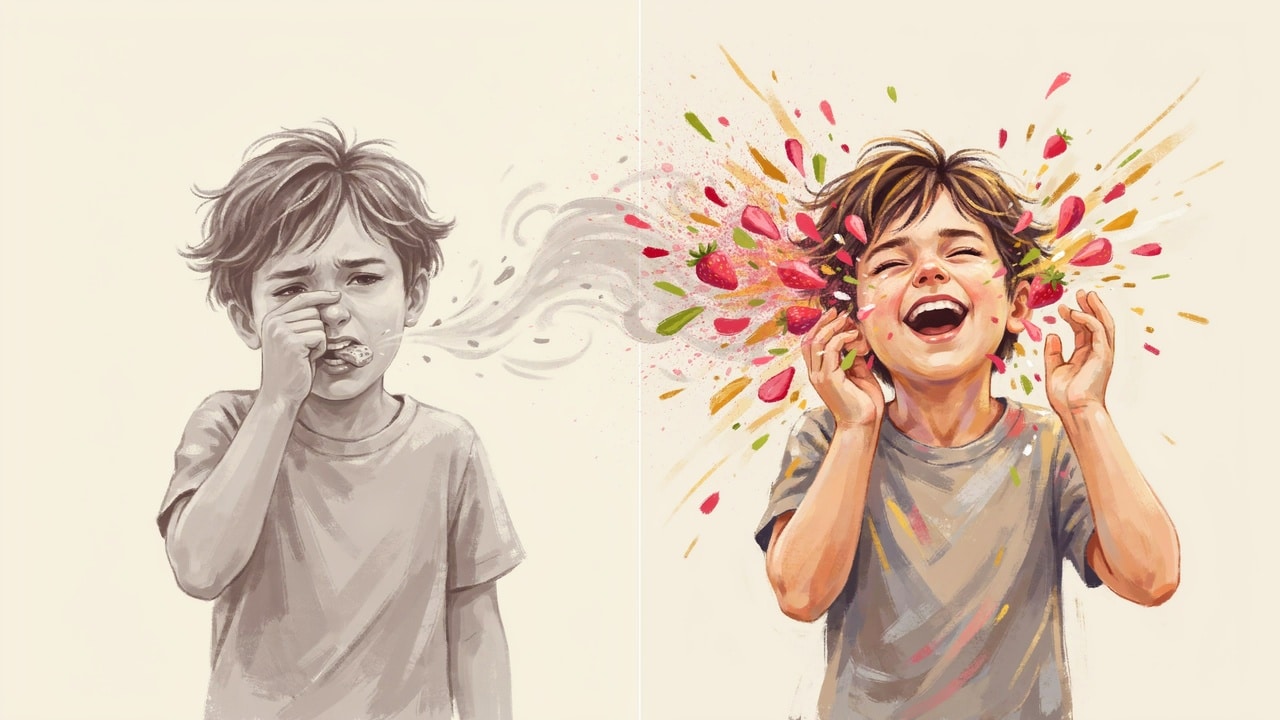
Block your nose, and a jelly bean loses almost everything except sweetness. The tongue detects a short list of basic tastes: sweet, salty, sour, bitter, and umami, the savoury taste found in foods like Marmite and parmesan. Everything beyond those five, the difference between strawberry and raspberry, comes from smell.
The route matters. When you chew, aromas travel up the back of the throat into the nasal cavity from behind. Scientists call this retronasal olfaction, as opposed to orthonasal olfaction, which is ordinary sniffing through the nostrils. Both reach the same smell-processing parts of the brain, but the brain treats them differently, which is why a cheese can smell unpleasant and taste fine.
Note the correction worth making in class: older resources often list four basic tastes. Umami was recognised as a fifth taste much later, and any resource that still teaches four is out of date.
3. Nobody Knows How Many Smells You Can Detect
You will find the figure “one trillion smells” in a great many articles, and it is genuinely contested. It comes from a 2014 study in the journal Science, which tested how well people could distinguish mixtures of odour molecules and estimated that humans can discriminate at least a trillion olfactory stimuli. The paper noted that the older textbook figure of 10,000 odours had never actually been tested. CarfieldprimaryCarfieldprimary
Within a year, other researchers pushed back hard. One reanalysis showed that the calculation was so sensitive to the study’s design that varying a few parameters could produce almost any answer you liked. A second paper built a simulated creature with only three possible smell perceptions, ran it through the same test, and found it also came out at a trillion. The honest position today is that the number is unknown. TwinklBlue Cross
For upper KS2, this is a gift. “Working scientifically” asks pupils to identify evidence used to support or refute ideas, and here is a headline number, a real challenge to it, and no settled answer. It is a far better example than most textbook ones because the disagreement is recent and the maths behind it is about a puzzle children can grasp.
4. Your Nose Is a Filter That Cleans Itself
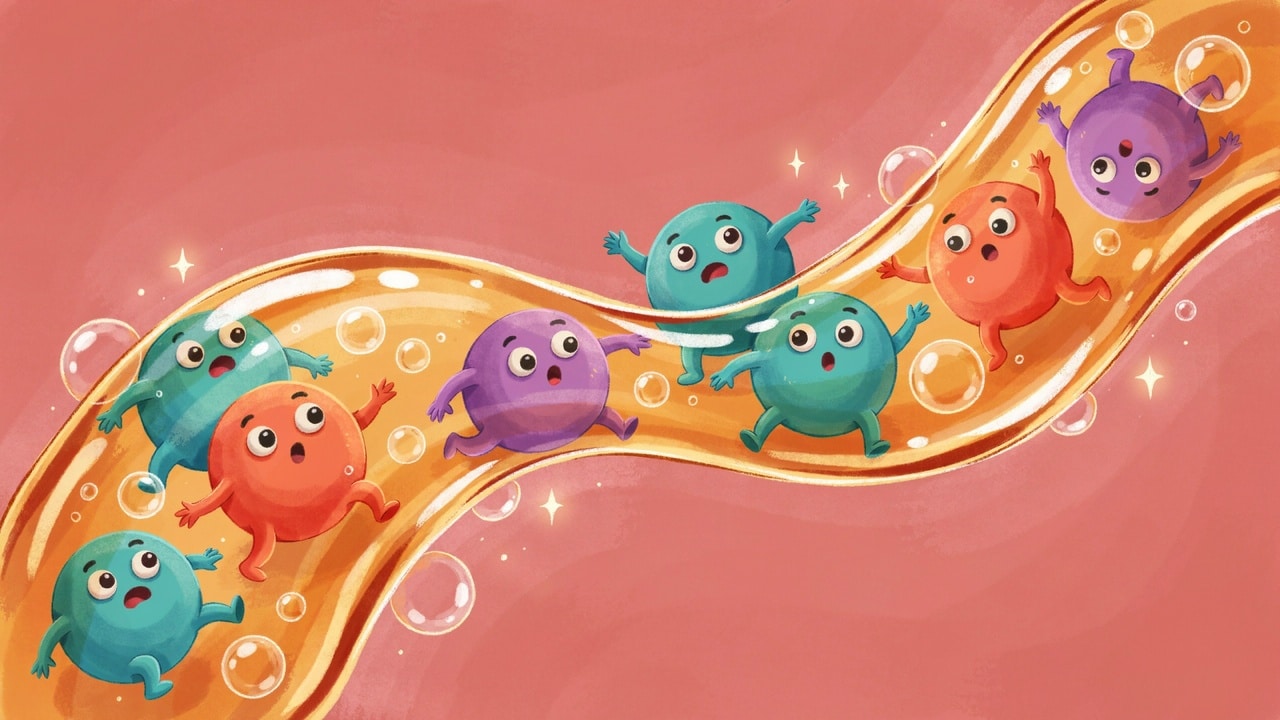
Every breath carries dust, pollen, bacteria, and pollution towards your lungs, and most of it never reaches them. Sticky mucus lining the nasal passages traps particles on contact. Microscopic hairs called cilia then beat in waves, sweeping the loaded mucus towards the back of the throat, where it is swallowed. Stomach acid deals with what the nose caught.
This is why breathing through the nose rather than the mouth matters. The mouth is a wider, straighter tube with no such equipment, so mouth-breathing sends unfiltered, unwarmed air straight down. Children usually work this out for themselves once the filtering job is explained.
5. Snot Is Doing a Serious Job
Snot is mucus that has done its work, and its colour is a clue rather than a diagnosis. Clear mucus is the everyday kind. Thicker, cloudier mucus usually means immune cells have arrived to deal with an infection.
Primary-aged children love this section, and it earns its place because it connects directly to hygiene teaching. Trapped germs in a tissue are germs that are not on a doorknob. A short discussion of why we catch a sneeze in a tissue and then wash our hands lands much better after children understand what the mucus was actually holding.
6. Your Nose Warms and Moistens Every Breath
Cold, dry air is hard on the lungs, so the nose conditions it first. As air swirls around the turbinates, it picks up moisture from the wet lining and warms towards body temperature. By the time it reaches the throat, it is much closer to the 37°C the lungs prefer.
This explains the runny nose children get in a cold playground. Warm, moist air inside the nose meets cold incoming air; the moisture condenses and runs out. It is condensation, the same process that fogs a window, and it is a neat link back to Year 4 work on states of matter. Our page on lung facts for kids picks up the story from the throat downwards.
7. Smells Reach Memory Before They Reach Words
Smell has an unusually direct route into the parts of the brain that handle memory and emotion. That is why a particular soap or a school corridor can produce a sudden, vivid memory that arrives fully formed before you can name what triggered it.
Children rarely have the vocabulary for this, but they all recognise it. Asking a class which smell reminds them of a person or a place will produce more usable writing material than most prompts, which is why this fact is worth teaching in English lessons as well as science.
8. A Sneeze Is a Pressure Reset
A sneeze is a reflex, which means the body does it without asking permission. Irritants in the nasal lining, dust, pepper, pollen, trigger a message to the brainstem, which fires off a coordinated burst: a deep breath in, the throat closes, pressure builds, and the whole lot is released through the nose and mouth at speed.
The related fact children ask about most is whether you can sneeze while asleep. Broadly, no. During sleep, and particularly during REM sleep, the nerve pathways involved are suppressed, so the reflex does not fire in the usual way. A strong enough irritant tends to wake you first, and then you sneeze.
9. Your Nose Shapes the Sound of Your Voice
Your voice is made in the larynx, but it is shaped afterwards by the spaces it travels through, including the nasal cavity and the air-filled sinuses in the bones of your face. Block those spaces and the sound changes, which is exactly what a heavy cold does.
Try it in class: have children say “morning” normally, then pinch their nostrils shut and say it again. Certain sounds in English, particularly m and n, require air to move through the nose to sound right. Pinch it off and “morning” starts to sound like “bordig”. This takes ten seconds and works every time.
10. Your Nose Does Not Keep Growing
The old belief that noses and ears continue to grow throughout life does not hold up. What changes with age are the skin and the supporting tissue, which lose firmness, allowing the nose to droop slightly and alter its shape rather than its size.
There is a neat piece of evidence here. Mehmet Özyürek of Turkey held the Guinness World Record for the longest nose on a living person, measured at 8.8 cm from bridge to tip on 18 March 2010. His nose was measured again in 2020 and 2021, and the results disproved the idea that it had continued to grow. Özyürek died in 2023, so the record is now a historical one rather than a current title.
Human Noses Compared With Animal Noses
Humans are middling smellers, not poor ones, and the comparison is more interesting than the usual “dogs are better” line. This table sets out the figures that are reasonably well established.
Animal
Approximate smell receptors
What this means in practice
Human
Around 5 to 6 million, using roughly 400 working receptor genes
Can tell apart a very large number of smells, but is poor at tracking
Dog
Roughly 125 million to nearly 300 million in breeds such as bloodhounds
Around forty times more receptors than a human, spread over a far larger surface
Mouse
Around 1,000 working receptor genes
More than twice the human genetic range for detecting odours
The receptor area is as important as the count. In humans, the sensing patch is often compared to a postage stamp; in a dog, it is closer to a handkerchief. Dogs also sniff in short bursts rather than taking steady breaths, and their nostrils move independently, which helps them determine the direction a scent came from.
A word of caution for teachers: figures for bears, sharks and elephants circulate widely online and are rarely traceable to a source. The three rows above are the ones worth displaying.
Where the Nose Fits in the UK National Curriculum
The nose appears in the National Curriculum from the very first year of primary school and returns in upper KS2 through the human body and working scientifically. This table maps the topic to the statutory content so you can drop it straight into planning.
Key stage
Year
Curriculum link
How the nose fits
KS1
Year 1
Animals, including humans: identify, name, draw and label the basic parts of the human body and say which part is associated with each sense
Naming the nose and linking it to smell; labelling a simple face diagram
KS1
Year 2
Animals, including humans: basic needs for survival, including air
The nose is the entry point for air; why we breathe
KS1
Year 1 to 2
Working scientifically: use senses to compare textures, sounds and smells
Mystery scent activities and simple observation
KS2
Year 4
States of matter: evaporation and condensation
Why a cold day make your nose run
KS2
Year 5 to 6
Animals, including humans: the human body and its systems
The nose within the respiratory system; the route from nostril to brain
KS2
Year 6
Working scientifically: identify evidence used to support or refute ideas
The disputed trillion-smells figure as a live example
The KS1 requirement is narrower than most teachers expect. Year 1 pupils need to name the nose and connect it to smell, not explain olfaction. Depth belongs in Years 5 and 6, where the respiratory system is already in the programme of study. Curriculum-aligned materials from LearningMole cover both stages separately for this reason. Our classroom activities for the human body and animals page have further ideas mapped to the same objectives.
Three Activities That Prove the Science
Each of these takes under ten minutes, needs almost nothing, and gives children a result they can feel rather than take on trust. Check allergies and dietary requirements before any tasting activity. LearningMole’s teaching resources cover science, maths, English and more, all designed by experienced educators. These three activities are typical of the practical approach we take to primary science.
The Blocked-Nose Sweet Test
Give each child two jelly beans of different flavours, keeping the colours hidden. Ask them to pinch their nose closed, eat the first sweet, and describe the taste. Most report sweetness and nothing else. Then ask them to release their nose while still chewing. The flavour arrives suddenly, and the reaction around the room is usually loud.
This demonstrates retronasal olfaction directly. Follow it with the question that makes it a science lesson rather than a party trick: what does this tell us about where flavour comes from?
The Mystery Scent Line-Up
Put small amounts of strongly scented household items onto cotton wool in identical opaque tubs. Vanilla extract, lemon, vinegar, coffee granules and mint work well. Children smell each and record what they think it is, then check their answers.
The useful data is not who got the most right. Ask children which ones they recognised instantly and which ones they knew but could not name. Almost every class produces plenty of the second kind, which opens up the memory-and-emotion link from fact seven.
The One-Nostril Breath Check
Have children hold a finger horizontally under their noses and breathe out gently. One side will feel stronger. Record which side around the class and tally it on the board. Repeat it after lunch and again the next morning.
The tally shifting between sessions is the nasal cycle in action, and it doubles as data-handling practice. Some children will show no clear difference at all, which is itself a good discussion point: not everybody shows the effect, and studies find a clear cycle in around 70 to 80 per cent of adults rather than in all of them.
Common Misconceptions Worth Correcting
Primary science teaching runs into the same handful of wrong ideas about the nose every year. Addressing them directly is quicker than waiting for them to appear in books, and it is a pattern we deliberately build into LearningMole’s science videos.
Common belief
What is actually the case
You taste with your tongue alone
The tongue handles five basic tastes; most flavour arrives through the nose
There are four basic tastes
Umami is the accepted fifth, alongside sweet, salty, sour and bitter
Noses keep growing all your life
The skin and supporting tissue change shape; the nose does not keep growing
Snot is dirty and useless
Mucus traps germs and dust before they reach the lungs
Both nostrils work all the time equally
Most people breathe mainly through one side at a time and swap every few hours
We smell with our noses
The nose collects odour molecules; the brain does the identifying
“Children hold onto a wrong idea far longer if nobody names it out loud. When I taught the senses in Year 1, the fastest fix was always to let a child test the belief on themselves, because a result they felt beat anything I could tell them,” , Michelle Connolly, Founder of LearningMole and former teacher with over 15 years of classroom experience.
Teaching Resources and Support from LearningMole
LearningMole produces educational videos aligned with the UK National Curriculum for children aged 4 to 11, and the human body is one of our most-used topic areas. Ready-made resources save planning time on units like the senses, where the practical work is straightforward but the explanation needs to be pitched carefully by year group.
For classroom use, the senses fit naturally into a broader human-body sequence. Our overview of the five senses works well as an introduction in KS1, while understanding the human body gives upper KS2 pupils the systems-level view they need before the nose makes full sense. Teachers running a full topic often pair these with the practical ideas on our human body activities page.
Parents supporting learning at home need less than teachers do. The three activities above use kitchen ingredients and work at a table. Home learning resources that match schoolwork help most when a child comes home mid-topic and wants to carry on, and the sweet test, in particular, tends to be repeated on every available family member. LearningMole serves teachers and parents across the UK and beyond with over 3,300 free resources, so a parent following a school topic can usually find the same ground covered.
Michelle Connolly founded LearningMole to help teachers and parents provide high-quality educational experiences for children, drawing on her years in the classroom. Based in the UK, LearningMole understands the specific needs of British schools and the National Curriculum, including the difference between what KS1 pupils are required to know and what upper KS2 pupils are ready for.
Frequently Asked Questions About How Your Nose Works
How many different smells can humans detect?
Nobody knows, and any resource giving you a firm number is overstating the evidence. A 2014 study in Science calculated at least one trillion, replacing a much older textbook figure of 10,000 that had never been properly tested. Within a year, two separate reanalyses showed that the trillion figure was unreliable, with one demonstrating that the same method would credit a creature with only three smell perceptions with a trillion as well. For upper KS2, the honest answer, that scientists are still working it out, is more useful than a number.
Why can’t you taste food properly when you have a cold?
Congestion blocks the route between your mouth and your smell receptors. Your tongue still detects the five basic tastes, so food registers as sweet or salty, but the aromas that normally travel up the back of the throat while you chew cannot get through. That is why soup tastes of salt and little else during a cold. The sense returns as the swelling goes down.
Why do we have two nostrils?
Two nostrils allow the nasal cycle, in which one side does most of the breathing while the other rests, swelling slightly and rehydrating before they swap over every 1 to 7 hours. This happens in roughly 70 to 80 per cent of healthy adults, and most never notice because the total airflow stays steady. Researchers think the alternation helps the nasal lining stay healthy, though the full explanation is still debated.
Is this topic suitable for Year 3 pupils?
Yes, with some selection. Year 3 sits between the KS1 requirement to name the nose and link it to smell and the upper KS2 study of body systems, so pupils can comfortably handle the facts about filtering, warming, and flavour. Hold back the receptor counts and the disputed trillion figure for Years 5 and 6. The blocked-nose sweet test works well in Year 3 and requires no prior knowledge of anatomy.
Why does my nose run when it is cold outside?
Warm, moist air inside your nose meets the cold air you are breathing in, and the moisture condenses into liquid, which runs out. It is the same process that fogs up a window on a cold morning. Cold air also prompts the nasal lining to produce extra mucus to protect itself. This makes a good practical link to Year 4 work on evaporation and condensation.
What is the point of snot?
Mucus traps dust, pollen, bacteria and pollution before they can reach your lungs, and tiny hairs called cilia sweep the loaded mucus to the back of your throat, where you swallow it. Your stomach copes with what the nose caught far better than your lungs would. Thicker, cloudier mucus during a cold means immune cells have joined in. It is a good starting point for teaching why we catch a sneeze in a tissue.
Can you sneeze while you are asleep?
Generally no. The nerve signalling involved in the sneeze reflex is suppressed during sleep, particularly during REM sleep, so the reflex does not fire in the usual way. If something strongly irritates your nose, you tend to wake up first and then sneeze. This is a common question from children and is worth answering directly.
What resources help teach the senses to primary children?
Visual demonstrations work better than descriptions for this topic, because the mechanisms are hidden inside the head. LearningMole’s video resources cover the human body and the senses in line with National Curriculum objectives for KS1 and KS2, and pair well with the three practical activities in this guide. Physical experience matters most: a child who has felt flavour vanish when their nose was blocked will not forget what smell contributes.
Conclusion
Your nose is quietly running four jobs at once, and children find that genuinely surprising when it is laid out for them. It filters what you breathe, warms and moistens it, shapes how your voice sounds, and supplies most of what you experience as the flavour of your food. None of this requires you to think about it, which is precisely why it goes unnoticed until a cold takes it away for a week.
For teachers, the topic earns its place on the timetable because it is one of the few areas of primary science where a child can test the science on their own body in a single lesson and obtain an unambiguous result. The blocked-nose sweet test settles the question of where flavour comes from in about ninety seconds. The one-nostril breath check produces class data that changes between sessions. Neither needs equipment beyond what is already in the cupboard.
The nose is also a good place to teach that science is unfinished. Children encounter many settled facts in primary school and comparatively few open questions. Handing upper KS2 pupils a headline figure, a serious challenge to it, and no resolution shows them what working scientifically actually looks like when the answer is not yet in the back of the book.
Explore LearningMole’s Human Body Resources
LearningMole provides free and subscription-based educational videos and teaching resources aligned with the UK National Curriculum. Whether you are a teacher planning a senses unit, a parent supporting home learning, or an educator looking for classroom-ready materials, our library covers science, maths, English, and much more.
Browse our human body and science resources | Subscribe for full access to our video library
Maths Circus, an innovative platform we've crafted, presents a captivating realm where children learn mathematics through the exciting theme of a circus. The joy of juggling numbers and solving circus...
Most of the water on Earth today has been moving around our planet for more than four billion years. The water in a child's glass may once have filled an...
Article Summary What this article covers: What good manners and etiquette for kids are, with 30 everyday manners for children grouped by setting (home, school, mealtimes, out and about, bathrooms...
Article Summary What this article covers: What cultural traditions are, with examples of festivals, food, music, clothing, games, greetings and family customs from every inhabited continent, plus guidance on teaching...









Leave a Reply