Subtraction for Kids 6: Mathematics has its own language, and like any language, fluency requires understanding vocabulary. For children learning subtraction, mathematical terminology can either illuminate concepts or create confusion. When children understand words like “difference,” “minuend,” and “regroup,” they can follow instructions more easily, communicate their thinking clearly, and access a wider range of mathematical resources.
However, mathematical vocabulary presents unique challenges—many terms sound unfamiliar, some everyday words have specific mathematical meanings, and certain concepts have multiple names that children must recognise and use appropriately.
Understanding mathematical vocabulary extends beyond simple definition memorisation. True vocabulary knowledge means recognising terms in various contexts, using them correctly in speech and writing, understanding relationships between related terms, and connecting vocabulary to conceptual understanding. When children hear “find the difference between 15 and 8,” they need to recognise this as a subtraction instruction, understand what “difference” means mathematically, and know how to approach the problem.
Moreover, strong mathematical vocabulary supports thinking and problem-solving. We think in language, and having precise mathematical terms available enhances our ability to reason about mathematical situations. Children with robust mathematical vocabulary can explain their thinking more clearly, understand textbook explanations more readily, and engage more fully in mathematical discussions. They’re better equipped to decode word problems, follow multi-step instructions, and access help from various sources.
However, vocabulary instruction must be approached thoughtfully. Simply providing definitions rarely produces genuine understanding or retention. Children need to encounter terms repeatedly in meaningful contexts, use vocabulary actively in their own mathematical communication, and connect new terms to existing knowledge. Effective vocabulary instruction combines explicit teaching with contextual learning, visual representations with verbal explanations, and passive exposure with active use.
This comprehensive guide explores essential subtraction vocabulary, explains terms clearly, and provides strategies for helping children develop confident command of mathematical language that supports their growing subtraction competence.
Core Subtraction Terms
Certain vocabulary words form the foundation of subtraction understanding. These terms appear frequently and require solid comprehension for children to follow instructions and communicate about mathematics effectively.
Subtraction is the mathematical operation of taking one number away from another or finding the difference between two numbers. It’s represented by the minus sign (−) and describes the process of removing, decreasing, or comparing quantities. Children encounter subtraction in various real-world contexts: removing items from groups, calculating change, determining how many more are needed, or finding time remaining.
Subtract is the verb form, describing the action of performing subtraction. “Subtract 7 from 15” instructs someone to remove 7 from 15. Understanding that “subtract” indicates an action helps children respond appropriately to instructions and word problems.
Minus serves multiple purposes in mathematical language. As a preposition, it indicates subtraction: “12 minus 5.” As children learn the name of the subtraction symbol (−), they read “12 − 5” as “12 minus 5.” Initially, many children find “minus” easier to understand than “subtract” because it sounds less formal and appears directly in written notation.
Take-away provides an informal, intuitive way for young children to understand subtraction. Take away” clearly describes removing items from a group, making it perfect for introducing subtraction concepts. As children mature mathematically, they transition towards using “minus” and “subtract,” though “take away” remains perfectly acceptable in many contexts.
Difference describes the result when one number is subtracted from another. It also represents the gap or distance between two numbers. “The difference between 14 and 6 is 8” means 14 − 6 = 8. Understanding “difference” proves crucial for word problems, as phrases like “find the difference” or “how much more” signal subtraction situations. Many children initially find “difference” confusing because everyday usage suggests “different” or “unlike,” rather than numerical gaps.
Equals indicates that quantities on both sides of the equals sign (=) have the same value. In “9 − 4 = 5,” the equals sign shows that “9 minus 4” and “5” represent the same amount. Children sometimes mistakenly view equals signs as instructions to “write the answer here” rather than as statements of equivalence. Understanding equals as “is the same as” or “has the same value as” supports algebraic thinking and equation-solving.
Terms for Numbers in Subtraction Sentences
Mathematical operations assign specific names to numbers based on their positions and roles within calculations. Whilst children don’t need to master these terms immediately, familiarity helps them understand instructions and mathematical texts.
Minuend is the number from which another number is subtracted—the starting amount or larger quantity. In 15 − 7 = 8, the number 15 is the minuend. The term derives from Latin, meaning “to be diminished.” Whilst technical, some curricula introduce this term, particularly in upper primary years. Understanding “minuend” helps children follow instructions like “identify the minuend in this equation.”
Subtrahend is the number being subtracted—the amount removed or taken away. In 15 − 7 = 8, the number 7 is the subtrahend. This term also comes from Latin, meaning “to be taken away.” Like minuend, subtrahend appears more frequently in formal mathematical contexts than in everyday classroom language, though recognition proves useful for understanding textbooks and standardised assessments.
Difference also serves as the name for the answer or result of subtraction. In 15 − 7 = 8, the number 8 is the difference. This dual usage—describing both the concept and the specific answer—can initially confuse children. Explicit teaching helps: “We call the answer to subtraction problems the ‘difference.’ When we subtract 7 from 15, the difference is 8.”
Many teachers initially avoid formal terms like minuend and subtrahend with young children, instead using more accessible language: “the number we start with” and “the number we take away.” As children mature mathematically and encounter these terms in resources, an explicit introduction becomes valuable. However, terminology should never overshadow conceptual understanding—knowing what subtraction means matters far more than memorising technical vocabulary.
Action Words and Phrases Indicating Subtraction
Word problems require children to identify which operation to use. Recognising vocabulary that signals subtraction situations proves essential for problem-solving success.
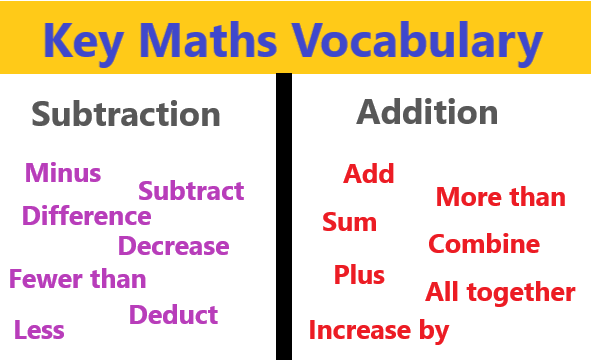
Remove, take away, take from, subtract from all explicitly indicate subtraction actions. “Remove 5 from 13,” “take away 4 from 10,” “take 6 from 15,” and “subtract 8 from 20” clearly instruct subtraction. These direct-action words help children confidently identify subtraction situations.
Decrease, reduce, and diminish suggest making quantities smaller through subtraction. “Decrease 18 by 5” means 18 − 5. These terms appear frequently in real-world contexts involving reduction or decline, helping children connect mathematics to everyday situations.
Lose, lost, gave away, spent, ate, and used describe specific contexts where quantities decrease through subtraction. “Jamie had 12 sweets and ate 4” signals subtraction through the action of eating. Recognising these contextual verbs as subtraction indicators helps children decode word problems effectively.
Fewer, less, more, left, remain, left over often signal subtraction situations, though they require careful interpretation. “How many fewer?” and “how many less?” ask for differences requiring subtraction. “How many are left?” or “how many remain?” suggest subtraction, indicating that something has been removed. However, context matters—”more” sometimes indicates addition, but “how many more?” typically signals subtraction through comparison.
The difference between, how much more ” and, how much less explicitly indicates comparison situations requiring subtraction. “What’s the difference between 15 and 9?” asks for 15 − 9. “How much more is 12 than 7?” requires calculating 12 − 7. These phrases prove particularly challenging because they don’t describe physical removal but rather comparison between quantities.
Teaching children to recognise these signal words helps them comprehend word problems. However, caution against over-reliance on keyword strategies. Context and problem structure matter more than isolated words. A problem might include “more” yet require subtraction, or include “left” yet require addition. Encourage children to visualise situations and understand relationships rather than simply responding reflexively to trigger words.
Vocabulary Related to Problem-Solving and Strategies
Certain vocabulary terms describe approaches to solving subtraction problems or represent concepts that support understanding of subtraction.
A number sentence or equation refers to mathematical statements showing relationships between numbers using operation symbols and equals signs. “9 − 4 = 5” is a number sentence or equation. Understanding this term helps children follow instructions like “write a number sentence to represent the problem” or “solve the equation.”
A number line is a visual tool that represents numbers as points along a line, useful for modelling subtraction as backwards movement. Children who understand “number line” can follow instructions like “use a number line to solve 13 − 5” and can discuss their problem-solving approaches clearly.
Strategy refers to planned approaches for solving problems. Subtraction strategies might include counting back, counting on, using number bonds, or decomposing numbers. Understanding “strategy” as a general term helps children discuss different solution methods and make strategic choices based on problem characteristics.
Mental maths or mental calculation describes performing calculations in one’s head without written work or manipulatives. As children develop subtraction fluency, they increasingly solve problems mentally. Understanding this term helps them recognise when mental calculation is appropriate and communicate about their thinking processes.
Estimating means making reasonable guesses about answers before calculating precisely. Estimating helps children predict whether answers make sense and provides benchmarks for checking calculations. Understanding “estimate” supports metacognitive thinking and error detection.
Regroup or borrow (also called “exchanging” or “renaming”) describes the process used in written subtraction when there aren’t enough ones, tens, or hundreds in a column to subtract from. When solving 42 − 17, we cannot subtract 7 ones from 2 ones, so we regroup one ten as ten ones, giving us 12 ones from which to subtract 7. Different curricula use different terminology—some prefer “regroup” whilst others use “borrow” or “exchange”—but the concept remains consistent. Children need exposure to multiple terms since they’ll encounter various texts and resources using different vocabulary.
Inverse operations or opposite operations describe operations that undo each other. Subtraction and addition are inverse operations because adding a number and then subtracting the same number returns to the starting point. Understanding this term supports checking work and solving missing number problems.
A fact family or number family refers to sets of related addition and subtraction equations using the same three numbers. The fact family for 5, 8, and 13 includes: 5 + 8 = 13, 8 + 5 = 13, 13 − 8 = 5, and 13 − 5 = 8. This term helps children discuss number relationships and inverse operations.
Vocabulary for Written Notation and Symbols
Understanding the symbols and notation used to represent subtraction proves essential for reading and writing mathematics.
The minus sign (−) is the symbol representing subtraction. Children must distinguish it from the similar hyphen used in writing or the negative sign used with negative numbers (introduced later). Recognising and correctly naming this symbol supports reading mathematical notation accurately.
The equals sign (=) indicates that quantities on both sides have the same value. Understanding equals as representing equivalence rather than simply indicating “write the answer here” supports algebraic thinking and equation comprehension.
Subtraction symbol, operation symbol are general terms for symbols representing mathematical operations. Children benefit from recognising that +, −, ×, and ÷ all belong to the category of operation symbols, helping them understand mathematical structure.
Horizontal format describes equations written across the page: 12 − 7 = 5. Vertical format or column format describes equations stacked vertically:
  12
−  7
____
   5
Children encounter both formats and must recognise them as representing the same mathematical operation. Understanding these format terms helps children follow instructions specifying which format to use for written work.
Strategies for Teaching Mathematical Vocabulary
Effective vocabulary instruction goes beyond simply providing definitions. Strategic approaches help children develop a deep, lasting understanding of mathematical language.
Introduce terms in context rather than isolation. When children encounter “difference” whilst actually solving subtraction problems, the term gains meaning through use. Contextual learning proves more effective than memorising decontextualised definitions.
Use multiple representations connecting vocabulary to visual images, concrete objects, and symbolic notation. When teaching “minuend,” show it in equations, point to it in concrete representations, and have children identify it in various contexts. Multi-modal learning strengthens retention and understanding.
Create word walls displaying mathematical vocabulary with definitions and examples. Regularly reference word walls during lessons, encouraging children to consult them when needed. Visual availability supports learning without requiring memorisation before use.
Model using vocabulary naturally in mathematical discussions. Rather than saying “that number,” specify “the minuend” or “the difference.” Hearing terms used correctly and naturally helps children internalise appropriate usage.
Encourage children to use mathematical vocabulary in their own explanations. When children describe their thinking, prompt them towards precise language: “Can you use the word ‘difference’ when you explain?” Active use strengthens vocabulary acquisition.
Connect everyday and mathematical meanings for words with dual purposes. “Difference” means “not the same” in everyday language, but “the result of subtraction” mathematically. Explicitly discussing these connections prevents confusion and deepens understanding.
Play vocabulary games, making learning engaging. Vocabulary bingo, matching games, pairing terms with definitions, or charades (acting out mathematical terms) all provide enjoyable practice that reinforces retention.
Provide visual supports, such as vocabulary cards, for children to reference during problem-solving. Knowing they can check meanings reduces anxiety and supports independent learning.
Review regularly rather than teaching terms once and moving on. Vocabulary requires repeated exposure across varied contexts for genuine mastery. Spiralling back to previously introduced terms in new contexts strengthens long-term retention.
Age-Appropriate Vocabulary Progression
Different terms suit different developmental stages. Introducing vocabulary at appropriate times prevents overwhelming children whilst ensuring they develop necessary language skills.
Early Years (Ages 5-6): Focus on accessible, intuitive terms: take away, minus, left, how many more, fewer, altogether. These concrete, action-oriented words connect easily to physical experiences and straightforward problem contexts.
Lower Primary (Ages 6-8): Introduce: subtract, difference, equals, number sentence, number line, strategy, estimate. These somewhat more formal terms support transition towards abstract thinking whilst remaining accessible.
Upper Primary (Ages 8-11): Add: minuend, subtrahend, inverse operations, fact family, regroup/borrow, equation. More technical vocabulary suits children’s increasing mathematical sophistication and prepares them for secondary mathematics.
This progression provides general guidance rather than rigid rules. Adjust vocabulary introduction based on individual children’s readiness, curriculum requirements, and the resources children encounter. Some mature younger students handle advanced vocabulary earlier, whilst others benefit from extended time with simpler terms.
Common Vocabulary Confusions and Solutions
Certain mathematical terms predictably confuse children. Recognising these challenges allows targeted support.
“Difference” meaning: Children accustomed to “different” meaning “not alike” struggle with “difference” as “the gap between numbers.” Solution: Use number lines showing difference as physical distance between numbers, making the concept spatial and visual.
“More” indicating subtraction: “How many more” suggests addition to some children. Solution: Model comparison situations concretely, showing how finding “how many more” requires matching items and counting the excess—a subtraction process.
Multiple names for concepts: Regrouping, borrowing, and exchanging describe the same process. Solution: Explicitly teach that different people and books use different words for identical concepts. Exposure to varied terminology prevents confusion when encountering unfamiliar resources.
“Equals” as instruction versus equivalence: Viewing “=” as meaning “write the answer next” rather than “has the same value as” creates problems. Solution: Present equations like 5 = 3 + 2 or 7 + 1 = 4 + 4, showing equals indicates equivalent values, not just where answers belong.
Conclusion
Mathematical vocabulary forms a crucial component of subtraction understanding. Whilst conceptual understanding remains paramount—children must know what subtraction means and how to perform it—linguistic competence supports that understanding, enabling communication, problem-solving, and access to mathematical resources.
Effective vocabulary instruction balances explicit teaching with contextual learning, formal terminology with accessible language, and passive exposure with active use. Children need opportunities to hear mathematical terms used correctly, to employ vocabulary in their own speech and writing, and to encounter terms across varied contexts until their meanings become automatic.
Remember that vocabulary development takes time. Children won’t instantly master mathematical language any more than they instantly master reading vocabulary or foreign languages. Patient, consistent instruction with regular review, varied contexts, and engaging practice gradually builds linguistic competence, supporting mathematical growth.
Parents and educators should model precise mathematical language naturally, provide visual and contextual supports, celebrate children’s vocabulary development, and maintain focus on understanding over mere memorisation. When children command mathematical vocabulary confidently, they possess powerful tools for thinking about, discussing, and solving mathematical problems throughout their education and lives.
Ultimately, mathematical vocabulary serves understanding—it’s a means to an end, not the end itself. The goal isn’t children who can define “minuend” but children who can subtract confidently, explain their thinking clearly, follow mathematical instructions accurately, and engage fully with mathematics using the rich, precise language that supports mathematical reasoning and communication.
Maths Circus, an innovative platform we've crafted, presents a captivating realm where children learn mathematics through the exciting theme of a circus. The joy of juggling numbers and solving circus...
The 9 times table multiplication has a reputation for being tricky, yet it holds more mathematical magic than any other table in the primary curriculum. Every answer follows two neat...
Article Summary What this article covers: Ten differences between river otters and sea otters, from size, fur and swimming style to diet, tool use and family life, plus which otter...
Article Summary What this article covers: The nine main types of natural disasters, how each one works and how they are measured, which hazards genuinely affect the UK, and how...










Leave a Reply