Do you know the difference between a sphere and a circle? These Spheres Facts for Kids reveal exactly why a sphere is the roundest shape there is and why it behaves so differently to a flat circle. In the world of maths, a sphere is the ultimate “no-edges” champion. While shapes like cubes have sharp corners and flat sides, a sphere is perfectly round in every direction, with every point on its surface exactly the same distance from the centre. Imagine a circle growing “puffy” like a balloon, and that is how a sphere is formed.
This matters for UK classrooms too: the National Curriculum introduces 3D shape recognition in Year 2 and expects children to describe the properties of spheres, including faces, edges and vertices, by Year 5.
This set of Spheres Facts for Kids goes further than a simple definition. It covers the properties that make a sphere unique, the everyday objects that are secretly spheres, the physics behind why planets and bubbles form spheres naturally, and the curious truth about whether the Earth is really a perfect sphere at all. Along the way, we connect each fact back to what children actually need to know for primary maths and science, so the article works as a classroom reference as well as a fun read at home.
Whether you are a teacher planning a Year 2 shape lesson, a parent helping with homework, or a curious child hunting for spheres around the house, this collection of Spheres Facts for Kids is written to be clear, accurate and genuinely useful. LearningMole, a UK educational platform founded by former primary school teacher Michelle Connolly, has built this guide around the specific misconceptions that come up again and again in primary classrooms, so teachers and parents both get something they can use straight away.
Spheres Facts for Kids: What Is a Sphere?
A sphere is a three-dimensional shape where every single point on the surface sits at exactly the same distance from the centre. That distance is called the radius, and it is the property that makes a sphere perfectly round in every direction, unlike a cube, cone or cylinder. The first and most important of our Spheres Facts for Kids is this: a sphere has no flat sides at all, which is why it rolls smoothly whichever way you push it.
For a broader introduction to how spheres relate to cubes, cones and cylinders, LearningMole’s magic of 3D shapes guide covers the full family of solid shapes side by side.
Children often confuse a sphere with a circle because both shapes look “round” at first glance. A sphere is solid and three-dimensional, taking up space in every direction, while a circle is flat and two-dimensional, existing only on a page or a screen. Once children grasp that difference, most other sphere properties fall into place quickly.
A Quick Definition for the Classroom
For Year 2 pupils, the simplest working definition is: a sphere is a solid shape that is perfectly round, like a ball, with no flat faces, no straight edges and no corners. This phrasing matches the language used in UK National Curriculum geometry teaching and gives children a definition they can repeat confidently in class. The wider 3D shapes video collection covers cubes, cylinders, pyramids and spheres for anyone wanting to explore beyond this single shape.
Spheres Facts for Kids: Properties of a Sphere
Every sphere shares the same set of properties, and these properties are exactly what UK primary assessments tend to test. Among the trickiest Spheres Facts for Kids to teach is the question of how many faces, edges and vertices a sphere actually has, because the answer catches out a lot of Year 2 and Year 5 pupils. LearningMole’s video on the surfaces of a sphere tackles this exact question for visual learners.
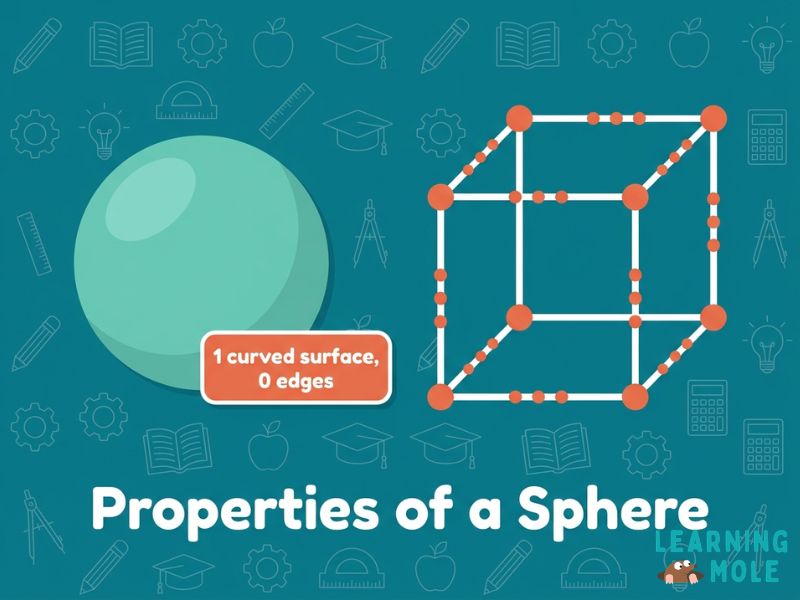
A sphere has one curved surface, no edges and no vertices (corners). Some teaching materials describe this as “0 flat faces” rather than “1 face”, because a face in geometry is traditionally understood as a flat surface, and a sphere has none. Either phrasing is acceptable in primary teaching as long as children understand why a sphere behaves the way it does: there are no flat sides to sit on, no edges where two faces meet, and no corners where edges meet.
Why “1 Curved Surface” Causes Confusion
The confusion usually comes from comparing a sphere with shapes like cubes and cylinders, which do have flat faces and straight edges. An edge only exists where two flat faces meet, so a shape with no flat faces cannot have any edges either. This is worth spelling out directly for children who are used to counting faces on cubes and cuboids. For a wider look at how faces, edges and vertices work across every 3D shape, LearningMole’s geometry and shapes guide is a useful companion resource.
Teacher’s Tip: “A common mistake in Year 2 is thinking a sphere has an edge somewhere. Remind pupils that an edge only forms where two flat faces meet, and a sphere simply doesn’t have any faces to meet in the first place,” says Michelle Connolly, Founder of LearningMole and a former primary school teacher with over 15 years of classroom experience.
You can work out the volume and surface area of any sphere using the number Pi (π), which is the same fixed value for every sphere regardless of its size. The diameter of a sphere is the maximum distance across it through the centre, and it is always exactly twice the length of the radius, since two radii placed end to end make up the full diameter.
Spheres Facts for Kids: Sphere vs Circle
One of the most useful Spheres Facts for Kids for clearing up classroom confusion is a direct comparison between a sphere and a circle, because the two shapes are related but fundamentally different. A circle is flat and two-dimensional; a sphere is solid and three-dimensional. A penny is a good example of a circle, while a marble is a good example of a sphere.
Property
Circle
Sphere
Dimensions
Two-dimensional (2D)
Three-dimensional (3D)
Surface
One flat surface
One curved surface
Edges/vertices
One edge, no vertices
No edges, no vertices
Real-life example
A penny or a clock face
A marble or a football
Measured using
Radius, diameter, circumference
Radius, diameter, surface area, volume
Children sometimes assume that because a circle “becomes” a sphere when it is rotated, the two shapes must share all the same properties. In fact, rotating a flat circle around its diameter is exactly how a sphere is generated mathematically, which is a genuinely useful way to picture the relationship between the two shapes without confusing their properties. Classroom-tested geometry classroom activities can help reinforce this distinction through hands-on tasks rather than definitions alone.
Spheres Facts for Kids: Why Are Planets and Bubbles Round?
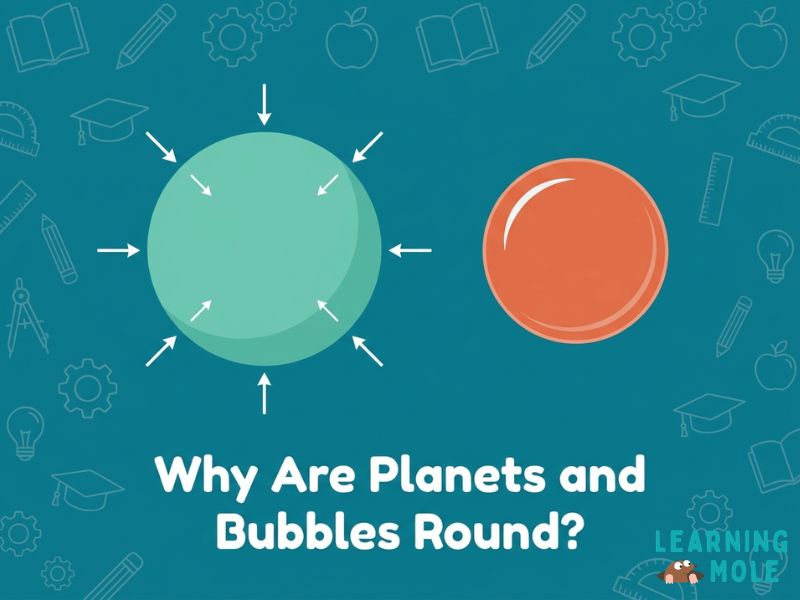
This next entry in our Spheres Facts for Kids collection moves from geometry into science, because spheres do not just appear in maths lessons; they appear throughout nature for a very specific reason. Planets, stars, water droplets and soap bubbles all tend towards a spherical shape because of physical forces that pull matter evenly towards a central point.
For planets, that force is gravity. A planet’s own gravity pulls its material equally in every direction towards its centre of mass, and a sphere is the shape that results when matter is pulled evenly from every side. Smaller objects like asteroids do not have enough mass to generate the gravitational pull needed to become spherical, which is why many asteroids look lumpy and irregular rather than round. LearningMole’s gravity facts collection explores this pulling force in more depth, including how it shapes planets, moons and orbits.
For bubbles and water droplets, the force at work is surface tension. The surface of a liquid behaves a little like a stretched skin, and that skin naturally pulls itself into the smallest possible surface area for the amount of liquid inside. A sphere is the shape that gives the smallest surface area for a given volume, so soap bubbles and raindrops settle into spheres unless something else, like air resistance or a surface they are resting on, changes their shape.
The Play-Doh Challenge
A simple home or classroom activity brings this to life. Give each child a cube of play dough and ask them to roll it into the roundest ball they can manage without adding or removing any dough. Ask them what happens to the surface area as the shape gets rounder, and why a sphere might be the “most efficient” shape for holding a fixed amount of material. This hands-on approach helps children connect the abstract idea of surface area to something they can feel and see. This kind of hands-on investigation sits well alongside LearningMole’s wider physics for primary students resources, which cover forces, gravity and motion for KS2 classrooms.
Spheres Facts for Kids: Is the Earth a Perfect Sphere?
Perhaps the most surprising of all the Spheres Facts for Kids in this guide is that the Earth is not actually a perfect sphere. The Earth spins on its axis, and that spin causes a very slight bulge around the equator while flattening the North and South poles very slightly. Shapes with this particular kind of bulge are called oblate spheroids.
The difference is tiny in everyday terms. The Earth’s diameter through the equator is only around 43 kilometres wider than its diameter through the poles, which is a difference of less than 1% of the Earth’s overall size. For primary-level teaching, it is enough for children to understand that the Earth is “almost” a perfect sphere, close enough that we call it one in everyday language, but that its very slight bulge has a proper scientific name and a proper scientific cause. LearningMole’s planets for kids guide covers similar size comparisons across the whole Solar System, which helps put Earth’s tiny bulge into perspective.
This is a genuinely useful extension for higher-ability KS2 learners who have already grasped the basic properties of a sphere and are ready for a more nuanced idea: that real objects in nature rarely match perfect mathematical shapes exactly, even when they come remarkably close. For a look at how scientists have confirmed Earth’s true shape using satellites and spacecraft photography, NASA’s history of Earth imaging traces this story from early balloon photographs to modern satellite data.
Spheres Facts for Kids: The Four Spheres of the Earth
Alongside the geometric meaning, “sphere” also appears in Earth Science, where scientists divide the planet into four interacting systems, each called a sphere. This is a common source of confusion in curriculum searches, since a search for Spheres Facts for Kids can mean either the maths shape or these Earth Science systems, so it is worth covering both clearly.
Sphere Name
What It Includes
Key Fact for Kids
Lithosphere
Rocks, soil and the solid crust of the Earth
This is the solid ground you stand on
Hydrosphere
Oceans, rivers, lakes and ice
Covers around 70% of the Earth’s surface
Biosphere
All living things, from bacteria to humans
Every living creature on Earth is part of this sphere
Atmosphere
The layers of gases surrounding the Earth
Protects the Earth and provides the air we breathe
These four spheres do not exist in isolation; they constantly interact with one another. Rain falling from the atmosphere feeds the hydrosphere, plants in the biosphere draw nutrients from the lithosphere, and living things depend on gases from the atmosphere to survive. LearningMole’s volcano facts article looks at the lithosphere in more detail, covering the Earth’s rock layers and tectonic plates.
For the water side of the system, the water cycle for kids guide explains how the hydrosphere constantly recycles water between the ground, the sea and the sky. The living side of the system is covered in LearningMole’s world biomes guide, while Earth’s atmosphere explains the gas layers that make up the fourth sphere. This overlap is a useful discussion point for KS2 geography and science lessons that go beyond simple definitions.
Spheres Facts for Kids: Real-World Examples From Sport to Space
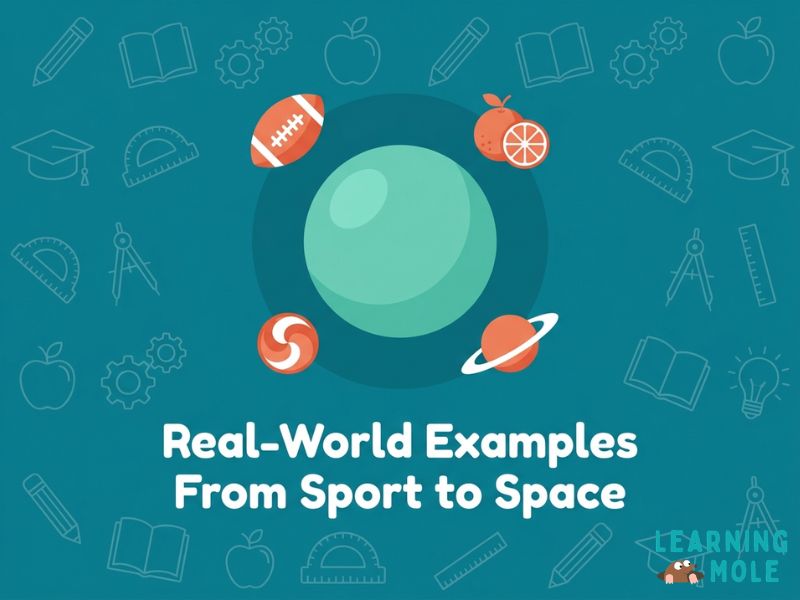
Spotting spheres in daily life is one of the quickest ways to make this topic stick, and it is a favourite among the Spheres Facts for Kids that children remember long after the lesson ends. Natural spheres include oranges, cherries, melons, planets, stars, raindrops and soap bubbles. Man-made spheres include footballs, tennis balls, marbles, light bulbs, Christmas decorations and globes. For more everyday space connections, LearningMole’s solar system facts for kids guide lists dozens of natural spheres found across the Solar System, from moons to gas giants.
A simple household challenge works well here: ask children to find five spherical objects around the house or garden and explain why each one counts as a sphere rather than another 3D shape. An orange counts because it is round in every direction; a tin of soup does not, because it is a cylinder with flat circular ends and straight sides. Younger children often enjoy turning this into a game, and LearningMole’s shape adventures activities offer more play-based ways to explore shape hunting at home or in the classroom.
Spheres Facts for Kids: What Is a Hemisphere?
A hemisphere is exactly half of a sphere, and it is a natural next step once children understand what a full sphere looks like. Any sphere can be divided into two equal hemispheres by slicing through its centre with a flat, two-dimensional surface, and the two halves that result are always identical in size and shape. LearningMole’s short video, hemisphere video guide, gives a visual introduction to how hemispheres work for both geography and geometry lessons.
Although the Earth is not a perfect sphere, it is still divided into hemispheres for geography teaching. The Equator divides the Earth into the Northern Hemisphere and the Southern Hemisphere, while the Prime Meridian divides it into the Western Hemisphere and the Eastern Hemisphere. The Equator works in a similar way to a sphere’s diameter, cutting straight through the centre of the Earth and separating it into two equal halves.
Spheres Facts for Kids: Teaching Resources and Support
Ready-made resources save planning time when a topic like this touches on both maths and science curriculum objectives at once. LearningMole’s curriculum-aligned video resources cover 3D shape properties, curved and flat surfaces, and the physics behind natural spheres, giving teachers classroom-ready material without having to build every explanation from scratch.
For parents supporting learning at home, the same sphere hunt and Play-Doh activities described above work well alongside LearningMole’s video resources, which reinforce the vocabulary and properties children need for KS1 and KS2 geometry. Home learning works best when it echoes the language used in the classroom, so matching activity types and terminology to what LearningMole covers on-site helps children transfer their understanding between school and home.
These Spheres Facts for Kids show that a shape most children think they already understand actually holds a surprising amount of curriculum-relevant detail, from the geometry of faces and edges through to the physics of gravity and surface tension. A sphere is not just “a round ball”; it is a precisely defined three-dimensional shape with properties that explain everything from why planets form to why a football rolls the way it does.
For UK primary teachers, the properties of a sphere connect directly to Year 2 shape recognition and Year 5 geometry objectives, while the Earth Science angle links neatly to KS2 topics on the Earth and space. Michelle Connolly’s classroom experience shows that the “1 face or 0 faces” debate and the true shape of the Earth are two of the most reliable ways to deepen a lesson that might otherwise stay at surface level.
Whichever angle brings a family or a classroom to this page, the aim is the same: a clear, accurate explanation of spheres that works equally well as a quick homework check or a full lesson resource, backed by curriculum-aligned teaching materials for anyone who wants to take the topic further.
FAQs
How many faces does a sphere have?
A sphere has one curved surface and no flat faces. Some teaching materials describe this as “0 faces” because a face is traditionally a flat surface, and a sphere has none.
Is a circle the same as a sphere?
No. A circle is flat and two-dimensional, while a sphere is solid and three-dimensional.
What is the most famous sphere in the world?
The Earth is often called a sphere, though it is technically an oblate spheroid because of a very slight bulge at the equator.
What are five real-life examples of spheres?
A marble, an orange, a basketball, a bubble and a planet are all everyday examples of spheres.
At what age do children learn about spheres?
In the UK, KS1 (ages 5 to 7) focuses on naming spheres and other 3D shapes, while KS2 (ages 7 to 11) covers their properties, faces, edges and vertices in more depth.
Where can I find sphere worksheets for my class?
LearningMole’s resource library includes curriculum-aligned 3D shape materials suitable for KS1 and KS2 geometry lessons.
Maths Circus, an innovative platform we've crafted, presents a captivating realm where children learn mathematics through the exciting theme of a circus. The joy of juggling numbers and solving circus...
Mexican traditions blend the customs of ancient Mesoamerican peoples, such as the Aztecs and the Maya, with Catholic festivals brought by Spanish settlers in the sixteenth century. The result is...
The moose (Alces alces) is the largest member of the deer family alive today, and a fully grown bull can stand about 2 metres tall at the shoulder, which makes...




Leave a Reply