Learn Shapes: Interesting 2D and 3D Shapes for Kids
Table of Contents
Learn Shapes for Kids: Shapes are one of the very first things children learn to name — long before they can read a word or add two numbers together. A ball is round, a window is square, a pizza slice is a triangle. That early recognition is not just play. It is the start of geometry, and the UK National Curriculum builds on it from EYFS all the way through to KS3. Getting children genuinely curious about shapes at the start makes everything that follows easier.
At LearningMole, a UK educational platform founded by former primary teacher Michelle Connolly, we know that children learn shapes best when lessons feel like discovery rather than drill. The difference between a circle and a sphere, or a square and a cube, only really clicks when children can handle objects, look at pictures, and spot those shapes everywhere around them. This guide covers 2D and 3D shapes for kids in a way that works for both classroom teaching and home learning.
Whether you are a teacher looking for a curriculum-aligned overview from EYFS to KS2, or a parent helping your child with homework, this article gives you clear definitions, real-world examples, teaching strategies, and activities that make shapes genuinely interesting rather than just something to memorise.
What is the Difference Between 2D and 3D Shapes?
A 2D shape is flat. A 3D shape is solid. That is the core distinction, and it is worth making it concrete for children before moving on to names and properties.
Think of it this way: a 2D shape is like a drawing on paper. You can see it and trace around it, but you cannot pick it up or hold it. A circle, square, triangle, rectangle and hexagon are all 2D shapes. They have length and width, but no depth. A 3D shape, by contrast, is like an object you can hold in your hand. A cube, sphere, cylinder and cone are all 3D shapes. They have length, width and depth, which means they take up space.
A simple classroom analogy that works well: hold up a flat piece of paper (2D) and then a ball (3D). Ask children which one they can hold. That physical comparison tends to make the difference stick far better than a written definition. The UK National Curriculum introduces this distinction in EYFS and Reception, when children begin identifying and naming basic shapes in their environment.
“Children confuse a square and a cube so often because they look similar in pictures. The fix is always tactile — once they have held a cube and run their fingers along its edges, they never mix them up again.” — Michelle Connolly, Founder of LearningMole and former teacher with over 15 years of classroom experience
The table below gives a quick reference for the main 2D shapes children encounter in the UK curriculum, along with their key properties and a real-world example.
| Shape | Sides | Vertices (Corners) | Real-World Example |
|---|---|---|---|
| Circle | 0 (one curved edge) | 0 | Wheel, coin, clock face |
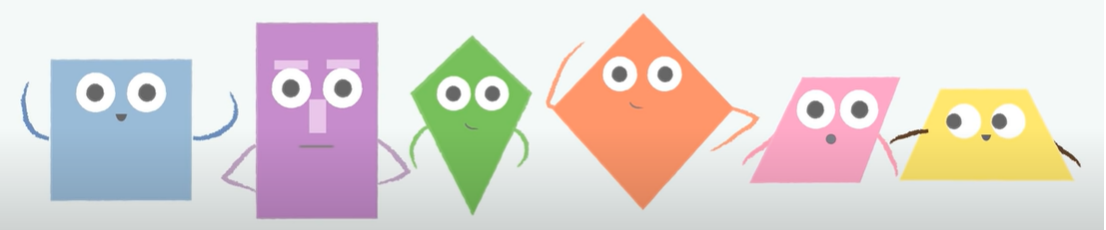
| Square | 4 (all equal) | 4 | Window pane, sticky note |
| Rectangle (Oblong) | 4 (opposite sides equal) | 4 | Door, book, cereal box face |
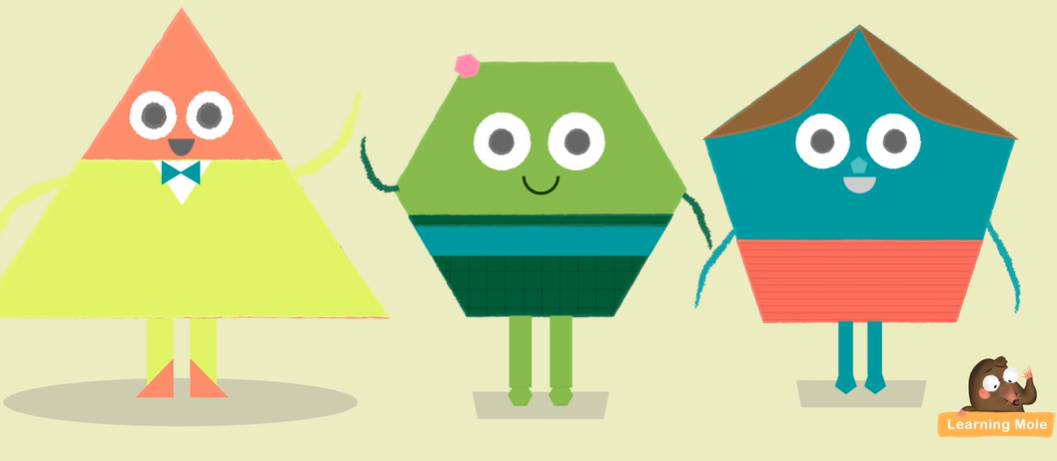
| Triangle | 3 | 3 | Sandwich cut diagonally, road sign |
| Pentagon | 5 | 5 | Home plate in rounders, some road signs |
| Hexagon | 6 | 6 | Honeycomb cell, some nuts and bolts |
| Heptagon | 7 | 7 | Some UK coins (old 50p shape) |
| Octagon | 8 | 8 | Stop sign |
| Rhombus | 4 (all equal, no right angles) | 4 | Diamond on playing cards |
| Trapezium | 4 (one pair of parallel sides) | 4 | Some handbag shapes, bridge cross-sections |
Exploring 2D Shapes: From Circles to Heptagons

Children in EYFS and KS1 start with the four core 2D shapes — circle, square, triangle, and rectangle — and gradually add more as they move through KS2. Each shape has specific properties that set it apart, and understanding those properties is what the National Curriculum geometry strand is really building towards.
Standard Polygons: Squares, Triangles, Rectangles, and Oblongs
A polygon is any closed 2D shape with straight sides. The most common ones children meet first are squares, triangles, and rectangles. One important UK teaching point: a square is a special type of rectangle where all four sides are equal. This means all squares are rectangles, but not all rectangles are squares. Children frequently get this backwards. The word “oblong” is used in some UK primary classrooms to describe a rectangle that is not a square — a useful distinction that prevents confusion.
Triangles deserve particular attention because they come in several forms. An equilateral triangle has three equal sides and three equal angles. An isosceles triangle has two equal sides. A scalene triangle has no equal sides. By Year 4 in the UK curriculum, children are expected to classify triangles based on their properties, so introducing these terms early pays off.
Why the Circle is One of the Most Interesting 2D Shapes
A circle has no sides and no vertices. That makes it different from every other 2D shape children learn. It also has infinite lines of symmetry, which is a concept that genuinely surprises children when they first encounter it. Unlike a square (4 lines of symmetry) or a rectangle (2 lines), you can fold a circle in half in any direction, and the two halves will always match perfectly.
Circles also appear more often in everyday life than any other shape — wheels, plates, coins, clock faces, the cross-section of a tree trunk. Asking children to count circles around the classroom usually produces a longer list than any other shape.
Unusual Polygons: Pentagons, Hexagons, Heptagons, and Octagons
Once children are confident with the four basic shapes, introducing polygons with more sides opens up interesting discussions. A pentagon has 5 sides. A hexagon has 6. A heptagon has 7. An octagon has 8. These names follow a pattern from Greek and Latin numbers — penta (5), hexa (6), hepta (7), octo (8) — and pointing that out helps children remember them and predict new shape names they have not met yet.
The hexagon is worth dwelling on because it appears so frequently in nature and engineering. Honeycombs are the most famous example, but hexagonal shapes also appear in basalt rock formations, pencil cross-sections, and some nuts and bolts. The reason hexagons appear in so many structures is that they tile perfectly, covering a flat surface with no gaps and using less material than circles or triangles for the same enclosed area. That is a genuinely interesting fact that connects geometry to science.
A note on UK versus US terminology: the shape with four sides and one pair of parallel sides is called a trapezium in the UK. In the US, it is called a trapezoid. This distinction matters because children may encounter both terms in different resources. LearningMole’s curriculum-aligned materials consistently use the UK term trapezium, in line with the National Curriculum.
3D Shapes: Solids That Build Our World

3D shapes have three dimensions: length, width, and depth. They are solid objects you can hold. Understanding their properties — specifically faces, edges, and vertices — is a key requirement of the UK National Curriculum geometry strand from KS1 upwards.
The Properties of 3D Shapes: Faces, Edges, and Vertices
A face is a flat or curved surface on a 3D shape. An edge is the line where two faces meet. A vertex is the point where three or more edges meet. The plural of vertex is vertices. These three terms are the vocabulary children need to describe any 3D shape, and using them precisely from the start builds much stronger mathematical literacy.
One common classroom error worth addressing: children sometimes use the word “corners” for 3D shapes, which works for cubes and cuboids but breaks down for cones (which have a single apex, not a corner). Using “vertices” throughout avoids that confusion.
| 3D Shape | Faces | Edges | Vertices | Real-World Example |
|---|---|---|---|---|
| Cube | 6 (all squares) | 12 | 8 | Dice, Rubik’s cube, building block |
| Cuboid | 6 (rectangles/squares) | 12 | 8 | Brick, cereal box, book |
| Sphere | 1 curved (no flat faces) | 0 | 0 | Ball, orange, globe |
| Cylinder | 3 (2 circles, 1 curved) | 2 | 0 | Tin can, toilet roll, rolling pin |
| Cone | 2 (1 circle, 1 curved) | 1 | 1 (apex) | Ice cream cone, traffic cone, party hat |
| Square-based Pyramid | 5 (1 square, 4 triangles) | 8 | 5 | Egyptian pyramid, roof of a tower |
| Triangular Prism | 5 (2 triangles, 3 rectangles) | 9 | 6 | Toblerone box, tent, roof section |
| Triangular Pyramid (Tetrahedron) | 4 (all triangles) | 6 | 4 | Some crystal formations |
The Interesting Ones: Torus, Hemisphere, and Triangular Prism
Beyond the standard curriculum shapes, a few 3D forms are worth introducing because they genuinely capture children’s curiosity. The torus is the mathematical name for a doughnut shape — a ring with a hole through the middle. It is unusual because it is a single continuous surface that curves back on itself. Children who have never heard of a torus invariably find it interesting once they spot it in a ring doughnut or a rubber ring.
The hemisphere is half a sphere. It appears in bowls, domes (such as the Millennium Dome), and igloo structures. A triangular prism is one that children meet in KS2. Its two triangular ends and three rectangular faces make it a useful bridge between 2D and 3D understanding — the triangles at each end are the same shape as the 2D triangles children already know.
Nets: How 2D Shapes Fold Into 3D Ones
A net is a flat 2D pattern that can be folded to create a 3D shape. Understanding nets is an explicit KS2 requirement and one of the more conceptually demanding aspects of geometry for primary children. The most common net children work with is the cube net: a cross-shaped arrangement of six squares that, when folded correctly, creates a cube with no gaps or overlaps.
Practical net-folding activities work well as home learning, too. Print a cube net on a card, cut it out, and fold it. Then try a cuboid net or a pyramid net. Each time, ask the child to predict how many faces the finished shape will have before they fold it. That prediction step builds spatial reasoning and connects the 2D net back to the 3D properties table above.
Geometry in the Wild: Why Nature Loves Shapes

One of the most effective ways to make shapes interesting for children is to show them that geometry is not a classroom invention. Nature uses specific shapes for very practical reasons, and exploring those reasons connects maths to science in a way that genuinely engages curious learners.
Hexagons in Honeycombs
Honeybees build their honeycombs in hexagons. This is not a coincidence. A hexagon tiles a flat surface perfectly — no gaps, no overlaps — and uses less wax per unit of storage space than any other regular polygon. This means bees use less energy to build their hive. Mathematicians proved this in 1999 (the Honeycomb Conjecture), but bees have been doing it for millions of years. This story lands well with primary children because it connects a curriculum shape to an animal they already know.
Spheres in Bubbles and Droplets
A soap bubble is always a sphere, and so is a raindrop in free fall. The reason is surface tension: a sphere encloses the greatest volume for the least surface area. Nature moves towards efficiency, and the sphere is the most efficient way to contain a volume of air or liquid. Children can test this with a washing-up liquid and water mix — blow a bubble, then watch it round itself into a sphere almost immediately.
Spirals in Shells and Sunflowers
The spiral shape in a snail’s shell or the seed arrangement in a sunflower follows the Fibonacci sequence, a mathematical pattern found throughout nature. Whilst the spiral itself is not a 2D polygon, understanding it connects shapes to number patterns — a natural curriculum link for KS2 children who are ready for something beyond the standard shape vocabulary.
The Shape Scavenger Hunt
One of the simplest and most effective shape activities for both the classroom and home is a shape scavenger hunt. Give children a list of shapes — including at least one unusual one like a hexagon or trapezium — and ask them to find a real object that matches each one. For younger children, focus on 2D shapes in the environment (a circular clock, a rectangular door). For KS2 children, extend to 3D shapes (a cylindrical tin, a spherical ball, a cuboid book). The activity works in any room and requires no materials beyond a pencil and paper.
Teaching Resources and Support

LearningMole provides curriculum-aligned video resources and teaching materials for primary schools, covering shapes from EYFS through KS2. Our educational videos explain 2D and 3D shapes with visual demonstrations that make abstract properties concrete and memorable — exactly what the National Curriculum’s geometry strand requires.
For teachers, LearningMole’s geometry and shapes video collection covers the properties of 2D and 3D shapes, net construction, symmetry, and real-world shape recognition across Key Stages 1 and 2. Videos are designed for whole-class teaching and can also be used by children independently for revision or home learning.
For parents supporting learning at home, LearningMole’s resources work well alongside the activities described in this article. Watching a clear visual explanation of cube nets or sphere properties before attempting a practical activity helps children build the conceptual understanding that makes the hands-on activity much more productive.
Frequently Asked Questions About Shapes for Kids

What are the most important 2D and 3D shapes for children to learn?
For 2D shapes, the core ones covered in the UK National Curriculum are circle, square, rectangle (including oblong), triangle, pentagon, hexagon, octagon, rhombus, and trapezium. For 3D shapes, the key ones are cube, cuboid, sphere, cylinder, cone, and pyramid. Children meet 2D shapes in EYFS and Reception, with 3D shapes introduced formally in KS1. By KS2, children are expected to know the properties of all these shapes — faces, edges, vertices for 3D shapes, and sides, angles, and lines of symmetry for 2D ones.
How do you explain the difference between 2D and 3D to a child?
The clearest explanation for young children is drawing versus building. A 2D shape is like something you draw on paper — flat, no depth, you cannot pick it up. A 3D shape is like something you build — it has depth, takes up space, and you can hold it. Hold up a piece of paper and a block side by side and ask which one they can hold. That physical comparison does the work that a written definition often cannot. For slightly older children, add the language: 2D means two-dimensional (length and width only), 3D means three-dimensional (length, width, and depth).
What is a vertex, and why does it matter?
A vertex is the point where two or more sides (in 2D shapes) or edges (in 3D shapes) meet. The plural is vertices. Using the correct term from early on matters because “corner” does not work for all shapes — a cone, for instance, has a single point at the top called an apex rather than a true vertex — and “corner” can imply a right angle, which is incorrect for shapes like triangles and rhombuses. The UK National Curriculum uses “vertices” as standard mathematical vocabulary from KS1 upwards.
Is a circle a polygon?
No. A polygon is a closed 2D shape made up entirely of straight sides. A circle has no straight sides — it has a single continuous curved edge — so it is not a polygon. This is a common misconception, partly because circles are taught alongside polygons and partly because children sometimes confuse the curved edge with a side. Other non-polygons include ovals and any shape with curved boundaries.
What is a net in maths?
A net is a 2D flat pattern that can be folded up to make a 3D shape. Imagine cutting open a cardboard box and laying it flat — the result is a net of a cuboid. Understanding nets is part of the KS2 geometry curriculum and helps children connect 2D and 3D shape knowledge. A cube net is typically a cross shape made of six squares. Multiple valid nets exist for most 3D shapes (there are 11 different valid nets for a cube), and exploring which arrangements fold into a closed shape and which do not is a productive investigative activity.
At what age do children learn 2D and 3D shapes in the UK?
In the UK, children begin identifying and naming basic 2D shapes (circle, square, triangle, rectangle) in EYFS and Reception, typically aged 4 to 5. 3D shapes (cube, sphere, cylinder, cone) are introduced in KS1 (Years 1 and 2). By KS2 (Years 3 to 6), children are expected to know the properties of a wide range of 2D and 3D shapes, understand symmetry, work with nets, and classify shapes by their properties. The progression is gradual — each year group builds on the vocabulary and concepts introduced in the one before.
What is the most interesting shape in nature?
The hexagon is a strong candidate. Honeybees build their combs in hexagonal cells because hexagons tile a flat surface with no gaps and maximise storage space relative to the amount of material used. The same efficiency principle appears in basalt rock formations (the Giant’s Causeway in Northern Ireland is a well-known example) and in some molecular structures. The circle comes a close second — bubbles and raindrops form spheres and circular cross-sections because a circle encloses the greatest area for a given perimeter, minimising the energy required. Both examples show geometry as something nature has solved rather than something invented for classrooms.
How can parents help children learn shapes at home?
The most effective home approach starts with objects rather than worksheets. Point out shapes in everyday life: the circular clock, the rectangular door, the cylindrical tin. Play simple guessing games — describe a shape without naming it and ask the child to identify it. Once children are confident with basic shapes, introduce a shape scavenger hunt where they photograph or sketch a real object for each shape on a list. For KS2 children, building nets from card and folding them into 3D shapes combines fine motor skills with geometry in a way that makes properties memorable. LearningMole’s video resources support all these activities with clear visual explanations that children can watch independently or alongside an adult.
Shapes Are Everywhere

The circle, square, triangle, and cube are just the beginning. The further children explore geometry, the more they find shapes behind everything — in architecture, in nature, in engineering, and in the patterns of the world they live in. That curiosity, once sparked, tends to stay with them.
For teachers, the key is vocabulary precision and physical exploration. Children who know the difference between a vertex and a side, who have held a triangular prism and counted its faces, and who have folded a net into a cube are building genuine mathematical literacy rather than just memorising names. LearningMole’s curriculum-aligned geometry resources are designed to support exactly that kind of learning, with visual explanations that work across EYFS, KS1, and KS2.
For parents, the message is simpler: shapes are already around you. Classroom learning sticks fastest when children can connect it to objects in their homes, gardens, or streets. A walk with a shape in mind — looking for hexagons, or counting cylinders — turns an ordinary afternoon into a geometry lesson that no worksheet can match.
Shapes and Geometry Resources from LearningMole
LearningMole provides free and subscription-based educational videos and teaching materials aligned with the UK National Curriculum. Our geometry and shapes resources cover 2D shapes, 3D shapes, nets, and symmetry for EYFS through KS2.
Browse 2D shapes videos: learningmole.com/topic-category/2d-shapes/ Browse 3D shapes videos: learningmole.com/topic-category/3d-shapes/ Full geometry resources: learningmole.com/category/maths/shape-and-space/


Leave a Reply