Amazing Math Games for Kids: Bigger, Smaller, Equal – KS1 & KS2

Avatar of Michelle Connolly
Updated on: Educator Review By: Michelle Connolly

Amazing Math Games: Children across UK primary schools often find maths challenging when it’s presented only through textbooks and worksheets. Games transform this experience by turning mathematical concepts into enjoyable challenges that children want to repeat. When you compare a traditional worksheet on number comparison with a fast-paced game involving bigger, smaller, and equal concepts, the difference in engagement and retention is remarkable.

Research consistently shows that children learn mathematical vocabulary and concepts more securely when they can physically demonstrate understanding through movement and play. Games that combine maths with physical activity create stronger neural connections because children are using multiple senses simultaneously. This multi-sensory approach particularly benefits children in Years 1-3 who are building foundational number sense and comparison skills that will support all future maths learning.

LearningMole provides curriculum-aligned educational videos and resources that make maths accessible through visual demonstrations and interactive approaches. Our video resources help teachers and parents introduce mathematical concepts in ways that stick, using engaging demonstrations that children can replay as many times as needed. With over 3,300 free resources covering the UK National Curriculum, LearningMole supports both classroom teaching and home learning.

Games focused on bigger, smaller, and equal teach essential comparison skills that appear throughout Key Stages 1 and 2. These concepts form the foundation for understanding place value, ordering numbers, fractions, and eventually algebra. When children can confidently identify and articulate which numbers are bigger or smaller, they’re developing the number sense that makes all subsequent maths learning more accessible.

Why Use Games to Teach Maths?

Games reduce maths anxiety by removing the fear of getting answers wrong. When children play maths games, mistakes become part of the learning process rather than something to avoid. This shift in mindset is particularly important for children who have developed negative feelings about maths through repeated struggles with written work.

The National Curriculum emphasises the need for children to develop fluency with numbers before moving to abstract calculations. Games provide the repetition needed for fluency whilst keeping children engaged. A child might refuse to complete twenty written sums but will happily play a game involving the same twenty calculations without realising they’re practising the same skills.

Physical maths games that involve movement help kinaesthetic learners who struggle to sit still for traditional maths lessons. When children can jump, stretch, or run whilst doing maths, they’re more likely to stay focused and retain what they learn. “Movement games work brilliantly for children who find it hard to concentrate during seated work. The physical element helps them process mathematical concepts in a way that sitting at a desk never could,” explains Michelle Connolly, Founder of LearningMole and former teacher with over 15 years of classroom experience.

Games also reveal how children think about numbers. Teachers can observe which children count from one every time, which children use known facts, and which children employ efficient strategies. This observational assessment is often more informative than a written test because you can see the thinking process, not just the final answer.

Building Mathematical Confidence Through Play

Children who experience success in maths games develop confidence that transfers to other mathematical activities. When a child wins a game by correctly identifying bigger numbers, they internalise the understanding that they can do maths successfully. This confidence-building is particularly important for children who have previously struggled.

Collaborative games teach children to explain their mathematical thinking to others. When children need to justify why their number is bigger or prove their answer is correct, they’re developing reasoning skills alongside calculation skills. These communication skills are explicitly required by the National Curriculum but are difficult to develop through worksheet-based learning.

Top Online Math Games by Key Stage (National Curriculum Aligned)

Anazing math games

EYFS & KS1 (Ages 3-7): Focus on Comparing Numbers and Quantities

Children in Reception and Year 1 need concrete experiences with comparing quantities before they can work with abstract number comparisons. Games at this level should involve visual representations that they can count and compare directly.

Comparing Object Sets

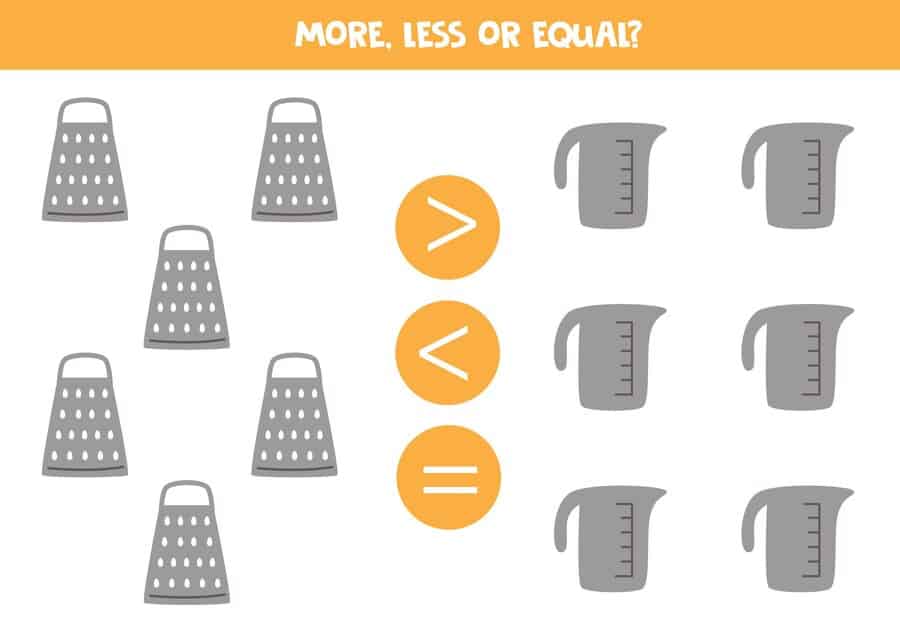
Simple games where children compare groups of objects help develop the language of comparison. Show two groups of counters, toys, or pictures and ask, “Which group has more?” or “Which group has fewer?” This direct comparison with manipulatives builds the understanding needed for later number comparison work.

Physical resources work particularly well at this age. Use two plates with different numbers of raisins and ask children to identify which has more. The immediate visual comparison, combined with the potential reward of eating the raisins afterwards, makes the learning memorable and enjoyable.

Number Track Racing

Create a number track from 0-10 using chalk or tape. Children roll a dice, identify the number, and move to that position on the track. The physical movement to bigger or smaller numbers helps them internalise that numbers further along the track are bigger.

You can extend this game by having two children race. When both have rolled, ask “Who rolled the bigger number?” This adds comparison to the physical movement and number recognition, building multiple skills simultaneously.

More or Less Card Games

Use a simple pack of number cards 1-10. Deal two cards face up and ask children to identify which number is bigger or smaller. Children at this age often need to count the dots or objects on the cards rather than recognising the numerals instantly, which is perfectly appropriate for early learning.

Make the game self-checking by having children place the cards in order from smallest to biggest after each round. This gives immediate feedback and helps children develop their understanding of number order alongside comparison skills.

Lower KS2 (Ages 7-9): Focus on Place Value and Mental Calculation

Children in Years 3 and 4 need to work with bigger numbers and develop an understanding of place value. Games at this level should include two-digit and three-digit numbers, focusing on understanding that position determines value.

Place Value Battle

Create digit cards 0-9. Each player draws two cards to make a two-digit number. The player with the bigger number wins both sets of cards. This simple game requires children to compare two-digit numbers and understand that the tens digit is more important than the units digit when comparing.

Extend the game by using three cards to create three-digit numbers. Children quickly realise they need to check the hundreds first, then the tens, then the units. This systematic comparison skill is exactly what the National Curriculum requires for Year 3.

Target Number Comparison

Choose a target number (for example, 50). Give children digit cards and ask them to create a number as close to 50 as possible. Children then compare their numbers, discussing whether they’re bigger or smaller than 50 and whose number is closest.

This game develops estimation and comparison skills simultaneously. Children need to think about which combination of digits will get them nearest to the target, requiring much more sophisticated mathematical thinking than simple comparison.

Times Tables Top Trumps

Create cards with multiplication facts (3×4, 7×2, 5×6, etc.). Players take turns turning over a card. The player with the bigger product wins both cards. This combines times tables practice with number comparison in a way that children find more engaging than traditional times tables drilling.

Year 4 children preparing for the Multiplication Tables Check particularly benefit from games that make times tables practice feel like play rather than test preparation. The comparison element adds an extra layer of mathematical thinking beyond mere recall.

Upper KS2 (Ages 9-11): Focus on Fractions, Decimals, and Percentages

Children in Years 5 and 6 need to compare more complex numbers, including fractions, decimals, and negative numbers. Games at this level should challenge children’s understanding of number value in different forms.

Fraction Wars

Use fraction cards showing different fractions. Players turn over one card each and identify which fraction is bigger. This requires understanding of equivalent fractions and common denominators – skills that many upper KS2 children find challenging in written work but can grasp through games.

Make fraction cards self-checking by including visual representations (bar models or circle sections) on the reverse. Children can check their answers by comparing the visual models, which reinforces the understanding that fractions represent actual quantities, not just abstract symbols.

Decimal Place Value Game

Create number cards with decimal numbers (3.7, 4.2, 3.85, 4.18, etc.). Players collect cards, aiming to arrange them in order from smallest to biggest. The player who creates the longest correct sequence wins.

This game addresses the common misconception that longer decimals are bigger (thinking 3.85 is bigger than 4.2 because 85 is bigger than 2). Through repeated play, children develop the understanding that each place-value column must be compared systematically.

Negative Number Races

Create a number line from -10 to +10. Players roll two dice – one for the number, one to determine if it’s positive (even roll) or negative (odd roll). Move your counter to that position. First player to reach +10 wins.

This game helps children understand that negative numbers are smaller than positive numbers and that -9 is smaller than -2, both concepts that require specific teaching in Years 5 and 6.

Amazing “Screen-Free” Math Games for the Classroom

Amazing math games

Classroom games that require no technology offer flexibility and accessibility that digital games cannot match. These games work well for whole-class participation, small-group work, or wet-playtime activities.

Movement-Based Number Comparison

Create three zones in your classroom or hall: “Bigger Than 10,” “Smaller Than 10,” and “Equal to 10.” Call out calculations or show number cards. Children must move to the correct zone based on the answer.

This game combines physical movement with mathematical thinking, making it particularly effective for kinaesthetic learners who struggle with seated work. You can adapt it for any age group by changing the target number and the complexity of the calculations.

Extend this game by having children form groups in each zone and total their answers. The zone with the biggest total wins that round adds an element of strategy as children try to remember which calculations give bigger or smaller answers.

Human Number Lines

Give children a large number of cards and ask them to arrange themselves in order from smallest to biggest without talking. This requires them to compare all the numbers and communicate non-verbally about positioning.

Make it more challenging by using fractions, decimals, negative numbers, or a mixture of all types. Children must work together to create the correct sequence, which develops both mathematical understanding and collaborative skills.

For younger children, use number cards 1-20 and include some purposeful gaps (missing 7, 13, 16). Children standing without number cards must identify which numbers are missing by looking at the sequence, developing their understanding of number order.

The Bigger Number Challenge

Divide the class into two teams. Draw two boxes on the board. Teams take turns choosing a digit (0-9), which you write in one of their boxes. After three rounds, each team has a three-digit number. The team with the bigger number wins.

This game requires strategic thinking as children must decide whether to place a high digit in the hundreds, tens, or units position. Teams quickly learn that the hundreds digit matters most, building place value understanding through strategic play rather than direct teaching.

Low-Threshold, High-Ceiling Card Games

Use a standard pack of playing cards (remove picture cards and use Ace as 1). Two players each turn over two cards and make a two-digit number. The player with the bigger number keeps all four cards. Most cards at the end win.

This simple game can be differentiated easily. Younger children make two-digit numbers, middle primary children make three-digit numbers using three cards, and older children can be challenged to make decimal numbers (using one card as the decimal point).

The game is “low-threshold” because every child can play regardless of maths ability, but “high-ceiling” because you can add complexity through strategic elements: “Choose which of your two cards to use for the tens digit and which for the units” develops place value understanding and strategic thinking simultaneously.

Device-Friendly Math Games: iPads and Tablets

Amazing math games

Many schools now use tablets for maths learning, making it important to know which games work well on these devices.

Apps for Comparing Numbers

Educational apps specifically designed for comparing numbers often include visual representations, immediate feedback, and progressive difficulty levels. Look for apps that show concrete representations (counters, blocks, or number lines) rather than just symbols, particularly for younger children.

Quality apps allow children to work independently whilst teachers support other learners or observe particular children. The best apps include reporting features that show teachers which children are struggling with specific concepts, informing future planning.

Interactive Number Lines

Tablet-based number lines offer advantages over physical versions. Children can drag numbers into position, zoom in to see more detail, or reset instantly if they make mistakes. This reduced fear of errors encourages children to attempt more challenging work.

LearningMole’s video resources work particularly well on tablets, allowing children to watch demonstrations of mathematical concepts at their own pace. Children can pause, rewind, and rewatch sections they find challenging without needing adult support for every step.

Considerations for Screen-Based Games

Whilst tablets offer benefits, balance screen time with physical games and concrete resources. Children develop mathematical understanding most securely when they experience concepts through multiple modalities – physical manipulation, visual representation, and abstract symbols.

Some children become distracted by the game elements of apps (sounds, graphics, characters) and focus less on the mathematical content. Choose apps where the mathematics is central, and game elements serve the learning rather than distracting from it.

How Teachers Can Use Maths Games as Assessment

Amazing math games

Games reveal children’s mathematical thinking in ways that written tests cannot. When you observe children playing maths games, you can see their strategies, misconceptions, and understanding development.

Observational Assessment During Games

Watch how children approach comparison tasks. Do they count from one every time, or do they use known facts as starting points? Children who count everything are at an earlier stage of development than children who can subitise (instantly recognise) small quantities.

Listen to the language children use during games. Children who can explain why 47 is bigger than 39 using place value language (“because forty is bigger than thirty”) demonstrate a more secure understanding than children who can identify the correct answer but cannot articulate the reasoning.

Identifying Common Misconceptions

Games quickly reveal misconceptions that might not be obvious in written work. For example, some children think that bigger numbers have more digits, leading them to incorrectly think 999 is bigger than 1000. This misconception becomes obvious in comparative games and can be addressed immediately.

Another common misconception is that longer decimals are bigger, so children think 0.75 is bigger than 0.8. Games where children must order decimals and then check using visual representations help address this misunderstanding through concrete experience rather than teacher explanation alone.

Tracking Progress Over Time

Keep simple records of which games children win, which they find challenging, and which strategies they employ. This informal tracking often provides richer information about mathematical development than formal test scores.

Children who consistently lose games involving larger numbers might need more place value support. Children who win games but cannot explain their thinking might have good number sense but need language development. This observational information informs teaching decisions more effectively than test scores alone.

Teaching Resources and Support

Amazing math games

LearningMole provides curriculum-aligned video resources that bring mathematical concepts to life through engaging, memorable visual demonstrations. Our educational videos work well as lesson introductions, teaching demonstrations for small groups, or resources for children who need concepts explained again.

Classroom Resources

Teachers seeking quality maths games and activities can access LearningMole’s extensive resource library covering all areas of the National Curriculum. Our resources are designed by experienced educators who understand the specific requirements of UK primary classrooms.

Video demonstrations show children playing maths games correctly, modelling the mathematical language and thinking processes that children should use. This visual modelling is particularly helpful for children who struggle to follow verbal instructions alone.

Supporting Amazing Math Games Learning at Home

Parents can use LearningMole’s resources to extend classroom learning without needing specialist mathematical knowledge. Our videos explain concepts in child-friendly language, making it possible for parents to support homework and reinforce school learning effectively.

Many parents feel anxious about supporting maths learning because they remember struggling themselves or because methods have changed since they were at school. LearningMole’s resources address this by clearly showing current teaching methods, helping parents understand how to support their children in ways that align with school approaches.

Why Video Resources Work

“Children learn mathematical concepts more securely when they can see demonstrations rather than just hearing explanations. Video allows us to show number comparisons visually, manipulate concrete resources on screen, and demonstrate thinking processes that would be difficult to convey through text alone,” explains Michelle Connolly, Founder of LearningMole.

Video resources also allow children to learn at their own pace. A child who grasps a concept quickly can move on, whilst a child who needs more time can rewatch the same demonstration without feeling they’re holding up the class. This differentiation happens naturally without requiring constant teacher intervention.

Frequently Asked Questions

Amazing math games

What are the best free math games for kids?

The best free maths games combine clear mathematical objectives with engaging gameplay. Simple card games using playing cards work brilliantly – try “Bigger Number Wins”, where two players each turn over a card, and the bigger number takes both. Physical movement games like “Jump to the Bigger Number”, where children physically move between number cards, also work well across primary years. LearningMole offers free educational videos demonstrating various maths games suitable for different ages and abilities.

Is there a difference between “math” and “maths” games?

The only difference between “math” and “maths” games is spelling – “math” is used in American English, whilst “maths” is correct in UK English. The mathematical principles, gameplay, and learning objectives remain identical regardless of which spelling you use. This article uses “maths” because LearningMole follows UK educational terminology and National Curriculum requirements, but any games described will work exactly the same way whether you call them math or maths games.

Which games help with the Year 4 Multiplication Tables Check?

Games that build speed and accuracy with times tables facts help children prepare for the Multiplication Tables Check. Try “Times Tables Top Trumps” where children compare products (6×7 versus 8×5), or “Beat the Clock” where children answer times tables questions against a timer. The key is making practice feel like play rather than test preparation, reducing the anxiety that interferes with recall during the actual check.

Are these games compatible with iPads and tablets?

Many maths games work very well on tablets, particularly those involving number comparison or ordering. Look for HTML5-based games rather than older Flash games, which won’t run on modern tablets. LearningMole’s video resources are specifically designed to work on all devices, including iPads, tablets, and smartphones, making them accessible for both classroom and home use.

How can I make math games at home?

You can create effective maths games at home using playing cards, dice, and household items like buttons or dried pasta for counters. A simple game: use two packs of playing cards, each player turns over two cards and makes a two-digit number, the biggest number wins both sets. Or create number cards 1-20, deal 7 cards to each player, arrange them in order from smallest to largest, and have the first person to complete their sequence correctly win.

Are online math games safe for children?

Reputable educational websites provide safe maths games, but always check for excessive advertising, in-app purchases, or data collection policies before letting children use any website independently. School-approved resources and established educational platforms like LearningMole prioritise child safety and educational value over commercial elements. Look for games that require minimal personal information and don’t include chat functions or external links.

Bringing Mathematical Learning to Life

amazing math games

Games transform mathematical learning from something children endure into something they enjoy. When children play maths games regularly, they develop fluency with numbers without the anxiety that often accompanies written maths work. The combination of competition, physical movement, and repeated practice in a game format creates learning that sticks.

Remember that the best maths games balance educational value with genuine enjoyment. If children are only playing because they must, rather than because they want to, you’ve chosen the wrong game or need to adjust the difficulty level. Games should challenge children just enough to keep them engaged without causing frustration.

LearningMole’s video resources and teaching materials support both classroom and home learning, providing teachers and parents with curriculum-aligned content that makes maths accessible and enjoyable. Visit LearningMole to explore our collection of maths games, demonstrations, and activities designed to build confident mathematicians.

Would you like to know more about learning games? Why not check our articles: Magic Math Tricks, Times Tables Games, Lego Math, 10 Fun Card Games, Play-Doh Games, Osmo: Intelligent Games, and 8 Fun Games for Teaching Children How to Count Money.

Why not subscribe to our LearningMole Library for as little as £1.99 per month to access over 1400 fun educational videos.

Leave a Reply

Your email address will not be published. Required fields are marked *