Mermaids, dragons, fairies, and mythical monsters arrive in most children’s lives looking friendly. Glitter, big eyes, a good singing voice. The older stories are nothing like that. In the folklore these beings came from, most of them were hideous creatures with a job to do: drown sailors, guard gold, or warn a family that somebody was about to die. That gap between the film version and the folklore version is one of the most useful things you can put in front of a Key Stage 2 class, because it makes children ask who changed the story and why.
This guide covers twenty mythical monsters for kids, grouped by where the legends said each one lived. Every entry explains where the story probably started. Some began with a real animal glimpsed badly in bad light. Others began with a fossil, a burning hillside, or a grave that was opened and misread.
The set sits inside the UK National Curriculum in two places: the KS2 History unit on Ancient Greece, and the KS2 English requirement that pupils read and discuss stories, myths and legends from other cultures and traditions. LearningMole is a UK educational platform producing curriculum-aligned teaching resources for primary schools, and mythology is one of the topics teachers ask us about most.
One note before you hand this to a class. Every creature here is described honestly, which means a few of them eat people. Framing solves that. These are stories that tell us what people long ago were frightened of, not warnings about anything real. Year 3 and Year 4 take that framing well when you say it out loud at the start. Year 5 and Year 6 can go further and argue about why one culture invented a sea monster while its neighbours invented a forest one.
What Is a Mythical Monster?
A mythical monster is a creature from folklore, myth or legend that never existed as a biological animal, usually built by combining parts of real creatures with human features. Griffins are eagle and lion. Centaurs are human and horse. Mermaids are human and fish. That mixing is the giveaway: real evolution does not bolt a bird’s head onto a cat.
The word itself carries a clue that children enjoy. “Monster” comes from the Latin monstrum, meaning a sign, omen or portent, which is related to monere, to warn. Roman writers used monstrum for anything unnatural that seemed to carry a message from the gods. A monster was originally a warning rather than a beast.
It helps to separate three words that primary pupils often use interchangeably. A myth explains something enormous: how the world began, why the sun moves, what happens after death, and it usually involves gods. A legend is attached to a place or a person who may have been real, and it grew in the retelling. Folklore is the wider body of local belief, custom and story passed on by word of mouth. Most creatures on this list belong to more than one category, which is a genuinely interesting problem for a Year 6 discussion.
The Monster Map: 20 Legends at a Glance
Creature
Where the legend began
Group
Curriculum link
Mermaid
Ireland, Scotland, wider Europe
Water
KS2 English, story comparison
Hydra
Ancient Greece
Water
KS2 History, Ancient Greece
Loch Ness Monster
Scotland
Water
KS2 Geography, UK regions
Banshee
Ireland
Land
KS2 English, other cultures
Leprechaun
Ireland
Land
KS2 English, character writing
Fairies
Ireland, Britain, Scandinavia
Land
KS2 History, local history
Goblin
Britain, Germany
Land
KS2 English, description
Golem
Jewish folklore, central Europe
Land
KS2 English, other traditions
Ogre
France, wider Europe
Land
KS2 English, traditional tales
Unicorn
Mesopotamia, India, medieval Europe
Land
KS2 History, ancient civilisations
Centaur
Ancient Greece
Land
KS2 History, Ancient Greece
Werewolf
Greece, wider Europe
Land
KS2 English, character writing
Bigfoot
Pacific Northwest, North America
Land
KS2 Geography, North America
Zombie
Haiti
Land
KS2 English, other cultures
Vampire
Slavic and Balkan Europe
Land
KS2 English, description
Gorgon
Ancient Greece
Guardian
KS2 History, Ancient Greece
Dragon
Mesopotamia, Greece, China
Guardian
KS2 History, ancient civilisations
Griffin
Egypt, Crete, Persia, Scythia
Guardian
KS2 History, ancient civilisations
Sphinx
Egypt and Greece, two versions
Guardian
KS2 History, Ancient Egypt
Chimera
Ancient Greece, Lycia
Guardian
KS2 History, Ancient Greece
Water and Shoreline Monsters
Water produced the cruellest monsters in European folklore, and the reason is practical. Before the twentieth century, people who worked on water often did not come home, and a monster explains a disappearance better than bad luck does.
Mermaids
Mermaids in the old stories were dangerous, not decorative. Irish folklore calls them merrows, from the Irish murúch, and Scottish and Cornish traditions carry their own versions. Meeting one was widely treated as unlucky, and in several tales the mermaid sings sailors onto rocks. Children often confuse mermaids with sirens, which is fair enough: the Greek sirens were bird-women who also killed by singing, and the two merged over centuries of retelling.
The likely real animal is the manatee or the dugong, both slow, grey, surface-breathing sea mammals that hold their young against their chest. Christopher Columbus recorded three “mermaids” in his 1493 journal and complained that they were not as beautiful as the stories claimed. He had almost certainly seen manatees.
The Hydra
The Hydra is the Greek water monster whose heads grow back. Its full name is the Lernaean Hydra, after the marsh at Lerna in the Argolid where it was said to live. Cut off one head and two replace it, which makes the creature effectively unkillable by ordinary fighting.
Heracles solved it with help, and that detail matters for classroom discussion. His nephew Iolaus burned each neck stump shut so nothing could regrow. The Hydra is the Greek myth that teaches children the difference between hitting a problem harder and thinking about it differently. Word power: regenerate.
The Loch Ness Monster
Nessie lives in Loch Ness, a long, deep freshwater loch in the Scottish Highlands, and is usually pictured as a long-necked animal with humps breaking the surface. The modern legend is younger than most children expect. It began with newspaper reports in 1933, after a new road along the loch gave drivers a clear view of the water for the first time.
The oldest account sometimes linked to Nessie is far older: a seventh-century life of Saint Columba describes him confronting a beast in the River Ness. Suggested explanations for modern sightings include boat wakes, floating logs and peat, swimming deer, otters, and large eels. Loch Ness is also genuinely enormous, which is a useful UK geography aside.
Land, Forest and Village Monsters
Land monsters cluster around the edges of settlements: the wood, the bog, the boundary ditch, the road home at night. They tend to explain missing objects, unexplained noises and sudden deaths rather than shipwrecks.
The Banshee
The banshee is a warning, not an attacker. The name comes from the Irish bean sídhe, meaning woman of the fairy mound. She appears as a woman with long pale hair, often in white or grey, and in some accounts shifts into a crow, a weasel or a hare. No traditional account describes her harming anyone.
What she does is wail. The cry announces a death that has not happened yet, either in the hearer’s family or to the hearer themselves. Many Irish families held that they had their own banshee attached to the household. People comparing the sound to something real usually land on a vixen’s scream or the shriek of a barn owl, both of which are startling at night.
Leprechauns
Leprechauns are solitary male fairies from Irish folklore, and they are tricksters rather than gentle helpers. They appear as small bearded old men in buckled shoes, working as shoemakers, and they guard hidden gold. Anyone who catches one is traditionally supposed to be able to demand treasure, though the leprechaun almost always cheats his way out.
The green is a modern addition. Earlier Irish accounts describe the leprechaun in red, and the switch to green happened largely through nineteenth and twentieth century popular imagery. That change is a neat, small example of a story being edited by the people retelling it.
Fairies
Fairies in older British and Irish tradition were feared, not befriended. The Irish Aos Sí, the people of the mounds, were powerful, easily offended and best left alone. Households left out milk and avoided naming them directly. The tiny winged fairy with a wand belongs to Victorian illustration and later children’s fiction, not to the folklore.
There is a real archaeology link here that works beautifully for local history. Many Irish “fairy forts” are ringforts, genuine Iron Age and early medieval farm enclosures. Farmers left them undisturbed for centuries out of respect for the fairies, which had the accidental effect of protecting thousands of archaeological sites.
Goblins
Goblins are small, malicious household and mine spirits from British and Germanic folklore, related to the German kobold and the English hobgoblin. They stand about the height of a child, and are described with pointed ears and greenish skin in later illustration. Their business is petty mischief: tools that go missing, milk that turns, animals let loose overnight.
Children mix goblins up with trolls and with leprechauns. The simplest separation is behaviour. Trolls are big and slow, leprechauns are solitary and mercenary, and goblins work in groups and spoil things for the pleasure of it. Word power: malevolent.
The Golem
The golem is a figure of clay or dust brought to life, and it comes from Jewish folklore. The word golem appears in the Hebrew Bible, in Psalm 139, meaning something unformed or unfinished, and it is also used for an embryo. In the legends, the golem is animated by sacred Hebrew words and exists to protect the community.
The best known version is the Golem of Prague, associated with Rabbi Judah Loew and set in the sixteenth century, though the story as we have it was written down in the nineteenth. The golem obeys instructions with no judgement of its own, which is why it appears so often in modern stories about machines that follow orders too literally.
Ogres
An ogre is a giant man-eater from European traditional tales, and it entered wide use through Charles Perrault’s French fairy tales in 1697. One proposed origin for the name is Orcus, a Roman god of the underworld and punisher of broken oaths. The female form is an ogress.
Ogres are big, strong, slow-witted and hungry, and in the old tales the hero beats them by thinking rather than fighting. Shrek is the reason most children picture a friendly one, which makes an excellent comparison task: read a Perrault ogre and a modern ogre side by side and ask what was changed and who it was changed for. Word power: grotesque.
Unicorns
The unicorn was described as a real animal for well over two thousand years, and that is the interesting part. One-horned beasts appear in Mesopotamian and Indus Valley art, usually in profile, which may simply be two horns overlapping. Around 400 BC the Greek writer Ctesias described a one-horned wild ass in India, and medieval Europe built the familiar white horse from these accounts.
Medieval belief held that a unicorn’s horn could detect or neutralise poison, so horns sold for enormous sums. Almost every “unicorn horn” in a European treasury turns out to be a narwhal tusk. The unicorn is also the national animal of Scotland, which surprises children every time.
Centaurs
A centaur has the head, arms and chest of a human and the body and legs of a horse, and it comes from Greek myth, associated with Thessaly. Most centaurs in the stories are wild and violent. Chiron is the famous exception, a scholar and healer who taught several Greek heroes, and he gives children a way into the idea that a myth can break its own rules.
One suggested explanation for the centaur is cultural rather than zoological. Peoples who did not ride may have described skilled mounted horsemen as single fused creatures. This is a proposal rather than an established fact, and saying so honestly is good modelling for Year 6.
Werewolves
A werewolf is a human who becomes a wolf, and the belief is far wider than Greece. The Greek strand involves King Lycaon, turned into a wolf by Zeus, which is where the term lycanthropy comes from. Similar shape-shifting beliefs run through Norse, Slavic, Baltic and French folklore.
The full moon is a film invention. Nothing in the older folklore ties the change to the lunar cycle; that arrived through Hollywood in the 1930s and 40s and then became “traditional” within about one generation. Real werewolf trials took place across Europe in the sixteenth and seventeenth centuries, which is a sobering piece of history for older pupils.
Bigfoot
Bigfoot is a large, hair-covered, ape-like figure said to live in the forests of the Pacific Northwest of North America. Indigenous traditions of the region describe wild forest beings long before European settlement. The word Sasquatch is an anglicisation of the Halkomelem sásq’ets, brought into English print in 1929 by the schoolteacher J. W. Burns.
The name Bigfoot dates from 1958, when large footprint casts from northern California were reported in newspapers. No physical remains have ever been produced. Bear tracks in soft ground distort and overlap in ways that look startlingly human, and several famous prints were later shown to be made with carved wooden feet.
Zombies
The zombie comes from Haitian Vodou, where a zonbi is a body without its own will, and the idea is bound up with the history of enslavement on the island. That origin is worth stating plainly, and it is also the reason to keep this entry brief and serious with primary pupils.
English readers met the word through a 1929 travel book, and the flesh-eating crowd that children picture now was largely built by cinema from 1968 onwards. The modern zombie is the youngest creature on this list by a wide margin.
Vampires
Vampires come from Slavic and Balkan folklore, where the returning dead were blamed for illness, livestock deaths and bad luck. A wave of vampire panics swept Habsburg-ruled Serbia in the 1720s and 30s and reached western European newspapers, which is how the word entered English.
Dracula is a novel. Bram Stoker published it in 1897, and the link between his fictional count and any particular Romanian castle is a later tourism association rather than folklore. The folklore itself has a grim, verifiable explanation: normal decomposition can leave a body looking flushed, bloated and bloodied, and communities who reopened graves during an outbreak read those changes as evidence of feeding.
Sky, Fire, and the Guardian Beasts
The last group exists to guard and to punish. These creatures sit at gates, on temple walls and beside treasure, and their job is to stop the wrong person getting through.
Gorgons
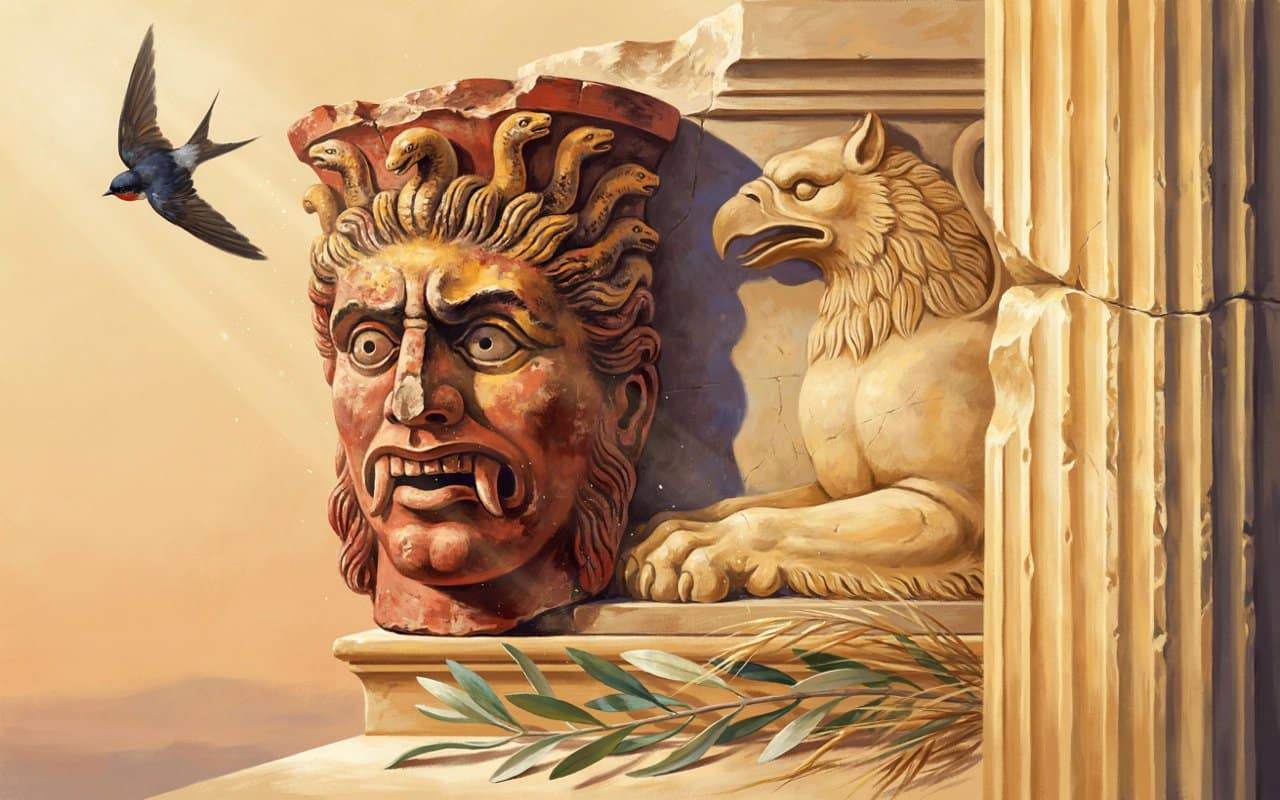
The gorgons are three monstrous sisters from Greek myth: Stheno, Euryale and Medusa. The name comes from the Greek gorgós, meaning grim, fierce or terrible. They are described with scaled skin, tusks, protruding tongues and living snakes for hair, and a gorgon’s gaze turned onlookers to stone.
Medusa was the only mortal sister, which is why she is the one Perseus could kill. The gorgon face had a practical function in the Greek world: it was carved onto temples, painted on shields and stamped on armour to frighten away harm. A monster used as a security device is a genuinely different way for children to think about myth.
Dragons
Dragons did not begin in one place. Mesopotamian tradition has Tiamat and the horned serpent Mušḫuššu. Greek drákōn simply means a large serpent, and Greek dragons guard springs and golden fleeces. Chinese lóng are different again: benevolent water and weather bringers, closer to a river god than a villain, and associated with rain and good fortune rather than destruction.
The fire-breathing, gold-hoarding, cave-dwelling dragon that children picture is mainly northern European and reaches us through Norse and Anglo-Saxon literature. Real inspirations probably include crocodiles, large constricting snakes and fossil bones. Chinese scholars catalogued “dragon bones” for centuries; many were dinosaur and mammal fossils.
Griffins
A griffin has the head, wings and talons of an eagle and the body of a lion, and it appears in Egyptian, Minoan, Persian and Scythian art. Its consistent role is guardian. Herodotus records griffins guarding gold in the far north, and later European heraldry kept them as protectors of treasure. Some depictions leave the wings off.
The best known modern explanation is that Central Asian gold prospectors found Protoceratops fossils, beaked and roughly lion-sized, and built the griffin from them. That idea was proposed by the folklorist Adrienne Mayor and has been challenged by later researchers who point out that griffin imagery predates the trade routes in question. Presenting a contested explanation as contested is exactly the modelling Year 6 needs.
The Sphinx
There are two sphinxes, and almost every children’s resource merges them. The Egyptian sphinx is male, wingless, and has a lion’s body with a king’s head. It guards. The Great Sphinx at Giza is the famous one, and Arabic tradition calls it Abu al-Hawl, commonly translated as father of dread.
The Greek sphinx is female, winged, and asks riddles. She sat outside Thebes and devoured anyone who answered wrongly, until Oedipus solved her question about the creature that walks on four legs, then two, then three. Keeping the Egyptian guardian and the Greek riddler separate is one of the quickest factual upgrades you can make to an Ancient Egypt or Ancient Greece unit.
The Chimera
The Chimera is a fire-breathing hybrid from Greek myth, and Hesiod’s description is specific: a lion at the front, a goat in the middle, and a serpent behind. It was said to live in Lycia, in what is now south-western Turkey, and Bellerophon killed it from the air riding Pegasus.
Lycia holds one of the most satisfying reality checks in the whole of Greek myth. At Yanartaş, natural methane seeps out of the rocky hillside and burns continuously, and has done for thousands of years. Ancient writers connected these permanent flames to the Chimera. A monster that breathes fire in a place where the ground genuinely burns is not much of a leap.
The Science of the Scare: Real Animals Behind the Legends
Most mythical monsters started with something real that was seen badly, found broken, or misunderstood. Working backwards from monster to explanation turns a folklore lesson into a science and enquiry lesson, and it is the single most effective way to hold a sceptical Year 5 or Year 6 class.
Monster
Likely real inspiration
How the mistake happened
Mermaid
Manatee or dugong
Grey surface-breathing mammal holding young to its chest
Unicorn horn
Narwhal tusk
Spiral tusks traded into Europe without the animal attached
Cyclops
Dwarf elephant skull
Central nasal opening reads as one huge eye socket
Kraken
Giant squid
Real deep-sea animal reaching over ten metres, rarely seen alive
Sea serpent
Oarfish
Ribbon-shaped fish several metres long, seen at the surface when dying
Griffin
Protoceratops fossils
Proposed link, and disputed by later researchers
Chimera
Burning methane vents at Yanartaş
Permanent natural flames on a Lycian hillside
Dragon
Crocodiles, large snakes, fossil bones
Big bones with no living animal to match them
The pattern repeats: an unfamiliar animal, an incomplete skeleton, or a natural process nobody could yet explain. A useful classroom question is what the equivalent would be today. If you found a fifteen-metre skeleton with no head on a beach and no internet, what would you tell your village?
Handle the griffin row carefully, because it teaches something better than certainty. The fossil explanation is popular, plausible and openly contested, and telling children that historians disagree is more valuable than giving them a tidy answer to memorise.
Hideous Creatures in the Classroom: KS2 English and History Links
Mythical monsters earn their place in the KS2 timetable through English composition and vocabulary first, and history second. The National Curriculum for English at KS2 asks pupils to read and discuss myths, legends and traditional stories, including work from other cultures and traditions, and to describe settings and characters with precision. A monster is the easiest character a reluctant writer will ever attempt.
“Reluctant writers will describe a monster long before they will describe a person. Give a child a griffin and a word bank and you get expanded noun phrases without ever having to call them expanded noun phrases.” , Michelle Connolly, Founder of LearningMole and former teacher with over 15 years of classroom experience
The history link runs through the KS2 requirement to study Ancient Greece and its influence, alongside the achievements of the earliest civilisations. Gorgons, the Hydra, centaurs, the Chimera and the Greek sphinx all sit directly inside that unit. Ancient Egypt gives you the Great Sphinx and the griffin. A local history study is the natural home for Black Shuck in East Anglia, the kelpie in Scotland, or the ringforts and fairy beliefs of Ireland.
Word Power: Ten Monster Adjectives for KS2
Word
What it means
Use it like this
formidable
frightening because it is so powerful
a formidable guardian coiled at the gate
malevolent
wanting to cause harm
a malevolent goblin waiting in the mineshaft
grotesque
ugly in a distorted, unsettling way
the ogre’s grotesque, mismatched hands
ethereal
delicate and unearthly
an ethereal figure drifting above the loch
colossal
enormous
a colossal shadow crossing the harbour
sinister
suggesting that something bad will happen
a sinister stillness in the marsh
ravenous
extremely hungry
ravenous jaws snapping at the raft
elusive
hard to find or catch
the elusive beast left only footprints
venomous
producing poison
venomous snakes writhing where her hair should be
spectral
ghostly
a spectral wail carried across the fields
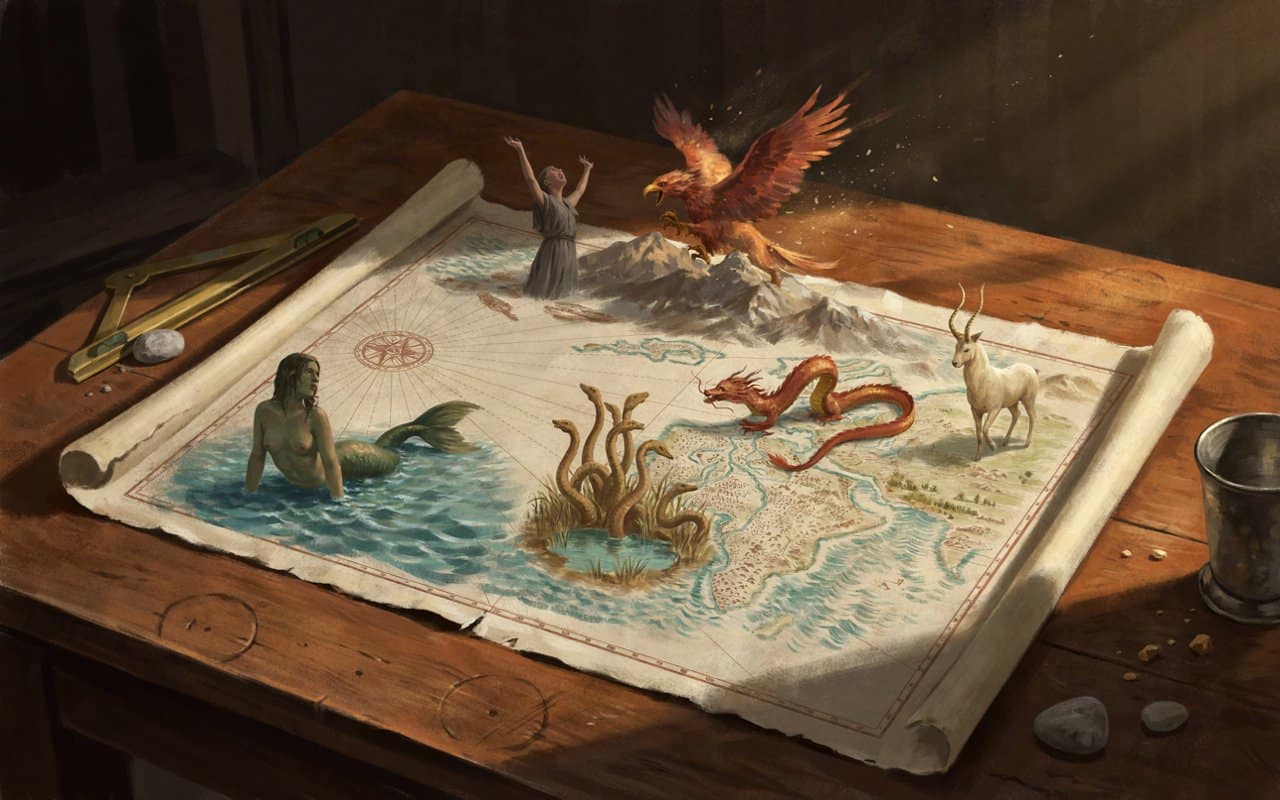
Three activities do most of the work. Ask pupils to build a fact file for one creature covering origin, appearance, power and weakness, which forces them to separate description from opinion. Ask them to write the same monster twice, once as the villain and once as the hero, which is character perspective without the jargon. Then have them pin each creature to its country on a world map, which turns a literacy task into geography.
Supporting Learning at Home
Parents can extend this without any planning. Read one creature a night and ask your child which real animal it might have been. Compare a film version to the older story and talk about what got changed to make it suitable for children. Look up the country each monster came from on a map. Home learning resources that match school work matter more than extra worksheets do, and a good conversation about a manatee beats a comprehension sheet most evenings.
Teaching Resources and Support
LearningMole provides curriculum-aligned video resources and teaching materials for the myths and legends topic, covering the individual creatures in this guide in more depth than a single list allows. Ready-made resources save planning time when a unit lands in a busy half term.
For classroom use, the mythology and ancient civilisations collections cover the Greek creatures alongside the historical context pupils need. For creative writing, the literacy collection includes description and character work that pairs directly with the vocabulary table above. Individual creature guides go further on the monsters children ask about most, including Medusa, mermaids and sirens, dragons, ogres, kelpies, griffins and Bigfoot.
Michelle Connolly founded LearningMole to help teachers and parents give children quality educational experiences, and the platform’s resources cover maths, English, science and the humanities across EYFS, KS1 and KS2. Based in the UK, LearningMole builds to the National Curriculum while remaining usable in international schools following other frameworks.
Mythical Monster FAQs
What is the difference between a myth and a legend?
A myth explains something fundamental about the world and usually involves gods, while a legend attaches to a real place or person and grew through retelling. The Hydra belongs to Greek myth because it sits inside stories about gods and heroes explaining the order of the world. The Loch Ness Monster is a legend because it is tied to a real loch and to specific reported sightings. Folklore is the wider category that holds both, along with local customs and beliefs. Most KS2 pupils grasp the difference quickly when you sort five creatures into the two columns together.
Are mythical monsters based on real animals?
Many are, though rarely in a simple way. Mermaids are widely explained by manatees and dugongs, the kraken by the giant squid, and sea serpents by the oarfish. Others came from fossils rather than living animals: dwarf elephant skulls have been proposed as the origin of the Cyclops, and dinosaur bones were catalogued as dragon bones in China for centuries. Some began with a natural process instead, like the permanently burning methane vents in Lycia that ancient writers linked to the Chimera. A few, including the golem and the zombie, have no animal origin at all and come from religious and cultural belief.
What is the scariest mythical creature for children?
Medusa and the gorgons usually win, because turning to stone by accident is a fear children immediately understand. The banshee unsettles older pupils for a different reason: she does not attack, she simply announces that a death is coming. If you are working with Year 3 or a sensitive class, stay with creatures whose scariness is physical and cartoonish, like ogres and goblins, and leave the ones about death and the returning dead for Year 5 and Year 6. Saying at the outset that none of these are real does more good than avoiding the topic.
What is the oldest mythical monster ever recorded?
The oldest monsters we can actually date come from Mesopotamia. Humbaba, the guardian of the cedar forest, and the Bull of Heaven both appear in the Epic of Gilgamesh, whose surviving tablets range from around 2100 BC to roughly 1200 BC. Tiamat, the primordial sea serpent of the Babylonian creation story Enūma Eliš, is preserved on tablets from around the twelfth century BC and describes far older tradition. Egyptian creatures such as Ammit and the earliest sphinxes are of comparable age. Greek monsters like Medusa are much later, reaching written form with Homer and Hesiod around the eighth century BC.
Are these stories appropriate for Year 3 pupils?
Yes, with framing and a little selection. Open by saying clearly that these are old stories people invented, not real animals, and Year 3 handles the rest comfortably. Choose the physical monsters first: ogres, goblins, leprechauns, dragons, unicorns and the Loch Ness Monster. Hold back the zombie, the vampire and the banshee, all of which centre on death, until pupils are older. Keep the reality-check angle front and centre, because explaining that a mermaid was probably a manatee makes the whole topic feel like solving something rather than being frightened.
How can I use mythical monsters in a KS2 lesson?
The strongest single lesson is a monster fact file followed by a description, using a supplied word bank. Pupils research origin, appearance, special power and weakness, then write a paragraph describing the creature entering a setting. Two other reliable options: compare two cultural versions of a similar creature, such as the Chinese dragon and the northern European dragon, and ask what each culture valued or feared; or write the same monster twice, once as villain and once as misunderstood hero. All three cover composition and vocabulary objectives, and all three work as a single session or a short block.
Where do mythical monsters fit in the National Curriculum?
They sit primarily in KS2 English and KS2 History. The English programme of study asks pupils to read and discuss myths, legends and traditional tales, including stories from other cultures and traditions, and to describe settings and characters. In History, the Ancient Greece unit and the study of the earliest civilisations give you gorgons, the Hydra, centaurs, the Chimera, the Greek sphinx, the Egyptian sphinx and the griffin. A local history study is the natural place for British and Irish creatures. Geography picks up the rest through mapping each legend to its country of origin.
How can parents explore mythical monsters at home?
Read one creature at a time and treat it as a puzzle rather than a story. Ask your child what real animal or object might have started the legend, then look it up together. Watching a film version and comparing it to the older story works well, because children enjoy spotting what was changed and can usually explain why. A world map on the wall with a pin or sticker for each creature keeps the topic going across a whole half term. LearningMole’s video resources cover many of these creatures if your child wants to go further than one story a night.
Conclusion
Twenty monsters, and almost every one of them turns out to be about something real: an animal nobody could name, a bone nobody could place, a hillside that would not stop burning, a grave that was opened at the wrong moment. That is what makes this topic worth more than a fortnight of Halloween. Folklore is a record of what people were afraid of and what they could not yet explain, and children are perfectly capable of reading it that way.
For teachers, the practical value sits in the vocabulary and the description work. A griffin gives a reluctant writer permission to be ambitious with language in a way that describing a bus stop never will. Pair the word bank with a fact file, insist on precision about origin and appearance, and the composition objectives look after themselves. The history and geography links follow naturally once pupils start asking where each creature came from.
For parents, one creature a night and one question is enough. What might it really have been? Children who get into the habit of asking that question about monsters tend to keep asking it about everything else, which is a better outcome than any worksheet. LearningMole’s curriculum-aligned educational content is there when a child wants to go deeper on the ones that stick.
Want full access to LearningMole’s library of our videos, quizzes, and printable resources? See our subscription plans to unlock everything KS1 and KS2 teachers need for primary education.
Share:
2 responses to “Beware These Hideous Creatures: 20 Mythical Monster Legends for Kids”
Maths Circus, an innovative platform we've crafted, presents a captivating realm where children learn mathematics through the exciting theme of a circus. The joy of juggling numbers and solving circus...
Mexican traditions blend the customs of ancient Mesoamerican peoples, such as the Aztecs and the Maya, with Catholic festivals brought by Spanish settlers in the sixteenth century. The result is...
The moose (Alces alces) is the largest member of the deer family alive today, and a fully grown bull can stand about 2 metres tall at the shoulder, which makes...




I knew all of this already.
Good for you! Continue to explore new topics to build a rich and diverse cultural foundation