Writing Letter T: Interesting and Fun LEGO Activities and Plans

Avatar of Shaimaa Olwan
Updated on: Educator Review By: Michelle Connolly

Writing Letter T: Before a child ever picks up a pencil, their hands are already practising for handwriting. Every time they press a brick into place or pull one free, they are building the pincer grip, the finger strength, and the spatial awareness that letter formation depends on. LearningMole’s LEGO letter t activity takes this connection seriously, turning a familiar toy into a genuine literacy tool that supports the UK National Curriculum from EYFS through KS1.

The letter t is one of the first letters children encounter in systematic synthetic phonics programmes, and it comes with a specific formation challenge. Unlike letters built from circles and curves, t demands two distinct directional strokes: a vertical stem pulled downward, then a crossbar drawn left to right. Getting that sequence right from the beginning matters because habits formed in early years tend to stick. This activity uses LEGO bricks to make both strokes visible, physical, and repeatable before a pencil ever appears.

Michelle Connolly, founder of LearningMole and a former primary school teacher with over 15 years of classroom experience, developed this approach as part of a broader commitment to tactile, play-based early learning. The activity works at home and in the classroom, scales from Duplo for nursery-age children to standard LEGO bricks for Year 1, and connects naturally to the phonics work children are already doing at school.

Why LEGO Bricks Help Children Write

Writing Letter T

LEGO builds fine motor strength in exactly the muscles children need to hold a pencil. Pressing bricks together requires controlled finger pressure. Pulling them apart works the intrinsic hand muscles, the small muscles inside the palm that govern precise finger movements. Neither of these actions feels like handwriting preparation, but both are.

There is also a concept from occupational therapy worth knowing here: proprioception. This is the hand’s ability to ‘feel’ the shape of something through resistance and pressure. When a child builds the letter t out of LEGO, they are not just seeing a shape — they are feeling its dimensions, its height, its crossbar, its proportions. That physical experience of the shape is what makes it easier to reproduce with a pencil later.

The table below maps specific LEGO actions to their handwriting equivalents.

LEGO SkillHandwriting EquivalentWhy It Helps
Pressing bricks togetherControlling pencil pressureGrip strength and finger control
Pulling bricks apartLifting pencil between strokesIntrinsic hand muscle development
Positioning a brick preciselyLetter placement on a lineSpatial awareness and accuracy
Building top-to-bottomCorrect letter formation directionDirectional habit for handwriting
Fitting the crossbar brick exactlyDrawing the T crossbar left to rightSequential movement planning

Mastering Letter t Formation: The UK Tower Method

Writing Letter T

Most UK phonics programmes use a consistent mnemonic for the letter t: “Down the tower, across the tower.” This phrase comes from Read Write Inc. and is echoed in Letters and Sounds. It describes the two strokes in the correct order, starting from the top, which is the single most important habit to establish.

Children who build their LEGO “t” from the bottom upward, stacking bricks from the base, risk forming the same reversed habit with a pencil. This is why the activity instructions below specify starting at the top of the stem and building downward, mirroring the pencil path.

StageWhat to Do
Step 1Start at the top centre. Pull the pencil straight DOWN to the bottom. This is the tall stem of the letter.
Step 2Lift the pencil. Return to the top. Draw across LEFT to RIGHT to make the crossbar. Stop level with the top of the stem.
Key saying“Down the tower, across the tower” (Read Write Inc. / Letters and Sounds mnemonic)
Common errorStarting from the bottom and building up. This reverses the correct formation direction. LEGO builds top-to-bottom reinforce the correct habit.
Lowercase ‘t’Very similar: start just below the top, pull down with a small kick at the base, then cross in the middle, not at the top.

The distinction between uppercase T and lowercase t is worth addressing early. Most UK phonics programmes introduce the lowercase form first, because that is the version children encounter most often in reading. Lowercase t has the crossbar in the middle, not at the top. The LEGO activity works for both, just shift the crossbar brick to demonstrate the difference.

Three LEGO Activities for Writing the Letter T

letter t

Activity 1: The 1:1 Scale Build (Letter Recognition)

This is the starting point for most children and works well as an introduction to the shape.

Print a letter t template at A4 size, a simple outline of the letter on a plain background. Place it flat on the table or LEGO board. Ask the child to fill the letter shape with LEGO bricks, matching the outline as closely as possible.

Younger children in Nursery or Reception should use Duplo for this activity, as the larger bricks are a better fit for their hands and easier to handle. Year 1 children can work with standard LEGO bricks for more precise placement.

While they build, reinforce the shape language: “That’s the tall part going down, that’s the stem of the tower. Now we need the bit that goes across the top, that’s our crossbar.” Use the phonics mnemonic naturally in conversation rather than drilling it separately.

Activity 2: The Brick-Tracing Challenge (Kinetic Formation)

This is the most powerful activity in the sequence, and the one that most directly prepares children for pencil writing. It addresses formation direction, where to start, and which way to move, rather than just shape recognition.

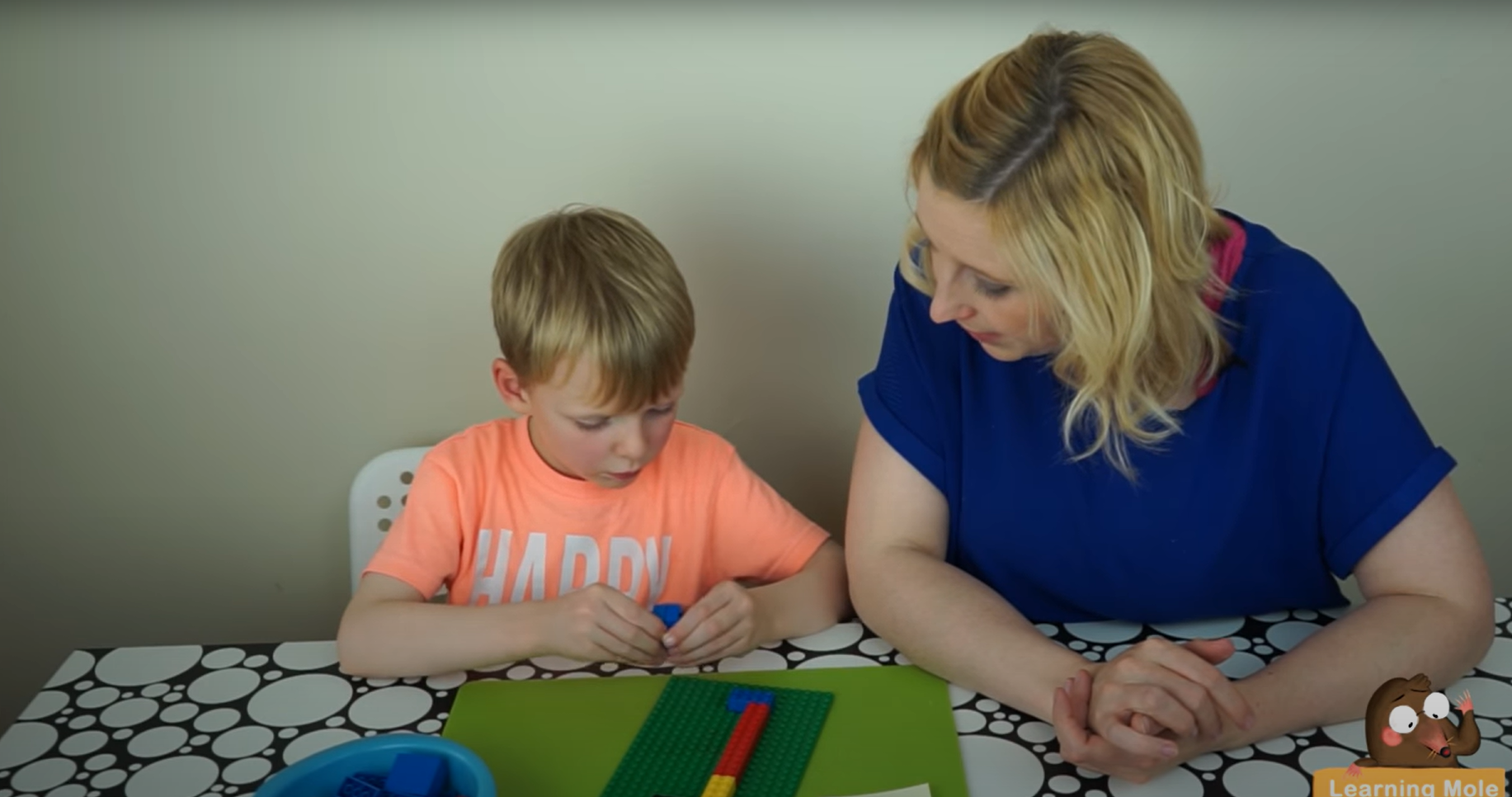
Set up a LEGO base plate on the table. Ask the child to build the letter T stem first, starting from the top and placing bricks downward. Then build the crossbar, placing bricks from left to right across the top.

Once the letter is built, take a small LEGO figure or a single spare brick and ask the child to “drive” it along the letter path, starting at the top of the stem and moving downward, then returning to the top and moving left to right across the crossbar. Say the mnemonic together as they do it: “Down the tower, across the tower.”

This kinetic tracing, moving a physical object along a physical path, is what occupational therapists call proprioceptive practice. The child’s hand and fingers are learning the movement pattern in a way that screen-based tracing apps simply cannot replicate. Research into early handwriting development consistently points to this kind of tactile, whole-body engagement as more effective for motor memory than digital alternatives.

Repeat the tracing three to five times. The goal is muscle memory, not speed.

Activity 3: LEGO Stamping — Sensory Letter Formation

This variant works well for children who need more sensory input or as a settling activity for SEND learners.

Fill a shallow tray with playdough, kinetic sand, or fine salt. Take a LEGO brick, a long 2×8 works well for the stem, a 2×4 for the crossbar, and press it into the surface to stamp the letter’s shape. Start with the vertical stem, pressing downward, then the crossbar across the top.

The resistance of the playdough or sand gives strong proprioceptive feedback. The child can feel the pressure needed, the direction of movement, and the resulting shape all at once. After stamping the letter, ask the child to trace the indentation with their finger, then re-smooth the surface and repeat.

Adapting the Activity: Duplo for EYFS, LEGO for KS1

letter t

Duplo bricks are the right choice for Nursery and Reception children. They are easier to grip, harder to drop, and require less finger precision to connect, which means children can focus on the letter shape rather than fighting the bricks.

Standard LEGO bricks become appropriate when a child has developed enough fine motor control to connect them reliably without frustration. For most children, this is around Year 1, though it varies. If a child is struggling with standard bricks, Duplo is not a step backwards; it is the right size for that child’s development.

For very young children in Nursery (age three to four), the goal is simply shape recognition and sensory exploration. Do not worry about the formation direction at this stage. For Reception children (age four to five), begin introducing the “top to bottom” language. For Year 1 children (age five to six), make the formation sequence explicit and connect it to their phonics work.

LearningMole Letter t Activity

letter t

The letter t makes an unvoiced sound, a short, sharp ‘t’ produced by touching the tongue to the ridge behind the upper teeth and releasing. This is different from the letter name “tee.” In systematic synthetic phonics, children learn the sound first, and the letter shape is the symbol for that sound. Keep this distinction clear in how you talk about the activity.

In Jolly Phonics, children associate the letter t with watching a tennis match, moving their heads from side to side as they make the sound. This physical movement connects the phoneme to a memorable action — exactly the same principle as the LEGO kinetic tracing above. If the child already knows the Jolly Phonics action for t, connect it explicitly: “You already know the sound t makes and the action for it. Now we’re learning what the letter looks like and how to write it.”

Once the child is confident with the letter t in isolation, extend the activity to other letters with similar formations. Letters like l, i, and the capital T all share the top-to-bottom stem movement. Letters like f share the crossbar. Making these connections explicit helps children transfer their understanding rather than learning each letter from scratch.

Teaching Resources and Support

multiplication

LearningMole provides curriculum-aligned resources for EYFS and KS1 teachers and parents supporting home learning. The letter t activity sits within a broader programme of alphabet and phonics content designed by educators who understand the UK National Curriculum requirements for early writing.

For more phonics and early literacy resources, visit the LearningMole phonics and alphabet section, which covers all 26 letters with activity guides, videos, and downloadable materials.

If you are looking for more hands-on letter formation activities using Play-Doh, building bricks, and sensory materials, the LearningMole Play-Doh alphabet guide and the LEGO education resources page provide further ideas for classroom and home use.

LearningMole’s teaching resources are designed by experienced educators, including Michelle Connolly, whose 15+ years in primary classrooms inform every activity. Whether you are a teacher planning EYFS provision, a parent supporting home learning, or a teaching assistant working with small groups, the resources are structured to save preparation time while meeting National Curriculum objectives.

“Children do not separate play from learning, and good teaching resources should not either. When a child builds a letter with LEGO bricks, they are doing serious literacy work, developing the muscle memory, spatial understanding, and directional habits that will support their handwriting for years.” Michelle Connolly, Founder of LearningMole and former teacher with over 15 years of classroom experience

Frequently Asked Questions

letter t

How does LEGO help a child learn to write?

LEGO play develops the fine motor skills that underlie writing: pincer grip strength, intrinsic hand muscle control, and spatial awareness. When children press bricks together and pull them apart, they are exercising exactly the hand muscles needed to hold and control a pencil. The proprioceptive feedback from handling bricks, the feel of resistance, position, and pressure, also helps the brain build a physical memory of shapes that translates into letter formation. This is why tactile activities like LEGO are more effective for early writing preparation than tracing on a screen.

What is the correct way to form the letter t in UK schools?

In UK primary schools, the letter t is typically formed in two strokes following the Read Write Inc. and Letters and Sounds mnemonic: “Down the tower, across the tower.” The first stroke is a vertical line drawn from the top downward. The second stroke is a horizontal line drawn left to right across the top of the stem. Lowercase t follows the same principle, but the crossbar sits in the middle of the stem rather than at the top. Starting from the top is the most important habit to establish; children who start from the bottom develop a reversed formation pattern that is difficult to correct later.

Should I teach uppercase T or lowercase t first?

Most UK phonics programmes, including Read Write Inc. and Letters and Sounds, introduce the lowercase form first. This is because children encounter lowercase letters far more frequently in reading, books, signs, labels, and screens, which predominantly use lowercase. The lowercase t is the symbol children learn in phonics for the /t/ sound. Uppercase T comes later, once the lowercase form is secure. The LEGO activity works for both: for lowercase t, the crossbar brick goes in the middle of the stem; for uppercase T, it goes at the very top.

Can I use Duplo instead of standard LEGO bricks?

Yes, and for Nursery and Reception children, Duplo is usually the better choice. Larger bricks are easier to grip and connect, which means younger children can focus on the letter shape and formation direction rather than struggling with the mechanics of the bricks themselves. Standard LEGO bricks become more appropriate as fine motor control develops, typically around Year 1. If a child finds standard bricks frustrating, switch to Duplo. The learning objective is the letter formation, not the brick size.

How do I stop my child from reversing the letter t?

Letter reversals with t usually come from building or drawing the letter from the bottom upward, or placing the crossbar in the wrong position. The most effective fix is reinforcing the correct formation direction through repetition and physical experience. In the LEGO activity, make the top-to-bottom sequence explicit: always start the stem at the top and build or trace downward. Use the mnemonic “Down the tower, across the tower” every time. The brick-tracing activity, moving a LEGO figure along the letter path, is particularly useful here because it makes the movement sequence a physical habit rather than an abstract instruction.

What age is this activity suitable for?

The core LEGO letter t activity is designed for EYFS and KS1 children, broadly ages three to seven. For Nursery children (age three to four), focus on shape recognition and sensory exploration without worrying about formation direction. For Reception children (age four to five), introduce the top-to-bottom language and the phonics sound connection. For Year 1 children (age five to six), make the two-stroke formation sequence explicit and connect it to the handwriting practice they are doing at school. Duplo is recommended for younger children; standard LEGO bricks from Year 1 onwards.

How does this connect to what children learn in school?

The letter t features in the early stages of all major UK systematic synthetic phonics programmes, including Read Write Inc., Letters and Sounds, and Jolly Phonics. In the UK National Curriculum, handwriting formation is a statutory requirement from Year 1, with the expectation that children sit correctly at a table, hold a pencil comfortably, and begin to form lower-case letters in the correct direction. The LEGO activity directly supports this by building fine motor skills and formation habits before formal handwriting practice begins. If your child’s school uses Jolly Phonics, the t action (watching a tennis match, looking left and right) complements the LEGO kinetic tracing particularly well.

Are there printable letter t mats I can use with this activity?

Printable letter formation mats work well alongside the LEGO activity for the 1:1 scale build. A simple A4 outline of the letter t gives children a guide to fill with bricks. LearningMole’s alphabet section includes letter activity resources alongside the video content. For the kinetic tracing activity, no printable is needed; the LEGO base plate itself serves as the work surface, and the formation path is built directly into the brick letter.

Conclusion

letter_T

The path from play to pencil is shorter than it looks. When children spend time building, tracing, and pressing LEGO bricks into the shape of a letter, they are not just having fun; they are doing the physical groundwork that makes handwriting feel natural rather than forced. The letter t is a good place to start, because its two clean strokes make the directional rules visible and repeatable in a way that more complex letters cannot.

At LearningMole, the approach has always been that children learn best when they can touch and move and build, not just watch and listen. The resources on this page are part of a broader library of curriculum-aligned activities covering every letter of the English alphabet, developed by educators who have spent years in UK primary classrooms and understand what early learners actually need. The LEGO activity connects directly to the phonics work children are doing at school, supports the fine-motor development occupational therapists recommend, and gives parents a simple, low-cost tool they can use at home without specialist knowledge.

Once the letter t is secure, move on to other letters with similar formations l, i, and f all share elements of the same strokes. And if LEGO is a firm favourite at home, the Play-Doh alphabet activities and broader LEGO learning guides on LearningMole offer the same approach across the full alphabet, keeping the connection between hands-on play and literacy learning strong throughout the early years.

Leave a Reply

Your email address will not be published. Required fields are marked *