Writing Letter ‘S’ Phonics Sounds for Kids (Phases 1 and 2)

Avatar of Michelle Connolly
Updated on: Educator Review By: Michelle Connolly

Phonics Sounds: The letter ‘s’ is the very first sound children meet in Phase 2 phonics, and how it is taught in those early weeks shapes a great deal of what comes next. Many parents search for ‘Phase 1 letter s’ activities, and that makes sense, but the UK’s Letters and Sounds framework places written graphemes firmly in Phase 2, when children move from listening to sounds to actually forming them on paper. Understanding that distinction helps teachers and parents give children the right support at the right time.

At LearningMole, a UK educational platform founded by former primary school teacher Michelle Connolly, we know that teaching ‘s’ well means more than showing children where to put the pencil. It means building the sound in their mouths first, then in their bodies through large movement activities, and only then guiding the fine motor skills that produce the written letter.

This whole-child approach is what separates confident young writers from those who struggle with reversals and unclear formation later on.

This guide covers the full journey: from the pure phoneme to gross motor warm-ups, from print formation to continuous cursive, and from classroom activities to common concerns such as lisps and mirror writing.

Whether you are a Reception teacher planning your first SATPIN lessons or a parent practising at the kitchen table, everything you need is here, aligned to the UK National Curriculum and the Early Years Foundation Stage.

Phase 1 vs Phase 2: When Should My Child Start Writing ‘s’?

Writing the letter ‘s’ belongs to Phase 2 phonics, not Phase 1, and making that distinction clear prevents a great deal of confusion. Phase 1 focuses entirely on speaking and listening: children learn to discriminate environmental sounds, develop rhythm and rhyme awareness, and begin to hear individual phonemes. No pencil is involved.

Phase 2 is where graphemes enter the picture. The DfE’s Letters and Sounds framework introduces ‘s’ as the first sound in the SATPIN group, which means most children encounter the written ‘s’ around the start of Reception (age 4–5).

Children arriving in your classroom seeking Phase 1 letter-writing activities are likely ready to begin Phase 2; they just need the right framing.

PhaseFocusWhat Children Do
Phase 1Oral sound discriminationListen to and discriminate sounds in the environment, develop awareness of rhythm, rhyme, and alliteration
Phase 2 (Week 1)Grapheme introduction — SATPINLearn to read and write ‘s’, ‘a’, ‘t’, ‘p’, ‘i’, ‘n’; begin blending simple CVC words
Phase 2 (Weeks 2–6)Expanding the grapheme setAdd further sounds; begin segmenting words to spell them
Phase 3Remaining phonemesLearn digraphs and trigraphs; read and write a wider range of words

Curriculum note: Letters and Sounds (DfE) is the dominant phonics framework in England, structured across six phases from nursery through Year 2. Many schools also use Jolly Phonics, which introduces the same SATPIN group first but uses an action (a weaving hand movement for ‘s’) to link sound to symbol. Both approaches agree: ‘s’ comes first.

How to Say the ‘s’ Sound: Teaching the Pure Phoneme

Phonics sounds, phonics, letter LearningMole

The phoneme /s/ should be taught as a pure sound, a sustained, hissing ‘ssss’, not as ‘suh’. Adding the schwa vowel (‘uh’) is one of the most common errors in early phonics teaching, and it causes real problems later. When a child tries to blend ‘sun’ using ‘suh-uh-nuh’, they hear three syllables instead of one word.

Getting the Mouth Position Right

To produce the pure /s/ sound, children should:

  1. Place their top and bottom teeth close together but not touching.
  2. Push air steadily through the gap between the teeth.
  3. Hold the tongue just behind the lower front teeth.
  4. Keep the sound going as long as possible — ‘sssssss’.

A useful prompt: ‘Show me your snake sound, keep it going, keep it going!’ The continuous nature of the sound naturally prevents the schwa from sneaking in.

Jolly Phonics connection: The Jolly Phonics action for ‘s’ is a weaving hand movement, like a snake moving through grass, made simultaneously with the ‘sssss’ sound. This multisensory approach helps children internalise the phoneme quickly and is supported by LearningMole’s phonics video resources.

Before the Pencil: Gross Motor Activities for Writing ‘s’

Phonics Sounds

Pencil control develops from the shoulder downwards. Before any child attempts to write ‘s’ on paper, their bodies need to practise the movement at a much larger scale. Gross motor activity builds the muscle memory for the curved, directional stroke that ‘s’ requires, and it is genuinely enjoyable, which matters enormously in EYFS.

Sky Writing and Ribbon Snakes

Ask children to stand up and trace a large ‘s’ shape in the air, starting from the top. Call it ‘sky writing’ or ‘rainbow writing’. To add challenge and visibility:

  • Give children ribbons or scarves to trail through the air as they form the shape.
  • Have them make the ‘sssss’ sound as they move, connecting phoneme to movement.
  • Demonstrate first with your own whole-arm movement so children can see the directionality clearly.

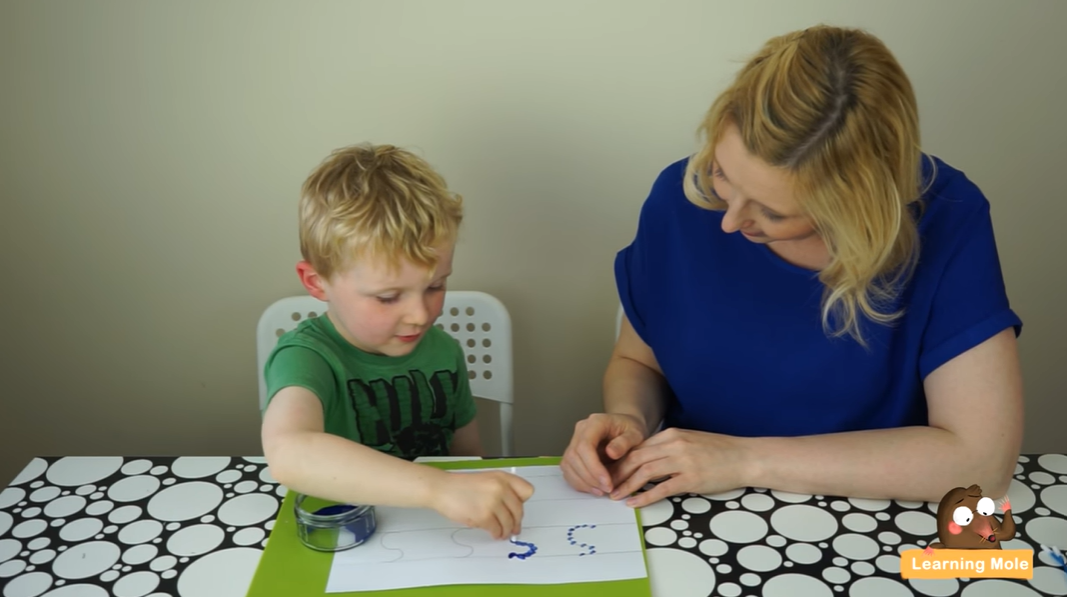
Sensory Trays: Sand, Salt, and Shaving Foam

Sensory trays let children feel the shape of ‘s’ before committing it to paper. Options that work well in Reception classrooms:

  • Sand or salt trays: children draw an ‘s’ with one finger, starting at the top.
  • Shaving foam spread on a tray: use one finger or a lolly stick to write the shape.
  • Play-dough: roll a thin sausage and curve it into an ‘s’ shape on the table.
  • Skipping rope on the floor: lay a rope in an ‘s’ shape and have children walk along it heel-to-toe while hissing.

Classroom Activity: The Snake Slither

  • Lay a long skipping rope on the floor in a large ‘s’ curve.
  • Children walk along the rope’s path, heel-to-toe, while making the ‘ssss’ sound.
  • As they complete the shape, ask: ‘Where did we start? At the top! Where did we end? At the bottom tail!’
  • SEND adaptation: children with motor difficulties can use a toy car or finger puppet to trace the rope instead of walking.
  • Extension: time how long children can hold the ‘sssss’ sound as they complete the snake walk.

How to Write the Letter ‘S’: Formation, Mnemonics, and School Styles

Phonics Sounds

Letter formation for ‘s’ follows a two-curve stroke that starts near the top, curves right and then reverses direction to curve left. The key instruction is: start at the top, curve round to face left, then curve back to face right. This is the movement that distinguishes ‘s’ from a backwards ‘s’ (a common reversal) and from ‘z’.

The ‘Slither Down the Snake’ Mnemonic

Mnemonics help children remember directionality. The most widely used for ‘s’ in UK classrooms is: ‘Start at the snake’s head, slither down to the tail.’ Some teachers use a more detailed rhyme: ‘Curve around the snake’s head, slide down its middle, flick out at the end.’

The key is consistency: choose one mnemonic and use it every time, so the verbal cue becomes automatic alongside the physical movement.

UK schools differ on handwriting policy. Some teach print (unjoined) letters from the start; others introduce continuous cursive, with lead-in and exit strokes, from Reception. The table below shows both approaches for ‘s’.

Handwriting StyleMnemonic / InstructionTop Tip
Print (unjoined)‘Curve around the top, slide down, flick out’ — no lead-in or exit strokeEnsure children start at the top centre of the letter, not from the bottom or middle
Continuous Cursive‘From the baseline, swing up and curve round the top, slide down, flick out and join’ — lead-in stroke from the lineThe lead-in stroke distinguishes cursive ‘s’ from print; practise it separately on the line first

Note for teachers: Check your school’s handwriting policy before teaching formation. If your school uses a specific handwriting programme (e.g. Letter-join, Nelson Handwriting), use their version of the ‘s’ mnemonic to ensure consistency across year groups.

Letter ‘s’ Scavenger Hunt: Words and Objects

Phonics Sounds

One of the most effective Phase 2 activities is asking children to identify objects beginning with the target phoneme, a form of phoneme discrimination that bridges oral Phase 1 work with the written Phase 2 focus.

Classroom Objects Starting with /s/

  • Sock, spoon, sandpaper, scissors, salt, sponge
  • Star (on a display), sun (picture), seed, stamp
  • Stone, sticky tape, stapler, sign

Activity: The Super Sock Sort

  • Fill a drawstring bag (the ‘Super Sock’) with objects, some starting with /s/ and some not.
  • Children pull out one object at a time, identify it, and decide: ‘Does it start with ‘sssss’? If yes, it goes in the sock.’
  • For writing practice: children write ‘s’ on a sticky note label for each object that belongs in the sock.
  • SEND adaptation: use picture cards instead of objects for children who find handling small items difficult.
  • Home learning version: parents can repeat this activity with household objects on a weekend morning.

Common Challenges: Lisps and Letter Reversals

Phonics Sounds

Two concerns come up repeatedly when parents contact teachers about progress with ‘s’: my child says ‘th’ instead of ‘s’, and my child writes ‘s’ backwards. Both are developmentally normal within certain age ranges, but both are worth understanding clearly.

Lisps: When ‘th’ Replaces ‘s’

A frontal lisp, where ‘s’ is produced with the tongue protruding between the teeth and sounds like ‘th’, is extremely common in children aged 3–5. Children at this age are still developing the fine motor control of the tongue tip required to produce a clean /s/. For the majority of children, the sound resolves naturally between ages 4 and 7 without intervention.

“Mirror writing of ‘s’ and difficulty with the /s/ phoneme are both within the normal developmental range for children up to age 7. What matters is the trajectory; if a child’s sound production is improving over time, that is a positive sign. Only when there is no change over several months, or the child themselves is distressed by their speech, would we typically consider a referral,” Michelle Connolly, Founder of LearningMole and former teacher with over 15 years of classroom experience

When to seek advice: if a child’s lisp persists beyond age 7, affects their confidence, or is preventing them from being understood by unfamiliar adults, a referral to a Speech and Language Therapist is appropriate. Schools can support this referral process through the SENCO.

Mirror Writing and Letter Reversals

Reversing ‘s’ (writing it as a backwards ‘s’) is common in children aged 4–7. The brain at this age has not yet fully specialised for left-to-right directionality, and children who are perfectly capable of forming the letter shape sometimes produce it as a mirror image. This is not a sign of dyslexia, though it can occasionally accompany dyslexic patterns if it persists beyond age 7–8.

Practical strategies:

  • Always model starting at the top, using a verbal cue every time you demonstrate (‘Start at the snake’s head at the top…’).
  • Mark the starting point with a small dot or arrow on tracing sheets so children can see directionality clearly.
  • Use sky writing and sensory trays to reinforce the correct direction through movement, not just visual copying.
  • For left-handed children, tilt the paper clockwise approximately 45 degrees so the writing arm does not obscure the line.

Teaching Resources and Support

Phonics Sounds

LearningMole provides curriculum-aligned phonics video resources designed for UK primary teachers and parents supporting home learning. Our Phase 2 phonics content covers the SATPIN group in full, with age-appropriate explanations and visual demonstrations that bring each grapheme-phoneme correspondence to life.

For the letter ‘s’ specifically, our educational videos model both the pure phoneme production and the written formation, making them useful for whole-class teaching on the interactive whiteboard or for children revisiting the sound independently. LearningMole’s resources are aligned to the UK National Curriculum and the EYFS framework, so they sit alongside your classroom teaching rather than pulling in a different direction.

“Quality educational videos do what textbooks alone cannot. They show concepts in motion, explain with visual clarity, and hold children’s attention while teaching. That’s why we focus so heavily on video at LearningMole.” Michelle Connolly, Founder of LearningMole and former teacher with over 15 years of classroom experience

Home Learning Support

  • Watch the LearningMole letter ‘s’ video together before practising writing.
  • Use kitchen trays with a thin layer of flour or salt as a free sensory writing surface.
  • Practise sky writing together before picking up a pencil — make it physical and fun.
  • Focus on one correct formation before repetition: one good ‘s’ is worth more than ten rushed ones.
  • Celebrate the sound, not just the shape: ask your child to find three things in the house beginning with ‘ssss’.

Frequently Asked Questions

Phonics Sounds

Is ‘s’ a Phase 1 or Phase 2 sound in phonics?

‘S’ is a Phase 2 sound in the UK’s Letters and Sounds framework. Phase 1 focuses on listening and discriminating sounds without any grapheme (written letter) work. Written letter formation, including ‘s’, begins in Phase 2, which is typically taught in the autumn term of Reception. However, many parents start searching for ‘Phase 1 letter s’ activities when their child is approaching the Phase 2 stage, so both terms are relevant to this guide.

What is the rhyme or mnemonic for writing the letter ‘s’?

The most widely used mnemonic in UK classrooms is ‘Slither down the snake’, start at the snake’s head at the top, curve round and slide down to the tail. Some teachers use a longer rhyme: ‘Curve around the top like a snake’s head, slide down the middle, flick out at the end.’ The key is to use the same rhyme every time, so children internalise the verbal cue alongside the physical movement.

My child says ‘th’ instead of ‘s’. Should I be worried?

A frontal lisp (saying ‘th’ instead of ‘s’) is within the normal developmental range for children aged 3–6. The tongue tip is still developing the fine motor control needed to produce a clean /s/ sound. Most children resolve this naturally between ages 4 and 7. If the lisp persists beyond age 7, affects your child’s confidence, or means unfamiliar adults cannot understand them, speak to your child’s teacher or ask for a referral to a Speech and Language Therapist through the school’s SENCO.

How can I help my left-handed child write the letter ‘s’?

Left-handed children often obscure their letters with their writing hand as they move across the page. To help with ‘s’ formation, tilt the paper clockwise by approximately 45 degrees. This angle allows the left hand to move naturally without covering the letter just written. Encourage a comfortable pencil grip with the pencil held slightly further from the tip than a right-handed child would use. The formation of ‘s’ itself is the same for left- and right-handed children; the difference is only in paper position and grip.

What are pure sounds in phonics, and why do they matter?

Pure sounds are phonemes produced without the added ‘uh’ sound that English speakers often attach to consonants. ‘ssss’ is pure; ‘suh’ is not. Pure sounds matter because blending relies on smooth phoneme connections. If children learn ‘s’ as ‘suh’, blending ‘sun’ becomes ‘suh-uh-nuh’, three syllables that the child cannot merge into a recognisable word. Teaching pure sounds from the start prevents this problem and makes word-building considerably easier.

Where can I find letter ‘s’ tracing sheets and phonics resources?

LearningMole provides free and subscription-based phonics resources aligned with the UK National Curriculum, including video demonstrations of Phase 2 letter formation. Visit learningmole.com to access our phonics resource library, or search our YouTube channel for letter ‘s’ and SATPIN video content suitable for classroom and home use.

At what age should children be able to write the letter ‘s’ correctly?

Most children in UK schools begin writing the letter ‘s’ in Reception (age 4–5), as part of Phase 2 phonics. Consistent, accurate formation is typically expected by the end of Reception or early Year 1. Some reversals and inconsistencies are normal up to age 7. If a child is not forming letters recognisably by the middle of Year 1, their teacher will usually provide additional support through targeted fine motor activities and one-to-one formation practice.

How does writing ‘s’ connect to the EYFS framework?

Writing the letter sits within the Literacy area of the EYFS framework, specifically under ‘Writing’. The EYFS Early Learning Goal for writing states that children should ‘write recognisable letters, most of which are correctly formed’ by the end of Reception. Phase 2 phonics, including SATPIN, directly supports this goal. The Physical Development area of EYFS also underpins letter formation through its focus on fine motor skills, which is why sensory and gross motor activities form a legitimate and important part of early handwriting teaching.

Conclusion

Phonics Sounds

Teaching the letter ‘s’ well is about far more than guiding a pencil. It begins with ears, listening for the pure ‘sssss’ sound in words, in rhymes, in the environment. It continues through the body, big arm movements, sensory trays, and snake walks along ropes on the floor. Only then does the pencil arrive, and by that point, children’s hands already know the shape because the rest of them have been practising it for days.

The most common difficulties children face with ‘s’, reversals, lisps, and inconsistent formation are almost always developmental and almost always resolve with time and consistent, low-pressure practice. What makes the difference is the quality of the early teaching: clear, pure sounds, embodied gross motor work, and a formation mnemonic that children hear every single time they pick up a pencil.

LearningMole’s phonics resources are designed to support exactly this kind of structured, curriculum-aligned teaching, whether you are in a Reception classroom or sitting at the kitchen table with a curious four-year-old. Explore our SATPIN video collection on YouTube, or visit learningmole.com to access our full library of free and subscription-based phonics materials for UK teachers and parents.

Leave a Reply

Your email address will not be published. Required fields are marked *