The ideas and impressions we get from films, especially those about animals, from a young age pretty much create hard-to-change stereotypes. These stereotypes can sometimes be bad. Consequently, they may potentially lead to certain behaviours towards those animals, some of which might be aggressive. For instance, humans started to badly treat and even kill wolves after the release of the famous story The Little Red Riding Hood.
In 2006, an interesting DreamWorks animated film called Over the Hedge was released. The film tells the story of a group of animals—a turtle, squirrel, skunk, a family of porcupines, and a single opossum parent with his one and only daughter Heather.
Those animals all lived together in a horizontal hollow tree trunk where they stayed all winter, consuming the food they collected in spring and summer. Until one day, a raccoon called RJ arrived at their garden and tried to convince them to steal humans’ food. Such food was for sure much more delicious and way more plentiful.
However, RJ did not do this because he loved those animals. He did it because he was on a mission to collect that food which he himself stole from a giant American black bear. Otherwise, RJ would be the bear’s food.
Though the film is pretty entertaining, it portrays the raccoon as a stealthy, rather sneaky animal, an exploiter who uses other poor animals for his own benefit. But is the raccoon really a sneaky animal? Is this idea the film created true? And does it really steal humans’ food?
Well, there is no way to find out except by learning about the raccoon. And this is precisely what we are doing today.
Raccoon
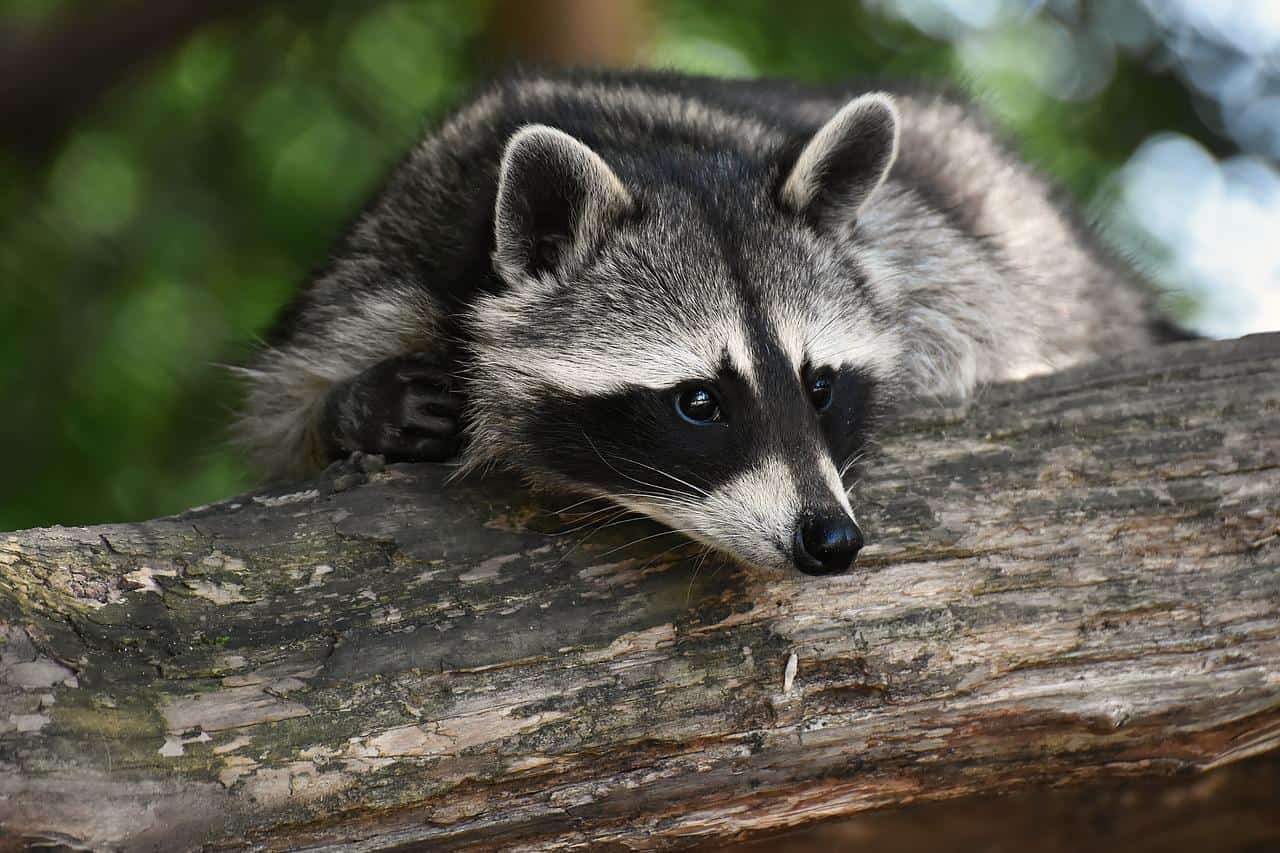
The raccoon is one good-looking, ninja-masked mammal native to North America and the northernmost regions of South America. It looks so much like and is also about the same size as the red panda. It even has the same ringed bushy tail. However, both animals are not truly related.
In total, there are seven different species of raccoons currently living on Earth. In addition, 22 named raccoon subspecies were recognised, some of which live in Central America. That said, the animal had already appeared on our planet around 25 million years ago, according to the fossil record.
Interestingly, those ancient raccoons were reportedly living in Russia. But at some point in time, around 19 million years ago, they crossed the Bering Strait which separates Asia from North America. So they had been residing there ever since.
The most common raccoon species is actually called the common raccoon and it lives in North America. This species in particular is what we are discussing today.
Raccoons live for an average of five years in the wild. If the animal’s habitat is abundant with food and less prone to threats from predators, raccoons can live up to 10 years. When being taken care of by humans, they can even live longer, up to 13 to 20 years.
That said, around half of the newborn raccoons die during their first year because of diseases such as canine distemper and rabies—a disease caused by the bite of rabid animals such as rabid dogs. Baby raccoons also get killed by predators. They sometimes lose their mothers or starve, especially during severe winters.
A male raccoon is called a boar, a female is a sow, and babies are kits.
Appearance
Though it might look the same size as a domestic cat, the raccoon is twice as large.
The raccoon has a body length of 40 to 70 cm with a long bushy ringed tail measuring between 20 and 40 cm. The animal is 23 to 30 cm tall at the shoulders.
Interestingly, the weight of the raccoon varies dramatically based on where it lives, with males being about 20% at maximum heavier than females. On average, the raccoon weighs between 5 and 12 kg. But some common raccoons living in different areas in North America can grow to 26 kg. The largest raccoon was reported to weigh 28.4 kg and measured 140 cm, from snout to tail.
The raccoon’s body is covered with a fluffy, quite long-haired grey fur coat which protects it from the winter cold. Interestingly, this coat is not of a single colour but many. The colours range from iron-grey to black with some brownish parts.
The raccoon’s fur releases moisture that encapsulates the hairs. This makes them better at insulating the body. In addition, the raccoon’s body has a special cooling system to help regulate its internal temperature in relation to the outside temperature.
Another distinct feature of the raccoon’s appearance is its multi-coloured face. For instance, there is a beautifully-looking, ninja-like, black mask around the raccoon’s eyes. Interestingly, this black mask is said to help enhance the animal’s vision in the presence of light as well as at night.
The raccoon’s cheeks and eyebrows are white and the forehead is grey. The ears are round and the muzzle is pointed.
Raccoons have pretty unique paws that allow them to do different functions. These paws look similar to human hands as they have what looks like five fingers. However, they are not fingers but are rather called digits. They also have sharp claws which make it easy for them to scratch and clean themselves, climb trees, swim, and dig holes.
Despite the lack of a thumb, raccoons use their front paws to grab and open things. These front paws are also hyper-sensitive, making the animal enjoy a sharp sense of touch that allows it to examine objects. If the animal happens to be underwater catching prey, its paws become even more sensitive since water softens the hard skin on them.
In addition, these sensitive paws have strong whisker-like hairs that enable the raccoon to identify objects even before touching them.
The raccoon has short legs. That is why it usually walks slowly and cannot run or jump a long distance. Its maximum running speed ranges between 16 to 24 km/h which apparently does not seem very competitive in the animal world. On the other hand, common raccoons can swim at a speed of 5 km/h on average.
Feeding
The raccoon is known to be omnivorous. That means its diet has a variety of foods including both plants and meat. In more detail, raccoons eat fruits and nuts which are their favourite foods. Other food options also include fish of different kinds, turtles and frogs, rodents such as mice, rabbits, and insects.
That said, the raccoon’s food is different based on the season. For instance, fruits with nuts are usually available and abundant at the end of summer and during autumn. So this is when the animal eats a lot of them. Other than that, the raccoon’s diet mostly consists of insects and worms.
Besides the different food options we just mentioned, raccoons also feed on the eggs and hatchlings of birds, lizards, snakes, and turtles. In some areas, raccoons are threatening some of these species and need immediate relocation.
Speaking of when they forage, raccoons are usually active and look for food during the night. This is referred to as being nocturnal. Yet, if food is pretty available, raccoons would sometimes forage during daylight as well. And this is when they become pretty picky about what they eat.
During winter, raccoons go into a deep rest state in which they reduce their physical activity to the minimum. This helps their bodies preserve the energy until they are able to go out to eat again in spring.
So to get ready for the winter, raccoons eat too much that sometimes they double their weight. This way, they build a fat layer to provide them with extra warmth as well as the required energy to survive the winter.
Having said that, raccoons themselves are prey for other predators such as great-horned owls, bobcats, and lynxes. Lynxes are medium-sized cats that look more like snow leopards and wolves respectively. Other predators that attack raccoons are the cougar, the jaguar (big cat species), the American black bear, grey wolves, American alligators, and some eagle species.
Oh boy! It seems like raccoons spend their entire life just hiding from all these predators!
Breeding
Adult male and female raccoons are mature enough to breed at the age of two years and one year respectively. Mating occurs once a year, usually during winter, from late January to mid-March. But sometimes, based on the habitat, the mating season can extend up to June.
That said, if a mother loses her kits to diseases, predation, or starvation, she breeds again and soon enough she gives birth to some other kits.
A female raccoon usually stays pregnant for 54 to 70 days, with 65 days being the most common period. During pregnancy, females find or build dens for their upcoming babies which they make sure are warm and safe. Dens are usually built in hollow trees and riverbanks. Females may also occupy abandoned dens that belonged to other animals such as the beaver.
Females usually give birth to two and up to five kits depending on where they live. For instance, they tend to give birth to more than two kits in areas where raccoons are threatened by harsh winters or are hunted by humans. It is as if nature is compensating for the decrease in raccoon numbers in such areas.
Kits are born almost completely helpless. They are blind and deaf and they have short light fur. They only measure 10 cm long and weigh between 60 and 75 g. Around 20 days or a little more after birth, they can open their eyes. By this time, kits have also developed a relatively fine hearing ability as their ear canals opened.
Raising kits is the sole responsibility of mothers, to which fathers do not usually participate. Mothers nurse their kits for around six weeks, feeding them nutrition-rich milk which enables them to grow up to 1 kg. This is when kits begin to get out of the den and explore the surrounding areas. Right about this time too, kits begin to consume solid food such as nuts, fruits, insects, and rodents while they are still nursing.
When kits grow to 16 weeks old, their mothers start reducing their nursing frequency until they eventually stop.
When kits grow into juveniles, mothers start to educate them about how to survive in the wild. For instance, they show them what they should eat, where they can get it, and how to catch prey. They also show them the way back to the den so they do not get lost.
Gradually, juveniles grow independent and eventually separate. This usually happens when they are one year old. Males tend to go far away from their birthplace, sometimes even further than 20 km away. On the other hand, females tend to stay closer to their mothers.
Skills
Besides their perfect sense of touch which is highly supported by their sensitive paws, allowing them to recognise, hold, and examine objects closely, raccoons enjoy some other skills that may have earned them the trait sneaky.
Based on the observations of zoologists and numerous experiments that were done during the second half of the 20th century, raccoons seem to possess a high level of intelligence as well as cleverness that they sometimes compete with foxes. Raccoons also proved to have a strong memory even after three years of the experiment.
Additionally, raccoons have shown a surprising act of cleanliness. They use their paws to grab objects. Then, they rub them to trim or remove any unwanted parts. Raccoons were also seen to bring their food to the water to wash it or pour some water on it before they eat it.
Besides examining and rubbing objects, raccoons can also open doors, windows, rubbish cans, and even locks. They can fit their bodies through holes as small as 10 cm wide. This makes sneaking into humans’ houses pretty easy for them. So they get inside houses and open fridges to look for food. They even steal people’s objects to either play with them or just keep them at their dens.
Behaviour
Raccoons are territorial. They define the areas in which they live and forage as their home range. Usually, adult raccoons, whether males or females, claim larger areas to themselves than those defined by juveniles.
Raccoons were found to live in groups of either males or females. Such groups are called gazes. Females sharing the same blood often form a gaze and share the same area where they live and look for food. They live in these areas with their kits until the latter grow up and move out. Females also split from their gazes when it is time to breed.
On the other hand, unrelated males seem to define themselves based on their physical strength. They form gazes of up to four individuals, each with a different social rank. High-ranking males are stronger. They have better chances of mating than lower-ranking ones. Those are usually the weaker members of the gaze. That said. Same-gaze members unite to protect one another against any invasion by other raccoons.
Sometimes males may show some aggressive behaviour towards the kits of other unrelated males. In such a case, mothers strive to protect their kits by making sure they do not leave the den until they are old and big enough to defend themselves.
Threats
Raccoons are classified as ‘least concern’ by the International Union for Conservation of Nature. That means the animal is found in plentiful numbers in the wild and is not currently facing any dangers of extinction.
However, raccoons do encounter several threats that can affect their population. On the other hand, they themselves impose huge threats to humans.
Threats on raccoons
For tens of years, raccoons have been hunted for their dense, shaggy fur which was and is still used to make clothes such as coats and caps. Because such a practice has been very common, it was called coon hunting. Coon hunting killed two million raccoons in 1963 and 1964.
Raccoons were also killed for their meat as some native tribes in North America used to consume it. However, that is not quite common anymore.
Threats by raccoons
Since raccoons are distinct for fast adaptability, some species of them move to cities and live near and around humans who they do not really fear. In the wild, raccoons eat both plants and animals. But in the city, they feed on whatever leftovers they find. They steal pets’ food and look in the garbage for any edible things.
This made their numbers in some of the big cities increase dramatically. They even build their dens in and around buildings, coming too close to humans.
The existence of raccoons very near to humans poses threats to human health and human property as well. Unfortunately, raccoons are prone to several diseases which they can potentially transmit to humans.
One example of such diseases is rabies. Rabies is a virus that infects the nervous system of mammals. It can be transmitted to an uninfected animal by the saliva of or with a bite from a rabid animal.
Rabies is a dangerous disease and does lead to death. When raccoons are found in large numbers in cities, humans become at risk of getting rabies infections. This is quite a critical problem in the USA. That is why several efforts are done to push raccoons away and back to their habitat. Many people tend to hunt, poison, or trap raccoons to prohibit them from getting into their houses.
That said, many other humans sometimes encourage the prolonged presence of raccoons in urban areas when they offer them food. Though such an act is kind, it somehow makes raccoons dependent on humans for food. Like stray cats, soon enough raccoons will come back to the same person to feed. They may even bring their friends!
Conclusion
And now we get to the end of today’s lesson.
In this article, we talked to you about the common raccoon, a North-America-native mammal that competes with the fox over being sly, cunning, and clever.
We demonstrated some interesting information about the raccoon’s attractive look characterised by its dense, shaggy, greyish fur coat, black eye mask, and ringed tail. We also discussed the raccoon’s diverse diet which allows it to eat a variety of plants, animals, fish, insects and even some birds’ eggs and nestlings.
Additionally, we discussed the behaviour of raccoons as well as their exceptional skills that earned them the name sly. As a result, we can now be sure that RJ from Over the Hedge was not badly portrayed.
Finally, we talked a little about the threats raccoons face and how they themselves are a threat to humans.
We hope you found today’s zoology lesson interesting. Tell us in the comments what you liked the most about the raccoon and whether or not you have watched or are planning on watching Over the Hedge.
Geometric jewellery is an artistic convergence of precise shapes and deliberately crafted angles, blending the mathematical rigour of geometry with the fluidity of design. We see the essence of shape...
Mathematics and nature intertwine in fascinating ways, creating patterns and sequences that delight and educate. As we observe the world around us, we find that counting petals and leaves isn't...
Maths on the farm is not just about profits and yields; it's a fundamental part of daily farm life, especially when it comes to managing livestock. Our days begin with...



Leave a Reply