5 Brilliant Learning Methods for Children: A Complete Guide
Table of Contents
Ask ten UK primary teachers about learning methods and how children learn best, and you will get ten different answers. Some will mention visual learners. Others will talk about hands-on activities, songs, or getting children up and moving. A few will point you towards cognitive science and terms like retrieval practice or dual coding. Every one of those answers describes something real. Only some of it holds up when researchers test it properly.

This guide covers five learning methods with strong evidence behind them, plus two structured approaches that many British primary schools already use. Each method comes with a classroom version and a kitchen-table version. The same principle works in a Year 4 maths lesson and during ten minutes of homework help. The methods here map onto National Curriculum expectations across Key Stage 1 and Key Stage 2. They sit comfortably alongside LearningMole’s [internal link: primary teaching resources hub] for planning purposes.
It is written for primary teachers, parents supporting learning at home, and home educators building their own sequence. LearningMole is a UK educational platform providing curriculum-aligned teaching resources for primary schools, and these approaches shape how we design our video content. Michelle Connolly founded LearningMole after fifteen years in the classroom, and the practical suggestions throughout come from that teaching background rather than from theory alone.
How Children Actually Learn: Beyond Learning Styles

Children do not have fixed learning styles that determine how they must be taught. Decades of testing have failed to show that matching a lesson to a child’s stated preference improves what they actually retain. The idea is comfortable and widespread, but the evidence for it is thin.
What is true is simpler and more useful. Children have preferences. Some enjoy listening, some prefer looking, some want to move and build. Those preferences are real and worth knowing about. They just do not predict how a child learns most effectively.
Here is the traditional three-part model, which you will still hear in staffrooms and parent evenings:
- Auditory learners are said to learn by listening, through talk, songs, and stories.
- Visual learners are said to learn by seeing, through pictures, diagrams, and written words.
- Kinaesthetic learners are said to learn by moving, through building, drawing, and physical activity.
The useful part of this model is that it reminds adults to teach in more than one way. The unhelpful part is the labelling. Once a child is told they are a visual learner, they may avoid listening tasks or reading tasks that they need. Almost every topic in the primary curriculum is best taught through several channels at once, for every child in the room.
Ofsted’s Quality of Education framework asks a different question. It looks at whether children retain what they have been taught over the long term, not whether lessons matched a preference. That shift, from how a lesson feels to what sticks afterwards, is where the five methods below come in.
| Old habit | Evidence-based method | The primary benefit |
|---|---|---|
| Re-reading notes or a page | Retrieval practice | Children pull knowledge out, which strengthens memory |
| Cramming the night before | Spaced repetition | Short, repeated sessions slow down forgetting |
| Copying text from the board | Dual coding | Words plus a sketch give two routes back to the idea |
| Doing twenty of the same sum | Interleaving | Mixing question types teaches children to choose a strategy |
| Marking work and moving on | Metacognition | Children learn to spot what they do not yet understand |
| Labelling a child as one learner type | Multi-channel teaching | Every child gets sound, image, and movement |
Retrieval Practice: Bringing Knowledge Back Out

Retrieval practice means asking children to recall something from memory without looking at their book. The act of retrieving strengthens the memory far more than reading the same page again. It is the single highest-value change most classrooms and kitchen tables can make.
The mechanism is worth understanding, because it explains why the method feels hard. When a child re-reads a page, everything looks familiar, so it feels like learning. When a child tries to recall the same content cold, some of it will not come. That difficulty is the point. Effortful recall is what builds the durable memory that Ofsted inspectors describe as sticky knowledge.
“Quizzing isn’t only for testing what children know. It’s one of the strongest ways to help them learn it in the first place. That surprises a lot of teachers when they first hear it.” , Michelle Connolly, Founder of LearningMole and former teacher with over 15 years of classroom experience
In the classroom
Start lessons with four or five low-stakes questions on the board. Two from last lesson, two from last week, one from last term. Children answer in exercise books, then you go through the answers together. No marks recorded, no pressure attached. Five minutes, every lesson.
Brain dumps work well from Year 3 upwards. Give children a blank page and two minutes to write everything they can recall about the Romans, or fractions, or the water cycle. Then let them add in a second colour after discussion with a partner. What they add in that second colour tells you exactly where the gaps sit.
At home
The dinner table quiz needs no preparation. Three questions about anything your child has been learning, asked while you are cooking or driving. Getting an answer wrong matters less than making the attempt.
Flashcards work if children use them properly. The rule is to say the answer out loud before turning the card over. Children who flip straight to the answer are re-reading, not retrieving, and they get very little from it.
Spaced Repetition: Little and Often Beats Cramming

Spaced repetition means revisiting the same material across several short sessions rather than one long one. Ten minutes on Monday, Wednesday, and Friday will beat thirty minutes on Friday alone. The gaps between sessions do the work.
Hermann Ebbinghaus described the forgetting curve in the 1880s, and the finding has held up ever since. Memory for new material drops sharply within days unless something interrupts the decline. Each review flattens the curve a little more, so the same knowledge survives longer before the next top-up is needed.
Weekly spelling tests already use this principle, though most schools use it accidentally rather than deliberately. The improvement comes from adding older words back in. A Year 4 list of ten new spellings plus three from a fortnight ago will produce better long-term results than ten new words alone.
For SATs preparation in Year 6, spacing matters more than volume. Twenty minutes of arithmetic three evenings a week from January will outperform an hour every night in April. Children arrive at the test with knowledge that has already survived several rounds of forgetting and recovery. LearningMole’s short video format suits this pattern, since a single topic video can be revisited in a few minutes rather than requiring a full session.
Dual Coding: Words and Pictures Together
Dual coding means presenting information as words and as a visual at the same time. The brain then stores two connected versions of the same idea. Children who have both a verbal and a visual route back to a concept recall it more reliably than children who have only one.
Allan Paivio proposed the theory in the 1970s, and it explains something teachers observe constantly. A child who cannot define evaporation in words can often draw the water cycle correctly and talk you through the drawing. The picture gave them a hook that the definition did not.
The method is not about handing children a finished diagram. Children get most benefit when they produce the visual themselves, however rough it looks. A two-minute sketch of a Viking longboat with three labels will do more for retention than a beautifully printed worksheet they only look at.
How to use it in primary teaching
Ask children to sketch the process, not the object. For the water cycle, that means arrows and stages rather than a pretty scene. For a story, that means a timeline of events rather than a portrait of the main character.
Keep labels short. Three or four words per label forces children to identify what matters. Long captions turn the exercise back into copying.
Talk over the drawing. The child explains their sketch aloud while you listen. That combination of speaking and pointing is where dual coding does most of its work, and it takes under a minute per child.
This is why video works well for primary-aged children. A good educational video shows a process moving while a voice explains it, which is dual coding delivered in its natural form. Our curriculum-aligned videos at LearningMole are built around that pairing, particularly for science and maths topics where abstract ideas need something concrete attached to them. You can find examples across KS2 science video resources.
Interleaving: Why Mixing Topics Beats Blocking
Interleaving means mixing different problem types within one session instead of grouping them. Ten mixed questions across addition, fractions, and measurement will produce better long-term learning than ten fraction questions in a row.
LearningMole’s maths videos are sequenced to support this mixing across a unit. Blocked practice feels better while you are doing it. Children get into a rhythm, accuracy climbs, and the page looks successful. The catch is that after the first two questions, children stop deciding which method to use. They are practising the procedure but not the judgement.
Interleaved practice feels worse and works better. Accuracy dips, children pause more, and the page looks messier. That pause is a child asking themselves what kind of question this is, which is precisely the skill a SATs arithmetic paper tests.
Start small. A Year 5 maths session might use eight blocked questions to secure the method, then six mixed questions drawn from the past three weeks. In English, mix spelling patterns rather than drilling one rule for a fortnight. The mixing works best once children have some grasp of each individual method, so introduce it after teaching rather than during it.
Metacognition: Helping Children Think About Thinking
Metacognition means a child noticing how their own learning is going and adjusting it. The Education Endowment Foundation rates metacognition and self-regulated learning among the highest-impact, lowest-cost approaches available to primary schools.
For a seven-year-old, the phrase itself is unhelpful. The behaviour is not. A child who says “I got stuck on the second step so I drew it out” is doing metacognition, whatever you call it. Your job is to make that kind of thinking visible and routine.
The most practical route is a short set of questions used consistently. Children need to hear the same prompts often enough that they start asking them without you.
- What was hard about that, and why?
- What did I try first? Did it work?
- What would I do differently next time?
- Which bit could I now teach to someone else?
LearningMole’s teaching guides include prompt sheets built around questions of this kind. Model the thinking aloud yourself. When you solve a problem in front of a class, narrate the wrong turns as well as the right ones. Say “I thought I would need to multiply here, then I checked and realised it was division.” Children who only ever see adults get things right conclude that being stuck means being stupid. It does not.
Keep it brief. Two minutes at the end of a lesson is enough. Long reflection tasks tend to produce children writing what they think you want to read, which teaches nothing.
Structured and Play-Based Learning Methods
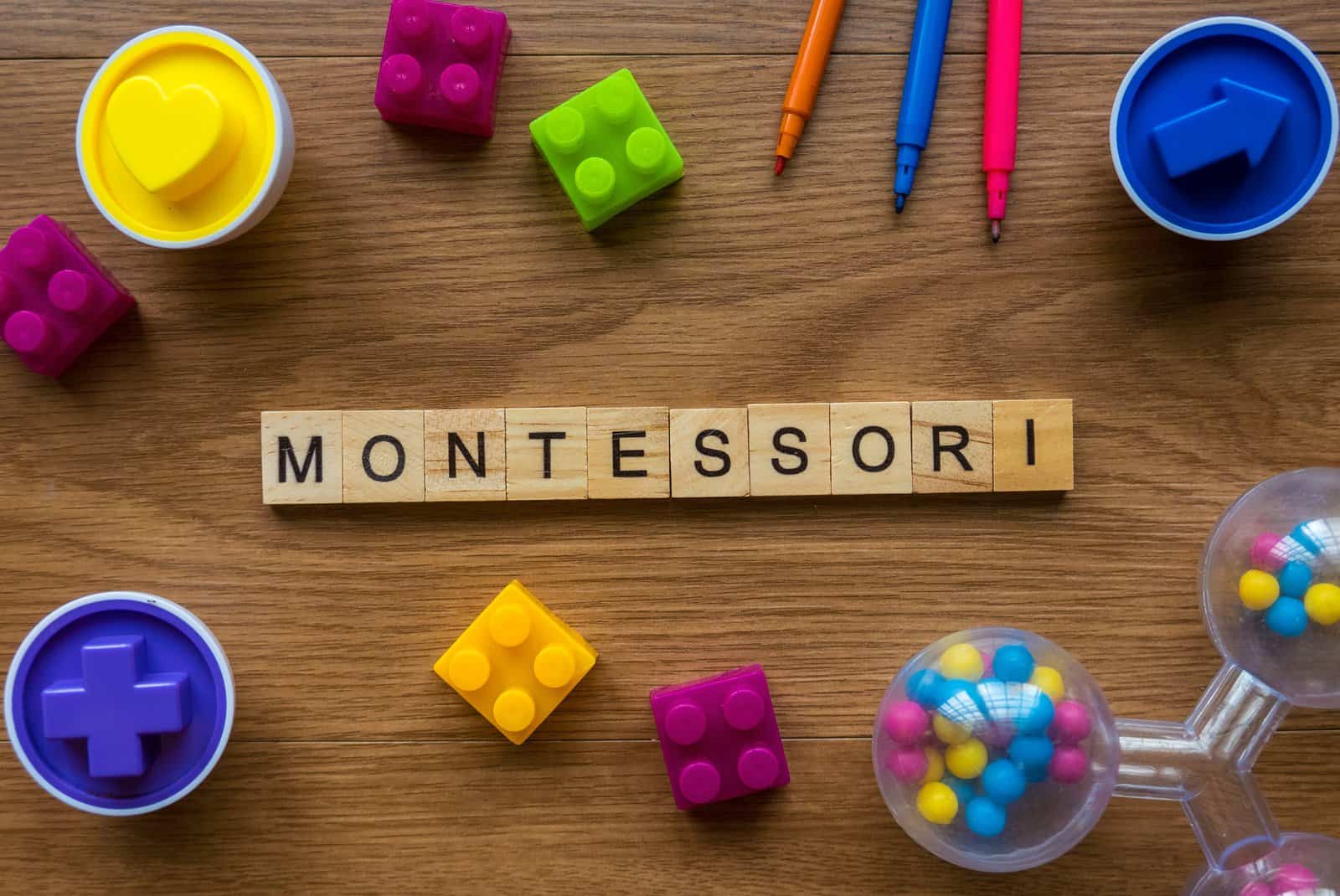
Structured and play-based approaches describe how a whole learning session is organised, rather than how one piece of knowledge is committed to memory. The two best-known examples in primary education are Montessori and Reggio Emilia. Both sit comfortably alongside the five cognitive methods above.
The Montessori method: a worked example
A structured learning method follows a defined path, with clear goals and a predictable shape. Children come to understand the rhythm of a session, which supports independence. The teacher acts as a guide rather than a source of answers.
Here is a Montessori transferring lesson, the kind used with children in Reception and Year 1. The skill is moving items from one bowl to another with a spoon. The adult can be a teacher, parent, grandparent, or childminder.
Step 1. The adult names every item on the tray out loud. Spoon, bowl, beans. This gives the child the vocabulary before anything else happens.
Step 2. The adult demonstrates in silence. Pick up the spoon, transfer the items one at a time, then return them. No commentary at all during this stage, so the child watches rather than listens.
Step 3. The child practises. They repeat as many times as they want, over as many sessions as they need. No correction unless safety is involved.
The sequence matters more than the activity. Name it, show it in silence, then let them do it. Doing all three at once overloads children, and overloaded children either disengage or start acting up. That separation of channels is the genuinely useful part of the Montessori approach, and it transfers to almost any primary skill.
The Reggio Emilia approach
Reggio Emilia is a philosophy rather than a curriculum. Learning is play-based, children direct much of the direction of travel, and teachers work as co-learners alongside them. Classrooms hold open-ended materials rather than single-outcome resources.
A typical sequence starts with a story read in a circle. Children listen and follow the illustrations. The adult then adds a movement or two and hands over control. Some children sing, some act out an animal, some invent a different ending. Where it goes is up to them.
Children who play explore, take small risks, use imagination, and solve problems. Those are the same skills that show up later as resilience in maths and willingness to draft and redraft in writing. Play-based work in EYFS and KS1 is not a break from academic learning. It is where several of the habits behind it are formed.
You are not obliged to pick one approach. Structured sessions suit skills with a correct sequence, such as letter formation or column addition. Play-based sessions suit open questions where several answers work. Most effective primary teaching moves between the two across a week.
Choosing a Learning Method That Fits the Task
Match the method to what you are trying to teach, not to the child. This is the practical reversal of learning styles thinking, and it is the single most useful planning habit to build.
| What you are teaching | Method to reach for | Why it fits |
|---|---|---|
| Facts that must be recalled quickly (times tables, spellings, key dates) | Retrieval practice plus spacing | Speed comes from repeated recall, not from understanding alone |
| Processes with stages (water cycle, long division, story structure) | Dual coding | The stages need a visual shape to hang on |
| Choosing between methods (mixed arithmetic, grammar in context) | Interleaving | The skill being tested is the choosing |
| New physical skills (handwriting, using equipment) | Structured demonstration | Silent modelling prevents overload |
| Open-ended topics (creative writing, exploring a theme) | Play-based enquiry | Several answers are legitimate |
| Any topic where children keep repeating the same error | Metacognition prompts | The error is usually in the approach, not the knowledge |
Two practical cautions. First, none of these methods rescues content a child has never been taught properly. Retrieval practice on material that was never understood produces frustration and nothing else. Teach it, then practise retrieving it.
Second, the methods that work best feel harder than the ones that do not. Children and parents often read that difficulty as a sign something has gone wrong. Saying so out loud helps. Telling a child that a slower, messier session usually means more learning is happening removes a lot of unnecessary worry.
Teaching Resources and Support

LearningMole provides curriculum-aligned videos and teaching materials that support every method described above. The resources are built for children aged 4 to 11 and mapped to National Curriculum objectives across Key Stage 1 and Key Stage 2.
For teachers, ready-made resources save planning time. Short topic videos work as retrieval prompts at the start of a lesson. They also serve as the visual half of a dual coding task, where children sketch and label what they have just watched. Because each video covers one idea, revisiting a topic three weeks later takes minutes, not a full lesson. You can browse subject areas through the KS1 and KS2 resource library.
For parents, the same material supports home learning without requiring you to teach. Watch a short video together, then ask your child to explain it back without looking. That single habit turns passive viewing into retrieval practice. Home educators can use the sequencing across home learning resources to build spaced review into a weekly plan.
For children with SEND, LearningMole pairs visual demonstration with clear narration. That combination reduces the reading load for many learners with dyslexia and attention difficulties. Teaching assistants and SENCOs use the videos as additional visual reinforcement without having to build separate resources. Further guidance sits in differentiation and SEND strategies.
Frequently Asked Questions
What is the most effective learning method for primary school children?
Retrieval practice has the strongest evidence base of any single method. Children recall information from memory rather than re-reading it, which strengthens the memory itself. It costs nothing, needs no equipment, and works from Year 1 upwards. Combining it with spaced repetition across several short sessions produces the biggest gains.
Do visual, auditory and kinaesthetic learning styles actually work?
Children have genuine preferences, but matching teaching to a stated preference has not been shown to improve results. Testing has repeatedly failed to support the model. What does help is teaching through sound, image, and movement together, for every child. Treat preferences as useful information about engagement rather than instructions about how to teach.
How can I help my child revise for SATs using these methods?
Use spaced repetition and interleaving. Twenty minutes three evenings a week from January beats an hour nightly in April. Mix arithmetic question types within each session rather than blocking them. Add a short retrieval quiz on older topics. Cramming produces recall that fades within days, which is no use in May.
Which learning methods work best for children with SEND?
Dual coding and multi-sensory retrieval tend to help most. Pairing a clear visual with spoken explanation reduces the reading load for children with dyslexia. Short, spaced sessions suit children with attention difficulties better than long ones. Metacognitive prompts help children who have strategies but struggle to choose between them. Individual needs still vary considerably.
How do I explain metacognition to a seven-year-old?
Call it thinking about your thinking, then make it practical. Ask what was tricky, what they tried first, and what they would change next time. Children do not need the word to do the thing. Modelling your own stuck moments aloud teaches it faster than any explanation.
What is the difference between Montessori and Reggio Emilia?
Montessori uses structured sequences with defined skills and a set order of steps, guided by the adult. Reggio Emilia is play-based and child-led, with teachers acting as co-learners and open-ended materials on offer. Montessori suits skills with a correct method. Reggio Emilia suits open exploration. Many primary settings borrow from both.
How long should retrieval practice take at home?
Three to five minutes is plenty. Ask three questions about something learnt in the past fortnight, with no writing involved. Frequency matters far more than length. A short quiz four times a week produces better retention than one long revision session at the weekend, and children resist it far less.
Where can I find resources that support these learning methods?
LearningMole’s video library and downloadable materials cover maths, English, science, and humanities for ages 4 to 11, aligned to the UK National Curriculum. Short single-topic videos suit retrieval and spaced review particularly well. Free content is available on the website and the LearningMole YouTube channel, with subscription access opening the full library.
Where to Start This Term
Pick one method and use it properly for half a term before adding another. Retrieval practice is the sensible first choice, because it needs no resources and shows results quickly. Five questions at the start of every lesson, or three at the dinner table, is enough to begin. Once that has become automatic, add spacing by pulling older topics into the same routine.
The harder shift is expectation. These methods produce lessons that look less polished and sessions that feel slower. Children get more wrong in front of you, and pages look messier. That discomfort is a reasonable sign the work is doing something. Saying so to children and parents removes a good deal of anxiety.
None of this replaces knowing your class or your child. The five methods here tell you how to make learning stick once it has been taught well. What to teach, when to push, and when to leave something alone still comes from the adult in the room. LearningMole’s curriculum-aligned resources are designed to take some of the planning weight off that adult, so more of the attention goes where it counts. Browse the full resource library or watch free videos on the LearningMole YouTube channel to get started.


Leave a Reply