Every country has landmarks that tell its story, and few do this better than the Eiffel Tower. Rising over Paris since 1889, this iron giant has survived demolition plans, a change of colour, and more than a century of French weather to become one of the world’s most recognised structures.
This guide brings together ten facts that work well for primary classrooms and family learning, covering the tower’s history, its unusual engineering, and its more recent green makeover. The topic connects naturally to the UK National Curriculum, particularly KS2 History (significant world events), KS2 Geography (world landmarks), and KS2 Design and Technology (structures and materials), making it a useful addition to any study of famous buildings or the Victorian era.
Whether you’re planning a lesson on world landmarks or a child simply wants to know why the tower gets taller in summer, these facts go beyond the basics you’ll find on most sites. For a broader look at how landmarks fit into primary geography teaching, LearningMole’s world landmarks and continents resources cover similar ground across every continent, giving teachers a wider set of reference points to draw on.
Why Was the Eiffel Tower Built?
The Eiffel Tower was built as the entrance arch for the 1889 World’s Fair in Paris, held to mark the 100-year anniversary of the French Revolution. French engineer Gustave Eiffel won a design competition against more than 100 other entries, and construction began on 28 January 1887.
It took just over two years to finish, an astonishingly fast build for something so tall. Eiffel didn’t design it alone. Structural engineers Maurice Koechlin and Émile Nouguier worked out the tower’s shape and framework, while architect Stephen Sauvestre added the decorative arches at the base. Around 300 steelworkers assembled the tower’s 18,000-plus iron parts on site, a genuinely huge undertaking for the 1880s, and one that finished on schedule despite the tower’s complex design.
Many people don’t realise the tower was never meant to be permanent. Read on for the full story of its narrow escape, and for a closer look at the man whose name it carries.
Who Was Gustave Eiffel?
Gustave Eiffel was a French civil engineer who built his reputation on bridges and metal structures long before Paris gave him its most famous monument.
Born in 1832, Eiffel trained as a chemical engineer before moving into metal construction, where he made his name designing railway bridges across France and beyond. His company also contributed to the internal iron framework of the Statue of Liberty, working alongside French sculptor Frédéric Auguste Bartholdi, which explains why the Eiffel Tower and the Statue of Liberty share a family resemblance in their engineering.
Eiffel’s skill lay in creating structures that were both strong and remarkably light, using open lattice ironwork rather than solid walls, a technique that allows the Eiffel Tower to stand so tall without the weight of a solid stone building. This background in bridge engineering explains why the tower’s lattice framework looks so different from a typical Victorian-era monument, and why it has stayed structurally sound for well over a century.
1. It Was Only Meant to Last 20 Years
The Eiffel Tower had a 20-year permit from the city of Paris. After that, the plan was to take it down and sell the iron for scrap.
This wasn’t unusual for World’s Fair structures, which were often built as temporary showpieces rather than permanent additions to a city. What saved the tower was its height. Nothing else in Paris came close, which made it perfect for a use nobody had planned for when it was built: sending radio signals across long distances. That single discovery changed the tower’s fate completely, and it’s worth reading on for the full story below.
2. The Eiffel Tower Grows Taller in Summer
The Eiffel Tower can grow by around 15 centimetres (roughly six inches) on a hot summer day compared with a cold winter one.
This happens because of thermal expansion. The tower is made almost entirely of wrought iron, and, like most metals, it expands slightly when heated and contracts when cooled. On a warm day, the sun heats the side of the tower facing it more than the shaded side, which can even make the top lean very slightly away from the sun until temperatures even out across the whole structure. Engineers have measured this shift precisely, and it’s one of the clearest real-world examples of thermal expansion that primary pupils are likely to encounter.
Did you know? If you measured the Eiffel Tower first thing on a freezing January morning and again during a heatwave in July, you could see a height difference taller than most Year 3 pupils standing on each other’s shoulders.
This is a brilliant, real-world way to introduce KS2 pupils to how materials behave when they’re heated, something LearningMole’s materials and their properties resources for KS2 explore in more depth through hands-on classroom experiments comparing how different materials react to changes in temperature.
3. It Was Originally a Different Colour
When it was first built, the Eiffel Tower was a reddish-brown colour, not the bronze shade most people picture today.
Since then, its colour has changed several times, moving through various shades of yellow-brown before settling on the custom bronze tone used now, sometimes called “Eiffel Tower Brown.” The tower gets repainted roughly every seven years to protect the iron from rust and corrosion, and each repaint uses a slightly different shade of paint so restorers can track how many coats have built up over the decades.
Weather plays a big part in this decision. Rain, wind, and temperature swings all wear away at exposed metal, so repainting isn’t just about appearance; it’s essential maintenance for a structure that’s been standing since 1889.
4. There’s a Secret Apartment at the Top
Gustave Eiffel kept a private apartment for himself near the top of the tower, and it’s still there today.
He used it as a place to work and to entertain guests away from the crowds below, including notable visitors such as the inventor Thomas Edison. Compared with the noise and heights most workers dealt with during construction, it’s an oddly cosy detail, furnished more like a Parisian sitting room than a working office at the top of an iron tower.
Visitors can now see the apartment recreated with wax figures through viewing portholes on the top level, giving children a genuine sense of what Eiffel’s daily life at the tower might have looked like while it was still a brand-new, controversial addition to the Paris skyline.
5. Repainting the Tower Takes Over a Year
A full repaint of the Eiffel Tower takes between 15 and 18 months and uses around 60 tonnes of paint.
Painters work in sections rather than tackling the whole structure at once, using ropes and harnesses to reach the trickiest parts of the iron lattice safely. The job is physically demanding and highly skilled, as painters work at extreme heights while applying an even coat across thousands of individual iron beams and joints. Because the repaint happens roughly every seven years, there’s rarely a point when some part of the tower isn’t being repainted or prepared for its next coat, making it a genuinely continuous maintenance job rather than an occasional one.
6. Parisians Used to Hate It
When the Eiffel Tower first went up, plenty of Parisians thought it was ugly.
A group of artists and writers, including novelist Guy de Maupassant, signed a public protest calling it an eyesore that would ruin the city’s appearance. They argued that a modern iron structure had no place among Paris’s older stone buildings and elegant boulevards. Ironically, Maupassant reportedly regularly ate lunch at the tower’s restaurant, saying it was the only place in Paris where he didn’t have to look at it.
Public opinion shifted gradually over the following decades, helped along by the tower’s usefulness for radio broadcasting, and it’s now one of the most photographed structures on Earth.
7. Radio Waves Saved the Tower From Being Torn Down
The Eiffel Tower avoided demolition because it turned out to be an excellent radio antenna.
From the early 1900s, engineers used the tower’s height to test long-distance wireless communication, something no other structure in Paris could offer at the time. Its usefulness for military and civilian radio, and later television broadcasting, gave Paris a strong reason to keep it standing well past its original 20-year permit. During the First World War, the tower’s antenna was even used to intercept enemy radio signals, adding a genuinely dramatic chapter to what started as a fairground attraction.
This connects neatly with wider KS2 science topics on electricity and communication, an area LearningMole’s history of radio for curious young scientists explores through its own set of classroom-ready facts about early wireless technology.
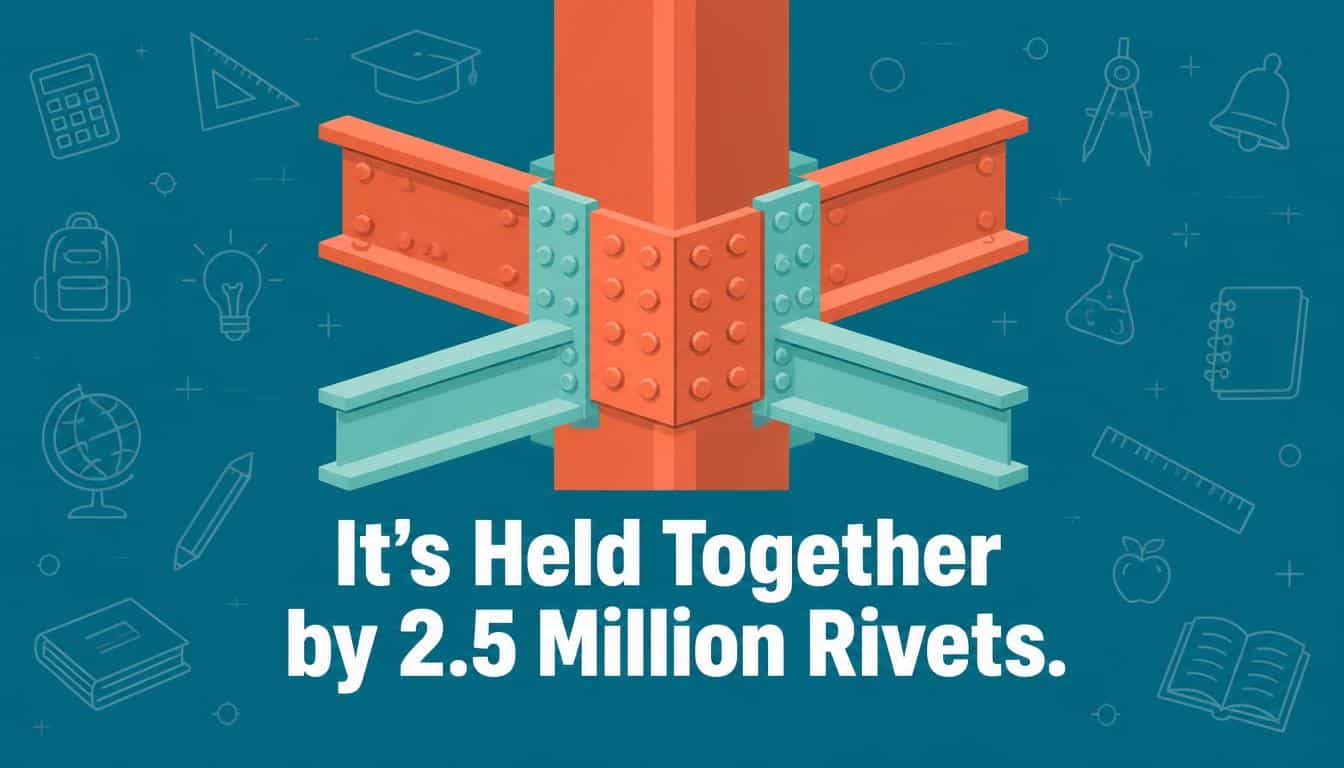
8. It’s Held Together by 2.5 Million Rivets
The Eiffel Tower doesn’t use welding or modern bolts. Instead, it’s held together by more than 2.5 million iron rivets.
Rivets work by joining two pieces of metal with a heated metal pin that’s hammered flat on both ends as it cools, locking the pieces together permanently. It’s a joining method that predates modern construction techniques but proved strong enough to support a 330-metre iron structure for well over a century, through storms, temperature swings, and millions of visitors climbing its stairs. This is a genuinely useful entry point for KS2 Design and Technology lessons on structures and joining materials.
A simple classroom challenge, such as building the tallest tower possible from spaghetti and marshmallows that can still hold the weight of a small object, gives pupils a hands-on feel for the same design problems Eiffel’s engineers had to solve, just at a much smaller scale. LearningMole’s STEM and engineering resources for KS2 include practical bridge-building and structure-testing activities that let children experiment with similar joining principles themselves.
9. The Eiffel Tower Has Gone Green
Since 2015, the Eiffel Tower has used wind turbines to generate some of its own electricity.
Two wind turbines sit on the second level of the tower, hidden within the ironwork so they blend into the structure rather than standing out against the historic skyline. Together they produce around 10,000 kilowatt-hours of electricity a year, enough to power the shops and facilities on the first floor.
The same renovation added rainwater collection systems for the toilets, solar panels to help heat water for the visitor pavilions, energy-efficient heat pumps, and LED lighting throughout the lower levels, replacing older bulbs that used far more electricity. Together, these changes demonstrate how a Victorian-era structure can be updated to meet modern environmental standards without altering its appearance or history.
“Children are naturally curious about how old things keep up with the modern world, and the Eiffel Tower gives us a brilliant example. Seeing a Victorian-era iron structure fitted with wind turbines helps children understand that history and sustainability aren’t opposites; they can work together,” says Michelle Connolly, Founder of LearningMole and former teacher with over 15 years of classroom experience.
10. It’s the World’s Most-Visited Paid Monument
Around seven million people visit the Eiffel Tower every year, making it the most-visited paid monument on the planet.
Visitors can walk up to the first and second floors using the tower’s 1,665 steps, though a lift is the only way to reach the very top level. According to the tower’s official website, the structure now stands 330 metres tall, including its antennas, making it the tallest structure in Paris more than 130 years after it was completed.
To put those visitor numbers in context, that’s roughly the entire population of a large UK city climbing the same steps and riding the same lifts every single year, which gives children a genuine sense of scale beyond a simple number on a page.
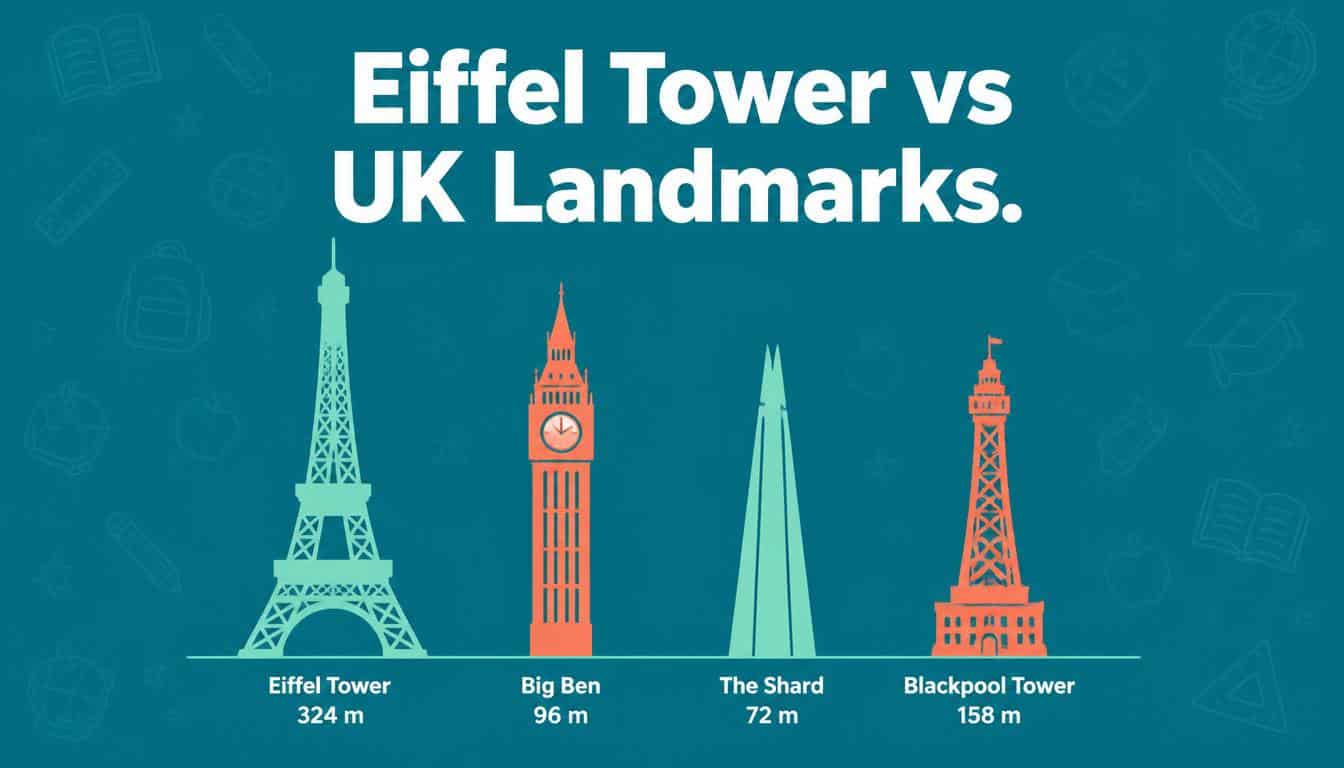
How Does the Eiffel Tower Compare to Famous UK Landmarks?
Comparing the Eiffel Tower to landmarks children already know from home helps make its scale easier to picture.
Landmark
Height
Year Opened
City
Eiffel Tower
330 m (1,083 ft)
1889
Paris
The Shard
309.6 m (1,016 ft)
2012
London
Blackpool Tower
158 m (518 ft)
1894
Blackpool
Elizabeth Tower (“Big Ben”)
96 m (316 ft)
1859
London
Blackpool Tower is a particularly good comparison for UK classrooms, since it was directly inspired by the Eiffel Tower and opened just five years later, using a similar iron lattice design at roughly half the height. The Shard, by contrast, shows pupils how modern engineering has closed the gap since 1889, standing only around 20 metres shorter than the Eiffel Tower despite being built with completely different materials and methods more than a century later.
For more famous structures with their own strange and surprising stories, LearningMole’s Leaning Tower of Pisa facts for kids and Statue of Liberty facts for kids make good companion reads, and the Statue of Liberty shares an engineer with the Eiffel Tower, giving you a natural cross-topic link if pupils enjoy this one.
Teaching Resources and Support
Landmarks like the Eiffel Tower serve as launchpads for several subjects at once, not just history.
For classroom teaching, LearningMole provides curriculum-aligned video resources that bring topics like this to life visually, supporting KS2 History, Geography, and Design and Technology in one go rather than treating each subject separately. Teachers looking for more structured lesson ideas can browse LearningMole’s free KS2 teaching resources or its wider geography activities for primary school, both of which include ready-to-use classroom activities that pair well with a landmark study like this one.
Parents supporting learning at home don’t need to turn this into a formal lesson. Simple activities work well: comparing the Eiffel Tower’s height to local buildings using the table above, trying a spaghetti-and-marshmallow tower challenge to explore structures hands-on, or watching footage of the tower’s evening light show together as a family. LearningMole’s home learning resources for KS2 offer further ideas for extending topics like this beyond the classroom, with activities designed to fit around family life rather than replace it.
Frequently Asked Questions
How old is the Eiffel Tower?
The Eiffel Tower opened in 1889, which makes it well over 130 years old. Construction started in January 1887 and finished just over two years later, in March 1889, ahead of that year’s World’s Fair.
Why was the Eiffel Tower built?
It was built as the entrance arch for the 1889 World’s Fair in Paris, celebrating the 100th anniversary of the French Revolution. Engineer Gustave Eiffel won a design competition to create it, beating more than 100 other entries.
How many stairs does the Eiffel Tower have?
There are 1,665 steps from the ground to the top, though visitors can only walk as far as the second floor. A lift is required to reach the very top level, and most visitors choose to take it rather than climb the full staircase.
Why does the Eiffel Tower change height?
The tower expands slightly in warm weather and contracts in cold weather, because the iron it’s made from reacts to temperature changes. This can make it up to 15 centimetres taller on a hot day than on a cold one.
Is this suitable for a KS2 classroom project?
Yes. The facts here connect naturally to KS2 History (significant world events), Geography (world landmarks), and Design and Technology (structures and materials), making the topic flexible enough for several different lessons rather than a single one-off session.
Who actually designed the Eiffel Tower?
Gustave Eiffel led the project, but structural engineers Maurice Koechlin and Émile Nouguier designed the tower’s framework, and architect Stephen Sauvestre added its decorative arches. It was very much a team effort, despite the tower carrying Eiffel’s name alone.
What is the Eiffel Tower made of?
The Eiffel Tower is made almost entirely of wrought iron, held together by over 2.5 million rivets rather than welds or modern bolts. This choice of material and joining method is part of what allows the tower to expand and contract with temperature changes.
How does the Eiffel Tower compare to buildings in the UK?
The Eiffel Tower is taller than every free-standing UK landmark commonly taught in primary schools, including The Shard, Blackpool Tower, and Big Ben’s Elizabeth Tower. Blackpool Tower is the closest stylistic comparison, as it was built as a direct tribute to the Eiffel Tower, using a similar iron framework.
Bringing the Eiffel Tower to Life for Your Class
The Eiffel Tower’s story is really a story about survival. Built for a temporary fair, saved by an accident of radio history, disliked by the very city it now represents, it’s a landmark that earned its place rather than being granted it from the start.
For teachers, that survival story is often more memorable for children than the height and dates alone. A structure nearly torn down for scrap, now fitted with wind turbines and solar panels, gives pupils a genuine talking point about how old buildings adapt rather than simply age, and it opens up a much wider conversation about how every landmark, however famous, started out as somebody’s risky idea.
If your class enjoys this kind of topic, pairing it with another landmark, whether that’s the Leaning Tower of Pisa, the Statue of Liberty, or a UK structure like The Shard, helps pupils start spotting patterns in how and why famous buildings get built in the first place, and why some survive while others don’t.
Want full access to LearningMole’s library of our videos, quizzes, and printable resources? See our subscription plans to unlock everything KS1 and KS2 teachers need for primary education.
Maths Circus, an innovative platform we've crafted, presents a captivating realm where children learn mathematics through the exciting theme of a circus. The joy of juggling numbers and solving circus...
Wolfgang Amadeus Mozart (1756 to 1791) was an Austrian Classical-period composer who wrote more than 600 works, including operas, symphonies, and piano concertos, in a life of only 35 years....
Cooks prepare, cook and present food for other people, working in restaurants, schools, hospitals, hotels, care homes and cafés. Their day covers washing and chopping ingredients, cooking dishes at the...
Actors use their voice, their body and their imagination to turn the words of a script into a believable person that an audience can follow, whether that audience is sitting...




Leave a Reply