Count 20 for Kids: Most children can chant numbers to 20 before they fully grasp what those numbers represent. That gap between recitation and genuine understanding is where early maths teaching earns its keep. Whether you are an EYFS practitioner planning counting activities, a Year 1 teacher addressing number fluency, or a parent sitting with your child at the kitchen table, the same challenge applies: making numbers meaningful.
This guide brings together practical strategies, classroom activities, and home learning ideas that help children move from simply saying the numbers to genuinely counting to 20 with confidence. Everything here aligns with the UK National Curriculum and the EYFS Mathematics strand, so teachers and parents can use it directly alongside school learning.
LearningMole, the UK educational platform founded by former primary teacher Michelle Connolly, has developed a library of curriculum-aligned video resources covering early number work, counting activities, and mathematical foundations for children aged 3 to 11. The counting resources are particularly strong for children in their first years of formal education.
Why Counting to 20 Matters for Early Maths
Counting to 20 is not a standalone skill. It is the foundation on which children build place value understanding, addition, subtraction, and number fluency through Key Stage 1 and beyond. Children who can count to 20 with genuine understanding, not just recitation, find it far easier to grasp teen numbers, the structure of our base-10 system, and early arithmetic.
The teen numbers (11 through 19) are where many children hit their first real stumbling block. In English, unlike in many Asian languages, the teen number names do not clearly reflect their mathematical structure. “Fourteen” does not obviously signal “ten and four” in the way that the Chinese or Japanese equivalents do. This makes the bridge from 10 to 20 genuinely tricky, and it is why careful teaching matters more than repetition.
Children who count past 10 with confidence develop stronger mental arithmetic skills in Year 1 and Year 2. Research consistently shows that early number sense, the intuitive understanding of how numbers relate to each other, predicts mathematical achievement through primary school and beyond.
What the UK National Curriculum Expects
Understanding where counting to 20 fits in the curriculum helps teachers and parents target their support precisely.
Count to and across 100 forwards and backwards; count, read and write numbers to 100
Year 2 (KS1)
6 to 7 years
Count in steps of 2, 3, and 5 from 0; count in tens from any number forward and backward
Counting to 20 with understanding is therefore the essential EYFS milestone. Without it, the Year 1 jump to 100 becomes unnecessarily difficult. Teachers who identify children struggling to count to 20 by the end of Reception are catching a problem early, when intervention is most effective.
“Children learn number best through experience, not instruction. They need to count real things, move real objects, and see numbers in their environment before abstract symbols start making sense.” — Michelle Connolly, Founder of LearningMole and former teacher with over 15 years of classroom experience
The Three Stages of Learning to Count
Effective counting instruction follows the Concrete-Pictorial-Abstract (CPA) approach, embedded in the UK curriculum and supported by decades of mathematics education research. Each stage builds on the last, and rushing ahead before a stage is secure creates gaps that become harder to fill later.
Stage 1: Concrete Counting
Children count physical objects they can touch and move. Counters, cubes, fingers, pebbles, toy animals, or pasta shapes all work. The key principle is one-to-one correspondence: one count for each object. Children who skip objects or count some twice need more time at this stage.
Effective concrete activities include:
Counting collections into a numbered tray (1 to 20 sections)
Threading beads onto a string and counting as they go
Filling numbered egg boxes with small objects
Counting steps, claps, or jumps during physical activities
Stage 2: Pictorial Counting
Children move to counting pictures, diagrams, and visual representations. Number lines, dot patterns, ten frames, and illustrated number charts help bridge the gap between physical objects and abstract symbols. This stage also introduces children to the idea that the same quantity can look different depending on the arrangement.
Useful pictorial tools include:
A 1-to-20 number line displayed at child height in the classroom
Ten frames showing numbers above 10 as “a full ten and some more”
Dot patterns that show teen numbers as structured groups
LearningMole’s counting video resources, which use colourful visual representations to show numbers 1 to 20 in child-friendly contexts
Stage 3: Abstract Counting
Children work with written numerals and symbols without needing physical or pictorial support. This includes reading and writing numbers 1 to 20, ordering them on a blank number line, and using them in simple calculations. Most children reach this stage by the end of EYFS or early Year 1, though many will still benefit from concrete support when tackling new mathematical ideas.
Classroom Activities for Counting to 20
These activities have been classroom-tested across EYFS and Year 1 settings. Each one targets a specific aspect of counting to 20 and can be adapted for different ability levels.
The Number Hunt
Hide number cards (1 to 20) around the classroom or outdoor area. Children find the cards and arrange them in order. This activity combines physical movement, number recognition, and sequencing. For children who find ordering difficult, provide a reference number line they can check against.
Counting Stations
Set up five or six stations around the room, each with a different set of objects to count. Keep quantities within the 1-to-20 range and vary the object types: buttons, cubes, toy vehicles, and natural materials. Children record their count at each station using tally marks or numeral cards. Rotate groups every ten minutes.
The Twenty Frame
A twenty-frame is two ten-frames placed side by side. Children fill it with counters (alternating colours for each set of ten) and count the total. This activity explicitly shows children that teen numbers are built from ten and some more, which directly addresses the conceptual difficulty of the teen numbers. It is one of the most effective tools for children who can count to 20 by rote but struggle with understanding teen numbers.
Count and Move
Call out a number between 1 and 20. Children perform many physical actions: jumps, claps, stamps, or hops. This activity reinforces counting in a kinaesthetic way and is particularly effective for children who find desk-based activities difficult to focus on. It also works well as a transition activity or brain break.
Number Stories to 20
Tell short stories that involve counting: “There were 12 birds on a fence. Three more flew in. How many are there now?” Children act out the story with counters or fingers. This bridges counting to early addition and subtraction within 20 and prepares children for the Year 1 curriculum.
Activity
Learning Focus
Works Best For
Number Hunt
Number recognition and ordering
Active learners, whole class or pairs
Counting Stations
One-to-one correspondence
Small groups, independent practice
Twenty Frame
Teen number structure
Children struggling with 11 to 19
Count and Move
Counting fluency
Kinaesthetic learners, brain breaks
Number Stories
Counting in context
Transition to addition/subtraction
Home Learning Ideas for Counting to 20
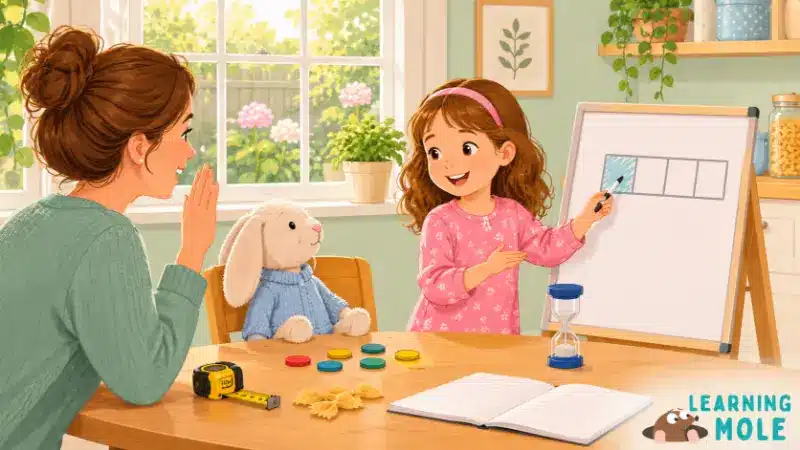
Parents do not need specialist resources or teaching knowledge to support counting at home. The most effective home learning happens through everyday activities that feel natural rather than like extra lessons.
Counting in Daily Routines
Counting opportunities exist throughout the day. Count out forks when setting the table. Count steps on the stairs. Count how many items go into the shopping basket. Count the number of cars parked in the street. These brief, repeated counting moments build fluency more effectively than a dedicated 20-minute counting session once a week.
Counting Games That Do Not Feel Like Learning
Many board games and card games practise counting without children realising it. Snakes and Ladders requires counting moves on a numbered board that goes to 100. Simple dice games can be adapted so children count their score using counters up to 20. Dominoes involve matching and counting dots.
Counting Books
Counting picture books gives children a reason to count with purpose. Books that show numbers with clear illustrations let children point and count the pictures on each page. Many extend to 20, and some focus specifically on the tricky teen numbers. Reading and counting together is one of the strongest home learning activities for combining literacy and numeracy.
Using LearningMole Videos at Home
LearningMole’s counting videos, freely available on YouTube, are designed specifically for children aged 3 to 7. They use engaging visuals and clear counting sequences that children can follow and join in with. Parents can use them as a starting point for a counting conversation: pause the video, ask your child to count the objects on screen, then continue. This active watching is more effective than passive viewing.
Common Mistakes and How to Address Them
Most counting errors are predictable. Knowing what to look for helps teachers and parents respond quickly and precisely.
Common Mistake
What It Tells You
How to Help
Skipping numbers (e.g. 1, 2, 3, 5, 6…)
Number sequence not yet secure
Practise rote counting daily; use number lines as reference
Use twenty frames; focus on “ten and some more” language
Says “eleven, twelve, twenty” (jumps to 20)
Teen numbers are not yet understood
Sing counting songs that slow down at 13 to 19
Can count objects but cannot say which comes after 14
Sequence knowledge and counting are separate skills
Practise “what comes next?” games on a number line
The most persistent counting difficulty in EYFS and Year 1 is the teen numbers. Children who can count to 12 often skip or muddle 13 through 19. This happens because the English names for these numbers do not follow a logical pattern that children can derive themselves, unlike the twenties (twenty-one, twenty-two), where the pattern is clear. Slowing down and giving extra practice time to the 13-to-19 range almost always resolves this.
Counting to 20 for Different Learners
Children come to counting with different backgrounds, abilities, and learning profiles. Good counting teaching is flexible enough to meet each child where they are.
Children Who Find Counting Easy
If a child can count to 20 confidently and accurately, the next step is not simply counting higher. It is deepening their understanding: Can they count backwards from 20? Can they count on any number (not just 1)? Can they quickly say which number comes before or after a given number? Can they count in 2s? These extensions build number fluency that supports KS1 maths throughout Years 1 and 2.
Children Who Are Still Developing Fluency
Children who struggle with sequencing or one-to-one correspondence benefit most from concrete, hands-on activities repeated frequently. Keep counting sessions short (five to ten minutes) but daily. Focus on a small range at a time: secure 1 to 5 before extending to 10, and 1 to 10 before pushing to 20. Use a consistent set of objects so the child builds confidence with familiar materials before varying them.
Children with SEND
Children with special educational needs and disabilities (SEND) may need adapted approaches. For children with dyslexia or working memory difficulties, visual number lines, number tracks, and consistent use of the same counting sequence help reduce cognitive load. For children with motor difficulties, large, easy-to-grip counters support concrete counting activities. For children with autism, predictable routines and familiar objects reduce anxiety and allow the counting skill itself to develop.
LearningMole’s educational philosophy, rooted in Michelle Connolly’s classroom experience with diverse learners, emphasises multiple representations and multi-sensory approaches. The counting videos use visual, auditory, and movement cues simultaneously, which benefits a wide range of learning styles.
Children for Whom English Is an Additional Language
Children learning English as an additional language often find counting in English harder than counting in their home language, even when they understand the mathematical concept. It is worth knowing that many children can count fluently in their home language, and building on this is a strength, not a problem. Allow children to count in their home language during concrete activities while gradually introducing English number names alongside.
Frequently Asked Questions
At what age should children be able to count to 20?
The EYFS Early Learning Goals set counting reliably to 20 as an expectation by the end of Reception (age 5). Many children will reach this earlier, particularly if they have had regular counting experiences at home and in nursery settings. Children who are not yet counting to 20 securely by mid-Year 1 (age 5 to 6) benefit from targeted support. Early identification and simple daily practice usually resolve counting gaps before they affect wider number learning.
How do I teach children the tricky teen numbers?
The teen numbers (11 to 19) are the hardest part of counting to 20 in English because the names do not clearly reflect their mathematical meaning. The most effective approach combines three things: first, repeated exposure to the sequence through songs and rhymes that slow down at 13 to 19; second, use of a twenty frame to show that each teen number is “ten and some more”; and third, explicit teaching of the number names, one at a time, with plenty of practice before moving on. Do not rush past this range.
Is counting by rote enough for EYFS children?
Rote counting (reciting the sequence) is a useful starting point, but it is not sufficient on its own. Children also need to count objects with one-to-one correspondence, recognise written numerals, order numbers on a line, and say which number is one more or one less. The EYFS Mathematics strand requires all of these, not just the spoken sequence. Rote counting provides the framework; the other skills fill it with meaning.
What resources help children learn to count to 20?
Effective resources for counting to 20 include twenty frames, number tracks (a counting track with numbered squares), small objects for sorting and counting, number cards, and visual number lines placed at children’s eye level. LearningMole’s counting video resources provide curriculum-aligned visual support that works well both in classrooms and at home. The videos are free on YouTube and use clear visual counting sequences that children can join in with actively.
How can parents support counting to 20 at home without making it feel like homework?
The most effective home counting practice is woven into daily life rather than treated as a separate activity. Count objects during household tasks, count during walks, count at mealtimes. Play simple board games that involve moving along a numbered track. Read counting books together. These brief, repeated experiences build fluency naturally and without the resistance that can come with formal practice sessions. Aim for five minutes of counting in everyday contexts every day rather than a longer session once a week.
What should I do if a child can count to 20 but cannot tell me what comes after a specific number?
This is a common gap, and it usually means the child has memorised the sequence but has not yet internalised it as a flexible tool. Practise counting on from different starting points: “start at 7, count to 20.” Use a number line and ask the child to point to a number, then say the next one without counting from 1 each time. Games where children roll a die and move a counter from a random starting position on a number track (rather than always starting at 1) also effectively build this flexibility.
When should children be able to count backwards from 20?
The EYFS profile does not require backwards counting from 20, but the Year 1 National Curriculum does. Most children who can count to 20 securely can be introduced to backward counting from 10 first, then from 20. This is typically introduced during Year 1, between ages 5 and 6. A number line or number track is helpful for supporting backward counting, as children can see the direction of travel visually.
Are counting songs and rhymes useful or just fun?
Both. Number rhymes and counting songs do genuine mathematical work while also being enjoyable. They embed the counting sequence through repetition and rhythm, making it easier to recall. Songs that count down from 10 or 20 are particularly useful because backward counting is harder and benefits from the melodic support. Classroom songs that pause at the teen numbers and emphasise them clearly help children hear the number names accurately. LearningMole’s educational video content includes counting activities with visual and musical elements for precisely this reason.
Counting Resources from LearningMole
LearningMole provides free and subscription-based educational videos and teaching resources aligned with the UK National Curriculum, including a range of counting and early number content for children aged 3 to 7. Whether you are a teacher planning EYFS number activities, a Teaching Assistant supporting counting development in Year 1, or a parent looking for engaging counting support at home, LearningMole’s resources are designed by experienced educators and used by teachers and families across the UK.
Browse early number and counting resources on LearningMole.com, or search LearningMole on YouTube for free counting videos your children can watch and join in with today.
Maths Circus, an innovative platform we've crafted, presents a captivating realm where children learn mathematics through the exciting theme of a circus. The joy of juggling numbers and solving circus...
Article Summary What this article covers: Twenty-eight polar animals sorted properly by pole, with 21 from the Arctic, 5 from the Antarctic and 2 found at both, along with the...
Article Summary What this article covers: Five active learning strategies for home education (inquiry-based learning, Socratic questioning, gamification, the concrete-pictorial-abstract approach and teaching back), with zero-preparation ideas for busy parents,...
Article Summary What this article covers: Ten facts about Egypt’s modern history from 1952 to today, including the end of the monarchy, the Suez Crisis, the Aswan High Dam and...







Leave a Reply