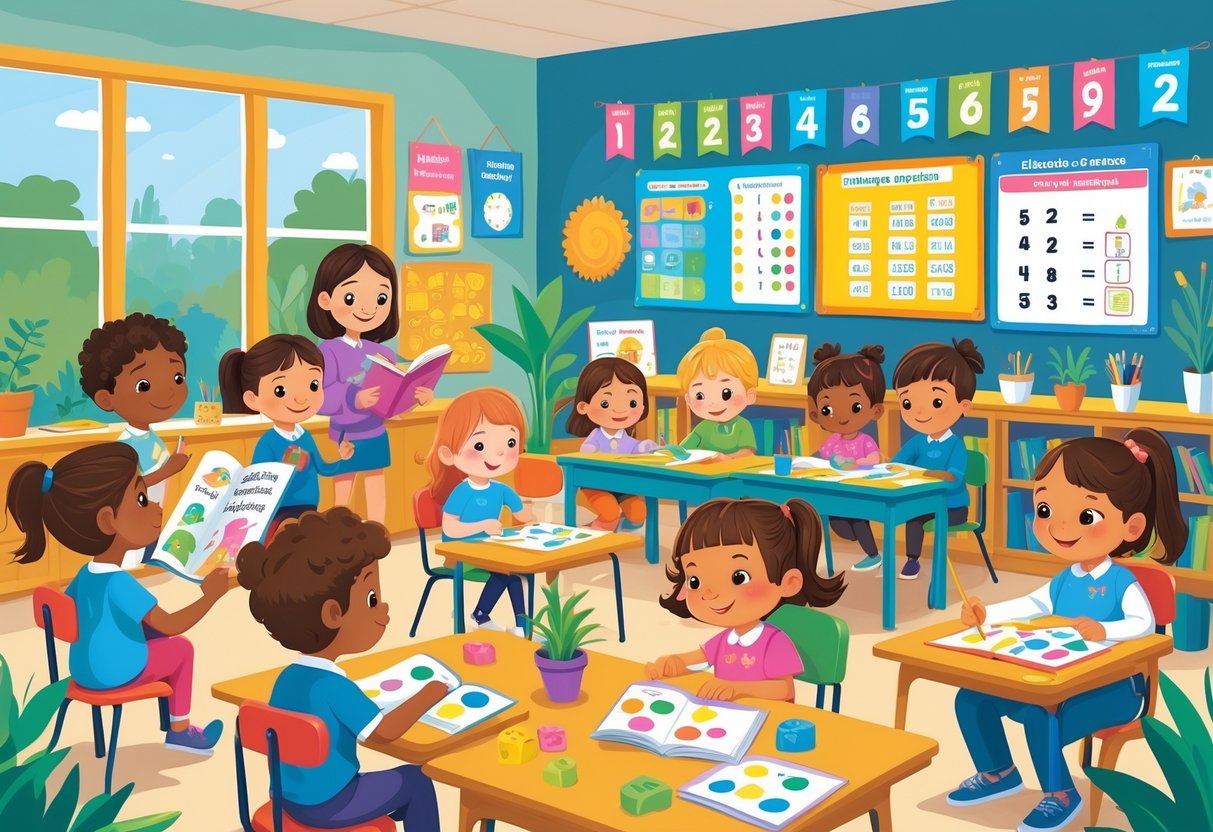
Children in Year 1 and Year 2 pick up foundational skills in reading, writing and maths. They also get to explore science, creative subjects and physical education. Year 1 and Year 2 form Key Stage 1 of the National Curriculum, where children aged 5 to 7 develop essential literacy and numeracy skills alongside broader subject knowledge. These years build on early learning and set the stage for the rest of primary school.
Michelle Connolly, founder of LearningMole and a former primary teacher with over 15 years in the classroom, says: “Year 1 and Year 2 are crucial years where children transition from learning to read to reading to learn. The skills they develop now form the building blocks for everything that follows.” LearningMole is a UK educational platform with curriculum-aligned resources for parents and teachers.
Children move from basic phonics and number work in Year 1 to more confident reading comprehension and two-digit calculations by the end of Year 2. If you know what children learn during Key Stage 1, you can support their learning at home and celebrate their progress.
Key Takeaways
Year 1 and Year 2 cover Key Stage 1, focusing on foundational literacy, numeracy and broader curriculum subjects.
Children develop phonics, reading comprehension, handwriting and storytelling skills in English.
Maths moves from counting and simple addition to working confidently with two-digit numbers and basic multiplication.
What Are Year 1 and Year 2?
Year 1 and Year 2 are the first two years of formal schooling in England. Children aged 5 to 7 start learning through the National Curriculum at this stage.
These years mark a big shift from play-based learning to a more structured classroom setting.
Key Stage 1 Overview
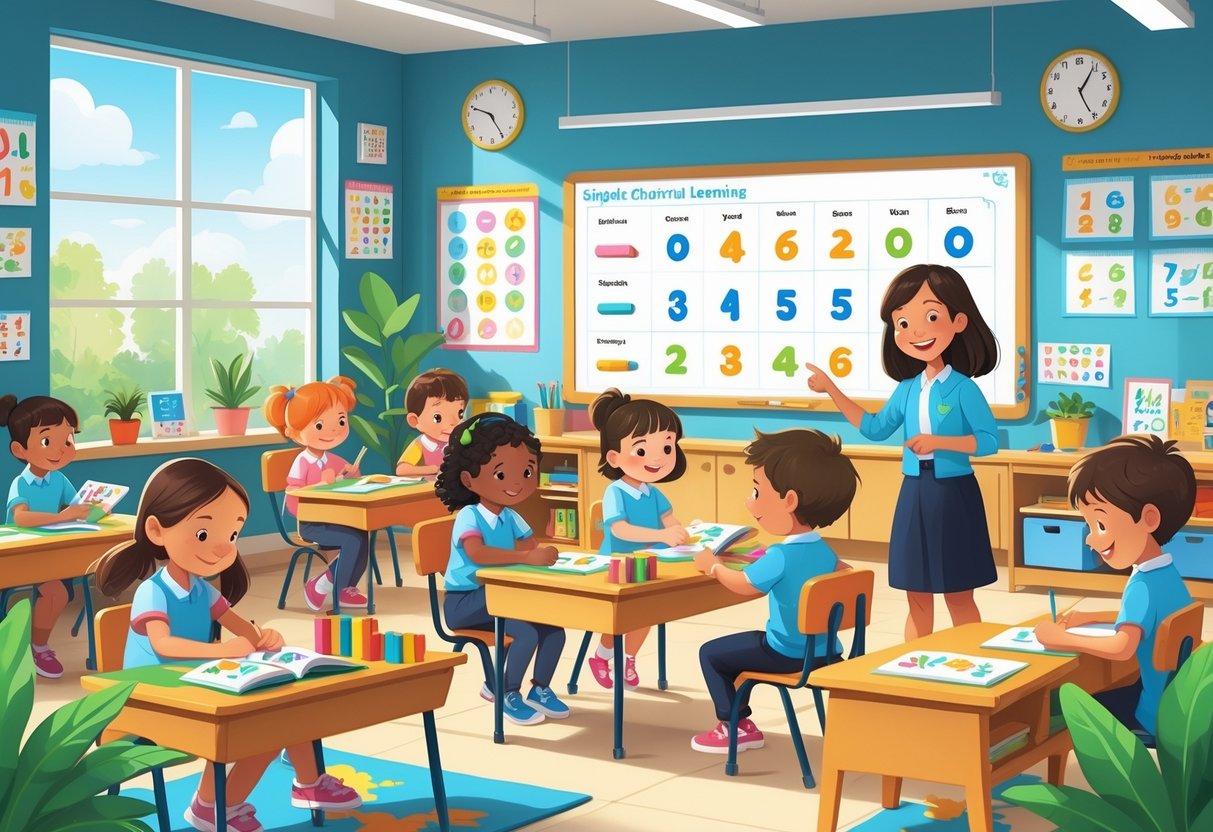
Year 1 and Year 2 together make up Key Stage 1, the first official stage of the National Curriculum in English primary schools. Children study core subjects like English, maths and science, plus foundation subjects such as art, history, geography, music, PE and computing.
The structure changes a lot from earlier education. In Year 1, children start subject-specific lessons with clear objectives, instead of the integrated approach they had before. Year 2 builds on these basics, and teachers encourage deeper thinking and expect more from written work.
At the end of Year 2, children complete national tests and teacher assessments in English and maths. In Year 1, they take the phonics screening check to check their reading ability with phonetically decodable words.
Teachers often call this transition a “cliff face” because the learning environment changes so much. In the foundation stage, children learn through play in a flexible, child-led setting. Year 1 brings in teacher-led lessons, more desk work and subject-based timetables.
Children spend most mornings on English and maths, when they’re usually most focused. Afternoons are for foundation subjects and creative activities.
Importance in Primary Education
These two years lay down the essential skills children need for the rest of primary school. Year 1 builds confidence with basic reading, writing and number work. Year 2 helps children become more independent learners, getting them ready for Key Stage 2.
By the end of Year 2, most children can read simple books on their own, write sentences with proper punctuation and solve basic maths problems. They practise cooperation, turn-taking and working as part of a group.
The phonics screening check in Year 1 checks if children can decode words accurately. Year 2 assessments help teachers spot any learning gaps before children move into Year 3. These early years really shape a child’s attitude towards learning and school.
National Curriculum and Assessment
Children in Year 1 and Year 2 follow the national curriculum for Key Stage 1. This sets out what children should learn in core subjects like English, maths and science, and foundation subjects such as history, geography and art.
Teachers check progress through ongoing assessments, rather than high-pressure exams. Formal testing starts at the end of Year 2.
Core Subjects in KS1
English, maths and science form the backbone of learning in Key Stage 1. In English, children develop reading skills through phonics, and in June, they take the Year 1 phonics screening check. They read 40 words aloud to their teacher, and if they don’t meet the expected standard, they retake it in Year 2.
Maths lessons build number sense, counting, addition and subtraction. Children learn to work with numbers up to 100 by the end of Year 2. They also look at shapes, measurements and basic problem-solving.
Science lessons encourage hands-on exploration. Children investigate topics like plants, animals, materials and seasonal changes. Teachers focus on observing, questioning and recording findings, not just memorising facts.
At the end of Year 2, children take national curriculum tests in English reading, grammar, punctuation, spelling and maths. Teachers mark these tests within the school and use them to inform their assessment of each child’s progress.
PE includes swimming as part of the curriculum. Children develop movement skills, play team games and build physical confidence. Computing introduces basic digital skills and simple programming.
History and geography often link to topics children find interesting. They might learn about important historical events, famous people or compare different places around the world. Art and design encourages creativity through drawing, painting, sculpture and craft.
Schools must also provide relationships and health education, plus religious education. Parents can withdraw their child from RE lessons if they want. Many schools teach PSHE (personal, social and health education), but it’s not compulsory at Key Stage 1.
Role of Teacher Assessments
Teachers use ongoing assessments to get a full picture of each child’s learning in Year 1 and Year 2. They observe work, participation and understanding across all subjects. These judgements look at much more than just test scores.
In Year 2, teacher assessments cover English reading, English writing, maths and science. Teachers decide if children are working at the expected standard for their age. Unlike Year 4 times tables checks or Year 6 SATs, Year 2 tests are set and marked by the child’s own teachers in May.
Schools share results with parents in July. If a child is working below the standard, teachers may use different assessment methods. The results help teachers plan support and spot where a child might need extra help.
Year 1 Curriculum Highlights
Year 1 brings children into formal learning, with a big focus on phonics, basic literacy and foundational maths. Children take their first statutory assessment and start building skills they’ll use throughout primary school.
Phonics Screening Check
The Phonics Screening Check takes place in June of Year 1. It checks if children can decode words using phonics. Children read 40 words aloud to a teacher, including 20 real words and 20 made-up words like “zop” or “plag”.
This assessment checks how well children understand grapheme-phoneme correspondences. It takes about five minutes and feels more like a chat than a test.
What the check includes:
Single syllable words with simple sounds.
Words with digraphs (two letters making one sound like “sh” or “ch”).
Pseudowords marked with a monster picture to show they’re not real.
A passing mark set each year by the government.
If a child doesn’t meet the standard, they’ll retake the check in Year 2. Schools use the results to spot children who need extra phonics activities support.
Understanding Year 1 English
Year 1 English focuses on phonics, with children learning to recognise and read 40+ phonemes by the end of the year. Children also build comprehension skills through a range of books: fiction, non-fiction, fairy tales and poems.
Reading skills include:
Sounding out unfamiliar words.
Reading graphemes (letters and letter combinations).
Making connections between stories and personal experiences.
Picking up new vocabulary from different texts.
In writing, children learn to spell familiar phonemes, common exception words and days of the week. They also start using simple prefixes and suffixes and practise proper letter formation.
By year’s end, children should form capital and lowercase letters correctly. They’ll practise holding a pencil comfortably and write digits 0-9.
Grammar and punctuation covers:
Leaving spaces between words.
Using capital letters and full stops.
Adding question marks and exclamation marks.
Joining clauses with “and”.
Introduction to Year 1 Maths
Year 1 maths builds number sense and introduces basic operations. Children learn to count forwards and backwards to 100, recognise numbers as words and begin to understand place value.
Children work with numbers up to 20 for most of the year, then extend to 100. They learn to add and subtract single-digit numbers using objects, pictures and mental strategies.
Key maths concepts:
Counting in multiples of 2, 5 and 10.
Understanding one more and one less.
Reading and writing numbers to 100 in numerals.
Using number bonds to 20.
Children also explore basic fractions, recognising and finding halves and quarters of shapes and quantities. They measure length, weight and volume using non-standard units, then move to standard measures.
Shape work includes naming and describing 2D shapes (circles, triangles, rectangles) and 3D shapes (cubes, cuboids, spheres). Children learn to tell time to the hour and half-hour on analogue clocks.
Year 2 Curriculum Highlights
Year 2 wraps up Key Stage 1, with children aged 6-7 building fluency in core subjects. The curriculum puts a spotlight on reading comprehension, extended writing and confident mental arithmetic as pupils get ready for junior school.
Preparing for End of KS1 Assessments
Teachers check your child’s progress all year by observing them daily and setting end-of-topic tasks. Since 2023-24, the end-of-Key Stage 1 SATs became non-statutory, so schools now decide if they want to use them.
Many schools still use optional assessment papers to check understanding. These usually cover reading, maths and grammar. Teachers gather evidence from classwork, discussions and quick quizzes instead of just one big test.
Teachers focus on ongoing assessment to plan what comes next. Your child might not even notice they’re being assessed. Schools often call these activities ‘puzzles’ or ‘challenges’ to keep things relaxed.
Assessment areas include:
Reading comprehension and fluency
Written composition and handwriting
Number facts and mental calculations
Grammar, punctuation and spelling
Building on English Skills
The Year 2 curriculum moves reading beyond just sounding out words. Your child answers questions about how characters feel, predicts what might happen next and explains why things happen in stories.
Writing becomes more ambitious and structured. Children start using conjunctions like ‘because’, ‘when’ and ‘if’ to join ideas. They write longer pieces such as narratives, instructions and letters. Teachers expect pupils to use capital letters, full stops and question marks every time.
Key English expectations:
Read fluently with expression
Use past and present tense correctly
Write coherent narratives in order
Apply phonics knowledge to spell tricky words
Use apostrophes for contractions (can’t, don’t)
Grammar lessons cover sentence types, expanded noun phrases and word classes. Your child identifies adjectives, verbs and adverbs in the texts they read.
Developing Maths Confidence
Children rely more on mental arithmetic in Year 2. Your child learns multiplication facts for the 2, 5 and 10 times tables. They add and subtract two-digit numbers in their head and explain how they worked it out.
The curriculum introduces place value, fractions and measurement in hands-on ways. Children use number lines and counters to understand before moving to written sums.
Core maths skills include:
Counting in steps of 2, 3 and 5
Understanding halves, quarters and thirds
Telling time to five-minute intervals
Adding and subtracting within 100
Recognising 2D and 3D shapes
Real-life maths activities put maths into context. Teachers use shopping, cooking and time problems to keep learning practical. Your child solves word problems and chooses the right operation for each one.
Your child learns to recognise all 40+ phonemes and their graphemes in Year 1. They use this knowledge to blend sounds and decode unfamiliar words. The National Curriculum in England expects children to read words quickly using taught grapheme-phoneme correspondences.
Children master common exception words that don’t fit regular phonic patterns, like “said”, “the” and “was”. Year 1 pupils read words with endings such as -s, -es, -ing, -ed, -er and -est.
By Year 2, your child reads multi-syllable words fluently without breaking them down. They’ll meet tricky words that need memorising. Children reread books to build fluency and confidence.
Developing Comprehension
Your child builds understanding by talking about what they read and learning new words. Year 1 pupils spot repeated words and phrases in stories. They connect stories to their own lives.
Teachers help children develop listening skills alongside reading. Pupils discuss quality books, poems and non-fiction to grow their vocabulary. They learn to explain their ideas and organise thoughts before writing.
Year 2 children answer questions about texts and make simple guesses about characters and events. They predict what might happen next based on what they’ve read. Your child learns to spot different types of texts such as fiction, non-fiction and poetry.
Discussion really matters for comprehension. Children chat about books, share opinions and listen to others’ ideas.
Writing and Handwriting Foundations
Your child starts forming lowercase and capital letters correctly in Year 1. They practise proper letter formation, starting and finishing in the right place. Handwriting takes longer to develop than reading because children have to think about spelling and how to move their hands.
Year 1 pupils write simple sentences with capital letters and full stops. They often say sentences out loud before writing them. Children learn to put sentences in order to tell short stories about real or imaginary events.
By Year 2, your child writes for different reasons, like stories, instructions and descriptions. They use past and present tense properly. Children begin joining letters in a cursive style as they move through Key Stage 1.
Planning gets more structured in Year 2. Your child will organise ideas before writing and check their work to make it better.
Grammar and Punctuation Basics
Year 1 children leave spaces between words and use capital letters for names and the pronoun “I”. They know sentences start with a capital and end with a full stop. Question marks and exclamation marks come in for different sentence types.
Your child joins words and clauses using “and”. They start to understand word classes like nouns, verbs and adjectives. The English curriculum brings in grammar words gradually to help build confidence.
Year 2 pupils add punctuation skills like commas in lists and apostrophes for contractions. They use the progressive form of verbs (like “she is running”). Children learn the difference between statements, questions, exclamations and commands.
Your child uses expanded noun phrases to add detail. They see how suffixes change word meanings and practise joining clauses with subordination and coordination.
In Year 1, your child counts, reads and writes numbers up to 100. They start by counting forwards and backwards, then work out one more or one less than any number.
By Year 2, children work with the place value of two-digit numbers. They learn to split numbers into tens and ones, like breaking 47 into 4 tens and 7 ones. This helps them see how numbers are built.
Your child compares and orders numbers to 100 using the symbols < and >. They practise writing numbers in both numerals and words, such as writing ‘thirty-five’ for 35.
Key number skills include:
Counting in steps of 2, 5 and 10
Reading number words
Spotting number patterns
Recognising odd and even numbers
Addition and Subtraction in Early Years
Year 1 focuses on addition and subtraction facts within 20. Your child adds and subtracts one-digit and two-digit numbers using objects, pictures and number lines.
They memorise number bonds to 10 and 20, like knowing 7 + 3 = 10. With practice, these facts become automatic.
In Year 2, children solve addition and subtraction with two-digit numbers. They try different calculation methods and use the symbols +, – and =.
Your child also learns about inverse operations. They realise subtraction undoes addition, so if 15 + 5 = 20, then 20 – 5 = 15.
Working with Two-Digit Numbers
Year 2 children grow confident with bigger numbers. They count in steps of 2, 3, 5 and 10 from any number.
Multiplication starts as repeated addition. Your child might solve 3 × 5 by adding 5 + 5 + 5. They write multiplication sentences using the × symbol.
Division begins with sharing and grouping objects. If 12 sweets are shared between 4 children, your child works out each person gets 3. They explore division with hands-on activities before writing number sentences.
Two-digit calculation methods:
Using number lines to jump forwards or backwards
Partitioning numbers into tens and ones
Using hundred squares for patterns
Applying known facts to bigger numbers
Exploring Shapes and Measures
Year 1 maths introduces 2D shapes like circles, triangles, rectangles and squares. Your child names these shapes and describes them by counting sides and corners.
They also spot 3D shapes such as cubes, cuboids, pyramids and spheres. Children find these shapes in everyday objects.
Measuring starts with comparing lengths, heights, weights and volumes using words like longer, shorter, heavier or lighter. Your child uses non-standard units first, like counting how many hand spans wide a table is.
In Year 2, children use standard units like centimetres and metres for length. They read scales and use rulers to measure things. Telling the time becomes important, with children learning to read the hour, half hour and quarter hour on analogue clocks.
Science Learning in Key Stage 1
Children in Key Stage 1 explore the natural world with hands-on activities that spark curiosity and observation skills. Your child studies animals, plants, materials and seasonal changes, and they learn to ask questions and try simple investigations.
Year 1 Science Themes
Year 1 pupils dive into four main areas that link straight to things they notice every day. They study everyday materials like wood, plastic and metal, learning to spot and compare their properties.
Children observe seasonal changes, tracking how weather shifts and daylight hours change as the months pass.
The animals topic introduces groups such as mammals, birds, reptiles, amphibians and fish. Children find out what these creatures eat and how to spot basic body parts.
They also explore plants by naming common types, labelling main parts like roots, stems and leaves, and figuring out what plants need to grow.
Working scientifically weaves through all topics. Children ask simple questions, watch closely, try out basic tests and use their findings to suggest answers.
Year 2 Science Exploration
Year 2 builds on what children already know, moving into more detailed investigations. Children explore how materials change shape by squashing, bending, twisting and stretching.
They investigate which materials work best for certain purposes and try to explain why.
The living things and habitats topic brings in different environments. Children learn about woodland, coastal and polar habitats, discovering how animals and plants adapt to survive.
They start to understand basic life cycles and simple food chains.
Pupils also study the human body basics, including how humans grow and what they need to stay healthy. Plant growth gets more detailed, with children planting seeds and bulbs and recording how they develop.
Science resources support these ideas through visual learning and hands-on activities.
Creative and Practical Subjects
Children in Year 1 and Year 2 get creative with hands-on activities in art and design and design and technology. They use different materials, pick up artistic skills and create practical projects to solve simple problems.
Art and Design Experiences
Year 1 and Year 2 pupils build skills in drawing, painting, sculpting and collage work. Art and design embodies some of the highest forms of human creativity, and children at this stage experiment with mixing colours, trying out brush techniques and using art materials like chalk, pastels and clay.
They look at the work of famous artists and craftspeople for inspiration. Children learn to notice details in nature and everyday objects, then try to recreate what they see using different artistic methods.
Key skills include:
Mixing primary colours to make secondary colours
Drawing from observation
Creating textured surfaces in artwork
Using tools like sponges, stamps and printing blocks
Talking about what they like or dislike in artwork
Teachers encourage children to talk about their artistic choices and explain the techniques they used. This builds critical thinking along with practical skills.
Children practise practical skills such as cutting, joining materials, measuring and using simple tools safely. They explore how things work and which materials suit different purposes.
Common projects involve:
Building structures with card, paper and tape
Making moving pictures with sliders and levers
Preparing healthy snacks
Designing and making toys with moving parts
The design process guides children to plan before making, test their ideas and improve their work based on what they discover.
Physical Education and Wellbeing
Year 1 and Year 2 children build movement skills through structured activities, learning about healthy habits, personal hygiene and emotional wellbeing that support their bodies and minds.
Physical Education Activities
Physical education in Key Stage 1 focuses on your child’s basic movement skills through games, dance and gymnastics. Children practise running, jumping, throwing and catching, building up balance and coordination.
Teachers plan lessons that help children master these movements. Your child learns to travel in different ways: hopping, skipping, galloping.
They explore how to move high and low, and how to move fast and slow.
Dance sessions encourage children to express themselves through movement. Your child might create simple sequences, respond to music and explore symmetry in their actions.
Team games introduce basic rules and cooperation. Children join in simple competitive activities that teach turn-taking and fair play.
These experiences build confidence and support social skills like teamwork and listening to others.
Promoting Health and Wellbeing
Year 1 and Year 2 children learn what keeping healthy means through daily routines and classroom chats. Children discover how physical activity helps them stay healthy and find ways to be active every day.
Teachers talk about basic nutrition, explaining which foods support good health. Children learn about the risks of too much sugar and why a balanced diet matters.
Simple hygiene routines become part of daily learning. Children see why handwashing matters and how to keep their bodies clean. These practical skills help stop illness and build independence.
Broader Learning and Preparation for Future School Years
Year 1 and Year 2 children build on their foundation stage skills, growing the independence and learning habits they need for primary education. These early years bridge the gap between play-based learning and the more structured approach in Key Stage 2.
The foundation stage focuses on learning through play and exploration. Year 1 brings a shift towards more formal teaching, but schools balance this carefully.
Children notice changes in how lessons run. Tables and chairs pop up more often, replacing floor-based activities.
Tasks get a bit longer and more focused. Teachers start to introduce expectations like finishing work alone and following multi-step instructions.
These skills set children up for the increased demands of Year 2 and beyond.
Link to Key Stage 2 and Later Years
Year 2 sets the stage for Key Stage 2, which covers Year 3 to Year 6. The maths concepts children learn now, like place value and basic multiplication, become key building blocks for more complex topics later.
Reading fluency developed in these early years affects how well your child can access the curriculum later. By Year 6, children handle challenging texts in all subjects, so strong reading foundations really matter.
Writing skills shift from simple sentences in Year 1 to paragraphs and different text types by the end of Year 2. This prepares children for essay writing and longer responses in Key Stage 2.
Children also build stamina for learning. The ability to focus for longer and work through challenges grows in importance as they move through primary school.
Frequently Asked Questions
Parents usually have specific questions about what their children learn in the early years of primary school and how they can help at home.
What key literacy skills are developed in Year 1 and Year 2?
Your child builds strong reading and writing foundations during Year 1 and Year 2. In Year 1, children focus on phonics to decode words and read simple sentences with growing fluency.
They learn to write simple sentences using capital letters and full stops. By Year 2, your child reads with more confidence and starts developing comprehension skills.
They practise reading for understanding and meaning while exploring different types of texts. Writing gets more sophisticated as children use conjunctions to make longer sentences and try out more punctuation.
Children take a phonics screening check in Year 1 to check their reading skills. Handwriting improves throughout both years, with many working towards joined-up writing by the end of Year 2.
Can you tell me about the maths curriculum for children in their first two years of school?
Children in Year 1 work with numbers up to 100, learning to count, compare and order them. They tackle addition and subtraction within 20 and start to understand place value.
Basic multiplication and division come in through counting in 2s, 5s and 10s.
Year 2 maths builds on these skills with more complex two-digit number work. Children practise addition and subtraction with two-digit numbers and learn to write multiplication sentences.
They learn division by sharing and grouping objects.
Place value understanding deepens as children break two-digit numbers into tens and ones. They count in twos, threes, fives and tens with more confidence.
Many schools still use optional SATs at the end of Key Stage 1 to check progress in maths.
What sort of science topics are covered in early primary education?
Key Stage 1 science introduces children to the natural world through hands-on exploration and observation. Children study plants and animals, learning about their basic needs and how they grow.
They explore different materials and their properties, investigating which materials suit different purposes.
Children notice seasonal changes during the year, observing how weather affects the world around them. They also study the human body, including basic anatomy and the importance of healthy eating and exercise.
Scientific enquiry skills grow as children ask questions, make predictions and record simple observations.
Practical experiments help children understand science through direct experience. They might plant seeds to watch them grow, test which materials float or sink, or watch how ice melts.
These activities spark curiosity and lay the groundwork for more complex science in later years.
How do children’s physical development milestones affect their learning in Years 1 and 2?
Fine motor skills shape how your child writes and manages classroom tasks. Children starting Year 1 need enough hand strength and coordination to grip a pencil and form letters. If they’re still working on these skills, writing can feel tough and lead to frustration in lessons.
Gross motor development links to concentration and behaviour in class. Kids who haven’t built up their core strength and balance might struggle to sit still or stay focused. Physical education lessons give them a chance to build these skills and offer much-needed movement breaks.
Hand-eye coordination helps with reading as children track words across a page. Those with good spatial awareness often get the hang of maths concepts like size, shape and position more easily. Schools notice these links and bring movement activities into the school day to boost learning.
What are some recommended activities to support a 1 to 2-year-old’s learning and development?
This question focuses on toddlers aged 1 to 2 years, not Year 1 and Year 2 pupils who are usually 5 to 7 years old. At this stage, toddlers grow through simple activities that build language, motor skills and social development.
Reading picture books together builds vocabulary and listening skills. Pick books with bright pictures and simple words, and let your child point out and name objects. Singing nursery rhymes and action songs supports language development and gets them moving.
Simple puzzles with big pieces build problem-solving and hand-eye coordination. Stacking blocks, playing with shape sorters and drawing with chunky crayons all help fine motor control. Outdoor play gives toddlers the freedom to run, climb and explore, which supports their physical development and confidence.
Are there any common signs I should watch for that might indicate a developmental concern in a 1-year-old?
A 1-year-old means a toddler, not a child in Year 1 of primary school.
Parents need to keep an eye on certain milestones at this age. Most 1-year-olds start walking on their own, but some still crawl or cruise along furniture.
Language skills really do vary. Many children at this age say a few basic words and can follow simple instructions.
If your child doesn’t seem interested in communicating with gestures, sounds or words, you might want to chat with your health visitor. Some signs like avoiding eye contact, not responding to their name, or acting as if others don’t exist could also mean you should get some professional advice.
Look out for physical signs too. If your child can’t sit by themselves, doesn’t want to move around, or has muscle tone that seems too stiff or too floppy, it’s worth asking someone.
If you notice your child not using both hands equally or losing skills they already had, contact your GP. Getting help early really can make a difference.
Maths Circus, an innovative platform we've crafted, presents a captivating realm where children learn mathematics through the exciting theme of a circus. The joy of juggling numbers and solving circus...
Imagine looking up from a Dorset beach 190 million years ago and seeing a creature with leathery wings gliding over the waves. Many children would call it a flying dinosaur,...
Article Summary What this article covers: Twenty-eight polar animals sorted properly by pole, with 21 from the Arctic, 5 from the Antarctic and 2 found at both, along with the...
Article Summary What this article covers: Five active learning strategies for home education (inquiry-based learning, Socratic questioning, gamification, the concrete-pictorial-abstract approach and teaching back), with zero-preparation ideas for busy parents,...





Leave a Reply