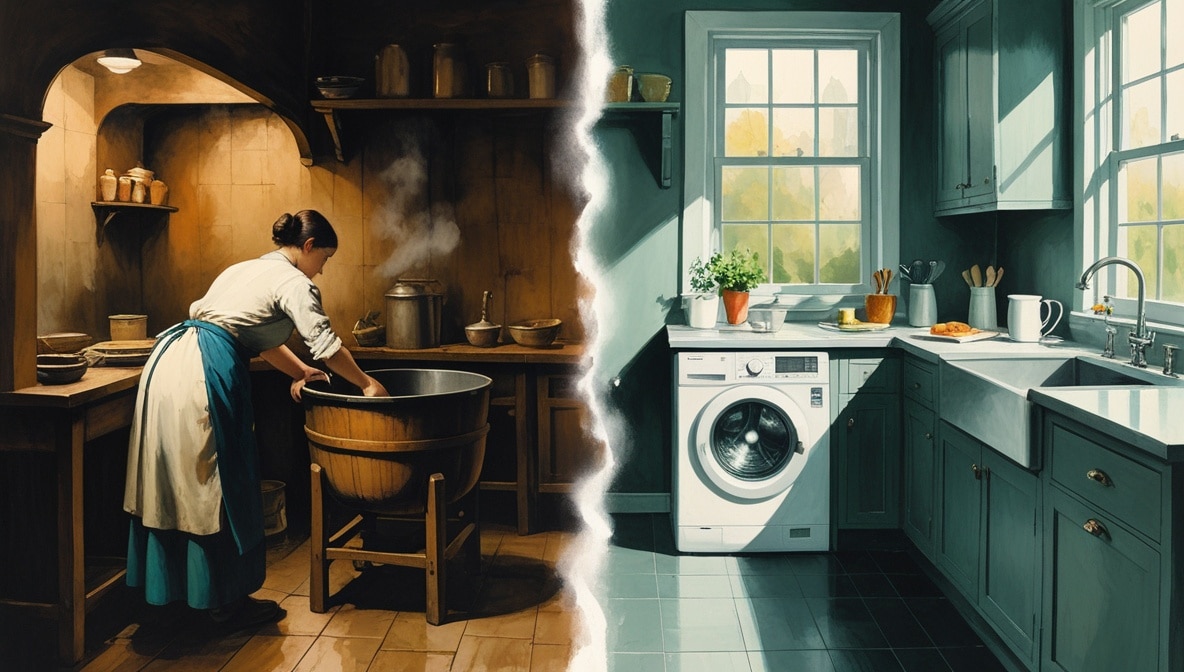
Washing Machine Facts: Ask a class of Year 2 children how their clothes get clean, and most will point at a machine in the kitchen. Ask them how their great-great-grandparents managed, and the room usually goes quiet. That gap is exactly what makes the washing machine such a useful teaching topic in UK primary schools. It sits inside the National Curriculum in two places at once. History treats it as a change within living memory and beyond. KS2 Science treats it as a working example of forces and electricity.
The real story is messier than a tidy list of inventors suggests. No single person invented the washing machine. The earliest English patent connected to washing and wringing clothes dates from 1691, more than two centuries before anyone plugged one in. What shifted across those years went well beyond the machinery. The change was in how much human effort a household spent on getting clothes clean, and who was expected to spend it.
This guide follows that story in order. It starts with the dolly tub and the posser, then finishes with eco cycles using around 50 litres of water. Along the way, you will find the UK vocabulary children need for a Victorians unit. There is also a comparison of wash day in 1880 against wash day now, plus a simple bucket experiment. LearningMole, a UK educational platform founded by former primary teacher Michelle Connolly, produces curriculum-aligned video resources on everyday inventions like this one. You can also explore Victorian life in Britain alongside this topic.
What Did People Use Before Washing Machines?
Before machines, clothes were cleaned by soaking, beating, rubbing and boiling, and every stage ran on muscle. Water had to be carried, heated over a fire, then carried again to be thrown away. The cleaning agent was usually lye, a strong alkaline liquid made by soaking wood ash in water. Mixed with animal fat, it produced a rough soap.
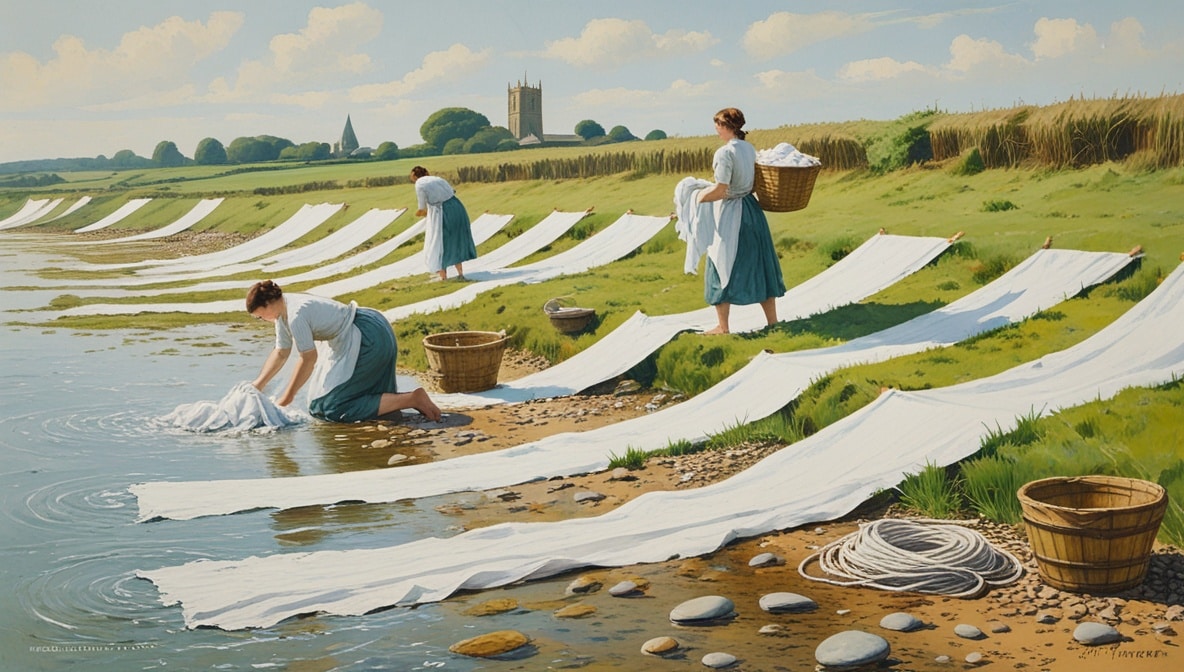
Where a river or lake was close by, washing happened outdoors. Women gathered at the water’s edge, beat cloth against flat stones and spread it on grass to dry and bleach in sunlight. These sessions were hard work and also social occasions, which is one reason they lasted so long as a practice. Clothes were washed far less often than today. The job was punishing, and woollen or linen garments could be brushed and aired instead.
Ancient Rome had a different approach. Professional laundries called fulleries used stale urine as a cleaning agent, because urine breaks down into ammonia, which lifts grease from wool. The Emperor Vespasian is recorded as taxing its collection. Children find the detail revolting and never forget it. It also gives a chemistry hook for older pupils asking what actually makes a substance clean things.
What Were a Posser, a Dolly, a Copper and a Mangle?
These four words open up most Victorian wash day sources, and British museum collections still label objects with them.
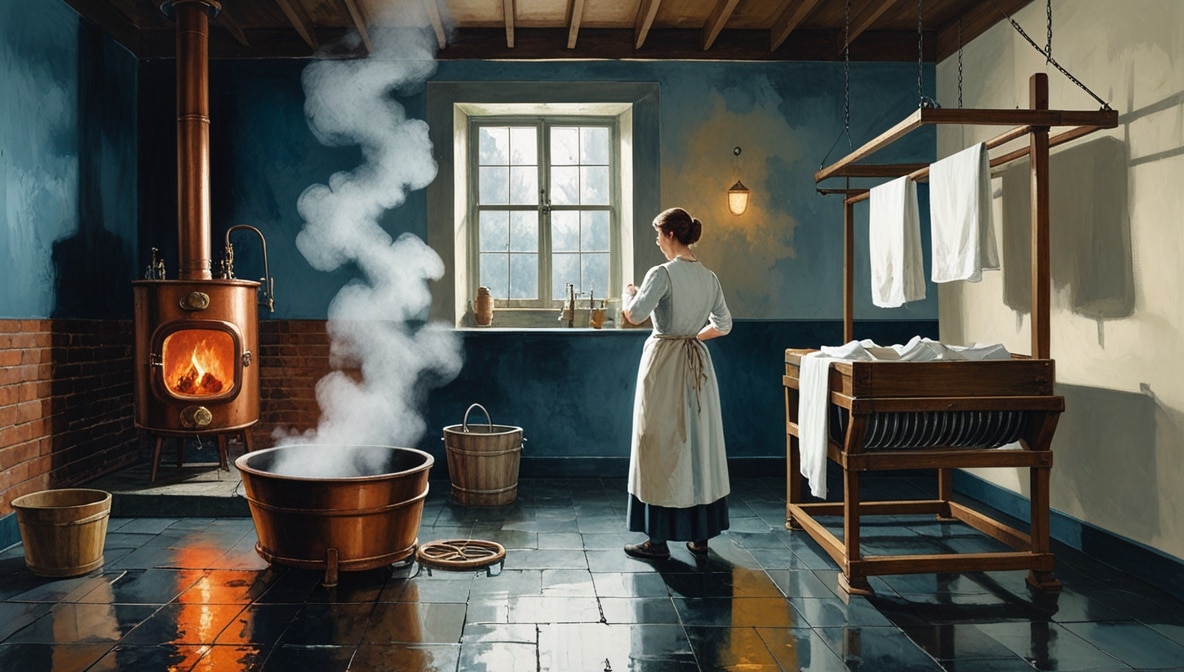
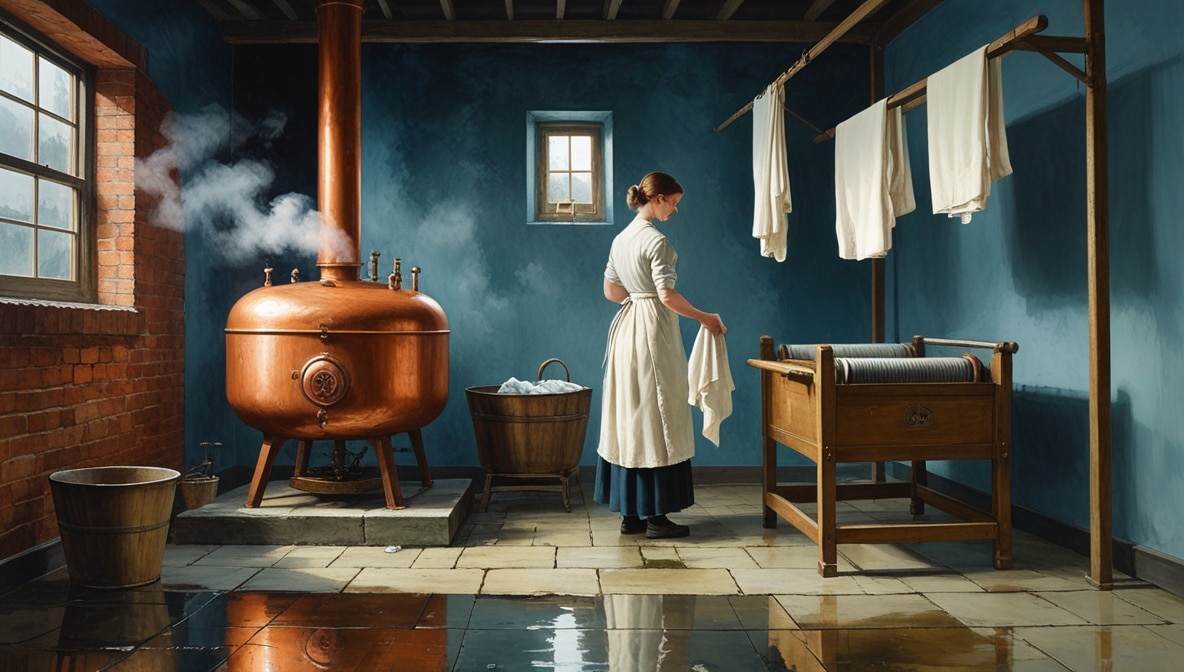
A copper was a large metal vessel, often set into brickwork with a fire underneath, used to boil whites. A dolly was a wooden tool shaped like a small stool on a long handle. Twisting it back and forth churned the clothes in a dolly tub. A posser did a similar job with a cone of copper or wood on a stick. It was punched down into the water to force it through the fabric. A mangle squeezed water out between two rollers turned by a handle, and it was genuinely dangerous. Trapped fingers and pulled hair were common household injuries.
The mangle also happens to be a clear demonstration of gears and mechanical advantage, which links neatly to Year 5 Science. Children can see the handle turning a small cog, which turns a larger one. The rollers then produce a squeeze no pair of hands could match. If you are teaching that unit, levers, wheels and inclined planes cover the same principles with activities.
How Long Did a Victorian Wash Day Actually Take?
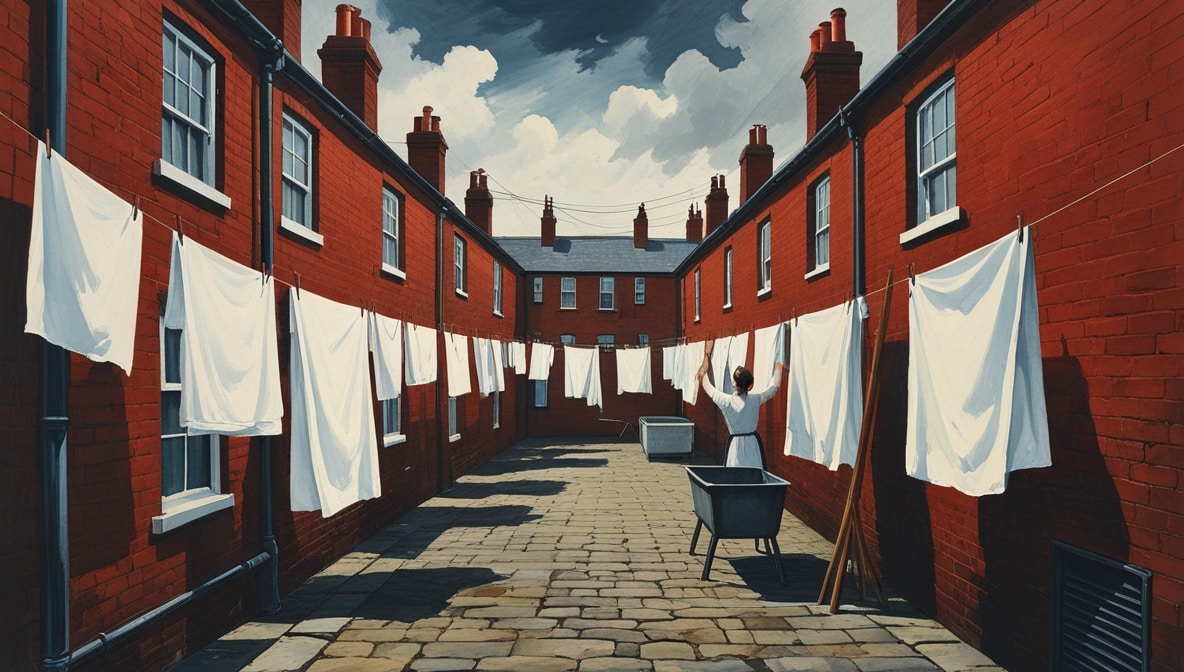
A full Victorian wash for an average household took two to three days, not a morning. Monday was the traditional washing day across much of Britain, which is where the phrase Blue Monday comes from.
The sequence ran roughly like this. Sunday evening, whites went into cold water to soak. Monday began early with water carried and heated in the copper. Clothes were boiled, lifted out with wooden tongs, scrubbed on a washboard, agitated with the dolly or posser, then rinsed at least twice. Tuesday was mangling and drying, weather permitting. Wednesday was ironing with flat irons heated on the range, which meant swapping irons as each one cooled.
The blue in Blue Monday has a second meaning worth mentioning to a class. Washing agents called blueing, sold in Britain under names such as Reckitt’s Blue, were added to the final rinse. White cotton yellows with age and washing, and a trace of blue dye cancels the yellow out visually, making fabric look whiter than it is. Modern detergents still use the same optical trick with brightening chemicals.
Who Invented the Washing Machine?
Nobody invented the washing machine on their own, which is the honest answer to give children. The machine in a modern kitchen is a stack of separate ideas built up across roughly 250 years. Each was patented by a different person in a different country.
Year
Country
What happened
1691
England
Earliest known English patent connected to washing and wringing clothes. Surviving detail is thin.
1767
Germany
Jacob Christian Schäffer publishes a design for a hand-cranked washing machine.
1782
England
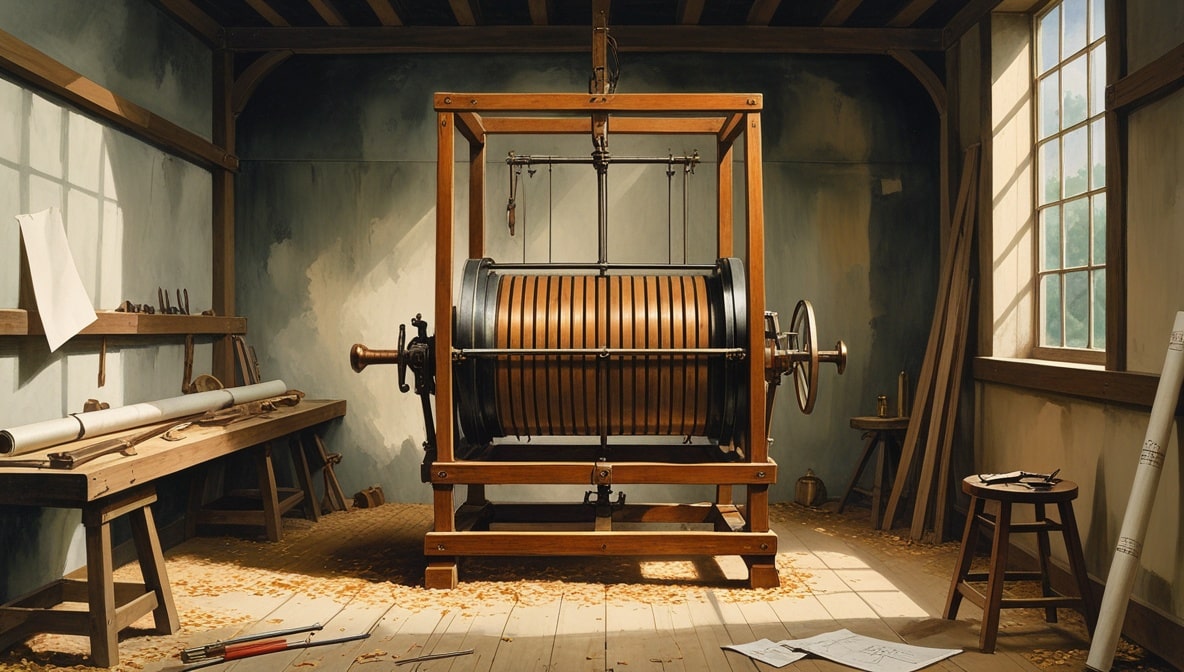
Henry Sidgier patents a rotating cage turned by a handle, an early revolving drum.
1797
United States
Nathaniel Briggs patents a clothes-washing machine. The records burned in the 1836 Patent Office fire.
1833
United States
Stephen Rust patents a zinc-covered washboard, longer-lasting than plain wood.
1851
United States
James King patents a hand-powered drum machine mounted in a frame.
1858
United States
Hamilton Smith patents a rotary machine that reverses direction mid-wash.
1861
United States
Wringer rollers start appearing as a fitted part of domestic machines.
1874
United States
William Blackstone builds a home washing machine, reportedly as a birthday gift for his wife.
1908
United States
The Thor, sold by the Hurley Machine Company and credited to Alva J. Fisher, is marketed as an electric washing machine. Its patent followed in 1910.
1937
United States
Bendix introduces the first automatic domestic washer, front-loading with a mechanical timer.
1957
United States
Push-button controls reach domestic washers, offering set wash and rinse temperatures.
1990s
Worldwide
Microchip controls become standard, improving cycle timing and bringing prices down.
2001
United States
Whirlpool launches a vertical-axis high-efficiency top-loader.
Two entries on that list deserve a caution flag if you are using it in class. The 1691 patent is often described as the first washing machine patent, though what it actually covered is unclear from surviving records. The Thor is widely called the first electric washing machine. Historians dispute that, since several manufacturers were fitting motors to tubs at around the same time. Teaching children that a famous “first” can be contested is a small lesson in historical enquiry.
How the Electric Motor Changed Wash Day
Adding an electric motor removed the human being from the middle of the process, and that single change did more than any earlier improvement. A dolly tub needed someone standing over it, working continuously. A motor turns the drum whether anyone is watching or not.
Early electric machines were still only partly automatic. The Thor and its rivals agitated the water. A person still filled the tub by hand, drained it by hand and fed everything through a wringer. Bendix’s 1937 automatic changed that by linking filling, washing, rinsing and spinning to a timer. It had no built-in water heater, so it drew hot water from the household supply.
Uptake in Britain came later than in the United States. Domestic electricity supply, wartime manufacturing restrictions and household budgets all slowed it down. Twin-tub machines needing manual transfer between washing and spinning drums stayed common in British kitchens through the 1960s and 1970s. Grandparents and great-grandparents are often the best primary source a class can get on this, and a short interview task works well as homework.
How Does a Modern Washing Machine Work?
A modern machine cleans through four things working together: water, detergent, heat and mechanical action. Take any one away and the wash gets noticeably worse, which is why cold quick cycles need more detergent to compensate.
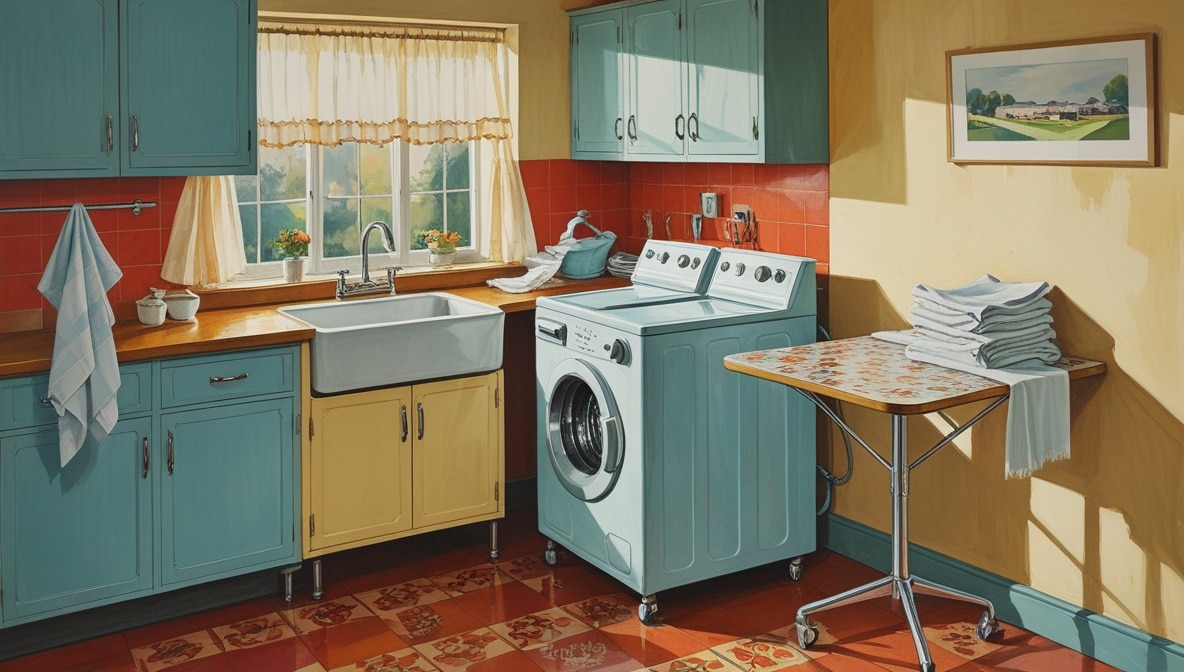
The drum sits inside an outer tub and spins on a horizontal axis in most British machines. Paddles on the drum wall lift clothes up and drop them back through the water. That is the modern equivalent of what a posser did by hand. Detergent molecules do the chemical part, gripping grease at one end and water at the other so oily dirt can be carried away. Heating happens through an element in the tub, controlled by a thermostat.
The spin cycle is the part children usually ask about, and it is straight KS2 physics. As the drum spins fast, water in the clothes keeps moving in a straight line and passes out through the perforations. The drum wall meanwhile keeps pushing the clothes inward. Nothing throws the water outwards. It simply carries on in the direction it was already travelling.
Sensors now weigh the load and measure water clarity to decide how long to run, which is why two identical-looking washes can take different times. For the underlying science, how forces work in everyday objects and simple electrical circuits both give children the groundwork. LearningMole’s video resources cover both strands at KS2 level.
How Are Washing Machines Becoming Greener?
Water and energy use per wash have fallen sharply, and the UK energy label is the clearest way to show children the difference. Labels were rescaled in March 2021 to a simple A to G scale. An older machine sold as A+++ may now sit at C or D.
A typical efficient machine on the UK market uses somewhere around 45 to 60 litres for a full cotton cycle. Estimates for hand washing the same quantity in a Victorian household run far higher, once boiling and multiple rinses are counted. Every litre also had to be carried by somebody. Eco cycles cut consumption further by washing longer at lower temperatures, trading time for heat. That surprises most people, who assume a shorter cycle must use less.
Three current directions are worth mentioning to older pupils. Detergent chemistry now works effectively at 20 or 30 degrees, cutting the energy needed. Filters that trap microplastic fibres shed by synthetic clothing are being fitted to some machines and are required by law in France. Machines are also being designed for repair rather than replacement, with bearings and pumps that can be reached without destroying the casing.
Set against that, laundry has become more frequent. Households wash more often and in smaller loads than they did fifty years ago, which offsets some of the efficiency gain. That tension between a more efficient machine and heavier use makes a good discussion prompt for a Year 6 sustainability lesson. Based in the UK, LearningMole builds its resources around National Curriculum objectives for KS1 and KS2, including this strand.
From Hard Labour to Free Time: What the Machine Gave Back
The washing machine’s biggest effect was giving time back. Whoever had been doing the washing recovered one to three days a week. In almost every household, that person was a woman.
Time freed from laundry fed into paid work, education and everything else. Economists discuss domestic technology as one factor among several in the rise of women’s participation in the labour force. Changes in law, contraception, wartime employment and social attitudes all played a part. The machine did not cause that shift on its own. It removed one large obstacle.
Wash day
1880
Today
Time taken
Two to three days, plus ironing
About two hours, largely unattended
Who did it
Women and girls of the household, or a paid washerwoman
Anyone who can press a button
Water
Carried by hand, heated over a fire, thrown away by hand
Plumbed in, heated in the drum, drained automatically
Cleaning agent
Lye from wood ash, rough soap, blueing in the rinse
Detergent designed for 20 to 30 degrees
Main tools
Copper, dolly tub, posser, washboard, mangle
Drum, motor, heating element, sensors
Physical effort
Heavy and continuous, with regular injuries
Loading and unloading
“Children take the washing machine completely for granted, which makes it perfect for teaching change. Once they have tried scrubbing a single sock in a bucket, the Victorians stop being a picture in a book and start being real people.” Michelle Connolly, Founder of LearningMole and former teacher with over 15 years of classroom experience
That is also why washerwomen belong in the story. Before machines, taking in other households’ laundry was one of the few paid trades open to working-class women in British cities, and it was gruelling. Public wash houses, many built by Victorian councils, served families with no space or water at home. Some survived into the 1970s.
Teaching Resources and Support
Washing machine history works best as a hands-on topic, and the single most effective lesson is making children try the old method for two minutes. LearningMole is a UK educational platform providing curriculum-aligned teaching resources for primary schools. Our video library covers the forces, electricity and Victorian history strands this topic touches.
Classroom Resources
For teachers planning a Victorians unit or a changes-within-living-memory sequence, ready-made resources save planning time. LearningMole produces educational videos aligned with the UK National Curriculum for children aged 4 to 11. Visual explanations of forces, gears and simple circuits support the science half of this topic. Our everyday household object history content gives you sibling topics to build a wider enquiry around.
Curriculum links at a glance
KS1 History: changes within living memory revealing aspects of change in national life
KS2 History: an aspect or theme in British history extending knowledge beyond 1066
KS2 Science Year 5: forces, including gears, pulleys and levers
KS2 Science Years 4 and 6: electricity, circuits and appliances
KS2 Science Year 5: properties and changes of materials, including dissolving and separating
Try This: The Great Sock Soak
This activity takes twenty minutes and needs almost nothing.
Give each pair a bucket of cool water, a wooden spoon, a bar of soap and one dirty sock. Garden soil rubbed in beforehand works well.
Set a timer for two minutes. Children agitate, scrub and wring by hand, counting how many times they lift the spoon.
Record how tired their arms feel on a simple scale, and how clean the sock looks against an unwashed one.
Discuss the sums. If two minutes cleans one sock, how long for a family’s whole wash in 1880?
Extend it by adding a second bucket for rinsing, then asking who carries and heats all that water.
LearningMole’s teaching materials include similar hands-on activities for classroom and home use.
Supporting Learning at Home
Parents can extend this without any preparation. Look at the energy label on your own machine together and find the letter. Time a cycle and compare it against the two to three days a Victorian wash took. Best of all, ask an older relative what their family used, whether that was a twin tub, a launderette or a mangle in the yard. LearningMole’s teaching videos work well for homework support, curious children who want more, and home education.
Frequently Asked Questions About Washing Machine History
Who invented the washing machine?
No single person did. The machine developed through many separate patents across roughly 250 years. Jacob Christian Schäffer published a hand-cranked design in Germany in 1767. Henry Sidgier patented a rotating drum in England in 1782. Nathaniel Briggs took out an American patent in 1797. Later contributors added the wringer, the electric motor, the automatic timer and microchip controls. Telling children the answer is “lots of people” beats naming one inventor. It also opens a useful conversation about how technology really develops.
What was a posser?
A posser was a hand tool for agitating washing in a tub. It had a long wooden handle topped with a cone or dome, usually of copper with holes punched through it, or sometimes turned from wood. Pushing it down forced water through the fabric under pressure, loosening dirt. Lifting it drew water back. The action is the same one a modern drum performs mechanically. Possers appear in museum collections across the north of England, where the word is most common. Many British families still had one in the 1950s.
What was a Victorian mangle used for?
A mangle squeezed water out of wet washing by feeding it between two rollers turned with a handle. It cut drying time considerably and made ironing easier, since fabric came out flatter. It was also a well-known household hazard. Fingers, sleeves and long hair could be drawn into the rollers, and mangle injuries appear regularly in Victorian medical records. For science teaching, the geared handle is a clear example of mechanical advantage, turning a modest push into a force no hands could produce.
Why was laundry day called Blue Monday?
Monday was the traditional wash day in most British households, which made it the week’s least popular day for the person doing the work. The blue also refers to blueing, a laundry additive sold under brands such as Reckitt’s Blue and added to the final rinse. White cotton develops a yellow tint over time, and a trace of blue dye visually cancels that yellow, making the fabric read as whiter. Modern detergents achieve the same effect with optical brightening agents.
How did the first electric washing machine work?
The Thor, sold from 1908 by the Hurley Machine Company in Chicago and credited to Alva J. Fisher, paired a galvanised metal tub with an electric motor that turned a drum. The motor replaced the arm that had previously worked a dolly or posser. It was not automatic. A person still filled the tub, emptied it and fed washing through a wringer afterwards. Its patent was granted in 1910. Historians dispute whether it was genuinely the first, since several firms were fitting motors to tubs at the same time.
Are modern washing machines better for the environment?
Per wash, considerably. Water and energy use per cycle have fallen sharply, and detergents now clean effectively at 20 or 30 degrees rather than needing boiling water. The UK energy label, rescaled to A to G in March 2021, lets you compare machines directly. Two things cut against the gain. Households wash far more often than they did fifty years ago. Synthetic fabrics also shed microplastic fibres into wastewater, which is why some machines now carry filters. Total consumption depends as much on habits as on the appliance itself.
Is washing machine history suitable for KS1 or KS2?
Both, with different framing. KS1 can treat it as a change within living memory, comparing a great-grandparent’s wash day with their own, which meets the History requirement directly. KS2 can go further, using it as an aspect of British history beyond 1066 within a Victorians unit. It also links to Year 5 forces work on gears and Year 4 or 6 electricity. The topic’s strength is that it carries genuine science and genuine history at the same time, so it fits a cross-curricular week neatly.
What resources help teach everyday inventions to primary children?
Video works particularly well here, because the old tools are unfamiliar and hard to picture from description alone. LearningMole’s curriculum-aligned videos cover the forces, gears, electricity and Victorian history strands this topic draws on. They suit teachers planning lessons and parents supporting learning at home. Pair the video with one physical activity, such as the sock soak above. Add a real object if you can borrow a washboard or visit a British social history museum. Subscription access includes the full video library across maths, English, science and humanities.
Conclusion
The washing machine deserves better than the corner of the kitchen it sits in. Its story runs from women beating cloth on riverside stones to a sealed box that cleans while nobody watches. That box weighs the load and judges how dirty it is. Along that route sit a German pastor and an English patent from 1691 that nobody fully understands. There is a birthday present from an Indiana man to his wife. There is a Chicago motor that quietly ended a job millions of women had done by hand.
For a primary classroom, the value lies in how much the topic carries at once. Children get gears and mechanical advantage from the mangle, then forces and inertia from the spin cycle. The motor gives them circuits. Lye and detergent give them chemistry. They also get a piece of social history they can check by asking a relative. Few topics offer that much across the curriculum for so little preparation.
The story has not finished either. Microplastic filters, repairable designs and cold-water detergents are all being worked on now. Children studying this can reasonably be asked what the next change should be. Ask them which household job they would automate next, and why nobody has managed it yet. The answers tend to be better than the question deserves.
Bring Everyday Inventions into Your Classroom
LearningMole provides free and subscription-based educational videos and resources aligned with the UK National Curriculum. Whether you are a teacher planning a Victorian unit, a parent supporting home learning, or a home educator, our library will help. It covers history, science, maths, English and much more, all made by experienced educators.
Maths Circus, an innovative platform we've crafted, presents a captivating realm where children learn mathematics through the exciting theme of a circus. The joy of juggling numbers and solving circus...
Fruit helps protect the body from disease because it delivers fibre, vitamins, minerals and natural plant compounds that support the heart, the gut, blood sugar control and healthy cells. The...
Dark chocolate is one of the few treats that scientists have studied in real depth, and the results are more measured than the headlines suggest. The cocoa bean is rich...
A tour guide leads visitors around a place of interest, such as a castle, a museum, a city centre or a nature reserve, and explains its history and stories in...





Leave a Reply