Are you ready to learn some Solar System facts! The Solar System is a gravitationally bound system of the sun and the objects that orbit it. It is a group of moons, Meteors and Meteorites, comets, asteroids, dwarf planets, different planets, and a black hole is located at the center of the Milky Way galaxy.
Our galaxy is the Milky Way galaxy. Make sure you visit LearningMole.com to learn some fascinating facts about our Solar System! The solar system is named after an ancient Roman word; Sol. The Solar System was formed 150 million years ago.
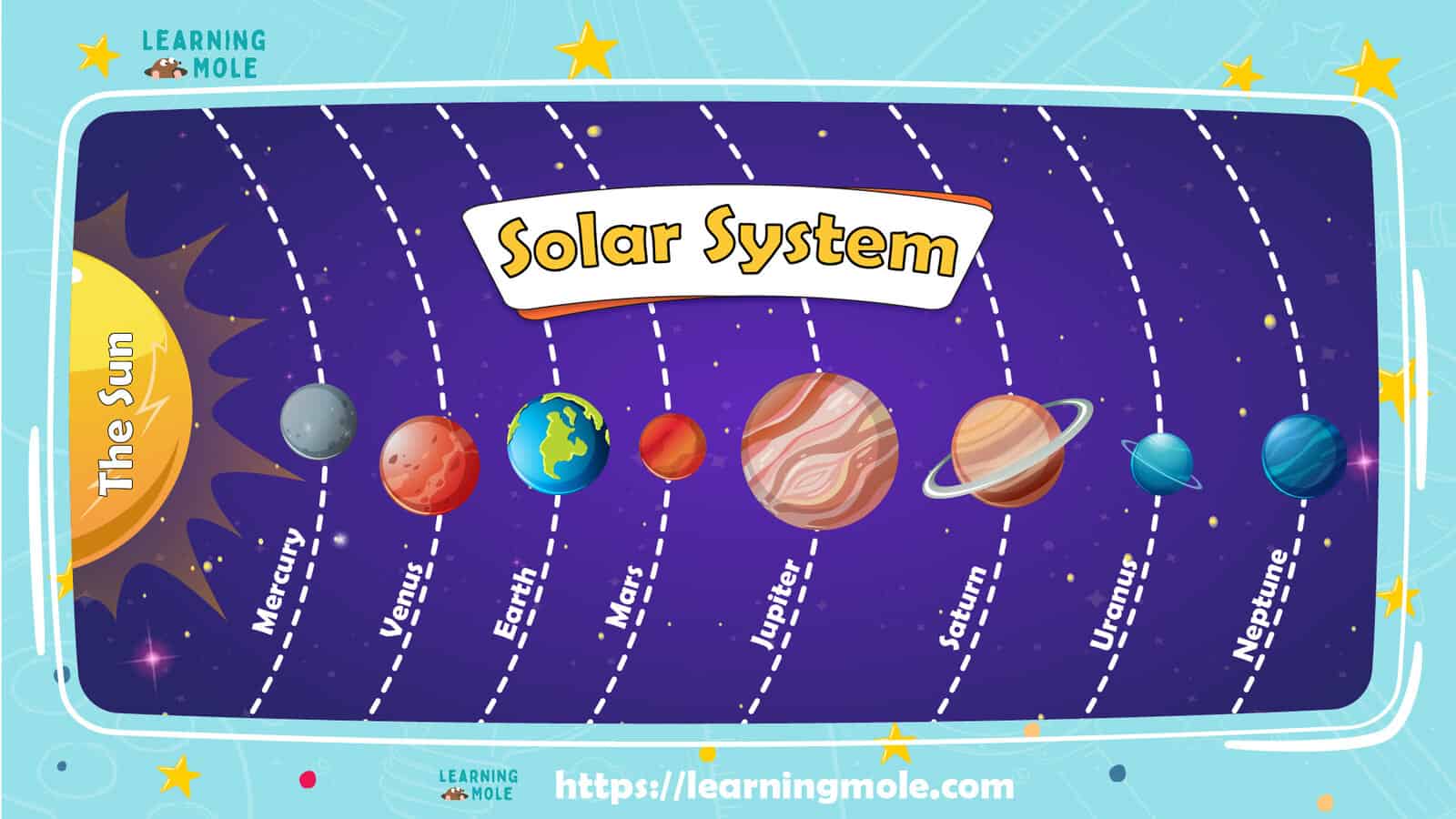
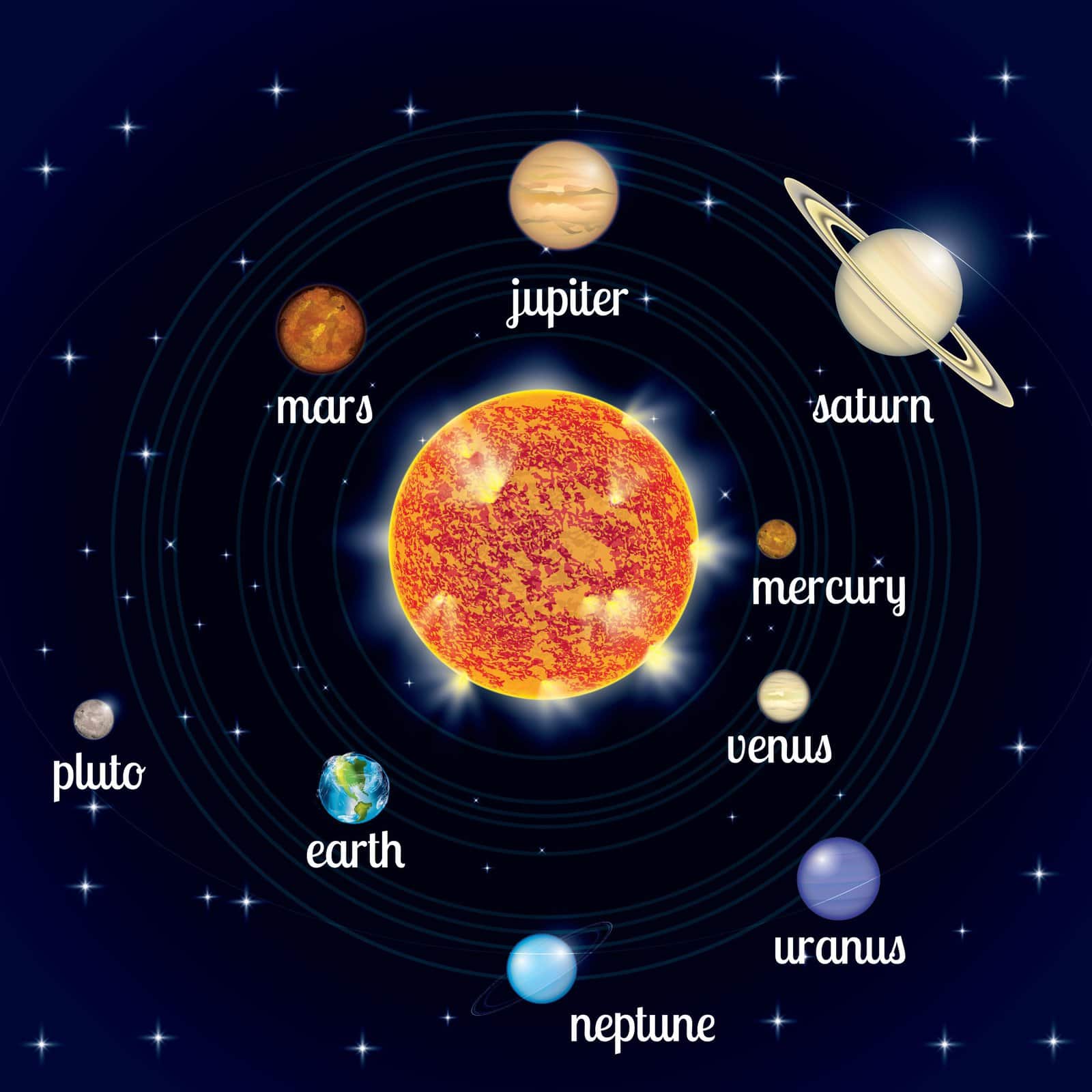
The Solar system is no longer a nine planet Solar System. It is an eight planet Solar System now. So, remember that when you are creating a Solar System model or searching for the kids Solar System project pictures at home.
How was the Milky Way Formed?
Let us answer the question of what the Milky Way is made of? The Sun and planets formed 4.6 billion years ago. It started out as a cloud of gas and dust. Later, called the solar nebula is how it all started.
A shock wave from a near supernova initiated the collapse of the solar nebula. The Sun appeared at the center and the planets formed disks orbiting around it. Finally, we had the Milky Way Solar System.
What does it consist of?
The Solar System has so many interesting stories to tell. Let us learn more Milky Way facts and information. It has an average-sized star which is the Sun. There are moons orbiting each planet. Except for Mercury and Venus. Mercury and Venus are considered the only planets in our Solar System which do not have a natural satellite.
There are numerous Meteors and Meteorites, asteroids as well as comets. There are also dwarf planets and 8 planets in our Solar System. Learn some more facts about the Solar System:
Sun in Space Facts for Kids
Let us listen to the stories the Sun has to tell. The Sun started off as a cloud of dust and gas. Slowly, it gained heat over time. It is made of hydrogen and helium. The Sun is in fact about 4.5 billion years old. That is the average age for a star. The light of the Sun can reach the Earth in only eight minutes. This is known as the speed of light. The Sun is considered the closest star to our planet. As a result, it is so bright and big. Many cultures, the ancient ones, thought the Sun was a god. Helio means sun in Greek.
The Sun is the main reason all of the other planets are in orbit. Due to its gravitational pull. Since the Sun makes up 98 % of the matter in the Solar System, it has a strong gravitational pull that keeps the planets and Solar System the way it is now.
The Sun controls the seasons. It controls the farming seasons and when the food is ripe. It controls our sleep patterns as well. We sleep when nighttime occurs.
Nighttime occurs when the side we live on on the Earth is facing away from the Sun. We wake up when the morning comes. Morning comes when the side we live on is facing the sun.
The Sun revolves around itself and around the center of the Milky Way galaxy which is a black hole. At the same time, the Earth revolves around itself as well and around the Sun. When the Earth does one round around itself, it completes one day.
Which is 24 hours. However, when it completes a cycle around the Sun, it completes a year with all its four seasons.
Sunspots are some areas on the Sun’s surface that are cooler than others. These areas look darker. Sometimes gases on the Sun’s surface erupt. These eruptions look beautiful from afar. However, they can cause problems here on Earth.
They can interfere with satellites. Our cell phones and the network in the area might not work because of that. Our televisions and internet might not work as well.
The temperature of the Sun is around 10,000 degrees Fahrenheit. Even though the Sun looks like a burning ball of fire, it actually has an internal structure.
The surface that we can see is called the photosphere. It heats up to a temperature of 6,000 degrees Kelvin. Beneath that, you will find the convective zone, where heat moves slowly from the inner Sun to the surface. Beneath that, further down, you will find the convection zone is the radiative zone. In this zone, heat can only travel through radiation. This is where temperatures can reach up to 13.6 million degrees Kelvin and molecules of hydrogen are turned into helium by the effect of heat.
On the other hand, above the surface of the Sun there is an atmosphere called the chromosphere. Their temperatures can reach 100,000 Kelvin. There’s a distant region called the corona, which extends to a volume that is even larger than the Sun itself.
Temperatures in that area can reach up to 1 million Kelvin. Pretty hot! Right? Even so, the Sun is not always shining. Sometimes a solar eclipse takes place. A solar eclipse is when the moon is between the Earth and the Sun whereas, a lunar eclipse is when the Moon passes by the shadow of the Earth
Moving onto our next part of the story, we have the Moon. The moon is many things. A natural satellite. The main cause of tides on Earth. The light reflection of the sun by night and so much more.
Moon Facts
The second part of our Solar System story is the Moon. The moon is considered the second brightest object in the sky after the Sun. It is also the fifth largest satellite in the Solar System. It completes one round around the Earth in 27 days.
The Moon’s surface is in reality not that bright, however. The reason it is so bright in the night sky is that it reflects the light of the Sun. Another fact about the Moon is that it keeps moving away from the Earth as time goes by. That is one of the reasons why the Earth keeps moving.
Gravity is what keeps the moon orbiting the Earth. It is also the reason why the tides of the ocean react to the gravitational pull of the moon by receding and returning. Not only is it the cause of the tides on Earth, but the Moon also has water on its surface. The sun causes some tides as well.
In addition to, containing precious metals, such as gold and silver. The Moon has quakes and scars due to its impacts with other celestial objects in space. The Earth is also hit by objects floating in space, but on Earth we have tsunamis, earthquakes, and other forms of natural disasters, as we call them, to hide the evidence of any form of previous impacts.
In addition to Aaron’s Moon facts:
Here are some facts we want you to know: The moon is about 2.1 million years old. The moon has no atmosphere. It can reach 270 degrees Fahrenheit when absorbing the Sun’s heat, but it can also drop down to -280 degrees Celsius when it is not absorbing the heat of the Sun.
The moon has eight different phases. There are four primary phases and four secondary phases. The first primary phase is called New Moon.
It is called a New Moon because it is the start of a new lunar cycle. It is when the Earth, the Sun, and the Moon are lining up.
The next primary phase is the First Quarter. It is named as such because the Moon passed 1/ 4 the way through its orbit. The next primary phase is the Full Moon. It is named as such because from our perspective the Moon is fully illuminated.
The final primary phase is the Last Quarter. It is named as such because the moon travelled 3/ 4 of the way of its orbit. On the other hand, there are four secondary phases for the Moon.
The first secondary Moon phase is the Waxing Crescent. Also known as the New Crescent. The Second secondary Moon phase is the Waxing Gibbous.
Also known as the New Gibbous. The third secondary Moon phase is the Waning Gibbous. Also known as the Old Gibbous.
The final secondary phase is the Waning Crescent. Also known as the Old Crescent.
After learning all about the Moon and the Sun, we will carry on our story to learn more about what the Solar System contains. Our next chapter is about Meteors and Meteorites.
Meteors and Meteorites
A meteoroid is a space rock. They are made of rock and metal. They range in size. Some are big and some are small. They float in space.
Sometimes, one or more meteoroids fall into Earth’s atmosphere. They either burn up completely in the sky before reaching the ground or reach the ground and cause a huge impact.
If they burn up completely we call them Meteors. We see them in the sky as they fall. If they are a group of space rocks, we call them a Meteor Shower. The most recent Meteor Shower happened on October the 21st.
This happens when small space particles that are left by comets pass through the Earth’s atmosphere. If the space rock does not completely burn up in the sky and reaches the Earth’s ground, we call it a Meteorite.
Comets
Next up are Comets! They orbit our Sun. They can contain ice from frozen gases, rock, as well as dust. A Comet is a giant space object that has a nucleus and two tails. The main body is called Coma. They float in space as well.
They do not float freely, however, but orbit the sun. They eventually heat up, the closer they get to the sun and blow up dust and gases. There are about 3, 535 Comets in our Solar System. It is believed that Comets are leftovers from the universe long ago.
Asteroids
Moving up onto Asteroids! They are rocks as well. However, they can be made of not only rocks, but also metal, carbon or even a punch of rubble piles forming a random shape under the effect of gravity.
They revolve and float each in its own orbit in the main asteroid belt. The asteroid belt is between Mars and Jupiter. Sometimes, they end up penetrating the Earth’s atmosphere. Some space rocks are large and cannot be described as merely a space rock, but smaller than a planet. We call those, dwarf planets.
Dwarf Planets
We come up onto Dwarf Planets. Dwarf Planets are big celestial objects that are smaller than a planet, but bigger than Asteroids and Comets. We have about 5 Dwarf Planets in our Solar System. They are: Pluto, Eris, Haumea, Makemake, and Ceres.
Pluto
Pluto was the ninth planet until scientists discovered same sized space objects or bigger. So, they decided to reclassify Pluto as a Dwarf Planet in 2006. Pluto is now the best example of a Dwarf Planet. Despite its small size, Pluto is able to capture 5 moons of its own.
The moons revolve around a central point that is not in Pluto’s mass. Pluto is actually the name of the Roman god of the underworld. Pluto is actually the largest known Dwarf Planet. It is made up of one-third of water.
Pluto can get close to the Sun way more than Neptune ever could. It also has an atmosphere. Pluto is mostly reddish-brown shades. It is the second closest Dwarf Planet to the Sun.
One day on Pluto is 6.4 days on Earth. Temperatures can drop down to – 387 degrees Fahrenheit on Pluto. Therefore, it has white-peaked mountains. The white caps are made of methane frost and the mountains are made out of ice water.
It can never be warm on Pluto, however, it has warmer seasons when its temperature is – 220 Celsius. Pluto takes 248 Earth years to do a complete cycle around the Sun. It was discovered that Pluto has a heart-shaped region called Tombaugh Regio in 2015. Pluto’s five moons are Charon, Kerberos, Styx, Nix, and Hydra.
Charon is in fact half the size of Pluto and is the largest moon in all five. A planet has to orbit the sun and Pluto does. A planet should be big enough to have enough gravitational force to be in a spherical round shape.
Which Pluto is. However, a planet should be big enough to clear away any objects similar in size near its orbit and Pluto could not do that. This is why it is a Dwarf Planet and not a planet.
Eris
The second Dwarf Planet in consideration is Eris. Eris was considered to be larger than Pluto at first. This led the scientists to reclassify Pluto as a Dwarf Planet. However, it turned out to be smaller in size slightly than Pluto. Eris takes 557 years to orbit the sun.
Eris’s orbit is three times larger than that of Pluto. It nearly intersects the orbit of Neptune crossing by Pluto. Eris is named after the goddess of chaos. It was almost considered our 10th planet in the Solar System.
Eris was first nicknamed as Xena and it has only one moon. Also, it is the second-largest Dwarf Planet after Pluto. The surface of Eris looks like Pluto’s heart.
A day on Eris is 25.9 hours on Earth. Its temperature varies from -217 to -243 degrees Celsius. Eris is rich in nitrogen and ice mixed with frozen methane.
Haumea
The third Dwarf Planet we will discuss is Haumea. It is named after a Hawaiian goddess of fertility. The temperature on Haumea reaches -402 degrees Fahrenheit. This is why it is probably frozen on the outside because it is very cold. However, It is the third closest planet to the Sun.
It is the dwarf planet with the shortest day in the Solar System which is 3.9 hours. The surface of Haumea is very bright. Still, it is rock-shaped with an ice coating and a large red spot. It has rings. Haumea is oval and three Haumeas can fit side by side on Earth.
Haumea has two moons. Which makes it the second Dwarf Planet in the Kuiper belt to host more than one moon. The first is Pluto.
Makemake
The fourth Dwarf Planet is Makemake. Makemake used to be called the Easter Bunny. It is very bright. It has one moon that was recently discovered. Makemake is partially blamed for Pluto’s reclassification into a Dwarf Planet.
Makemake is named after a god of fertility in Rapa Nui mythology. The temperature can get really low on Makemake. It can reach -243 degrees Celsius. Therefore, the surface of Makemake is possibly covered in methane, ethane, or nitrogen ices.
Makemake is reddish-brown in color. It can make a complete rotation around the Sun in 22 and a half hours. This makes it similar to the day length of the Earth and Mars. Makemake is responsible for the reclassification of Pluto from a Planet to a Dwarf Planet along with Eris and Haumea.
Ceres
The fifth and final Dwarf planet is Ceres. Ceres is not a planet because of the same reason that Pluto is not a planet. Since Ceres does not push away other asteroids that are sharing its orbit. In addition to how massive Ceres is, Pluto is 14 times even more so.
Ceres is round and possibly has an atmosphere. It is named after a Roman goddess. That of agriculture. It has bright spots and may harbor a subsurface ocean. It lies between Mars and Jupiter. One day on Ceres is about 9 hours on Earth and it takes 1682 days to make one complete rotation around the Sun.
Ceres probably has more water than Earth does because it is composed of 25% of water. The crust is rocky and dusty with large sums of salt. Ceres is a beautiful rocky Dwarf planet with a high probability of life on it.
Dwarf Planets are amazingly distinguished. Each of them has its own shape and characteristics that distinguish it from the others. There are even more celestial objects out there that are believed to be Dwarf Plants. They are Orcus, Sedna, Gonggong and Quaoar.
Planets Facts for Kids
Since we know more about our Solar System and the Dwarf Planets that are in it, let’s get more familiar with the 8 planets in our Solar System. The 8 planets have a story of their own to tell us, so we better pay close attention and check out some amazing facts about our solar system right here:
First, we need to learn more about what it actually means to be a planet. A planet is a celestial body that orbits the Sun, has enough mass to use its gravitational force to stay in a nearly round shape, and clear the neighboring celestial objects that enter its orbit or revolve around it.
There are three types of planets. The rocky, gas giants, and ice giants. They form two main categories: terrestrial and Jovian. The terrestrial planets are the rocky planets whereas the Jovian planets are the ice and gas giants.
The terrestrial planets are only four. Those are Mercury, Venus, Earth, and Mars. The Jovian planets are four as well. Those are Jupiter, Saturn, Uranus, and Neptune. Jupiter and Saturn are gas giants. Uranus and Neptune are the ice giants. There are a set of characteristics that differentiate each category.
The terrestrial planets are rocky, they have a solid surface, their core contains metals or heavy elements, have higher density because of their core, smaller than the giants, closer to the Sun, do not have many moons, have less gravitational force, and have a rocky mantle.
The atmosphere of a terrestrial planet is a mix of gases, like carbon dioxide and nitrogen gases. They rotate faster than the Jovian planets around the Sun or themselves. They have features, like valleys and volcanoes.
The Jovian planets are either icy or gaseous. They have gaseous surfaces. They are basically large balls of hydrogen and helium gases. They are much larger than the terrestrial planets. They have less density than that of terrestrial planets because they are gaseous balls.
They are further away from the Sun. They have rings. They have high gravitational force. Therefore, they have many moons. They rotate slower around themselves and the Sun. They tend to have thick atmospheres that contain hydrogen, helium, methane, and ammonia.
They have water in their atmosphere. They also contain ice. That is composed of water, ammonia, and methane. Sometimes, they may contain some rocky material that can be found in their core. Make sure to learn even more about the planets of our Solar System:
Mercury
The first planet we will hear from is Mercury. Mercury is the nearest planet to the sun. However, it is not the hottest. Venus is. It is, however, the smallest planet in our Solar System. You can even check for yourself:
A year on Mercury is 87.97 Earth days, whereas a day is 59 Earth days.
Mercury is a rocky planet. Making it one of our four terrestrial planets. Mercury does not have any moons. It is covered with craters because of past impacts with space rocks. It also has some smooth plains. Mercury is dark grey.
Over four billion years ago Mercury was actually 9 miles bigger. Mercury is actually shrinking! It is a slow process. However, Mercury has a huge iron core. Maybe it is shrinking because its iron core is cooling and turning solid. Since the metal core contains liquid iron that makes up three out of four of its radius.
Mercury has a changing atmosphere depending on how distanced it is from the Sun. It has ice that is visible to be younger than it actually is from Earth. Mercury looks so much like Earth’s moon.
The magnetic field of Mercury is actually different at its poles and behaves similarly to the magnetic field of Earth. However, if you weigh 65 KG on Earth, you will weigh 24.56 KG on Mercury.
Mercury lies at a distance of 57.91 million km from the Sun. It is also called the Swift Planet since it is the fastest moving planet in our Solar System. Mercury is actually named after the swift footed messenger of the gods in Roman mythology.
Venus
The second planet we will hear from is Venus. Venus is our second terrestrial planet because it is rocky as well. Venus is named after the goddess of love and beauty in Roman mythology.
It is the second nearest planet to the Sun., the nearest planet to the Earth, and is considered not only a bright object but the third brightest object in the entire sky after the Sun and the Moon. It is the third smallest planet in our Solar System. It is considered the hottest planet in our Solar System. You can learn more about it:
It is so because it has thick poisonous clouds that trap the heat from the Sun. Venus is light yellowish. Its core is metallic iron and it has a molten rocky mantle. The crust of Venus is mostly basalt.
Venus lies at a distance of 108.2 million km from the Sun. One day on Venus is an average of 116 days on Earth. Venus takes about 225 days to complete one orbit around the Sun. This makes one year on Venus to be 225 days.
Venus spins in the opposite direction of the Earth and most of the other planets. Therefore, Venus spins clockwise on its axis. Venus is also known as Earth’s sister. Earth and Venus are almost the same size, have the same mass, and are made of nearly the same material.
The temperature can reach up to 880 degrees Fahrenheit. It is believed to be impossible to be able to live on Venus due to the high scorching atmosphere which makes the air hot and heavy. Therefore, there cannot be any form of life on Venus. Venus has no moons.
The air pressure on Venus is 90 times that on Earth. Despite being as beautiful as the second brightest object in the night sky after the moon, it is impossible to tolerate or live on Venus. There is also no chance Venus is cooling off anytime soon till most of the carbon dioxide has been removed.
Earth
The third planet we will hear from is Earth. Earth is our third terrestrial planet. The closest planet to our hearts. Earth is considered the only planet out of all the planets that were not named after a Greek or a Roman god or goddess.
Earth is actually an English or German word of origin that means the ground. Earth is the third on the list of the nearest planets to the Sun. It is also the only planet that we know of that inhabits different varieties of species. It supports life as we know it. Earth is about 149.6 million km away from the Sun.
One day on Earth is 24 hours whereas a year is 365 days. This means that Earth takes about 365 days to orbit the sun and 24 hours to complete one rotation around itself.
We are a total of 7.753 billion people on Earth. 70% of the Earth’s surface is covered in water. It is almost a sphere. Earth is mostly iron, oxygen, and silicon. The Earth has a molten iron core. Which is the reason why it has a magnetic field.
The Earth’s rotation is gradually becoming slower every passing day. Which means, the days are getting longer. The Earth has only one natural satellite which is the Moon. It is considered to be the densest planet in our Solar System. The Earth also has a very powerful magnetic field.
People used to believe that the Earth is the center of the universe. The clouds help regulate the Earth’s temperature. The Earth looks like a blue marble with white swirls all over. The name of the Earth’s atmosphere is the geosphere. The atmosphere of the Earth is the area above its surface.
The Earth is actually divided into two systems. The geosphere and the biosphere. The Earth’s atmosphere, the geosphere, is divided up into 4 areas. The first area is the atmosphere. The second area is the lithosphere. The third area is the hydrosphere. The fourth area is the cryosphere. Most of the water on Earth lies in the hydrosphere area.
The atmosphere area, on the other hand, is the “air” area. It is held in place by the effect of the gravitational force of the Earth. The atmosphere of the Earth has six layers. The troposphere, stratosphere, mesosphere, thermosphere, exosphere, and Ionosphere are the six layers of the atmosphere.
The troposphere is the layer in which we breathe in. It starts at the ground and goes up to 10 kilometers in altitude. It is where all the clouds form and 99% of the water of the Earth’s atmosphere is found in this layer.
It contains nitrogen, oxygen, argon, carbon dioxide, nitrous oxides, methane, and ozone gases. This layer also contains some water vapor, dust, pollutants, and other similar stuff mixed into the atmosphere. The higher we go, the thinner the atmosphere gets.
The Stratosphere is the next layer. It contains the ozone layer. The air gets warmer and there is no turbulence. The mesosphere comes next. It is where all the gases are mixed up and meteors entering the atmosphere of Earth gradually break here.
The thermosphere is quite thin. It can be really hot here. The temperature reaches 4500 degrees Fahrenheit. Due to the high UV and X rays. They are radiation from the Sun. There can be a lot of satellites, space stations, and so much more found at this layer.
The Exosphere is where we can find hydrogen and helium and the atmosphere is quite thin. The ionosphere is the active layer of the atmosphere that overlaps all the layers. It is the ionized part of the Earth’s atmosphere. It is where Auroras occur.
An Aurora is a phenomenon of natural colors appearing in the night sky. Due to the electrified particles from the Sun that get trapped in the Earth’s atmosphere and magnetic field. So, the Earth’s atmosphere has six layers and the Earth’s geosphere consists of four areas.
The second area is the hydrosphere. All water on Earth is a part of the hydrosphere. The third area, it is the lithosphere. Which stands for lithos in Greek, meaning “rocky”. It is the element of the Earth’s crust.
The fourth area is the cryosphere. Which is all of the frozen water on Earth. As for the biosphere, it is all the living organisms that are alive. It is like the four elements of life. Earth is the biosphere containing life.
The biosphere contains all living organisms, starting from microscopic bacteria up to animals. Rock, instead of fire, which is the lithosphere. Water can be found in many forms. In a liquid or vapor form, as the hydrosphere as well as in the ice solid forms which is the cryosphere. Air is the atmosphere.
Mars
The fourth planet we will hear from is Mars. Mars is the fourth terrestrial planet. Mars is 227.9 million km away from the Sun. It orbits the Sun in 687 days on Earth. It takes approximately 1 day to complete one rotation around itself.
Mars is actually the name of the God of War in Latin. It has a similar mass to the Earth. It is where the tallest mountain in our Solar System lies. From Mars, we see the Sun half the size that we see on Earth. Mars used to have water in the past, but now it only has frozen water.
It used to have a thicker atmosphere. It is now very thin. The atmosphere is composed of carbon dioxide, nitrogen, and argon. Mars has seasons, volcanos, and weather. It controls two moons. It is often referred to as the red planet.
The color Mars appears to be is brown, Gold, and maybe tan. However, we can all agree it looks a bit reddish due to the oxidization of the iron present in the rocks and dust on Mars. The rock and dust are accumulated in the atmosphere to reflect the reddish color we see.
The Martian atmosphere contains 96% of carbon dioxide whereas oxygen is only 0.13%. In comparison, the Earth has 21% of oxygen. Mars also has four seasons. Each season is twice as long as that of the seasons on Earth since the year on Mars is twice as long as the year on Earth.
Mars is the second smallest planet in our Solar System. It has powerful snowstorms that form at night. It has the four seasons of summer, spring, autumn, and winter. It does not rain on Mars. It is called Sol to distinguish its 24 hours and 40 minutes a day from the Earth’s 24 hours a day.
The sky on Mars appears blue near the sun, but appears red away from the Sun. The Sun may appear mostly white with a bluish brush into it. The dust in Mars’s atmosphere is as thick as a sandstorm on Earth.
It eventually absorbs the blue sky and gives off a red color. Mars is the most likely planet we will move on to live on after Earth in the far future ahead.
Jupiter
The next planet we will hear from is Jupiter. Jupiter is one of the gaseous giant Jovian planets. It is massive. Jupiter’s magnetic field is 14 times stronger than that of Earth’s. Jupiter is actually the largest planet in our Solar System. Check out more about Jupiter:
Jupiter is the fourth brightest object in our Solar System. Jupiter has the largest moon in the Solar System. It is even larger than Mars. Jupiter has a total of 79 moons.
Making it the second planet with many moons after Saturn. The gravity on Jupiter is 2.5 times that on Earth. There is no firm surface on Jupiter to stand.
Scientists believe that it may be raining diamonds on Jupiter. Lightning storms on the planet turn methane into soot that eventually hardens and turns into chunks of graphite and become diamonds as they fall down. It is believed that Jupiter may have a solid core that is as huge as Earth.
Jupiter contains nitrogen, hydrogen, helium, methane, and ammonia. It is mostly made of hydrogen and helium. It most likely has three skies. The top sky is made out of ammonia ice, whereas the middle one is made out of ammonium hydrosulfide crystals. Jupiter is covered in swirling cloud stripes.
The clouds on Jupiter are 50 km thick. Which is why the pressure on Jupiter may crush any object. Jupiter has rings. These rings are mainly composed of dust particles. Thus, they are faint. They are divided into three levels. The first is the halo. The second is a bright ring. The third is the outer gossamer ring.
It has a great red spot that keeps moving clockwise. The red spot is actually a storm. Three Earths can fit right into that storm. It moves 400 miles per hour. It looks like a big red spot from afar. Humans have been studying it from afar for more than 150 years.
The temperature on Jupiter is about – 234 degrees Fahrenheit. It is about 778.5 million km away from the Sun. A day on Jupiter is the shortest day in the entire Solar System. A day is actually 9 hours long.
Jupiter is the fifth planet from the Sun and it takes 12 years to orbit the Sun. Therefore, a year on Jupiter is actually 12 years on Earth. Since Jupiter is the largest planet in our Solar System, it is named after the king of the gods in Roman mythology. In addition to being named Zeus in Greek mythology. Zeus is the king of the Greek pantheon.
Saturn
The next planet we will hear from is Saturn. Saturn is the second of the gaseous giants Jovian planets. Saturn has a total of 82 moons. It used to have 62 moons, but they discovered 20 more moons making it 82 moons total. Making it the planet with the most moons in our Solar System.
Saturn is 1.434 billion km away from the Sun. One day on Saturn is about 10 hours on Earth. It takes Saturn 29 years to orbit the Sun once. Saturn is the least dense planet in our Solar System. It is a flattened ball.
It is a massive ball of mostly hydrogen and helium. Since it is a gaseous planet, it can float on water. The rings of Saturn are huge and thin because they are made out of particles of dust and sand. In addition to asteroids and other space material floating in the rings.
It has a yellowish-brown appearance. Saturn is actually named after the god of agriculture in Roman mythology. It is the fifth brightest object in the sky.
Saturn is also the name of the Roman god of time. Saturn is considered to be the slowest planet is orbiting the sun. Saturn itself is made up of ammonia ice and methane gas.
Uranus
The next planet we will hear from is Uranus. Uranus is one of the icy gaseous giant Jovian planets. It is about 2.871 billion km from the Sun. One day on Uranus is 17 hours and it takes 84 years to complete one orbit around the Sun. Uranus has 27 moons. It is considered the second least dense planet after Saturn. Uranus is the coldest planet in our Solar System. The average temperature on Uranus is -353 degrees Fahrenheit. Check out more about Uranus on:
It is the only planet in the entire Solar System named after a Greek god rather than a Roman one. Uranus is named after an ancient Greek god. That of the sky. Uranus and Neptune are considered to be the outer planets of the Solar System by the international astronomical union.
It has no solid surface. Uranus is composed of gases, like methane, ammonia, and water ices. We can only live on the outer cloud top layers of Uranus. Uranus is bluish-green because of the absorption of the red light by methane gas.
It was also known as Georgium Sidus. It was named as such by the English astronomer William Herschel in honor of his patron, King George III. Its nickname is the bulls-eye planet because of how its rings are vertical and appear like a bulls-eye on a target.
Uranus has a small rocky center and faint rings. Its atmosphere is made out of hydrogen and helium like Jupiter and Saturn. The methane gas that is present in Uranus’ atmosphere makes it blue in color.
Uranus is the only planet whose equator tilts till it is nearly at a right angle to its orbit. It is probably because of a collision with a space object that is about the same size as the Earth. The seasons on Uranus are extreme because of this tilt. A season on Uranus takes 42 years.
Neptune
The next and final planet we will hear from is Neptune. Neptune is one of the icy gaseous giant Jovian planets. One day on Neptune takes 16 hours on Earth. It takes 165 years to orbit the Sun once. It is about 4.495 billion km away from the Sun.
80% of the planet is made up of icy water, methane, and ammonia. It is the eighth planet from the Sun. It is the third-largest planet because of its mass. It is also the fourth largest because of its diameter.
Because of how blue Neptune looks, it was named after the god of the sea in Roman mythology. The blue color is a result of the methane atmosphere absorbing the red infrared light on Neptune just like in Uranus’ atmosphere.
Neptune has the strongest winds in the Solar System. It is the most distant planet. Neptune is actually the smallest of the Gas Giants. The gravity of Neptune is nearly the same as that of Earth. Neptune can also be considered the coldest planet in the Solar System along with Uranus. The temperature reaches -373 degrees Fahrenheit.
Neptune is very similar to Uranus. It is also known as the planet exterior to Uranus. Its atmosphere is also similar to that of Uranus’. Neptune is 58 times bigger than Earth. It is 17 times heavier than Earth. It also has a core that is probably Earth-sized.
Neptune has an internal rocky core structure. It consists of silicates and metals. The second layer consists of water, ammonia, and methane ices. It is called the mantle. Finally, the atmosphere. The atmosphere consists of hydrogen, helium, and methane gas.
Neptune is made up of thick layers of water, ammonia, and methane. It has five rings. The first ring is Galle. The second ring is Le Verrier. The third ring is Lassell. The fourth ring is Arago. The fifth ring is Adams.
Concepts and inventions related to our solar system
The next part of our story will contain very interesting discussions about concepts and inventions that have to do with space and our Solar System!
Some of the interesting concepts that have to do with our Solar System are Black Holes and the Milky Way galaxy that the Solar System exists in. We will also explore its spacecraft with all the different types that exist in our Solar System.
Black Holes
The next part of our Solar System story is about black holes in space. Our Solar System has a supermassive black hole at its center. Black holes can be found at the center of a galaxy. They swallow anything that comes close enough to them.
It is called the galactic center. The Milky Way has one itself. They are super strong. With so much strength, they can even absorb light. Scientists believe that black holes originated as stars. In other words, black holes used to be stars that are now dead.
Black holes can be either primordial, stellar, or supermassive. A primordial black hole is probably a leftover from the universe’s creation process. A stellar black hole is often created due to the death of a star. As for the supermassive black holes, they are massive and can be found at the center of every galaxy.
The Milky Way indeed has many stars and so, it will and may have as many black holes. After these stars die, black holes will form. Black holes do not live forever, do not worry! Black holes evaporate in space with time and their energy returns to the universe.
The Milky Way Galaxy
A galaxy is a system that is bounded and shaped by the effect of gravity. It contains different types of all space objects. Our galaxy, as we mentioned at the beginning of the article, is called the Milky Way galaxy. A galaxy actually means milky in Greek. It is called the Milky Way because it looks like a milky light band in the dark from afar.
Galaxies have different shapes and sizes. They also have types. Most if not all of the galaxies have a black hole at their center. Some galaxies are called dwarf galaxies because they contain a small number of stars.
Other galaxies are large because they contain a large number of stars. The Milky Way is a large galaxy. Galaxies are classified into three types. The first type are the Elliptical galaxies. The second type are the Spiral Galaxies.
This type has two classifications. It could either be a barred spiral galaxy which has a bar across its center and its arms extending from the ends of that bar. Or it can be a normal spiral galaxy which has arms extending from its center. The Milky Way galaxy is a large barred spiral galaxy.
The third type is the Lenticular Galaxies. Galaxies are divided based on how they look from afar. The elliptical galaxy has a light distribution that does not have features and is smooth. It appears as an ellipse in pictures.
Whereas a spiral galaxy is flat. It has a rotating disc with stars, planets, and space particles. Its name comes from the star formations that happen regularly. They are present in the spiral structures that extend from the galactic disc.
Finally, a lenticular galaxy has a bright bulge at the center. It is surrounded by a structure that is similar to a disc. Some galaxies do not really have a clear shape so they are labeled as irregular galaxies.
Most galaxies are small galaxies. The closest galaxy to our Milky Way galaxy is the Andromeda galaxy. It is a spiral galaxy. It is believed that in the future it will merge with our Milky Way galaxy.
It actually takes a long time for the Sun in our galaxy to orbit the center of the galaxy. That is called a galactic year. It may take up to 2.6 million light-years for a star like the Sun to orbit the center of our galaxy.
Space Race
All of this information about space was discovered over the years by different nations. They used to have what is called a space race. It was mainly between the United States and the Soviet Union.
It was like a competition between them. They compete on which out of them will discover and conquer more of the universe. It all started in the 1957s. They sent out space crafts and astronauts for exploration. Thankfully, the competition ended by the 1970s.
Space Technology
They were able to explore and conquer space by the use of space technology. Space technology is an advanced form of technology and engineering systems that are designed specifically for space exploration. Our Milky Way galaxy contains space technology to further explore our Solar System.
The spacecraft that is sent to explore or for other purposes in the universe is developed by space technology. Meaning, space technology is the vehicles sent into space. For example, spacecraft, satellites, space shuttles, rocket ships, and space missions.
SpaceCraft
A spacecraft is a vehicle designed to fly in space. There are eight types of spacecraft out there. The first type of spacecraft is Flyby spacecraft. It is used for space exploration mainly. It may follow up to three axes that it can orbit. It can survive in space for a long time. It stores data and sends it to Earth.
The second type is the orbiter spacecraft. This spacecraft mission is to study and explore a specific object or planet in space. It enters the orbit of the object or planet. It enables us to study the object or planet in detail and up close.
The third type is the Atmospheric spacecraft. They are designed for short-term exploration. They help us learn more about a planet’s atmosphere. It measures the planet’s pressure, density, and temperature. They are carried over to the planet by another spacecraft. Usually, it contains a balloon to soften the landing.
The Fourth spacecraft is the Lander spacecraft. They are mainly designed to reach the planet and survive on it for a longer period of time. In order to study the planet further and explore it in more detail, it survives for a long period of time on the planet.
The fifth spacecraft is the Penetrator spacecraft. It is designed to enter the surface of the body we wish to explore like a comet. It penetrates the surface of the planet or object and collects data and information to transmit back to Earth.
The sixth type of spacecraft is the Rover spacecraft. They are designed and tested over and over in order to survive even longer on the planet they are sent to. Space rovers were sent to explore Mars in a more detailed way. Its plane, weather, and the feel of walking on Mars were all visualized by space rovers.
The seventh spacecraft is the observatory spacecraft. It does not enter the atmosphere of the object we wish to explore. Instead, it locks onto either the Earth’s orbit or a random orbit that allows it to clearly observe the object we wish to explore from afar.
Finally, the eighth spacecraft is the communication and navigation spacecraft. They are mostly in the Earth’s orbit. They allow us to communicate using our mobile phones. They enable us to transmit connections through the internet.
They allow us to air news worldwide. In addition to, enabling us to navigate the sea and the sky when on a ship or a plane. In the future, there may be communication and navigation spacecraft all over the other planets’ orbits, like Earth’s.
Satellites
Satellites are an example of the communication and navigation spacecraft out there in space. A satellite is an object that orbits a bigger object. It can either be natural, like the moon orbiting the Earth. Or artificial satellites that are created for space exploration and other purposes.
Only two planets do not have a natural satellite. They are Mercury and Venus. As for the artificial satellites, there are different types of satellites. Some satellites are used by the military for spying.
Every year, satellites are launched into space to orbit the Earth and other planets in space. Communication satellites are used to transmit information and connection through our phones, televisions, and internet.
Satellites are also used for navigation through the sky and through the sea. For example, the GPS. Some satellites are in fact space ships for astronauts. Satellites are mainly made of titanium and aluminum.
The first part of a satellite is the communication system. It transmits and receives signals using the antennas. The second part is the power system which contains solar panels to absorb solar energy. The third part is the propulsion system.
It is a rocket that propels the satellite into space. The final part in a satellite is optional. It is the payload part in case we want the satellite to collect information. For example, the military satellites. Moving onto space shuttles.
Space Shuttles
A space shuttle can be launched over and over again. It consists of three parts. The first part is the orbiter. The orbiter is the place where the spacecraft crew would live. The external tank is the second part. It is where the fuel storage lies.
The third part is the boosters. The boosters give the space shuttle a push when launching. However, space shuttles are no longer used as much as they used to be. Instead, there are new spacecraft appearing. All of which require a rocket to be launched into space.
Rocket Ships
Rockets use the exhaust from their engine to push forward. A rocket launches burning the fuel to escape Earth’s gravity. They were used as weapons when they were first created. A rocket is normally designed to contain four sections.
The first section is the structural section. It is the frame of the rocket. The second section is the payload section. Normally, it contains either a passenger or the object we want to launch into space.
The third section is the guidance system. It is like a GPS for the rocket to be directed through. The fourth is the propulsion system. It is responsible for pushing the rocket forward through the use of boosters.
Space Missions
We explore space using the previously mentioned spacecraft. We carry out space missions that enable us to explore space. Exploring space can be through a quick visual or through a more in-depth observation.
There are different kinds of space missions. Some missions require an astronaut. Mostly, however, do not. The first kind of space mission is the flyby space mission. It sends a spacecraft to pass by the object we want to observe. It takes a picture and maybe records some quick observations.
The second kind of space mission is the orbiter space mission. The spacecraft enters the orbit of the object we want to study further and orbits it to collect detailed information about the object. It collects information and sends it to Earth to be further analyzed.
The third kind of space mission is the rover space mission. It includes a spacecraft landing on the object and maybe swapping different samples to be analyzed and be able to learn more about the object we are studying.
The fourth kind of space mission is the human space exploration mission. A human is sent to space to explore the object even further and bring back more information about the object to be analyzed on Earth.
Conclusion
We have come to the end of our story. The story of what and how the Solar System came to be. We learned about all the different planets, their types, and what they contained. We heard all the stories the planets and Dwarf Planets had to tell us.
We have spoken about the Solar System, how it all started with the solar nebula, what it contains, and the different concepts that our Solar System holds. We learned all about the Sun, the Moon, Meteors and Meteoroids, Comets, Asteroids, Dwarf Planets, and the planets.
The Dwarf planets that exist in our Solar System are Pluto, Eris, Haumea, Makemake, and Ceres. We learned all about their characteristics and what distinguishes each of them. We also mentioned different space entities that may be labeled as Dwarf planets later on.
The 8 planets of our Solar System are Mercury, Venus, Earth, Mars, Jupiter, Saturn, Uranus, and Neptune. We discussed different facts about each of them and what made each planet unique in brief detail.
Finally, we discussed all of the different concepts related to our Solar System. We learned more about black holes, our Milky Way galaxy, the space race, space technology, spacecraft, satellites, space shuttles, rocket ships, and space missions.
Geometric jewellery is an artistic convergence of precise shapes and deliberately crafted angles, blending the mathematical rigour of geometry with the fluidity of design. We see the essence of shape...
Mathematics and nature intertwine in fascinating ways, creating patterns and sequences that delight and educate. As we observe the world around us, we find that counting petals and leaves isn't...
Maths on the farm is not just about profits and yields; it's a fundamental part of daily farm life, especially when it comes to managing livestock. Our days begin with...




Leave a Reply