Scales in Music: Music holds a mysterious power to evoke emotions, often attributed to the contrasting characters of major and minor scales. Major scales, with their series of tones and semitones, are commonly associated with bright, cheerful emotions, embodying a sense of resolution and completeness. In contrast, minor scales offer a rich tapestry of sombre, contemplative, and sometimes melancholic hues, providing a depth of feeling that complements their major counterparts.
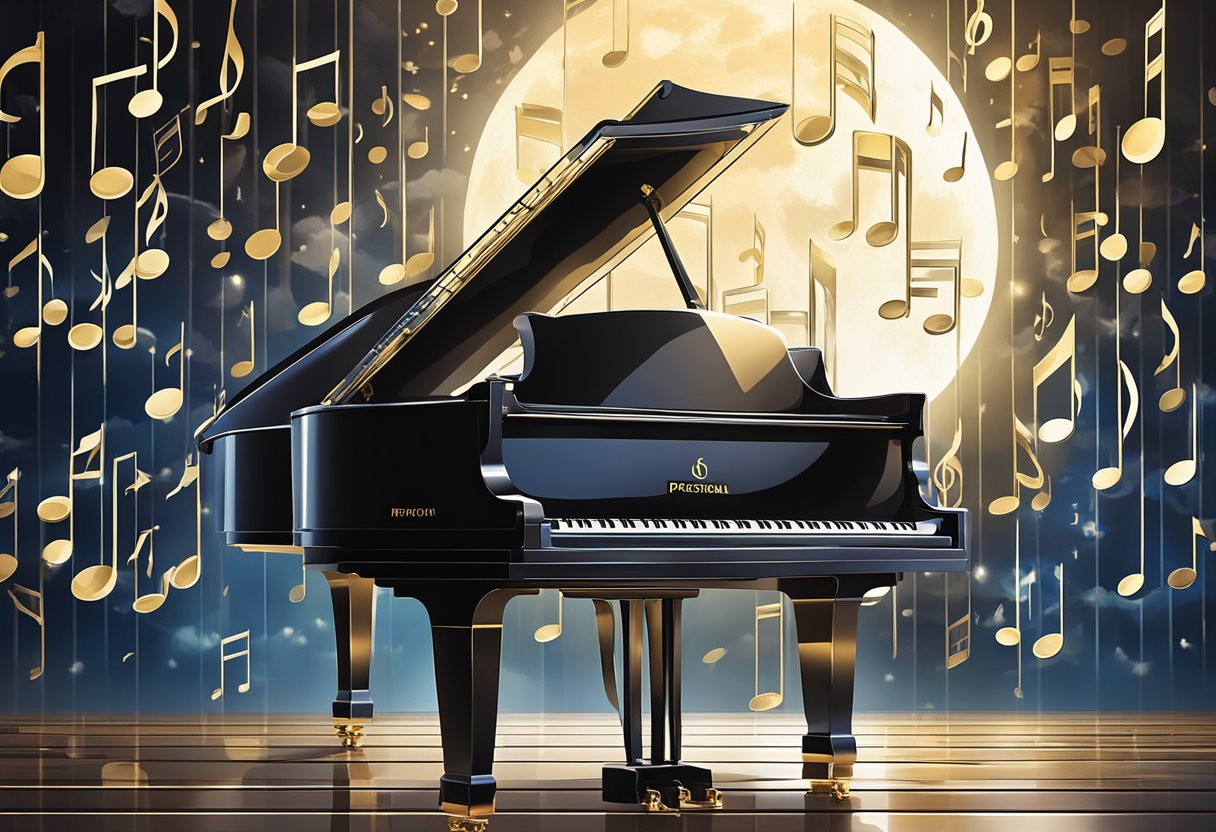
A grand piano sits in a moonlit room
Understanding the structure of these scales is crucial for musicians. The arrangement of whole steps and half steps creates the unique sound and emotional impact of major and minor scales. Moreover, the scales’ influence on the creation of chords and harmony forms the backbone of musical composition across various genres. From the simplest melodies to the most complex orchestrations, the choice of scale can dramatically alter the narrative conveyed by the music.
The structure of scales affects harmony and chord creation.
Scale choices significantly influence musical composition across genres.
Exploring the Fundamentals of Major Scales
When we discuss the major scale, we’re referring to a sequence of notes that follows a specific pattern of whole steps and half steps. It’s a foundation of Western music theory and crucial for understanding tonality. The scale is typically heard as sounding happy or bright.
Major scales are built around a tonic, which is the starting note or key of the scale. From there, the pattern proceeds: whole step, whole step, half step, whole step, whole step, whole step, half step. This brings us to an octave above our starting note – an interval where the pitch is doubled and the scale begins anew.
Consider the C major scale, which can be understood using the Ionian mode – one of the modes in music used to construct scales. It consists of the notes:
C (tonic or keynote)
D
E
F
G
A
B
C (octave)
In music, understanding this basic structure allows us to build scales in any key, simply by following the pattern of steps from any starting note. It’s like a magic formula that underpins melodies and harmonies, making them recognisable and memorable. As Michelle Connolly puts it, “The major scale is the backbone of music education, offering a clear map to navigate the intricate world of musical composition.”
Our exploration of major scales informs us on how sound is organised in music, guiding how we listen to and create various pieces, from pop songs to classical symphonies. By mastering this elementary concept, we arm ourselves with knowledge that enriches our musical experiences and creations.
Minor Scales: Varieties and Characteristics
Minor scales form the underpinning of a multitude of melancholic and sad tunes that evoke a particular emotional resonance in music. In Western music, minor scales are characterised by a pattern of tones and semitones. There are chiefly three types of minor scales that give rise to different moods and textures in music.
Natural Minor Scale – This scale is built on a pattern that includes whole tones and semitones. It follows the sequence: tone, semitone, tone, tone, semitone, tone, tone. It’s often associated with a sombre and melancholic quality.
Harmonic Minor Scale – To create a distinctive sound, the harmonic minor scale raises the seventh note of the natural minor scale by a semitone. This alteration introduces an interval called an augmented second, contributing to the scale’s unique tension and drama.
Melodic Minor Scale – The melodic minor scale has a different personality when ascending versus descending. On the way up, the sixth and seventh notes are raised, which smoothens the sharp edges of the harmonic minor. While descending, it replicates the natural minor.
Here’s a concise breakdown:
Scale Type
Ascending Pattern
Descending Pattern
Characteristics
Natural Minor
T – ST – T – T – ST – T – T
Same as ascending
Melancholic and sombre
Harmonic Minor
T – ST – T – T – ST – A2 – ST
Same as ascending
Tense and dramatic
Melodic Minor
T – ST – T – T – T – T – ST (when ascending)
T – ST – T – T – ST – T – T (when descending)
Softer tension, smoother descent
(T = Tone, ST = Semitone, A2 = Augmented second)
Our founder Michelle Connolly, an educational consultant with over 16 years of classroom experience, says, “The power of minor scales in music is undeniable; they weave emotions into melodies, which can be infinitely fascinating for children learning music.”
Minor keys and scales are a significant part of music education and appreciation, as they foster a deeper understanding of the emotional and tonal variety in compositions. In the hands of a skilled composer or performer, these scales are not merely sad or melancholic, but can also be expressive, introspective, and profoundly moving. Through learning about these scales, we can appreciate the intricate, emotive patterns that they create in music.
Understanding Keys and Key Signatures
In music, the concept of keys refers to groups of notes that form specific major or minor scales. Each key has a corresponding key signature, which is a set of sharps (#) or flats (b). These symbols are placed at the beginning of a piece of music to indicate which notes will be consistently raised or lowered.
When we discuss a major scale, such as the C major scale, we’re referring to a sequence of notes that begins and ends on C and follows a specific pattern: tone, tone, semitone, tone, tone, tone, semitone. Meanwhile, the G major scale includes one sharp (F#), the D major scale has two sharps (F# and C#), and so on. To identify a key signature quickly, we look at the last sharp or the second to last flat in the sequence.
Here’s a quick reference for key signatures:
C major scale: No sharps or flats
G major scale: One sharp (F#)
D major scale: Two sharps (F#, C#)
A major scale: Three sharps (F#, C#, G#)
E major scale: Four sharps (F#, C#, G#, D#)
F major scale: One flat (Bb)
The chromatic scale, however, includes all twelve notes within the octave. It’s a scale where each note is a semitone apart from the next, encompassing both sharps and flats.
Michelle Connolly, an expert in educational methodologies, reminds us: “Understanding keys and key signatures is much like reading a map before a journey; it provides a framework that guides us through the landscape of music.” Following this map, we can predict the rise and fall of melodies, allowing us to enjoy and create music with greater insight and emotion.
The Role of Tones and Semitones
In music, tones and semitones are the building blocks that create the tension and familiarity within major and minor scales, driving the emotional landscape of melodies and harmony.
Building Tension and Release
Tones, which are also known as whole steps, and semitones, known as half steps, work together in scales to establish a pattern of tension and release. This is fundamental to the emotional effect of music. In a major scale, the sequence typically follows whole-whole-half-whole-whole-whole-half pattern. When a composer moves away from the home note or tonic, it creates tension; moving towards it creates a sense of resolution.
In contrast, minor scales start with a whole-half-whole-whole-half-whole-whole pattern, which can evoke a different emotional response. The use of a semitone movement, especially leading from the dominant to the tonic, is critical for that moment of release and the satisfying resolution in both major and minor keys.
Pattern Recognition in Scales
Pattern recognition plays a crucial role in how we perceive music. These patterns emerge through the use of chromatic scales and the specific order of half and whole steps within diatonic scales. Listeners become familiar with these patterns which influences the way melodies and harmonies are received and processed. As Michelle Connolly, the founder of LearningMole, notes, “Recognising patterns in music is much like recognising words in a sentence; it gives us a framework for understanding and helps us to predict what might come next, adding to the musical experience.”
The repeating patterns of tones and semitones allow us to anticipate the movement in a piece of music, contributing to our overall understanding of musical harmony and melody. Each scale creates its own set of expectations based on the sequence of whole and half steps it presents, contributing to the unique character of the music it produces.
The Emotional Impact of Major and Minor
In our exploration of music’s effect on emotions, it’s well-documented that major and minor scales hold significant sway over our mood. Major scales, with their bright and full-bodied sonorities, are typically associated with feelings of joy and happiness. They are often employed in compositions to evoke a sense of optimism and uplift the spirit.
Conversely, minor scales carry a different kind of emotional weight. They tend to colour music with a more melancholic tone, conveying a sense of sadness or contemplation. It’s not just a simple stereotype; these associations are rooted in centuries of musical tradition and the lived experiences of listeners around the world.
Michelle Connolly, founder and educational consultant with over 16 years of classroom experience, beautifully sums up our intrinsic connection to music’s emotional language: “Just as we’re drawn to a smile or a frown on a face, we’re naturally attuned to the sonic cues of major and minor scales in music, which can guide our emotional responses.”
Here are some noteworthy points:
Major Scales:
Often evoke a positive and uplifting mood.
Frequently used in music to signify celebration and elation.
Minor Scales:
Elicit a more reflective or sorrowful emotional state.
Commonly associated with introspection and solemnity.
Our relationship with music’s dichotomy of major and minor is a testament to its profound ability to mirror the human experience. Through just a few notes, composers can tap into a universal language of emotion that resonates deeply with us all.
Scales and Chords: Harmony in Music
In music, scales and chords form the foundation of harmony. Scales are sequences of notes ordered by pitch, while chords are groups of notes played simultaneously. The major scale is one of the most commonly used scales and is known for its bright and definitive sound. It consists of seven notes, with the tonic, or first note, defining the key of the scale.
Chords within a key are built on the scale degrees; for example, the tonic (I), dominant (V), and subdominant (IV) are primary chords that define the musical key. The interplay between these chords creates progressions that are the heart of a song’s harmony. The major scale forms major chords, which are perceived as happy or resolved, while the minor scale typically gives rise to more somber or tension-filled minor chords.
Harmony is grounded in the use of both major and minor scales, as each provides a unique emotional contour to music. For example, a chromatic scale, which includes all twelve pitches of the octave, allows for more complex harmonic possibilities. Similarly, pentatonic scales, which reduce the octave to five notes, offer a simpler harmonic framework often found in folk music around the world.
Here’s an insightful observation from Michelle Connolly, founder of LearningMole and an educational consultant with extensive teaching experience: “Harmony in music is much like a conversation, with each note and chord contributing its voice and dynamics to the shared narrative.”
In sum, our understanding of harmony in music is built upon how various scales and chords interact to create the underlying emotional fabric of a piece. It is the careful selection and combination of these musical elements that invites listeners into a rich auditory experience.
Scale Degrees and Their Functions
Within the framework of music, every note of a scale plays a unique role, akin to a character in a play, with the major and minor scales each expressing a distinct atmosphere.
From Tonic to Leading Tone
The tonic, or first scale degree, is the anchor of any scale; it’s the note that provides a sense of home and resolution in both the major and minor scales. In the Ionian mode, the equivalent of the major scale, the tonic fosters a sound that is bright and stable, whereas in the Phrygian mode, associated with the natural minor scale, it can emit a more sombre or exotic essence.
The mediant, the third scale degree, tells us whether a scale is major or minor, based on its interval from the tonic. It’s like the keystone in a musical arch and helps to set the emotional tone of a piece.
In contrast, the dominant, or the fifth scale degree, is imperative for its stabilising force and readiness to resolve back to the tonic. Major or minor, this powerful scale degree brings a sense of expectancy that energises the progression of a piece.
The subdominant, lying just below the dominant, serves as the fourth scale degree. Its placement makes it a perfect counterbalance to the dominant, offering a sense of suspension and a push towards change.
Finally, the leading tone is the seventh scale degree and one step below the tonic. It’s a note filled with tension, yearning to resolve upward to the tonic. In the minor scale, this note is often raised to enhance the pull towards resolution, but even in its natural state, the leading tone is a critical component in the scale’s sense of movement and closure.
Michelle Connolly, founder and educational consultant at LearningMole, emphasises this point: “Understanding the role of each scale degree is vital for appreciating the emotional language of music.” With over 16 years of experience in the classroom, Michelle’s insight reflects the essence of musical theory—each note has its purpose, contributing to the overall narrative of the composition.
Impact of Scales on Compositions and Genres
In music composition, scales are foundational. They provide a structure from which melodies and harmonies are crafted. Major and minor scales, in particular, have a profound influence on the mood and direction of a piece. Our understanding of this concept is enhanced as Michelle Connolly, an expert with 16 years of classroom experience, puts it, “Scales are the DNA of music; they give a composition its unique identity, directly affecting how it resonates with the listener.”
When it comes to different genres, the impact is even more pronounced. Take, for instance, jazz—improvisation often relies on the modal scales, which allows for the exploration of complex chord progressions and dichotomies between tension and release. Pop music, conversely, tends to favour the diatonic scales, resulting in catchy and memorable tunes that resonate on a more universal level.
Classical compositions, rich in tradition, harness both major and minor scales in intricate patterns, blending formality with emotional expression. Composers like Beethoven and Mozart meticulously used scales to construct pieces that contributed to the timeless canon of Western music.
In the sphere of Latin rhythms and melodies, scales serve as the backbone to infuse songs with distinctive tonal flavours that characterise the genre.
Let’s summarise the use of scales in different genres:
Classical: Formal and complex compositions, major/minor scales for emotional depth.
Jazz: Modal scales for improvisation, complex chord progressions.
Pop: Diatonic scales for catchy, universal appeal.
Latin: Specific scales to create characteristic tonal flavours.
Our relationship with music deepens when we realise how scales shape the vast landscape of genres. They’re not just a series of notes; scales infuse life into a composition, allowing the composer to convey an array of emotions and stories, thus connecting with listeners across cultural divides.
Practical Applications for Musicians
Understanding major and minor scales is foundational for musicians in Western music theory. These scales are not just theoretical concepts but practical tools that enhance musicality, from composition to performance.
Improvisation and Creativity
Improvisation is the soul of creativity in music, allowing musicians to express themselves spontaneously. Practising major and minor scales is key; they serve as the building blocks for improvisation, acting as a guide for musicians to weave melodies seamlessly. Whether on the keyboard or any other instrument, knowing these scales inside and out provides a framework upon which to craft solos. “In the midst of improvisation, it’s our familiarity with scales that injects the magic into the music we’re creating,” shares Michelle Connolly, an educational consultant with extensive classroom experience.
Daily Routines: Consistently practice scales with a metronome to improve timing.
Varying Patterns: Play scales in thirds, fourths, and other intervals to diversify understanding.
Ear Training and Education
Ear training is integral to music education. It allows musicians to identify pitches, chords, and rhythms, aiding in transcribing and understanding music by ear. Practising scales plays an essential role in this development, as our ears become accustomed to the sound of different tonalities and the relationship between notes. “By integrating ear training practice with scale knowledge, students develop a more instinctive feel for music,” explains Michelle.
Ear Training Exercises:
Singing Scales: Vocalising scales helps internalise their sound.
Scale Degree Identification: Play a note within a scale and identify its position by ear.
By grounding our practice in the application of scales for improvisation and ear training, we set a solid foundation for musical growth.
Structural Aspects of Scales in Western Music
Photo of a kid playing an electric guitar
In Western music, scales form the cornerstone of melody and harmony. A scale is essentially a sequence of notes ordered by pitch. Two primary types of scales dominate this musical tradition: the major scale and the minor scale. Both impart a distinct emotion in compositions and play a crucial role in establishing tonality.
The major scale, often associated with happier, brighter emotions, follows a specific pattern of whole and half steps: W-W-H-W-W-W-H (‘W’ represents a whole step, and ‘H’ represents a half step). For example, the C major scale consists of the notes C, D, E, F, G, A, B, and C. Its structure provides a solid foundation for numerous musical scales and is fundamental in the development of Western music theory.
In contrast, the minor scale—typically conveying a sadder or more complex mood—has different forms. The natural minor follows the pattern W-H-W-W-H-W-W. However, alterations can lead to the harmonic and melodic minor variants, each with a unique step pattern and emotional implication.
Modes, further variations of scales, such as the Ionian (major) and Aeolian (natural minor), offer a spectrum of tonalities from which musicians draw to create rich melodic textures.
Our understanding of scales extends beyond their use in form and structure; these elements are the framework upon which our Western musical heritage is built. As Michelle Connolly, founder and educational consultant with 16 years classroom experience, aptly puts it, “Scales are the DNA of our musical pieces, weaving through the fabric of every tune and defining their character.”
For anyone looking to explore the mysteries of scales, A geometry of music outlines how the structure of scales plays into the broader context of harmonic and counterpoint practices.
Advancing Musical Knowledge: Modes and Modulations
In our exploration of musical theory, we often encounter modes and modulations as vital concepts. Modes provide a framework for the variety of tonalities that can exist within music. For example, the Ionian mode, synonymous with the major scale, radiates a sense of brightness and stability, while the Aeolian mode aligns with the minor scale and often conveys a mood that is perceived as more sombre.
Scales serve as the building blocks of melody and harmony. Besides the major and minor scales, modal scales like Dorian, Phrygian, and Lydian offer unique intervals and flavours. The pentatonic scales, which reduce the typical seven notes of the major scale to five, also make for compelling melodic structures due to their simplicity and universal appeal.
Mode
Characteristic
Related Scale
Ionian
Bright, Stable
Major Scale
Aeolian
Sombre, Emotional
Minor Scale
Dorian
Mysterious, Soulful
Modal Scale
Phrygian
Exotic, Tense
Modal Scale
Lydian
Dreamy, Ethereal
Modal Scale
Pentatonic
Simple, Universal
Pentatonic Scale
Modulation, the process of changing from one key to another within a piece, brings dynamic shifts in tonality. It’s akin to changing the scene in a play and can invigorate a composition with new life and direction. It’s not merely a technical shift but an emotional journey, guiding the listener through the narrative of the music. As Michelle Connolly, the founder of LearningMole, put it, “Modulation is the sparkle that can surprise and delight the ear, taking us on an unexpected journey mid-melody.”
In our shared pursuit of musical knowledge, understanding how various scales, modes, and modulations interact is fundamental. It allows us to create and appreciate the intricate tapestry of sound that weaves through cultures and epochs, each note a reflection of humanity’s diverse emotions and stories.
Frequently Asked Questions
We’ve compiled a list of frequently asked questions to help demystify the role of major and minor scales in music.
Why do certain key signatures feature prominently in compositions?
Composers often favour certain key signatures because they provide a specific tonal foundation that influences the mood and technical aspects of a composition. For instance, a key with many sharps might convey brightness, while flats can suggest a softer, darker sound.
What significance do major and minor scales hold within music theory?
Major and minor scales form the basis of Western music theory; they are the building blocks for melody and harmony. “The difference in sound and mood between the two is the essence of what makes music so expressive,” remarks Michelle Connolly, an educational consultant with a wealth of classroom experience.
Can you explain the theory behind the major scale in music?
The major scale is a series of seven notes with a specific pattern of whole and half steps. It’s the foundation of Western harmony and melody, providing a sense of resolution and stability that’s often associated with positive emotions.
What distinguishes the use of major scales from minor scales in composition?
Major scales tend to evoke happiness and brightness, while minor scales are often used to create a feeling of sadness or melancholy. Composers choose between these scales to craft the emotional narrative of their music.
How do major and minor scales contribute to the emotion of a piece?
The emotional contribution of major and minor scales is pivotal; major scales often evoke joy or triumph, while minor scales can evoke introspection or sorrow. “It’s about the emotional journey that the composer wants to take the audience on,” notes Michelle Connolly.
What role do major and minor chords play in the structure of music?
Major and minor chords serve as the harmonic foundation of a piece. They establish the tonality and can dramatically shape the music’s character and direction.
Maths Circus, an innovative platform we've crafted, presents a captivating realm where children learn mathematics through the exciting theme of a circus. The joy of juggling numbers and solving circus...
Athena was the ancient Greek goddess of wisdom, strategy and defensive warfare, and the protector of the city of Athens, which still carries her name. In the stories the Greeks...
The Mysterious World of Bees: Bees are stranger and cleverer than most children expect, and the UK alone is home to around 270 bee species. Only one of them is...
Fruit helps protect the body from disease because it delivers fibre, vitamins, minerals and natural plant compounds that support the heart, the gut, blood sugar control and healthy cells. The...






Leave a Reply