Early numeracy skills are the building blocks for a child’s mathematical journey. These foundational abilities, including counting, pattern recognition, measurement, and basic maths concepts, develop naturally in young children through everyday activities. Research has shown that early numeracy skills predict later academic success, not just in mathematics but across various subjects.
“The foundations of mathematical thinking begin long before formal schooling. When children sort objects by colour, count steps, or notice patterns in nature, they’re developing critical numerical concepts that will serve them throughout life,” explains Michelle Connolly, an educational consultant with 16 years of classroom experience. The home numeracy environment plays a crucial role in this development, with parents’ expectations and activities significantly influencing children’s mathematical abilities.
Studies demonstrate that preschool learning environments, both at home and in early education settings, directly impact the development of numeracy skills during ages 3-5. When we incorporate counting games, measurement activities, and pattern recognition into playtime, we’re not just having fun—we’re building essential cognitive frameworks that support children’s future learning potential.
The Foundations of Early Numeracy
Early numeracy skills form the bedrock of a child’s mathematical development, establishing crucial cognitive pathways that influence future academic success. These foundational abilities emerge naturally through play and everyday experiences.
Understanding Numeracy and Its Significance
Numeracy goes far beyond simply recognising numbers. It encompasses the ability to understand and work with numbers confidently in real-life situations. Early numeracy development is essential for later mathematics learning and significantly impacts a child’s educational journey.
“As an educator with over 16 years of classroom experience, I’ve observed that children who develop strong numeracy foundations before age five tend to perform better not just in maths, but across all subjects,” notes Michelle Connolly, founder and educational consultant.
Research shows that the basics of numeracy are present from a very early stage, with babies demonstrating an awareness of quantity long before they can speak. These intuitive abilities develop rapidly during the preschool years.
One-to-one correspondence (matching one number to one object)
Understanding that the last number counted represents the total (cardinality)
Pattern recognition is another crucial element where children identify and create repeating arrangements. This skill helps them understand mathematical relationships and make predictions.
Home numeracy experiences significantly influence children’s development. Simple activities like counting toys, setting the table, or discussing shapes during play build these foundations naturally.
Comparison concepts form another vital component, where children learn to distinguish between quantities using terms like ‘more than’, ‘less than’, and ‘the same as’. These comparisons help children understand relative values, an essential precursor to mathematical operations.
Development of Numeracy Skills in Early Childhood
Young children develop mathematical understanding through a gradual process that builds on their natural curiosity about the world. These early numeracy abilities form the foundation for later maths achievement and thinking skills.
Age-Appropriate Mathematical Understanding
Children’s mathematical abilities emerge in predictable patterns as they grow. By age 3, most children can recognise some numbers and count small groups of objects. They begin to understand concepts like “more” and “less” through everyday experiences.
Between ages 4-5, children typically develop more sophisticated counting skills and can count to 10 or higher. They start to grasp one-to-one correspondence, understanding that each object gets counted once.
“As an educator with over 16 years of classroom experience, I’ve observed that children develop numeracy most effectively when mathematical concepts are embedded in play and daily routines,” explains Michelle Connolly, educational consultant and founder.
By ages 5-6, most children begin to understand simple addition and subtraction using concrete objects. Their spatial awareness improves, helping them recognise shapes and patterns in their environment.
Key Numeracy Milestones
Early Counting Skills:
Rote counting (reciting numbers in order)
One-to-one counting (matching one number word to one object)
Understanding that the last number counted represents the total
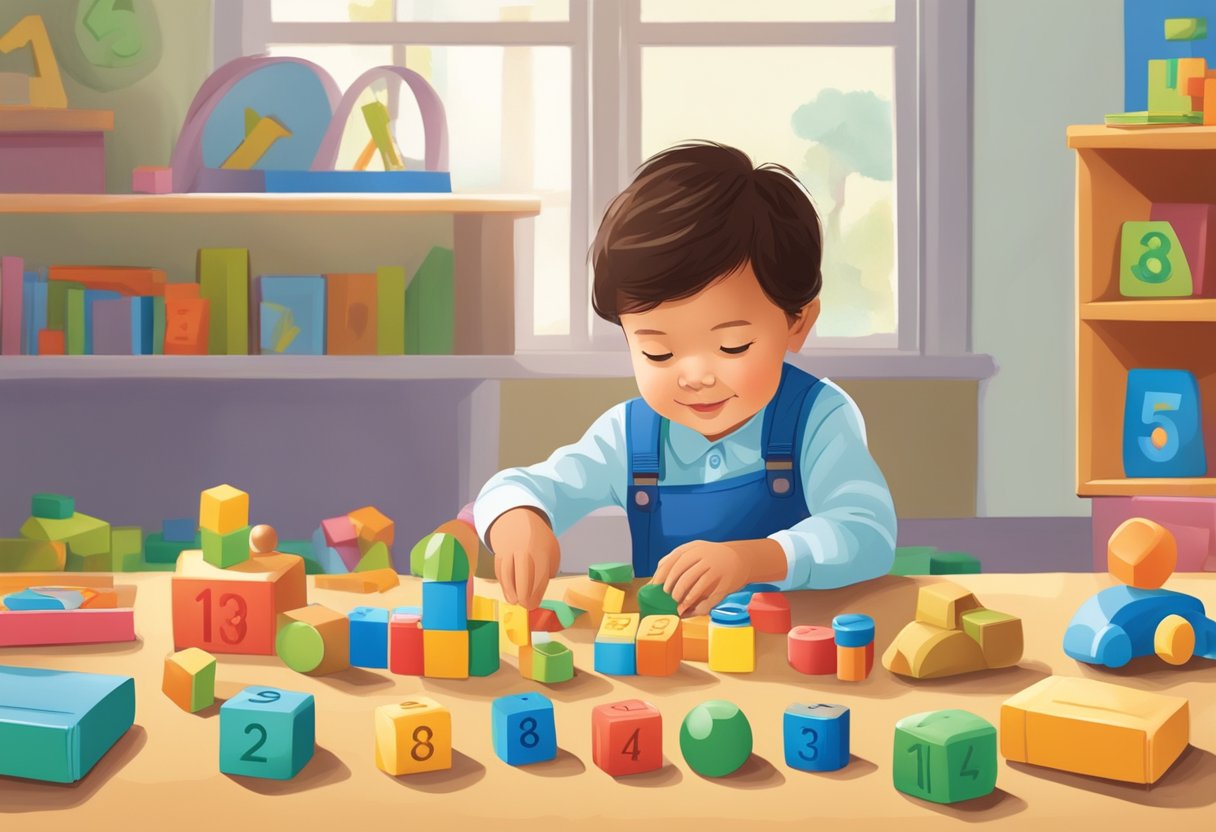
Classification and Sorting: When children sort objects by colour, size or shape, they’re building crucial mathematical thinking skills. These activities help them recognise similarities, differences and patterns—important foundations for later mathematics abilities.
Number Recognition: Between ages 3-6, children gradually learn to identify written numerals. Research shows that home numeracy experiences significantly influence this development, with activities like counting games and cooking together.
Early Operations: By school age, most children begin to understand adding and taking away using real objects before moving to mental calculations. These skills develop alongside general cognitive abilities that support mathematical thinking.
Numeracy in Everyday Life
Numeracy skills are essential tools we carry through life, helping us navigate daily tasks with confidence and efficiency. From shopping trips to cooking, numbers play a vital role in our ability to make informed decisions and solve practical problems.
Real-Life Application of Numeracy
You use numeracy skills far more often than you might realise. When you’re shopping, you calculate discounts, compare prices, and estimate if you have enough money. These seemingly simple tasks require important numeracy skills that begin developing in early childhood.
“As an educator with over 16 years of classroom experience, I’ve observed that children who develop strong numeracy foundations early on approach everyday challenges with greater confidence,” explains Michelle Connolly, founder and educational consultant.
When cooking, you measure ingredients, adjust recipes, and time your dishes. Even planning your day involves understanding time intervals and scheduling—all numerical skills at work!
Consider these everyday activities requiring numeracy:
Managing money: Budgeting, saving, and spending
Travel planning: Reading timetables and calculating journey times
DIY projects: Measuring spaces and calculating materials needed
Integrating Numeracy with Daily Routines
You can easily enhance numeracy skills through everyday activities. Turn a supermarket trip into a learning opportunity by asking your child to estimate the total cost or work out discounts.
Cooking offers brilliant chances to practice measuring, understanding fractions, and time management. When you bake together, you’re not just making treats—you’re building mathematical confidence!
Time management activities help children understand concepts like duration and scheduling. Use a visual timer for brushing teeth or create a picture timetable for the day’s activities.
Try these simple integration ideas:
Count stairs as you climb them
Play board games involving counting, strategy, and probability
Talk about shapes and patterns in your surroundings
Use measuring tapes during play or home projects
These everyday numeracy experiences are vital for developing skills that will support learning throughout school and into adult life.
Improving Numeracy Through Play
Play offers a fun and effective way to build children’s early numeracy skills. When children engage with counting songs, games and puzzles, they develop mathematical understanding without even realising they’re learning important concepts.
Counting Songs and Rhymes
Counting songs and rhymes create a joyful way for young learners to develop early numeracy skills. These musical activities naturally embed numbers in a memorable format that children love to repeat.
“As an educator with over 16 years of classroom experience, I’ve seen how counting songs transform reluctant mathematicians into confident counters,” says Michelle Connolly, founder and educational consultant. “The rhythm and repetition help cement number sequences in children’s minds.”
Popular rhymes like “Five Little Speckled Frogs” or “Ten in the Bed” teach not only counting but also subtraction as characters disappear one by one. These songs introduce mathematical language in a natural context.
You can enhance these activities by adding finger puppets or visual aids. This creates a multi-sensory learning experience that helps children connect abstract numbers with concrete quantities.
Try incorporating movement by having children jump, clap or hop along with the counts. Physical activity paired with counting reinforces number concepts while keeping children engaged.
Educational Games and Puzzles
Board games provide excellent opportunities for developing numeracy in a relaxed, playful environment. Games like Snakes and Ladders help children recognise numbers and count spaces as they move.
Simple puzzles with numbers or quantities develop problem-solving skills alongside numeracy. Number jigsaws, for example, can help children learn to sequence digits correctly.
“Drawing from my extensive background in educational technology, I’ve found that games create a low-pressure environment where children feel safe to experiment with mathematical concepts,” explains Michelle Connolly.
You can easily adapt familiar games to focus on specific skills:
Use dice with dots rather than numerals for younger children
Create matching games with numbers and quantities
Try dominoes to develop subitising (recognising quantities without counting)
Digital games can also support numeracy development, but choose ones that encourage thinking rather than just quick answers. The best educational games provide immediate feedback and gradually increase in difficulty.
Don’t underestimate everyday activities like cooking, shopping, or setting the table. These provide authentic contexts for counting, measuring and problem-solving that make numeracy meaningful.
School Readiness and Numeracy
School readiness is a critical aspect of a child’s educational journey. It refers to whether a child has the skills needed to succeed when they begin school. Research shows that children who start school ready to learn achieve better literacy and numeracy outcomes.
Early numeracy skills form a vital part of school readiness. These include counting, recognising numbers, understanding patterns, and basic concepts like more/less comparisons. When you help children develop these skills before they start school, you give them a strong foundation for future learning.
“As an educator with over 16 years of classroom experience, I’ve seen how children who enter school with strong early numeracy foundations typically progress more confidently in maths,” says Michelle Connolly, educational consultant and founder of LearningMole.
Key Early Numeracy Skills for School Readiness:
Counting to 10 and beyond
Recognising numerals
Understanding one-to-one correspondence
Comparing quantities (more/less)
Recognising patterns
Basic shape recognition
Studies indicate that early maths skills at school entry can predict later academic achievement. Children’s numeracy abilities when starting school are strong indicators of how well they’ll perform in maths throughout primary school.
You can support your child’s numeracy development through everyday activities. Counting stairs as you climb them, sorting objects by size, or playing simple board games all help build these essential skills.
Research confirms that school-entry academic skills, particularly in numeracy, strongly predict later achievement in both reading and mathematics. This highlights how numeracy readiness impacts overall academic success.
Parental Involvement and Home Learning
Parents play a crucial role in developing early numeracy skills. The home learning environment significantly impacts how children understand and engage with numbers before formal schooling begins.
“As an educator with over 16 years of classroom experience, I’ve seen countless examples of how simple changes at home can transform a child’s relationship with numbers,” says Michelle Connolly, founder and educational consultant.
To create a maths-friendly home:
Display numbers around the house (clocks, calendars, measuring tools)
Provide maths toys like building blocks, shape sorters, and puzzles
Include counting in daily routines like setting the table or sorting laundry
Make maths fun by incorporating games that involve numbers during family time. Board games with dice, card games, and even cooking activities can reinforce mathematical concepts naturally.
Parents as Educators in Numeracy
You don’t need to be a maths expert to support your child’s numeracy development. Studies indicate that parental attitudes toward maths significantly influence children’s confidence and ability.
Math talk is particularly powerful—simply discussing quantities, shapes, and patterns during everyday activities helps build foundational skills. Try using phrases like “We need three more plates” or “Can you find the square blocks?”
Research shows that formal numeracy activities at home, such as practising number recognition or simple addition with objects, directly correlate with improved maths performance.
Consider these practical activities:
Counting objects during shopping trips
Measuring ingredients while cooking
Comparing sizes and amounts during bath time
Remember that your enthusiasm matters—when you approach numeracy positively, your child is more likely to develop confidence with numbers.
Linking Numeracy with Other Learning Areas
Early numeracy skills don’t exist in isolation. They connect with and enhance many other areas of learning, creating a richer educational experience for young children.
The Relationship Between Literacy and Numeracy
Research has consistently shown a strong connection between early literacy and numeracy skills. When children develop strong language abilities, they often show better performance in maths as well. This isn’t coincidental – many numeracy concepts require understanding specific vocabulary.
For example, when learning to count, children need to know number words. When comparing sizes, they use terms like “bigger” and “smaller.” Mathematical problem-solving often involves reading and understanding word problems.
“As an educator with over 16 years of classroom experience, I’ve observed that children who struggle with reading often face challenges in maths too. The foundation skills overlap significantly,” explains Michelle Connolly, educational consultant and founder.
Some specific connections include:
Vocabulary development – understanding mathematical terms
Sequencing skills – used in both storytelling and number patterns
Visual processing – needed for both letter and numeral identification
Cross-Curricular Connections
Numeracy skills enhance learning across the entire curriculum. When you integrate maths into other subjects, you create meaningful learning experiences that help children see the relevance of numbers in everyday life.
In science, children use measurement, data collection, and graphing to conduct experiments. These activities build both scientific knowledge and mathematical understanding simultaneously.
Art activities offer natural opportunities for exploring shapes, patterns, and spatial relationships. When children create patterns in artwork, they’re developing both artistic skills and mathematical thinking.
Physical education involves counting, scoring, timing, and spatial awareness – all numeracy skills in action!
Ways to connect numeracy across the curriculum:
Use cooking activities to teach measurement and fractions
By connecting numeracy with other subjects, you’re helping children develop more robust understanding and more meaningful learning experiences.
Assessment and Tracking Progress
Measuring early numeracy skills is essential for identifying children’s strengths and areas needing support. Various assessment tools can help educators and parents track math achievement and design targeted interventions for young learners.
Evaluating Early Math Skills
When evaluating children’s early numeracy abilities, it’s important to focus on foundational concepts like cardinality (understanding that the last number counted represents the total quantity), number recognition, and basic counting skills. These core competencies form the building blocks for later mathematical development.
“As an educator with over 16 years of classroom experience, I’ve found that regular assessment of early numeracy skills helps identify learning gaps before they become significant barriers,” explains Michelle Connolly, founder and educational consultant.
You can use observation during play-based activities to gauge children’s natural mathematical understanding. Look for how they:
Sort objects by attributes
Create patterns
Compare quantities
Use numbers in meaningful contexts
Consider using developmental progressions to track growth over time. These help you see how children advance from basic counting to more complex mathematical thinking.
Utilising Surveys and Tests
Formal and informal math tests provide valuable data about children’s numerical understanding. The Preschool Early Numeracy Scales and similar tools offer structured ways to evaluate specific skills.
When selecting assessment tools, look for those that:
Align with developmental expectations:
Age-appropriate challenges
Clear progression of skills
Engaging format for young learners
Provide actionable information:
Specific areas of strength/weakness
Suggestions for next steps
Progress monitoring capabilities
Curriculum-based progress monitoring helps you track children’s development throughout the year. These brief, frequent assessments can quickly identify which pupils need additional support.
You might also create simple surveys for parents to complete, gathering information about home mathematical activities and children’s interests. This holistic approach ensures you’re capturing the full picture of each child’s numeracy journey.
Challenges and Support Strategies
When helping children develop early numeracy skills, it’s important to understand both the difficulties they might face and how to support them effectively. Early identification of problems and targeted help make a big difference in a child’s maths journey.
Identifying Difficulties
Children may struggle with early maths for various reasons. Look for signs such as difficulty recognising numbers, trouble with counting sequences, or problems understanding basic concepts like “more than” or “less than”. Some children might also find it hard to match numbers to quantities or compare small sets of objects.
“As an educator with over 16 years of classroom experience, I’ve noticed that children who struggle with numeracy often show clear warning signs as early as age 3 or 4,” says Michelle Connolly, founder of LearningMole and educational consultant. “The key is spotting these signs early rather than waiting until formal schooling begins.”
Research shows that early numeracy development is essential for later mathematics learning. Pay attention to how children:
Organise objects by size, shape, or colour
Use maths language in everyday situations
Solve simple problems during play
Show interest in counting and numbers
Providing Targeted Numeracy Interventions
Once you’ve spotted potential difficulties, it’s time to offer appropriate support. Make maths meaningful through everyday activities like cooking, shopping, or playing board games. These real-life connections help children see the purpose of numeracy skills.
Use a multi-sensory approach that includes physical objects, visual aids, and verbal explanations. Children learn best when they can touch, see, and talk about maths concepts. Effective numeracy practice in the early years emphasises hands-on learning.
Create opportunities for mathematical exploration during playtime. Block play, for example, naturally encourages problem-solving as children balance blocks and create structures. Water and sand play also develop understanding of measurement and volume.
Technology can be helpful too, with appropriate apps offering engaging ways to practise skills. Just ensure screen time is balanced with physical activities and real-world maths experiences.
Effective Teaching Strategies
Early numeracy teaching works best when it connects to children’s everyday experiences. You can incorporate counting during daily activities like lining up or distributing snacks to make maths feel natural and relevant. Research shows that preschool educators significantly influence early numeracy development through their teaching approaches.
“As an educator with over 16 years of classroom experience, I’ve found that the most effective numeracy teaching happens when children don’t even realise they’re learning maths,” explains Michelle Connolly, educational consultant and founder. “Simple games and daily routines become powerful learning opportunities.”
Use these evidence-based techniques:
Explicit instruction combined with guided play
Visual aids like number lines and counters
Regular assessment to track progress and adjust teaching
Scaffolded learning that builds on existing knowledge
Creating an Engaging Learning Environment
Your classroom environment greatly influences how children develop numeracy skills. A well-designed maths-rich setting encourages exploration and makes abstract concepts more concrete for preschool children.
When setting up your learning space, include:
Maths centres with measuring tools, pattern blocks, and sorting materials
Number displays at children’s eye level
Real-life maths props like play money, clocks, and calendars
Open-ended materials that encourage problem-solving
Provide daily opportunities for children to engage with numbers through meaningful play. This helps them see maths as enjoyable rather than intimidating.
Language matters too! Use precise mathematical vocabulary and ask open-ended questions that prompt children to explain their thinking and develop deeper understanding of early math skills.
Conclusion
Early numeracy development represents a critical foundation that extends far beyond basic mathematical competency, serving as a gateway to cognitive development and academic success across multiple disciplines. The evidence presented throughout this examination demonstrates that children who develop strong numeracy skills between ages 3-5 through play-based activities, everyday routines, and meaningful interactions establish neural pathways that support not only mathematical thinking but also language development, problem-solving abilities, and executive function skills.
Michelle Connolly’s extensive classroom observations reinforce the research findings that numeracy concepts embedded naturally within daily experiences—from counting stairs to sorting objects by attributes—prove far more effective than formal instruction divorced from meaningful contexts. The integration of assessment tools with targeted interventions ensures that potential difficulties are identified early, whilst the cross-curricular connections between numeracy and literacy, science, and creative arts create rich learning environments that support holistic cognitive development.
The broader implications of effective early numeracy education encompass both individual achievement and societal outcomes, highlighting the crucial role of coordinated efforts between home and educational settings. The research consistently indicates that parental attitudes, home numeracy environments, and quality early childhood programmes work synergistically to create optimal conditions for mathematical thinking to flourish, with effects that persist throughout children’s educational journeys and into adult life. The emphasis on play-based learning approaches, multi-sensory teaching strategies, and meaningful real-world applications provides a framework for practitioners that respects children’s developmental readiness whilst building essential school readiness skills.
Moving forward, the success of early numeracy initiatives will depend upon continued investment in high-quality early childhood education, comprehensive parent support programmes, and evidence-based teaching practices that recognise numeracy development as both a cognitive achievement and a social-cultural process that empowers children to navigate an increasingly quantitative world with confidence and competence.
Maths Circus, an innovative platform we've crafted, presents a captivating realm where children learn mathematics through the exciting theme of a circus. The joy of juggling numbers and solving circus...
Foreword A child may be confident using a smartphone to chat on messaging apps or find videos on YouTube. However, they may not understand why certain content appears on their...
Mammals are animals with a backbone that breathe air through lungs, have hair or fur at some stage of life and feed their young on milk. Scientists sort every mammal...
Norse mythology creatures range from Jörmungandr, a serpent long enough to circle the human world, to Ratatoskr, a gossiping squirrel on a giant tree. This guide explains 13 of them...










Leave a Reply