Integrating technology through toys and learning tools is opening up new avenues for cognitive and social development. Tech-integrated toys are not simply playthings; they are gateways that introduce young learners to the basics of coding, problem-solving, and creativity, encased in a form that resonates with their curiosity and capacity for wonder. By blending learning with play, these tools provide a multifaceted educational experience that speaks to today’s digital-native generation.
As educators and parents, it’s essential to understand both the potential benefits and the challenges that come with integrating technology into the classroom and home environments. Teachers play a pivotal role in guiding effective tech integration, ensuring that it aligns with curriculum goals and augments traditional learning methods.
Michelle Connolly, founder of LearningMole and an expert with over a decade and a half of classroom experience, emphasises the importance of a balanced approach: “Technology should enhance education, not overshadow the fundamental principles of effective teaching and learning.”
The use of technology must also address concerns of accessibility and equity to ensure that all students have the opportunity to benefit from these innovations. It’s about paving the way for an inclusive learning experience that caters to various needs and learning styles. With emerging trends constantly shaping the future of education, tools that adapt and grow with the changing landscape are key in preparing children not just for the classroom, but for a world that is increasingly reliant on digital competence.
Educational technology has undergone significant transformations over the years. It began with the introduction of slates and chalk in the 1800s, which provided a reusable and portable medium for students. By the mid-1900s, overhead projectors became popular, offering teachers a way to present information to the entire class simultaneously. This era marked the initial steps in technology integration within the educational sphere.
Fast forward to the last few decades, when innovation truly began to accelerate. Computers entered the classroom in the 1980s, followed by the internet in the 1990s, which expanded educational resources beyond physical textbooks and allowed for global connections. As we moved into the 21st century, technology integration became critical for preparing students for a digital world, with interactive whiteboards and digital tablets becoming commonplace.
The Rise of Interactive Learning Tools
The advent of interactive learning tools has drastically shaped modern education. LearningMole, an initiative by Michelle Connolly with 16 years of classroom experience, signifies this shift with its plethora of interactive educational content. “We aim to make learning active and enjoyable,” says Connolly, emphasising the platform’s dedication to hands-on learning.
Today, innovative technologies like educational apps, online modules, and virtual reality offer dynamic and personalised educational experiences. These tools cater to various learning styles and needs, reflecting the educational technology’s ongoing evolution to create inclusive learning environments. With the integration of technology in education now a mainstay, ongoing innovation ensures that teaching methods and learning experiences are continually being enhanced for educational enrichment.
Understanding Tech-Integrated Toys
As you explore the world of tech-integrated toys, you’ll find that these advanced playthings are much more than mere toys. They’re interactive learning tools designed to merge play with educational content, aiming to enhance the early education experience.
Definition and Types
Tech-integrated toys are a category of playthings that incorporate various technological elements such as sensors, motors, and digital interfaces to create an interactive environment for children. Types of these toys include:
Augmented Reality (AR) Games: They overlay digital elements in the real world, offering an immersive learning experience.
Interactive Storybooks: Books that employ sounds or use a tablet to bring stories to life.
Technological Features and Capabilities
The technological features of these toys usually include:
Connectivity: Wi-Fi or Bluetooth enables updates and access to additional content.
Interactive Software: Apps or built-in programs provide interactive learning activities.
Their capabilities can be astonishing, as they often allow for:
Adaptive Learning: Toys adjust to a child’s learning pace.
Data Tracking: Progress and preferences are tracked, helping tailor the learning experience.
Voice Recognition: Enhance engagement through conversation with the toy.
These innovations make tech-integrated toys powerful tools that promote learning while retaining the fun and wonder of traditional play. Michelle Connolly, a pioneer in educational approaches, remarks, “Tech-integrated toys are revolutionising how we think about playtime. They’re not just about fun; they’re a gateway to limitless learning opportunities.”
These toys can transform how children learn by inviting technology into play, making education a truly hands-on and interactive journey.
Pedagogical Benefits and Challenges
Integrating technology with toys in early education bridges the gap between play and learning, enhancing both teaching and learning. These toys, when used alongside a thoughtfully designed curriculum, can transform pedagogical practices.
Facilitating Learning Processes
Technological pedagogical content knowledge (TPCK) is pivotal in effectively integrating tech-enhanced toys into the educational landscape. Teachers must harness this knowledge to align technological resources with the curriculum goals. For instance, programmable robots can serve as engaging tools that introduce fundamental coding concepts to young learners, nurturing their problem-solving skills.
As Michelle Connolly, an educational consultant with extensive classroom experience, puts it, “Deploying technology in classrooms isn’t just about keeping up with the latest trends; it’s about enriching the learning process through tools that cater to various learning styles.”
Addressing Educational Challenges
Pedagogy must adapt to include tech-integrated toys in a way that addresses educational challenges while ensuring equity. LearningMole underscores the importance of accessibility, providing a multitude of resources for children with special educational needs (SEN). This adaptability ensures that every child benefits from technological advancements without exclusion.
However, the challenge remains in equipping educators with the right skills and in ensuring that technological tools do not overshadow the essential teacher-student interaction. In recognising these dynamics, it’s clear that while tech-integrated toys can profoundly enhance early education, they require thoughtful implementation to realise their potential within the fabric of contemporary pedagogy fully.
The Role of Teachers and Educators
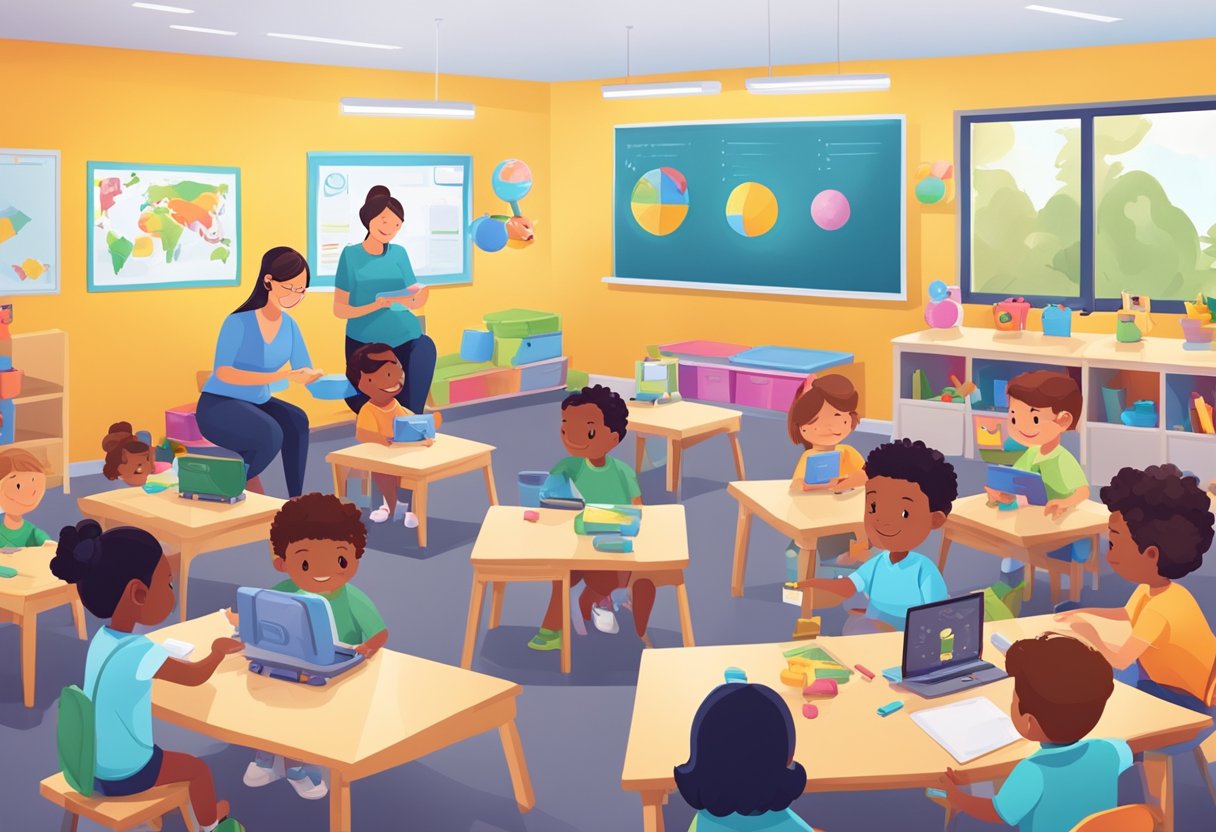
When tech-integrated toys are used in the classroom, teachers’ expertise makes the integration successful. They are the architects of the learning environment, strategically deploying technology to enrich and personalise education.
Integrating Technology into Lesson Plans
Teachers are central to crafting lesson plans that integrate technology in ways that enhance learning. By weaving in tech-integrated toys, they offer students tactile and interactive experiences that underscore academic concepts. For instance, these resources can bring mathematical theories to life and allow students to visualise complex ideas through hands-on exploration. This application can make the difference between memorisation and deep comprehension.
“Tech toys have transformed traditional learning approaches, offering educators like yourselves a whole new toolkit for engagement,” says Michelle Connolly, an educational consultant with a wealth of classroom experience.
Professional Development and Training
Continuous professional development is vital for teachers to keep abreast of the latest educational technologies and teaching strategies. Training in using tech-integrated toys allows educators to extract their full value in an educational setting. Additionally, teacher education courses now often include modules on using technology to support learning, highlighting its increasing importance.
Michelle Connolly emphasises, “Training sessions are not just about learning how to use the latest gadgets; they’re about understanding how technology can fundamentally improve the way we teach and how children learn.”
Remember that your role as an educator is pivotal. You bring technology to life, shaping your students’ minds with innovative tools that support a dynamic learning experience.
Impact on Student Engagement and Performance
In early education, tech-integrated toys have revolutionised how students engage with learning content and positively influenced academic performance. Innovative tools now support interactive and personalised learning experiences that cater to the diverse needs of young learners.
Case Studies and Research Findings
Tech-integrated toys have been shown to increase student engagement and promote active participation in learning processes. In a basic qualitative study, findings suggest that technology can leverage students’ prior knowledge, making the learning experience more relatable and stimulating. Another case study reflects on the implementation of iPads in an elementary school setting, examining the observed shifts in student motivation and engagement due to personalised learning experiences enabled by these devices.
To echo these sentiments, Michelle Connolly, an educational consultant with a wealth of classroom experience, notes, “Integrating technology in education tailors the learning journey to each individual child, making it more impactful and memorable.”
Assessment and Feedback Methods
The integration of tech in toys and educational tools has also significantly impacted assessment methods and feedback delivery. Real-time feedback provided by educational devices can help educators evaluate academic performance more accurately and offer personalised guidance to students. This immediacy helps children adjust their learning strategies on the fly, reinforcing positive educational outcomes and encouraging a cycle of continuous improvement in student learning.
One study discussing computer-assisted writing instruction on elementary students underlines the role of tech in providing feedback that can greatly aid in developing writing skills. It emphasises the idea that technology can be a catalyst for creativity and critical thinking rather than a mere facilitator of rote learning.
Curriculum Development and Instructional Strategies
Incorporating technology in the form of tech-integrated toys can be pivotal in enhancing early education. This presents opportunities for educators to devise curriculum plans that are not only engaging but also versatile, catering to various learning styles.
Incorporating Tech-Integrated Toys in Various Subjects
In mathematics, tech-integrated toys such as programmable robots can turn abstract concepts into tangible challenges. For instance, learners can directly apply geometry and measurement concepts by programming a robot to navigate a maze. In science, digital microscopes linked to tablets enable children to record and share observations, fostering collaborative learning experiences.
“With the right tech tools, we can bring complex mathematical and scientific theories into the hands of young learners,” remarks Michelle Connolly, who has a wealth of experience in the classroom spanning 16 years.
Adapting to Different Learning Styles
Technology-integrated learning toys have a unique potential to adapt to different learning styles. For auditory learners, interactive storybooks can enhance literacy skills. Visual learners might engage with interactive whiteboards that bring graphical representations of data to life during science lessons.
Kinesthetic learners excel when manipulating their learning environment, and tech toys provide this in abundance. Connolly notes: “Every child is unique, and technology can provide that personalised touch to help each one of them excel in their education.”
The Importance of Accessibility and Equity
In the realm of early education, the proactive inclusion of tech-integrated toys plays a crucial role in supporting development equity. Ensuring that every child can benefit from these educational resources is vital.
Ensuring Equal Access to Technology
When it comes to tech-integrated toys, access is more than just having the tools; it’s about ensuring that all young learners, regardless of their background, can engage with technology that educates and entertains. Emphasis on digital literacy from an early age prepares children for a future where digital fluency is as essential as reading and writing. Michelle Connolly, founder of LearningMole, asserts, “Balanced access to educational technology is instrumental in levelling the playing field for every child, offering equal opportunities for learning and growth.”
Bridging the Digital Divide in Education
Bridging the digital divide—a gap between those who have ready connectivity and those who do not—is pivotal in creating an equitable education system. Fostering equity means more than just access to devices; it involves providing reliable internet connections and supporting resources.
Educational strategies must include provisions for children who might not have tech at home, ensuring that all students can harness the benefits of technology-infused learning. By prioritising access and equity, we lay the foundation for a more inclusive educational future where every child can thrive.
Emerging Trends and Future Perspectives
As you look forward to the educational landscape, it’s essential to understand how technology is reshaping early childhood education. Let’s explore how artificial intelligence and virtual reality are not just buzzwords but tools that are fundamentally transforming learning experiences for the young ones.
The Role of Artificial Intelligence
Artificial Intelligence (AI) has become a cornerstone of educational innovation, introducing intelligent systems that adapt to your child’s learning pace. Imagine toys that can assess and respond to a child’s individual needs, creating a personalised learning environment. Michelle Connolly, a pioneer in educational strategies with over a decade and a half of classroom experience, says, “AI is revolutionising the way we approach learning, providing tools that can offer tailored support and facilitating an environment where children can thrive at their own pace.”
This ability of AI-enabled toys to deliver adaptive learning experiences is instrumental in catering to children with a diverse range of abilities, including those with special educational needs (SEN). These sophisticated toys can now assist in bridging educational gaps, making learning accessible and fun for every child.
Virtual Reality and Gamification
Virtual reality (VR) introduces an immersive dimension to learning, where children can explore concepts and environments in a way that traditional teaching methods can’t match. By donning a VR headset, your child could walk with dinosaurs, dive into the ocean’s depths, or explore outer space, all from the classroom or the living room.
Gamification, leveraging game design mechanics, transforms learning into an engaging and interactive process. Michelle Connolly notes, “Gamification harnesses a child’s natural desire for play, competition, and achievement to drive deeper engagement and learning.” This method significantly impacts motivation and enhances the retention of knowledge through an enjoyable, game-like experience.
These trends showcase the power of technology to enrich early education, demonstrating that the future of learning is not just about information but about engaging and captivating young minds in the wonders of discovery.
Evaluating the Quality of Tech Integration
When examining the integration of technology into early education, assessing the tools’ effectiveness and the teaching practices around them is crucial. This ensures that children receive the highest benefits from their learning experiences.
Assessing the Impact on Learning Environments
Understanding the impact of tech-integrated toys on learning environments means scrutinising the interaction between the child, the toy, and the educational setting. It’s not just about providing the most advanced gadgets; it’s about evaluating how these tools support and enhance the learning process. For instance, Michelle Connolly, the founder of LearningMole and an educational consultant with extensive experience, states, “Technology must be purposeful, enhancing the curriculum and engaging children in meaningful ways.”
Classroom Practices:
How frequently and in what context technology is used.
The adaptation of teaching methods to include tech toys.
Is there supporting material for educators to utilise the technology effectively?
Quality Indicators and Best Practices
Quality indicators are benchmarks that help educators and decision-makers determine the value of their technology choices. They focus on the quality of technology integration into the teaching process and the outcomes for learners.
Best Practices:
Utilise technology that aligns with the curriculum and enriches the content.
Offer training for teachers to integrate tech tools effectively.
Encourage a blend of traditional and tech-based teaching methods to cater to different learning styles.
Quality Indicators:
Engagement: Do students show increased interest and motivation?
Enhancement: Does technology usage deepen understanding rather than just replace traditional tools?
Extension: Can students apply learned concepts in new scenarios thanks to technology?
As you navigate the waves of educational technology, remember to prioritise the child’s learning needs, ensuring they aren’t just passively consuming technology but actively engaging with and learning from it.
Community, Parental Involvement, and Responsibility
In the realm of early education, the integration of technology with toys has redefined the way communities support learning and foster responsibility among parents and guardians.
Building Communities of Practice
Communities of practice are essential in nurturing an inclusive learning environment around tech-integrated toys. By collaborating on educational technology projects such as those provided by LearningMole, individuals can share insights and strategies to enhance children’s learning experiences. Here, responsibility is collective, ensuring that tech-savvy toys are not just sources of amusement but also potent educational tools.
“Hand-in-hand, teachers, parents, and educational experts like us at LearningMole create rich learning landscapes; our shared insights forge stronger educational communities,” says Michelle Connolly, founder of LearningMole.
Engaging Parents and Guardians
Engagement with parents and guardians is pivotal. As primary educators, their involvement becomes a catalyst for enhanced learning. The responsibility lies in coupling play with purpose, turning interactions with tech-integrated toys into opportunistic learning moments. Consider the effective use of technology in home-based learning tasks, which underscores the importance of parental involvement in children’s educational journey.
Michelle Connolly, who also serves as an educational consultant with a wealth of classroom expertise, states, “It’s about guiding and supporting, not just observing. Parents’ collaborative engagement with their children during tech-led activities is a powerful component of early education.”
Frequently Asked Questions
Identifying the touchpoints between technology and early education unfolds a multitude of benefits and considerations. As technology becomes increasingly embedded in learning environments, the dynamics of early childhood education are transforming. Here’s a deeper look at the commonly asked questions surrounding tech-integrated toys and their impact on young learners.
How does the incorporation of technological toys influence a child’s learning experiences in the early stages?
Technological toys often provide interactive experiences that can enhance a child’s engagement and motivation. When used effectively, they support various learning styles and could introduce concepts such as cause and effect, logic, and problem-solving. Michelle Connolly, with her vast teaching experience, suggests that “the right tech tools can turn a curious child into an eager learner who looks forward to educational challenges.”
In what ways can interactive tech toys positively contribute to a child’s developmental growth?
Interactive tech toys can play a pivotal role in the development of motor skills, cognitive processing, and social competencies. They may encourage self-directed learning and foster a sense of achievement as milestones are reached. “Through playful interaction, children absorb information more readily, making tech toys a valuable addition to learning,” states educational consultant Michelle Connolly.
What are the changes observed in children’s playing patterns due to the introduction of technology-based toys?
With technology-based toys, play patterns shift towards more explorative and often collaborative experiences. Children may seek to understand functionality and outcomes, which can lead to a more goal-oriented play. These shifts can harness critical thinking and adaptability—skills essential in today’s dynamic world.
Are there any long-term benefits to including technology in a young learner’s educational journey?
Inclusion of technology in education has the potential for long-term benefits by laying down the foundations for digital literacy, which is increasingly important in our digital world. Moreover, when deployed thoughtfully, it can provide personalised learning trajectories, preparing children for future educational challenges.
What research has been conducted on the role of technology in developing and educating young children?
Research has shown that technology, when used as part of a balanced approach, can support and enhance learning opportunities. Studies highlight the importance of developmentally appropriate tech-tools that complement traditional teaching methods and engage young learners in meaningful ways.
How do technological advancements shape the interaction and education of children during their formative years?
Technological advancements are reshaping the landscape of early childhood education by providing new ways to interact with content and concepts. As Michelle Connolly notes, “The right technology, guided by experienced educators, opens up a world where learning can be tailored to the child’s pace and interests, making education a more personal experience.”
Maths Circus, an innovative platform we've crafted, presents a captivating realm where children learn mathematics through the exciting theme of a circus. The joy of juggling numbers and solving circus...
The 9 times table multiplication has a reputation for being tricky, yet it holds more mathematical magic than any other table in the primary curriculum. Every answer follows two neat...
Article Summary What this article covers: Ten differences between river otters and sea otters, from size, fur and swimming style to diet, tool use and family life, plus which otter...
Article Summary What this article covers: The nine main types of natural disasters, how each one works and how they are measured, which hazards genuinely affect the UK, and how...





Leave a Reply