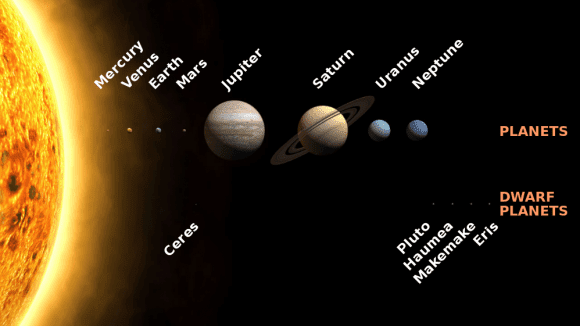
Our Solar System revolves around the sun, hence the name Solar System. In our system, we have 4 terrestrial planets and 4 gas giants. The four outer planets, also called giant planets or Jovian planets, collectively make up 99% of the mass known to orbit the Sun.
Jupiter and Saturn are together forming more than 400 times the mass of Earth and consist overwhelmingly of the gas’s hydrogen and helium, hence their designation as gas giants. Uranus and Neptune are far less massive.
They are less than 20 Earth masses (M Earth) each. They are composed primarily of ices. For these reasons, some astronomers suggest that they belong in their own category, ice giants. All four giant planets have rings, although only Saturn’s rings system is easily observed from Earth.
The four terrestrial or inner planets have dense, rocky compositions, few or no moons, and no ring systems. They are composed largely of refractory minerals, such as the silicates which form their crusts, and mantles and metals, such as iron and nickel which form their cores.
Three of the four inner planets (Venus, Earth, and Mars) have atmospheres substantial enough to generate the weather. All of them have impact craters and tectonic surface features, such as rift valleys and volcanoes.
The term inner planet should not be confused with inferior planet, which designates those planets that are closer to the Sun than Earth. Let’s go over them, but first, here’s a quick rundown of each planet in order of size and distance from the sun.
If you give most people enough time to think, they can come up with the names of all of the planets. What those same people will have difficulty with is the Solar System order. It can be difficult to remember which planet it was that came first.
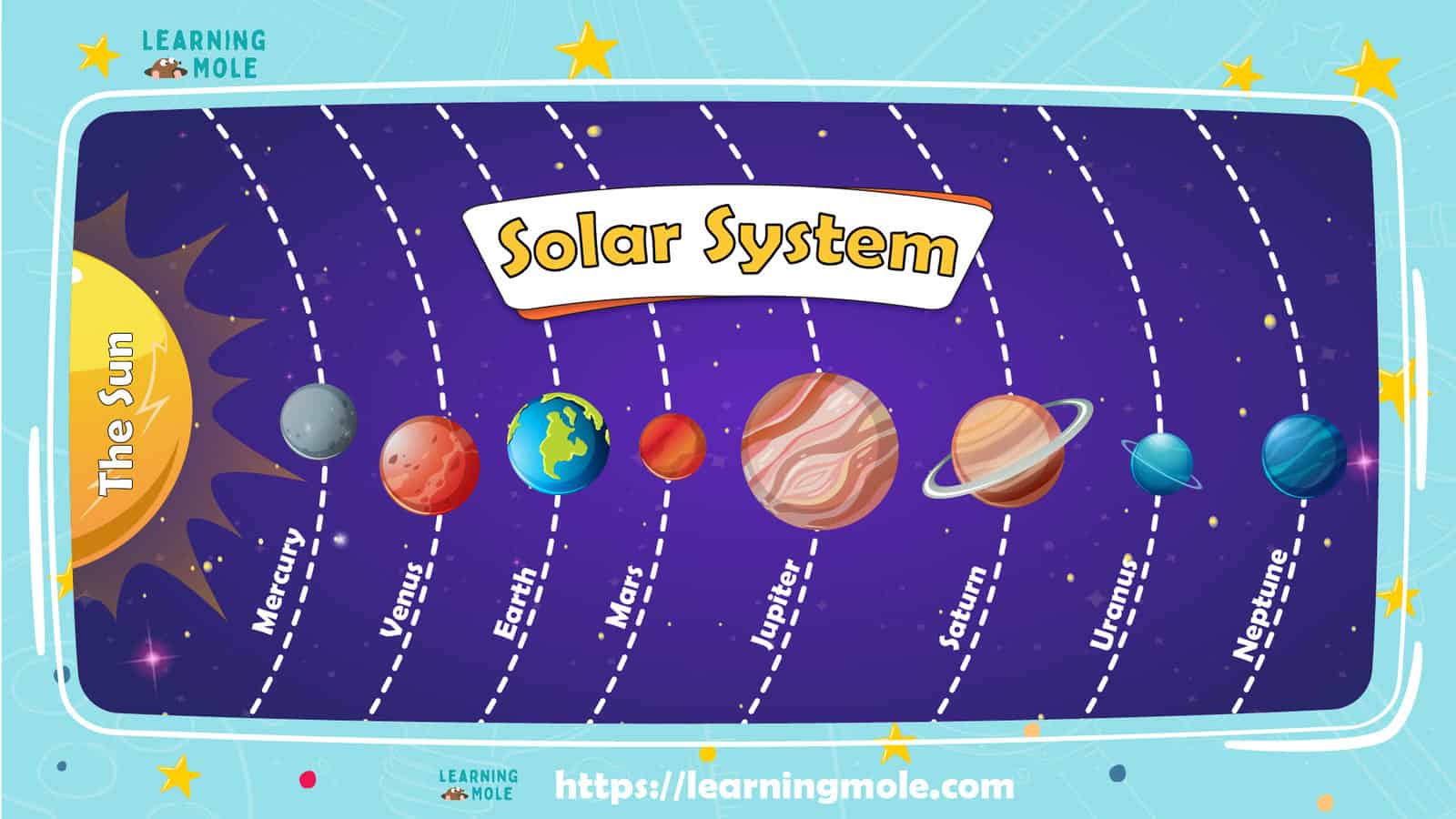
The current Solar System order is Mercury, Venus, Earth, Mars, Jupiter, Saturn, Uranus, and Neptune. The best thing to do is come up with a handy mnemonic. Here are a few details about each planet.
Mercury is the smallest and closest to the sun of our Solar System. This plant was formed about 4.5 billion years ago. It takes 88Earth days to orbit the sun. Mercury is slightly larger than Earth’s moon and is 1/3 (0.38%) the width of Earth.
4,879.4 km (3,031.91 miles)
38% the size of Earth
Mars is the fourth planet from the Sun and the second- the smallest planet in our Solar System. This planet is also known as the red planet of our Solar System. Mars has formed about 4.5 billion years ago. It takes 687 Earth days to orbit the sun. It has two moons.
6,780 km (4,212.890 miles)
53% the size of Earth
Venus is the second planet from the sun and the third smallest planet in our Solar System. This planet is also known as Earth’s Sister. It is the hottest planet (Average temperature of about 800֯ F or 430 ֯ C) in our Solar System. Venus has formed about 4.6 billion years ago. It takes 225 Earth days to orbit the sun. The size of Venus is similar to the size of Earth (0.95 times Earth-size).
12,100 km (7,520 miles)
95% the size of Earth
Earth Well, we are all familiar with this planet, because it is the planet where life exists. In other words, it is our home planet. Earth is the fourth-smallest and fifth largest planet in our Solar System. This planet was formed around 4.54 billion years ago. It takes 365 days to orbit the sun. Earth is slightly similar to Venus in size. The size of Earth is around 1/109 times as compared to the sun.
12,742km (7,917.5 miles)
100% the size of Earth
Neptune is the ice giant and the most distant planet in our Solar System. It is the fifth smallest and the fourth largest planet of our Solar System. Neptune has formed about 4.5 billion years ago. It takes 165 Earth years (60, 190 Earth days) to orbit the sun. Neptune is about 4 times the size of Earth.
49,244km (30,598.8 miles)
388% the size of Earth
Uranus is also a nice giant. It is the seventh planet from the Sun. It is the sixth smallest and third largest planet in the Solar System. This planet was formed about 4.5 billion years ago. It takes 84 Earth years (30,687 Earth days) to orbit the Sun. Uranus is almost 4 times the size of Earth.
50,724km (31,518.43)
400% the size of Earth
Saturn is the sixth planet from the Sun and the second-largest planet in our Solar System. This planet was formed 4.5 billion years ago. It takes about 9 times the size of Earth. Saturn is a gas giant planet and is also known as “The Ringed planet”. It’s because it has very beautiful rings made of ice and rocks. Furthermore, Saturn is the most beautiful planet in our Solar System.
116,464 km (72,367.37 miles)
945% the size of Earth
Jupiter Planet Jupiter is the fifth planet from the sun and the largest planet in our Solar System. This planet is also a gas giant and was formed around 4.5 billion years ago. It takes about 12 Earth years (4,333) to orbit the sun. This large planet is approximately 11 times the size of Earth.
139,822 km (86,881.36 miles)
1120% the size of Earth
The Sun is a yellow dwarf star and the largest object of our Solar System. This star was formed more than 4.5 billion years ago. The sun is about 109 times the size (in Diameter) of Earth. But by volume, the sun is about 1.3 million times bigger than Earth. In other words, about 1.3 million Earths could fit inside the sun
1,391,016km (864,337.27 miles)
The Moon is the only natural satellite of the Earth. This moon is the fifth largest moon in our Solar System. It takes around 27 days to make one revolution around the Earth. The size of the moon is about 1/3 rd. the size of the Earth.
3,475km (2,159.26 miles)
Arrange the planets in order of size
Arrange the planets in order of distance from the sun
Arrange the planets in order of density
Arrange the planets according to the force of gravity
Arrange the planets according to the length of the day
Arrangement of planets according to size: The Size of all planets in order is: –
Mercury
Mars
Venus
Earth
Neptune
Uranus
Saturn
Jupiter
The Solar System consists of one star, which is the sun, and all that revolves around it of bodies and bodies caught in its gravitational field, and among the most important of these bodies and bodies, the planets.
They are Mercury, which is the closest planet to the sun, then Venus, then Earth, then Mars, then Jupiter, then Saturn, then Uranus, then finally Neptune, which is the farthest planet from the sun.
The planets of the Solar System vary in their sizes and characteristics. Jupiter is the largest of the planets in size. The following table shows the order of the planets from largest to smallest:
The order of the planets from the sun:
The order of the planets from the sun
Planet
Diameter (km)
Jupiter
142,984
Saturn
120,536
Uranus
51,118
Neptune
49,528
Earth
12,756
Venus
12,104
Mars
6792
Mercury
4879
the solar system is divided into two main parts of the planets: the inner planets and the outer planets, separated by a band of rocks and dust scattered in space, known as the asteroid belt. The Solar System includes eight recognized planets.
They are the inner planets: The inner planets are known as the four planets that lie between the Sun Belt and the asteroid belt. They contain heavy metals, such as iron and nickel. They are also distinguished by having very few moons. They have a thin atmosphere.
The following table shows the distances of the planets from the sun starting with the closest to the farthest:
The order of the planets from the sun
Planet
distance from the Sun (km)
Mercury
57,910,006.85
Venus
108,199,995.17
Earth
149,599,951.14
Mars
227,939,920.24
Jupiter
778,330,257.41
Saturn
1,429,400,028.67
Uranus
2,870,989,228.8
Neptune
4,504,299,579.65
Arranging the planets according to Density is defined as the mass per unit volume of a substance. The density of any substance can be calculated by dividing the mass of the substance by its volume. The following table shows the order of the planets from the highest density to the lowest:
The order of the planets from the sun
Planet
Planet density (g/cm3)
Earth
5.52
Mercury
5.43
Venus
5.24
Mars
3.93
Neptune
1.64
Jupiter
1.33
Uranus
1.32
Saturn
0.69
The order of the planets according to the force of gravity is defined as the force that causes two bodies to be attracted to each other, and the following table shows the order of the planets from the strongest to the weakest:
The order of the planets from the sun
Planet
gravity (m/s2)
Jupiter
23.1
Neptune
11.0
Earth
9.8
Saturn
9.0
Venus
8.9
Uranus
8.7
Mars
3.7
Mercury
3.7
The following is the order of the planets according to the length of their day. The length of the day on the planet is defined as the time that the planet spends revolving around itself while revolving around the sun. The following table shows the order of the planets from the longest day to the shortest:
The order of the planets from the sun
planet
All-day (hour)
Mercury
4222.6
Venus
2802.0
Mars
24.7
Earth
24.0
Uranus
17.2
Neptune
16.1
Saturn
10.7
Jupiter
9.9
The sun is the most important part of the Solar System. It is located in its center and is many times larger in size than all the other planets and bodies combined. Within the sun, there are about 99.86% of all the mass (material) of the Solar System and the remaining one percent belongs to all the other bodies that revolve around it.
Namely, the planets, the moons belonging to them, dwarf planets, comets, asteroids, scattered clouds of gas and dust, and each type of these bodies have different physical and chemical properties
Here are a few details about each planet:
Mercury has a tenuous atmosphere. So, despite being the planet closest to the Sun, it is unable to retain the heat it is exposed to. The temperature ranges by a few hundred degrees Celsius each Mercurial day.
Venus has a thick atmosphere and an average surface temperature of 460 degrees Celsius. If you were standing on Venus, you would choke on the high amounts of carbon dioxide as your skin dissolved in the sulfuric acid rain.
Mars is perhaps the most studied planet besides Earth. It has a nearly nonexistent atmosphere, so it is a cold world. Temperatures are about -140 Celsius in the winter. At the height of summer, you could not comfortably wear shorts.
Jupiter is 2.5 times as massive as all of the other planets in the Solar System combined. Jupiter has 63 recognized moons, but more are thought to be in orbit. That accounts for about 1/3 of the moons in our Solar System.
Saturn is a contradiction. It is the second-largest planet, yet it has a very low density. It would float if you had enough water to put it in. There are 60 acknowledged moons orbiting Saturn.
Uranus is tilted like crazy. All planets are slightly tilted on their axis, but Uranus is tilting at 98 degrees.
Neptune is last, but not least. It orbits an average of 4.5 billion km from the Sun. It was discovered in 1846, making it the most recently recognized planet to be discovered.
Planets have the colors of what they have on their surface or of what they are made of. How their surfaces or atmospheres reflect sunlight also affects what they appear like. Mercury has a dark gray, rocky surface that is covered with a thick layer of the surface that is thought to be made up of igneous silicate rocks and dust.
Venus is entirely covered with a thick carbon dioxide atmosphere and sulphonic acid clouds which give it a light yellowish appearance. Earth shows its blue oceans and white clouds as its green and brownish land
Mars is covered with fine dust which contains iron oxide (rust). This gives Mars its orange color. Jupiter is a giant gas planet with an outer atmosphere that is mostly hydrogen and helium with small amounts of water droplets, ice crystals, ammonia crystals, and other elements.
Clouds of these elements create shades of white, orange, brown, and red. Saturn is also a giant gas planet with an outer atmosphere that is mostly hydrogen and helium. Its atmosphere has traces of ammonia, phosphate, water vapor, and hydrocarbons giving it a yellowish-brown color.
Uranus is a gas planet that has a lot of methane gas mixed in. Its atmosphere is mainly hydrogen and helium. This methane gas gives Uranus a greenish-blue color. Neptune also has some methane gas in its mainly hydrogen and helium atmosphere, giving it a bluish color.
Neptune has the strongest winds in the Solar System. Winds whip clouds of frozen methane across the planet at speeds of more than 1,200 miles per hour (2,000 kilometers per hour). This is close to the top speed of a Hornet fighter jet! The most powerful winds on Earth reach only about 250 miles per hour (400 kilometers per hour).
What is the largest moon in the Solar System?
One of Jupiter’s moons, Ganymede, is the largest moon in the Solar System. Ganymede has a diameter of 3270 miles (5,268 km) and is larger than the planet Mercury. It has a rocky core with a water/ice mantle and a crust of rock and ice. Ganymede has mountains, valleys, craters, and old lava flows.
Jupiter is the fastest spinning planet in our Solar System, rotating on an average of once in just under 10 hours. That is very fast especially considering how large Jupiter is. This means that Jupiter has the shortest days of all the planets in the Solar System.
Since Jupiter is a gas planet, it does not rotate as a solid sphere. Jupiter’s equator rotates a bit faster than its polar regions at a speed of 28,273 miles/hour (about 43,000 kilometers/hour). Jupiter’s day varies from 9 hours and 56 minutes around the poles to 9 hours and 50 minutes close to the equator.
The highest mountain and volcano in the Solar System is on the planet Mars. It is called Olympus Mons and is 16 miles (24 kilometers) high which makes it about three times higher than Mt. Everest.
In addition to being very tall, it is also very wide (340 miles or 550 kilometers) and covers an area larger than the entire chain of the Hawaiian Islands. Olympus Mons is a very flat mountain that slopes by only 2 to 5 degrees. It is a shield volcano built up by eruptions of lava.
Are moons always smaller than planets?
Moons are always smaller than the planets that they orbit (move around). A smaller body always orbits around a larger body rather than the other way round because the larger body has more gravity.
However, not all of the moons are smaller than all of the planets. There are seven moons in our Solar System, including our own Moon that are larger than Pluto. Jupiter’s moon Ganymede is the largest moon in the Solar System.
Ganymede, as well as Saturn’s moon Titan, are both larger than Mercury and Pluto. Earth’s Moon, Jupiter’s moons, and Neptune’s moon, Triton, are all larger than Pluto, but smaller than Mercury.
How do the planets stay in orbit around the sun?
The Solar System was formed from a rotating cloud of gas and dust which spun around a newly forming star, our Sun, at its center. The planets all formed from this spinning disk-shaped cloud. They continued this rotating course around the Sun after they were formed.
The gravity of the Sun keeps the planets in their orbits. They stay in their orbits because there is no other force in the Solar System which can stop them.
How did the planets get their names?
All of the planets, except for Earth, were named after Greek and Roman gods and goddesses. Jupiter, Saturn, Mars, Venus, and Mercury have given their names thousands of years ago. The other planets were not discovered until much later after telescopes were invented.
The tradition of naming the planets after Greek and Roman gods and goddesses was carried on for the other planets discovered as well. Mercury was named after the Roman god of travel. Venus was named after the Roman goddess of love and beauty.
Mars was the Roman god of War. Jupiter was the king of the Roman gods, and Saturn was the Roman god of agriculture. Uranus was named after the ancient Greek king of the gods. Neptune was the Roman god of the Sea.
Pluto, which is now classified as a dwarf planet, was the Roman god of the underworld. The name Earth is an English/German name that simply means the ground.
How many planets in the Solar System have rings?
Four of the planets in the Solar System have rings. They are the four giant gas planets. Those are Jupiter, Saturn, Uranus, and Neptune. Saturn, which has by far the largest ring system, was known to have rings for a long time.
It was not until the 1970s that rings were discovered around the other gas planets. The rings around Jupiter, Uranus, and Neptune are much smaller, darker, and fainter than the rings of Saturn.
Rings around gas giants are thought to be transient over the lifetime of the planetary system. That is, if we had lived at a very different time, perhaps we would not see the big rings around Saturn, but just another one of the gas giants.
All of the planets are round because of gravity. When our Solar System was forming, gravity gathered billions of pieces of gas and dust into clumps which grew larger and larger to become the planets.
The force of the collision of these pieces caused the newly forming planets to become hot and molten. The force of gravity pulled this molten material inwards towards the planet’s center into the shape of a sphere.
Later, when the planets cooled, they stayed spherical. Planets are not perfectly spherical because they also spin. The spinning force acts against gravity and causes many planets to bulge out more around their equators.
The Solar System is the sun and everything that orbits around it. It includes the planets and their moons as well as numerous asteroids and comets. These objects are all held in orbit around the sun by the sun’s strong gravity. The planets in order from the sun are Mercury, Venus, Earth, Mars, Jupiter, Saturn, Uranus, and Neptune.
Planets in Order of Mass:
Planet
Mass (kg)
Jupiter
1.8986 x 1027
Saturn
5.6846 x 1026
Neptune
10.243 x 1025
Uranus
8.6810 x 1025
Earth
5.9736 x 1024
Venus
4.8685 x 1024
Mars
6.4185 x 10²³
Mercury
3.3022 x 10²³
The Terrestrial Planets in Order
1. Mercury
The first planet in our Solar System is Mercury. It is slightly smaller than Earth’s moon and is extremely hot. As it could reach about 850 Fahrenheit or so. NASA launched the MESSENGER probe in 2004 to learn all about Mercury since we don’t really know much about it.
Facts:
Orbit time: 88 Earth days
1 day on Mercury is 59 Earth days
Has a diameter of a little over 3,000 miles
2. Venus
Venus is the second planet in our Solar System and is named after the Roman goddess of love. Venus is actually hotter than Mercury and is abundant in greenhouse gasses. Venus is similar to Earth in size and general structure.
Facts:
Its orbit takes about 225 Earth days
1 day on Venus is the equivalent of 241 Earth days
7,500-mile diameter
Venus Facts for Kids
3. Earth
The Earth is the third planet from the sun and is the planet that we call home. It is the only planet that we know of, that can maintain and support life. Earth has formed around 4 billion years ago and has gone through many changes in that time period.
Earth has 4 seasons because of the tilt of Earth’s axis, and our oceans have tides because of the gravitational pull of the moon. The moon is our only natural satellite.
Facts:
1 orbit around the sun takes 365 days
1 day is 24 hours
Earth has an almost 8,000-mile diameter
Earth Facts for Kids
4. Mars
Mars is the fourth planet from the sun and is the last terrestrial planet. It is the only planet that humans can somewhat survive on (with the help of technology and science, of course).
Mars is very cold and is currently inhabited solely by robots. Mars’ gravity is 1/3 that of on Earth, but it is enough for humans to live on.
Facts:
1 Martian day is called a sol
1 sol is the equivalent of 25 hours
Mars’ orbit lasts 669 sols
Mars Facts for Kids
The Gas Giants
The remaining planets are separated from the terrestrial planets by the asteroid belt. All of the gas giants have some type of ring surrounding it.
5. Jupiter
Jupiter is the first of the gas giants and is the largest planet in our Solar System. We got our first images of Jupiter up close from the space probe Voyager, which is actually still flying through space outside of our Solar System.
Jupiter is comprised primarily of hydrogen and helium and it is still unknown if Jupiter’s core is solid or not. If Jupiter were about 80 times its size, then it would be considered a star, just like our sun.
Jupiter has a lot of natural satellites surrounding it, which are believed to be from meteors. Jupiter actually protects the Earth from meteors, so in a way, Jupiter is a kind of Earth’s protective big brother.
Facts:
Features an ongoing hurricane called the Great Red Spot
An orbit takes 12 Earth years
1 day on Jupiter is the equivalent of 9 hours
Has a diameter of a whopping 86,881 miles
6. Saturn
Saturn is the second gas giant and is our second largest planet. Saturn was also seen by Voyager. Saturn is most recognizable by its rings that are made up of ice and space debris. Saturn is comprised of hydrogen and helium, but it is unknown whether Saturn has a solid core (just like Jupiter). Saturn also has quite a few natural satellites as well.
Facts:
Its orbit around the sun takes 30 Earth years
1 day on Saturn is the equivalent of 11 Earth hours
Saturn is slightly smaller than Jupiter coming in at a diameter of almost 75,000 miles
Saturn Facts for Kids
7. Uranus
Uranus is the seventh planet from the sun and is the third of the gas giants. Just like Jupiter and Saturn, the Voyager probe gave us our first look at the planet in 1986. Our first images of Uranus came on the same day that the Challenger blew up, killing the 7 astronauts on board.
Uranus has a very serious tilt to where the equator is actually at a right angle to the orbit. It is believed that Uranus had a collision with another planet, causing its tilt. The planet is made up of helium and hydrogen and is believed to have icy elements on its surface. Uranus’ core is thought to be extremely icy, instead of being molten like other planets.
Facts:
1 orbit around the sun takes 84 Earth years
1 day is the equivalent of 18 Earth hours
Had a diameter of 31,760 miles
Discovered in the 1780s
8. Neptune
Neptune is the eighth planet from the sun and is the last of the gas giants. It is comprised of hydrogen and helium primarily and is surrounded by a thick cloud layer that houses winds faster than the speed of sound.
The blue coloring is produced by an abundance of methane and it is unknown if Neptune’s core is solid. Neptune was predicted to exist by math before we actually saw it, making it the first predicted planet.
Neptune Facts for Kids
Facts:
1 orbit around the sun takes 165 Earth years
1 day equals 19 hours on Earth
Has a diameter of 30,775 miles, making it the third-largest planet in our Solar System?
It was officially discovered in 1846
We have never seen this final planet, but scientists are predicting it exists, just that it probably exists. This planet was predicted in 2014 after astronomers noticed that Neptune’s orbit was slightly different than some other planets.
There is a theory that this planet is massive and at one point had a collision with Jupiter that “bounced” it farther away. It is merely a theory, but it’s fascinating nonetheless. Keep checking Learning Mole for more amazing facts!
Mathematics and nature intertwine in fascinating ways, creating patterns and sequences that delight and educate. As we observe the world around us, we find that counting petals and leaves isn't...
Maths on the farm is not just about profits and yields; it's a fundamental part of daily farm life, especially when it comes to managing livestock. Our days begin with...
Exploring the vast and enchanting underwater world provides a unique backdrop for engaging children in the essential subject of mathematics. At LearningMole, we believe that bringing together the excitement of...


Leave a Reply