The Amazing 5 Even Numbers: A Guide for KS1 Children and Teachers

Avatar of Shaimaa Olwan
Updated on: Educator Review By: Michelle Connolly

Numbers are everywhere in a child’s world, from counting the legs on a spider to sharing sweets after school. Even numbers are one of the first patterns children meet in maths, and the five smallest positive even numbers: 2, 4, 6, 8, and 10 appear so often in daily life that spotting them quickly gives children a real head start.

In the UK National Curriculum, Year 1 and Year 2 pupils are expected to count in steps of two and begin identifying whether numbers are odd or even, which makes understanding these five numbers a practical classroom priority for KS1 teachers and parents alike.

What makes 2, 4, 6, 8, and 10 so useful as a starting point is that they are concrete and manageable. A child can count pairs of shoes, pairs of eyes, or the legs on an insect and immediately see the idea in action. At LearningMole, we have found that children who understand even numbers through pairing objects before moving to abstract rules tend to build much stronger number sense overall. The jump from “I paired everything up, and nothing was left over” to “the number ends in 0, 2, 4, 6, or 8” becomes intuitive rather than a rule to memorise.

This guide explains what even numbers are, walks through each of the Amazing 5 in detail, covers the key properties teachers need to explain, and offers practical activities for the classroom and home. Whether you are planning a Year 2 maths lesson or helping your child with homework, the explanations and examples here are aligned with how the UK curriculum approaches number patterns at Key Stage 1.

What Makes an Even Number?

An even number is any whole number that can be split into two equal groups with nothing left over. The simplest way to explain this to a child is the Partner Rule: if every object can find a partner, the total is even.

Take 6 socks. Lay them out and pair them up into three pairs; nothing unpaired. Six is even. Now try 5 socks. Four pair up, but one is left without a partner. Five is odd. This pairing method, often called the Concrete-Pictorial-Abstract (CPA) approach, is the most effective way to introduce parity to KS1 pupils because it gives the concept physical meaning before any rule is stated.

In formal terms, even numbers are divisible by 2 with a remainder of zero. Any whole number that can be expressed as 2 × k (where k is a whole number) is even. So 2 = 2 × 1, 4 = 2 × 2, 6 = 2 × 3, and so on. Children do not need this algebraic form in Year 1 or Year 2, but it underpins everything they will later learn about multiplication tables, division, and factors.

A quick visual check works at any age: look at the digit in the ones place. If it is 0, 2, 4, 6, or 8, the number is even, regardless of how large it is. 3,472 is even because it ends in 2. 1,005 is odd because it ends in 5. This one-digit shortcut is exactly what the UK National Curriculum expects KS1 children to know by the end of Year 2.

Even and Odd at a Glance

FeatureEven NumbersOdd NumbersExample
Ends in0, 2, 4, 6, or 81, 3, 5, 7, or 914 is even; 15 is odd
Paired objectsNo leftoverOne leftover6 objects = 3 pairs; 7 objects = 3 pairs + 1
Divisible by 2?Yes, remainder 0No, remainder 18 ÷ 2 = 4; 9 ÷ 2 = 4 r 1
General form2k2k + 14 = 2×2; 5 = 2×2+1

Meet the Amazing 5: 2, 4, 6, 8, and 10

even numbers

The five smallest positive even numbers are the ones children meet first and use most often. Each has its own character and its own set of real-world connections that make it stick in a child’s memory.

Number 2: The Only Even Prime

Two is the smallest even number and the only even prime number. A prime number has exactly two factors, itself and one. Two fits that definition perfectly: its only factors are 2 and 1. Every other even number has at least three factors (1, 2, and itself), so no other even number can be prime. This makes 2 genuinely special in mathematics, and it is worth mentioning to Year 2 children who are ready to think about what makes numbers different from each other.

In everyday life, 2 appears as a pair of eyes, two hands, two halves of a sandwich, or two sides of a see-saw. Counting in twos from 2 is the first step toward understanding multiplication by 2, which appears formally in the Year 2 times tables programme.

Number 4: The First Square Number in the Amazing 5

Four is 2 × 2, which makes it the smallest square number that is also even. Children often meet 4 first as four legs on a table or chair, four corners of a square, or four seasons. In the classroom, 4 is useful for showing how even numbers always split cleanly: four counters always make two groups of two, with nothing left over.

Four is also the first composite even number, meaning it has factors beyond just 1 and itself (its factors are 1, 2, and 4). When children later learn the 4 times table, the connection back to even numbers helps reinforce why multiplying by 4 always gives an even result.

Number 6: The First Perfect Number

Six has a remarkable property that mathematicians have studied for thousands of years: it is the smallest perfect number. A perfect number is one whose proper divisors (all factors except itself) add up to the number itself. The proper divisors of 6 are 1, 2, and 3, and 1 + 2 + 3 = 6. You do not need to teach this to Year 2 pupils, but it is a wonderful enrichment detail for more confident mathematicians or for a class discovery session.

More practically for primary classrooms, 6 connects beautifully to real-world objects: six legs on an insect, six sides on a honeycomb cell, six faces on a cube, and six dots on a standard dice face. These physical examples give teachers several no-prep ways to bring the number to life.

Number 8: The Doubling Number

Eight appears constantly in nature and in the classroom. Spiders have 8 legs, octopuses have 8 arms, and a standard musical bar often has 8 beats. In maths, 8 is 2 × 2 × 2 (two cubed), which makes it the smallest even cube number. This gives teachers a natural bridge to discussions about doubling: 2 doubled is 4, 4 doubled is 8.

For KS1 children, 8 is often the trickiest of the Amazing 5 to pair intuitively because four pairs of objects take a moment to arrange. Using ten-frames or Numicon tiles makes the pairing concrete and visual, which is the approach LearningMole recommends for any child who needs to see the structure before trusting the one-digit rule.

Number 10: The Base-10 Leader

Ten is both an even number and the foundation of our entire number system. We count in base 10 because humans have 10 fingers, and the entire decimal system, place value, column addition, and beyond, rests on groups of ten. For even-number learning specifically, 10 is important because it shows children that the pattern continues past single digits: 10 ends in 0, it divides into two groups of five, and it sits at the top of the first row of the hundred square.

Ten also provides the most accessible real-world check: fingers and toes. Every child has 10 of each. Two groups of 5, nothing left over. That lived experience makes the abstract definition feel obvious.

The Amazing 5 at a Glance

NumberSpecial PropertyReal-World ExampleCurriculum Connection
2Only even prime numbersEyes, hands, halvesCount in 2s (Year 1/2); 2× table (Year 2)
4Smallest even square numberTable legs, square corners, seasons4× table (Year 2); arrays (Year 2)
6Smallest perfect numberInsect legs, dice faces, honeycomb cells6× table (Year 3); factors (Year 5)
8Smallest even cube (2³)Spider legs, octopus arms, musical beats8× table (Year 3); doubling chains (Year 2)
10Base-10 foundationFingers, toes, 10p coinsPlace value (Year 1+); 10× table (Year 2)

How to Spot an Even Number: The Ones-Digit Rule

even numbers

The most reliable shortcut for identifying even numbers is to look only at the digit in the ones place (also called the units digit). If that digit is 0, 2, 4, 6, or 8, the number is even. This works for numbers of any size because even numbers in base 10 always end in an even digit.

Walk children through a few examples: 12 ends in 2, so it is even. 37 ends in 7, so it is odd. 450 ends in 0, so it is even. 1,003 ends in 3, so it is odd. Once the pattern clicks, most Year 2 children can apply it quickly without needing to count pairs, which is exactly the stage of abstraction the National Curriculum aims for by the end of KS1.

For children who are not yet ready to use the one-digit rule independently, the pairing method remains the most reliable bridge. Give them 10 small objects and ask them to pair them up. The physical action of moving objects into pairs makes the concept tangible before the shortcut makes sense. LearningMole’s video on even and odd numbers uses this exact progression, starting with objects before introducing the digit rule.

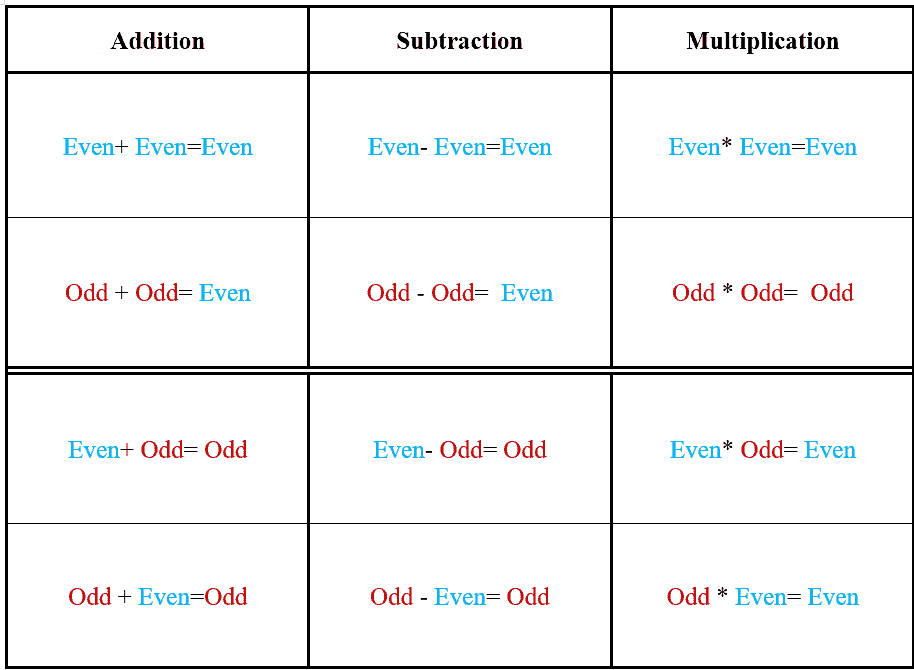
Properties of Even Numbers: Addition, Subtraction, and Multiplication

Once children know which numbers are even, they can begin to explore how even numbers behave when you add, subtract, or multiply them. These properties follow consistent rules that are worth teaching explicitly, because they help children check their own arithmetic and begin to reason about number patterns.

Addition Rules

Even + Even = Even. Adding 14 and 6 gives 20 — still even. This happens because both numbers can be split into pairs, and combining two sets of pairs always gives a set of pairs.

Odd + Odd = Even. Adding 11 and 13 gives 24. Two odd numbers each have one leftover object; those two leftovers pair up, so the total is even.

Even + Odd = Odd. Adding 8 and 5 gives 13. The even number provides complete pairs, but the odd number contributes one leftover, so the total is odd.

Subtraction Rules

Even − Even = Even. Taking 6 from 16 gives 10. Removing a complete set of pairs from another complete set of pairs leaves pairs.

Odd − Odd = Even. Taking 11 from 23 gives 12. The two leftover singles cancel each other out, leaving a clean, even number.

Even − Odd = Odd (and Odd − Even = Odd). One leftover survives in both cases, making the result odd.

Multiplication Rules

Even × Even = Even. 6 × 4 = 24. Two sets of pairs multiplied together always give pairs.

Even × Odd = Even. 8 × 5 = 40. An even number of groups of any size always produces an even total.

Odd × Odd = Odd. 3 × 5 = 15. Without any even factor, the product cannot be split into pairs.

Properties Summary Table

OperationEven + EvenOdd + OddEven + Odd
AdditionEven (14 + 6 = 20)Even (11 + 13 = 24)Odd (8 + 5 = 13)
SubtractionEven (16 − 6 = 10)Even (23 − 11 = 12)Odd (16 − 5 = 11)
MultiplicationEven (6 × 4 = 24)Odd (3 × 5 = 15)Even (8 × 5 = 40)

Is 5 an Even or Odd Number?

even numbers

This question receives thousands of searches every month, making it one of the most common maths queries for this topic. The answer is straightforward: 5 is an odd number.

Five ends in 5, which is not in the set of even digits (0, 2, 4, 6, 8). If you try to pair up 5 objects, you get 2 pairs and 1 leftover. That leftover is what makes 5 odd. The same applies to all numbers ending in 1, 3, 5, 7, or 9.

It is worth being explicit about this in the classroom because children sometimes confuse 5 with even numbers, possibly because it appears so often in counting by fives or in the five times table alongside even multiples. A quick objects-and-pairing activity clears up the confusion immediately: lay out 5 cubes, pair them, and ask what is left over.

Is 50 an Even or Odd Number?

Fifty is even. It ends in 0, which is an even digit, and it divides into two equal groups of 25 with nothing left over. This query also appears frequently in search data, suggesting that children and parents sometimes feel unsure whether the one-digit rule still applies to two-digit numbers. It does. The size of the number makes no difference — only the ones digit matters.

Fifty also offers a useful teaching moment: it sits exactly halfway to 100, it is 5 × 10, and it features in activities involving the hundred square. Asking children to colour all even numbers in a hundred square creates a striking visual pattern: every column ends in 0, 2, 4, 6, or 8, reinforcing the rule in a way children remember.

Even Numbers in the UK National Curriculum

number facts

The concept of odd and even numbers appears formally in the KS1 programme of study. By the end of Year 1, pupils are expected to count in multiples of 2, which lays the foundation for recognising even numbers. By the end of Year 2, pupils should count in steps of 2 from different starting points and begin to identify whether numbers are odd or even.

The National Curriculum does not require Year 1 or Year 2 children to use the term “divisible by 2” or to know the algebraic form 2k. The focus at KS1 is on pattern recognition, pairing, and the one-digit rule. The deeper properties — addition and multiplication rules, and the concepts of prime and composite numbers — are revisited in KS2.

“Children who understand even numbers early are building pattern-recognition skills that carry through to fractions, factor pairs, and algebraic thinking later in their schooling. The Amazing 5 are the perfect entry point because they are small enough to pair physically but mathematically rich enough to teach genuine reasoning.” Michelle Connolly, Founder of LearningMole and a former primary school teacher with over 15 years of classroom experience

Classroom and Home Activities for the Amazing 5

Understanding How Children Learn Counting Numbers

The Pairing Activity (Year 1, Concrete Stage)

Gather a set of small objects — cubes, buttons, or counters. Ask children to take a handful, pair them up side by side, and record whether the total is odd or even. Repeat ten times and record results in a table. Children will quickly notice that the totals alternate or cluster around recognisable digits.

Hundred Square Colouring (Year 2, Pictorial Stage)

Give children a printed 1–100 number square. Ask them to colour all the even numbers. The result is five coloured columns, all ending in even digits. This visual pattern is one of the most powerful ways to show that the rule is consistent — it never breaks, no matter how large the number gets.

Real-World Even Number Hunt (Home or Classroom)

Ask children to find examples of the Amazing 5 in the room or at home. Four legs on a chair, 2 eyes on a face, 10 fingers, 6 sides on a cube, 8 crayons in a small set. Recording findings in a simple table reinforces the connection between physical objects and abstract numbers.

Even or Odd Card Sort (Years 1–2)

Write numbers 1 to 20 on cards. Children sort them into two piles: even and odd. To differentiate upward, include two-digit numbers up to 50 or 100. To differentiate downward, use only the Amazing 5 and their odd neighbours (1, 2, 3, 4, 5, 6, 7, 8, 9, 10).

Teaching Resources and Support from LearningMole

coding for kids

LearningMole provides curriculum-aligned video resources and teaching materials for KS1 and KS2 maths, designed to support both classroom teaching and home learning. Our even and odd numbers video uses the pairing approach recommended above, showing children how to move from concrete objects to the one-digit rule at a pace that suits early learners.

For teachers planning a Year 2 maths sequence on odd and even numbers, LearningMole’s resources can serve as a lesson starter, an independent activity, or a homework support tool. For parents, the videos explain the concepts using the same language and methods children hear in school, which makes home practice more consistent and less confusing.

Visit learningmole.com to explore the full range of KS1 maths videos and resources, covering number patterns, times tables, place value, and more — all aligned with the UK National Curriculum and designed by experienced educators.

Frequently Asked Questions

even numbers

What are the first five even numbers?

The first five positive even numbers are 2, 4, 6, 8, and 10. These are the ones most commonly introduced in Years 1 and 2 at KS1 because they are small enough to demonstrate with physical objects and appear frequently in counting patterns and multiplication tables. Zero is technically also an even number, because 0 ÷ 2 = 0 with no remainder, but in UK primary teaching, we typically begin the sequence at 2 to avoid confusing children who are still consolidating their understanding of zero as a placeholder.

Is 5 an even or odd number?

Five is an odd number. It ends in 5, which is not an even digit (0, 2, 4, 6, 8). If you try to pair 5 objects, you will always have one left over. Five appears regularly alongside even numbers in skip-counting activities (counting in 5s from 0 gives 5, 10, 15, 20…), which can cause confusion. Reassure children that 5 is always odd — only the numbers ending in 0, 2, 4, 6, or 8 are even.

Is 50 an even or odd number?

Fifty is even. It ends in 0, which is an even digit, and 50 ÷ 2 = 25 with no remainder. The ones-digit rule works for any size of number: only the final digit determines whether a number is even or odd. This is a good teaching moment for Year 2 pupils who have mastered the Amazing 5 and are ready to apply the rule to larger numbers.

How do you explain even numbers to a child?

The most effective approach for KS1 children is the pairing method. Take any number of small objects and try to pair them all up. If every object has a partner and nothing is left over, the number is even. If one object has no partner, the number is odd. Once children are confident with this physical approach, introduce the shortcut: even numbers always end in 0, 2, 4, 6, or 8. LearningMole’s video on even and odd numbers demonstrates both steps clearly using the objects-first, rule-second sequence.

What is the rule for an even number?

There are two ways to state the rule, depending on the level. For KS1 children, the practical rule is: a number is even if all its objects can be paired up with nothing left over. The shortcut rule, which children can apply without pairing, is: a number is even if its ones digit (the last digit) is 0, 2, 4, 6, or 8. For older learners, the formal rule is that a number is even if it is divisible by 2 with no remainder, or equivalently, if it can be expressed as 2k, where k is a whole number.

Which of the Amazing 5 is a prime number?

Only 2 is a prime number. A prime number has exactly two factors: 1 and itself. Two fit this definition because its only factors are 1 and 2. All other even numbers (4, 6, 8, 10, and beyond) have at least three factors: 1, 2, and themselves, so they are composite numbers, not primes. This makes 2 the only even prime number that exists, a mathematical fact worth highlighting to children who are ready for it.

Why is 10 an even number?

Ten is even because it ends in 0 (an even digit), because 10 ÷ 2 = 5 with no remainder, and because 10 objects can be split into two equal groups of 5. Ten is also significant because it is the base of our number system — every time we reach 10, we move up a place value. For young learners, fingers and toes provide the most concrete demonstration: 10 fingers, 2 hands of 5, nothing left unpaired.

How many even numbers are there between 40 and 60?

There are 9 even numbers between 40 and 60 (excluding 40 and 60): 42, 44, 46, 48, 50, 52, 54, 56, and 58. If you include 40 and 60, the count rises to 11. This type of question often appears in Year 2 assessments and is an excellent way to check whether children can apply the one-digit rule to a range of numbers rather than just identifying isolated examples.

Conclusion

even numbers

Even numbers are one of the most foundational patterns in primary mathematics. The Amazing 5: 2, 4, 6, 8, and 10 give children a memorable set of numbers to anchor the concept, and the progression from pairing physical objects to applying the ones-digit rule mirrors exactly how the UK National Curriculum builds understanding at KS1. Teachers who use concrete resources first, whether counters, Numicon, or everyday objects, tend to find that children make the transition to the abstract rule more confidently and retain it longer.

The properties covered here, how even numbers behave in addition, subtraction, and multiplication, set children up for success across KS2. Understanding that even × even always gives even, or that odd + odd always gives even, is the kind of number reasoning that makes mental arithmetic faster and more reliable. These are not tricks to memorise; they are patterns children can rediscover every time they need them, provided the initial concept is secure.

LearningMole’s resources on odd and even numbers are designed to support every stage of this journey, from the first pairing activity in Year 1 to the more complex number reasoning expected by the end of KS2. Visit learningmole.com to explore curriculum-aligned videos and teaching materials that bring number patterns to life for primary-aged children.

Leave a Reply

Your email address will not be published. Required fields are marked *