Teaching young children to read music sheet is a rewarding venture that opens doors to musical literacy and a lifetime appreciation for music. When we introduce the basics of music sheet, we lay a foundation for understanding musical notation and rhythm. This early exposure helps children decipher the symbols and signs that communicate how music should be played.
Music Sheet: Kid playing a piano
As educators, it’s vital for us to develop engaging lesson plans that gradually introduce note names and values, as well as fundamental music theory. By using a variety of games and age-appropriate activities, we can foster a fun learning environment that encourages children to read music with confidence. Michelle Connolly, a seasoned educational consultant, emphasises the importance of these early stages, stating, “Laying a solid foundation in music not only nurtures musical ability but also boosts overall cognitive development in children.”
We recognise that each child’s learning journey is unique. It’s essential to adapt our teaching methods to cater to individual learning paces, ensuring that each child feels supported and confident as they navigate the world of music. By integrating music reading skills with the excitement of playing an instrument, we can create a more holistic and enjoyable learning experience.
Key Takeaways
Introduce musical concepts steadily to build a strong foundation for reading music sheet.
Use interactive games and activities to make learning to read music fun and engaging.
Adapt teaching methods to the individual pace and skills of each child.
Understanding the Basics of Music Sheet
When teaching young children the foundations of music, understanding music sheet is like learning a new language. It’s about recognising symbols and patterns to interpret melodies and rhythms.
The Music Staff and Its Importance
The music staff is the backbone of written music, consisting of five horizontal lines and four spaces. Each line and space represents a different pitch. When children learn to read this, they learn the alphabet of music. Together, the lines and spaces comprise the stave, and when combined with clefs, they delineate the pitch of the notes.
Clefs: Treble and Bass
The clefs are symbols at the beginning of the stave that assign individual notes to certain lines and spaces. The treble clef, with its ornate G-shape, is used for higher-pitched sounds and often governs the right-hand part on the piano. Conversely, the bass clef, resembling a stylised F, is for lower pitches, guiding the left hand. Children must understand these two to read music effectively. Michelle Connolly, founder of LearningMole and an educational consultant with over 16 years of classroom experience, emphasises that “Mastering the difference between treble and bass clefs is essential for budding musicians to navigate the full spectrum of music notes.”
By understanding the music staff, stave, clefs, treble clef, bass clef, and grand staff, children lay the groundwork for their musical education, opening up a world of expressive possibilities.
Introducing Note Names and Values
Music Sheet: Colorful music notes and symbols float above a child’s open music book
Before teaching young learners to read music sheet, it’s integral to familiarise them with the names of the notes and their corresponding values. This foundation is crucial for their ability to understand and perform music.
Learning Note Names
In our introduction to music notation, we ensure that children become comfortable with the letters A through G, which represent the note names in music. We initiate this journey by creating associations between these letters and their positions on the staff. For instance, we might relate the note E to the very first line of the treble clef staff, making it easier for children to remember. Our approach involves using visual aids and interactive exercises to strengthen their recall abilities.
“Recognising note names is like meeting new friends; you need to spend time with them to learn who they are,” says Michelle Connolly, whose expertise in education is sculpted by her 16 years in the classroom.
Understanding Note Values
Moving on, we help our young musicians grasp the concept of note values, which dictate the duration a note is held. We introduce them to different note types, such as:
Semibreves (whole notes): lasting four beats
Minims (half notes): lasting two beats
Crotchets (quarter notes): lasting one beat
Quavers (eighth notes): lasting half a beat
We incorporate visual representations to show how these notes appear on the music sheet and employ rhythmic clapping and other engaging activities to make learning these concepts a fun experience. By breaking down rhythms into manageable parts, we equip our learners with the knowledge to read notes and understand their beat value, setting a solid groundwork for musical literacy.
Foundational Music Theory for Beginners
Music Sheet: Colorful music notes and symbols float above a staff on a white background
Before we introduce young learners to instruments, it’s crucial that we build their understanding of music theory. We’ll touch on reading music sheet and recognising rhythms—the very basics to set a strong musical foundation.
Exploring Music Notation
Music notation is the language of music and, just like any language, it has its own script. Notes and symbols on a stave represent different pitches and durations, and teaching children these basics is akin to teaching them the alphabet before they learn to form words and sentences. Our approach includes starting with the treble and bass clefs, familiarising learners with note values such as crotches, quavers, and semibreves, and how they are written on the stave.
We ensure that learning to read music is engaging by integrating rhythm games that leave a lasting impression of what each symbol means. As Michelle Connolly mentions, “Children thrive on playful learning. When they’re clapping out rhythms or spotting note values in games, they absorb music theory effortlessly.”
Grasping Basic Rhythms and Beats
Rhythm forms the heartbeat of music, and understanding it is essential. We teach children to tap into the pulse of music by starting with the basics—the steady beat. Clapping and stepping to different rhythms helps to internalise tempo and metre, making abstract concepts tangible. By creating rhythm games that encourage learners to identify patterns and sequences in music, we’re not only reinforcing their theoretical knowledge but also enhancing their listening skills.
Our practice in rhythm lays a brilliant foundation as children soon learn to pair what they see in music notation with what they perform, bridging the gap between theory and practice. This critical connection is well captured by Michelle Connolly’s words, “When a child claps along to a rhythm, they’re not just moving to music, they’re feeling it, and that’s where true understanding blossoms.”
We’re passionate about creating a musical journey that is as enriching as it is enjoyable, always mindful that a strong foundation in music theory sets the stage for a lifetime of musical exploration and joy.
Developing Music Reading Skills
To excel in reading music sheet, children must focus on consistent practice and the identification of recurring musical patterns. These key elements contribute to their proficiency and confidence in music reading.
Repetition and Practice
We understand that to become proficient in reading music, repeated practice is essential. By encouraging practice sessions regularly, children reinforce their knowledge of musical notes and rhythms. It’s akin to learning a new language; the more they immerse themselves in the musical notation, the more fluent they become. Setting aside dedicated time each day for these practice sessions enables a routine.
Recognition of Patterns
Musical pieces often comprise recurring patterns that children can learn to recognise. These may be rhythmic motifs or melodic sequences. Identification of these patterns not only speeds up the music reading process but also aids in memory retention. For example, many pieces use scales and arpeggios, which, once familiar, make reading and performing music much simpler.
Michelle Connolly, a founder with extensive classroom experience, remarked, “Spotting patterns in music is like uncovering hidden treasures for young learners; it empowers them and illuminates their reading path.”
Engaging Games and Activities
We understand the importance of making the journey of learning to read music sheet enjoyable for young learners. The inclusion of games and activities in music education not only makes the process fun but also enhances understanding and retention.
Incorporating Rhythm Games
Rhythm games are an exceptional way to develop a child’s ability to recognise and perform musical patterns. Body percussion and movement activities encourage children to physically experience the beat, which helps to cement their understanding. For example, clapping, stomping or patting in time to a rhythm quickly turns an abstract concept into a tangible experience.
Clap and Count: Clap along with the beat of a favourite song and count the rhythms out loud.
Rhythm Echo: Take turns with the child being the leader in a call-and-response game, where one creates a rhythm, and the other echoes it back.
Using Flashnote Derby and Other Apps
Flashnote Derby and similar apps are fantastic tools to aid in the teaching of note reading. These interactive platforms use gamification to motivate young learners and make music sheet reading less intimidating.
Interactive Learning: Children race against the clock or competitors, identifying notes to move their character forward in a fun and engaging way.
Progressive Challenges: As children advance, the games can introduce sharps, flats, and various clefs, providing a comprehensive learning experience in a stimulating environment.
Michelle Connolly, founder of LearningMole and educational consultant with 16 years of classroom experience, reinforces the need for engagement in music education: “Apps like Flashnote Derby bring an element of excitement to music theory; it’s about connecting notes on the page with live feedback, encouraging our young musicians to strive further.”
Utilising these playful strategies, we help children see the joy in every note, setting a firm foundation for their musical adventures.
Implementing Solfege in Reading Music
Introducing solfege to young learners is a powerful way to enhance their ability to read music sheet. By learning and using solfege syllables, children develop strong music literacy skills.
Learning Solfege Syllables
We start with the basics: do, re, mi, fa, sol, la, and ti. These are the foundational blocks of solfege, a method used to teach pitch and sight singing in music education. It’s vital for children to become comfortable with these syllables as they directly relate to musical notes on a scale. We often use interactive games and visual aids to help children memorise these syllables, ensuring each session is filled with fun and learning.
“Getting children to engage with music isn’t just about teaching notes and scales but about bringing a sense of joy and excitement to the learning process,” advises Michelle Connolly, founder of LearningMole and educational consultant with extensive classroom experience. Her approach aligns with LearningMole’s ethos of making education engaging as well as informative.
Using Solfege to Build Music Literacy
Once the solfege syllables are ingrained, we use them to develop music literacy. We encourage students to ‘sing’ the notes they see on music sheet using solfege. This technique links the auditory with the visual, helping young musicians understand the connection between the symbols on the page and the sounds they produce.
For instance, when children see a sequence of notes, they translate them into solfege and sing them aloud. This way, they practice pitch and rhythm together, which is essential for developing sight-reading skills. Through regular practice, they gain confidence and the ability to read and perform new pieces of music with increasing complexity.
Tips for Music Teachers
Our role as music educators is to ignite a passion for music in young minds. It’s about finding the right balance between discipline and creativity to cultivate both their skills and their love for music.
Crafting Engaging Lesson Plans
We understand that the foundation of successful music education lies in well-thought-out lesson plans. It’s imperative to include a variety of activities that cater to different learning styles. For instance, we could incorporate rhythm clapping exercises to develop a sense of timing or use interactive games to make note recognition fun. Our friend at LearningMole, Michelle Connolly suggests, “A great lesson plan is one that feels like a journey, starting with a clear objective and ending with a realised goal, all the while ensuring the students hardly notice they’re learning.”
Activity Ideas:
Movement and Music: Combine physical actions with music to support kinaesthetic learning.
Visual Aids: Utilise colourful flashcards to reinforce note names and positions.
Innovative Teaching Techniques
In an ever-changing educational landscape, it’s crucial for us to adapt and evolve our teaching methods. By employing innovative techniques, we can overcome the challenges of teaching complex concepts like music sheet reading. Techniques like backwards chaining, where learners start with the last bar of a piece and work backwards, can greatly enhance their understanding and retention of the music.
Technique Examples:
‘Silent’ Practice: Have students practice fingerings and dynamics without producing sound to focus on physical aspects of playing.
Technology Integration: Use apps and online resources from platforms such as LearningMole to offer an interactive learning experience.
Strategies for Boosting Confidence
Music Sheet: A colorful music note chart surrounded by smiling children
When teaching young children to read music sheet, we must consider approaches that enhance their self-assurance. Children thrive when they feel successful and supported.
Celebrating Small Successes
We understand the power of praise in cementing a child’s progress. In our lessons, prioritising the celebration of even the tiniest milestones is essential. By doing so, we bolster their confidence, making each new note they learn an accomplishment. As Michelle Connolly, founder of LearningMole, notes: “Recognising every small step empowers children to embrace and love the learning process.”
Creating an Encouraging Environment
Constructing a nurturing educational space where mistakes are viewed as learning opportunities is a strategy we embrace wholeheartedly for teaching music. It’s our goal to foster an environment where each question is valued and every attempt is met with encouragement. This approach not only supports confidence building but also cultivates a love for music that can last a lifetime.
Pairing Reading Music with Instrumental Skills
Instilling the ability to read music and play an instrument simultaneously can accelerate a child’s musical development. Through practical application, we ensure that these skills complement rather than conflict with each other.
Note Reading on the Keyboard
Note reading on the keyboard is a fundamental skill for young musicians. When children learn to play the keyboard, recognising and playing notes becomes an essential first step. Our approach encourages them to see the keyboard as a visual representation of the notes on the music sheet. This allows for immediate visual and auditory feedback, which reinforces their reading and playing skills. By associating the position of keys with musical notes, children can more quickly establish spatial awareness and develop hand-eye coordination.
Keys to Notes: Using colour-coded stickers or visual aids helps link keyboard keys to the corresponding notes on the staff, making the connection clearer for young learners.
Simple Melodies: Starting with short, simple melodies allows children to build confidence as they practise note reading and explore basic rhythmic patterns.
Michelle Connolly, with her rich 16-year classroom background, says, “By starting young children on the keyboard, we lay down a firm foundation for their journey in music, effectively meshing note reading with instrumental familiarity.”
Instrumental Activities and Coordination
Incorporating instrumental activities to enhance coordination is vital. We focus on activities that allow children to manage different aspects of playing an instrument, such as holding the instrument correctly, developing rhythm, and coordinating both hands. Each exercise is crafted to build upon the last, ensuring a smooth progression of skill development.
Rhythmic Patterns: Clapping or tapping exercises that match the rhythm of a piece they are learning to play can boost their timing and precision.
Hand Coordination Drills: Activities involving alternating hand movements can improve children’s motor skills and prepare them for more complex pieces.
“We make use of various instrumental exercises to fine-tune a child’s motor skills, which in turn supports their music reading ability,” remarks educational expert Michelle Connolly.
Integrating Music into Wider Learning
Incorporating music into the broader educational framework enriches the learning experience, linking cognitive skills across subjects, especially in language development and the structuring of music education through different grade levels.
Connecting Music with Language Skills
We understand that music and language are inherently connected due to their shared reliance on sound recognition and rhythm patterns. Introducing music lessons at an early age can significantly enhance phonological awareness, which is essential for reading and language acquisition. Michelle Connolly, the founder of LearningMole with 16 years of classroom experience, observes, “Music’s rhythm and melody help children grasp the cadence of language, which can lead to better reading comprehension skills.”
By engaging in music classes, children can develop a keen ear for the nuances in sounds, a skill that translates effectively into honing language abilities. This integration serves not only as an introduction to music sheet but also fortifies the foundational elements of literacy.
Incorporating Music in Various Grades
Structured music programs across elementary grades set the stage for a deeper involvement in music as children move through their educational journey. As we incorporate music in middle and high school music programs, we witness its power to support and enhance academic performance across the curriculum.
Music lessons are adapted to suit the evolving abilities and interests of students. By the time students reach higher grades, the complexity of music theory and practice can be aligned with the development of higher-order thinking skills. For instance, analytical skills are sharpened as students dissect and interpret music sheet, drawing parallels with the analysis of literary texts. This clarity in pattern recognition and interpretation is crucial across core subjects.
In summary, we see that threading music throughout an educational system enriches the learning landscape, forging connections between auditory skills and language development, and creating a cohesive learning experience from elementary right up to high school levels.
Adapting to Individual Learning Paces
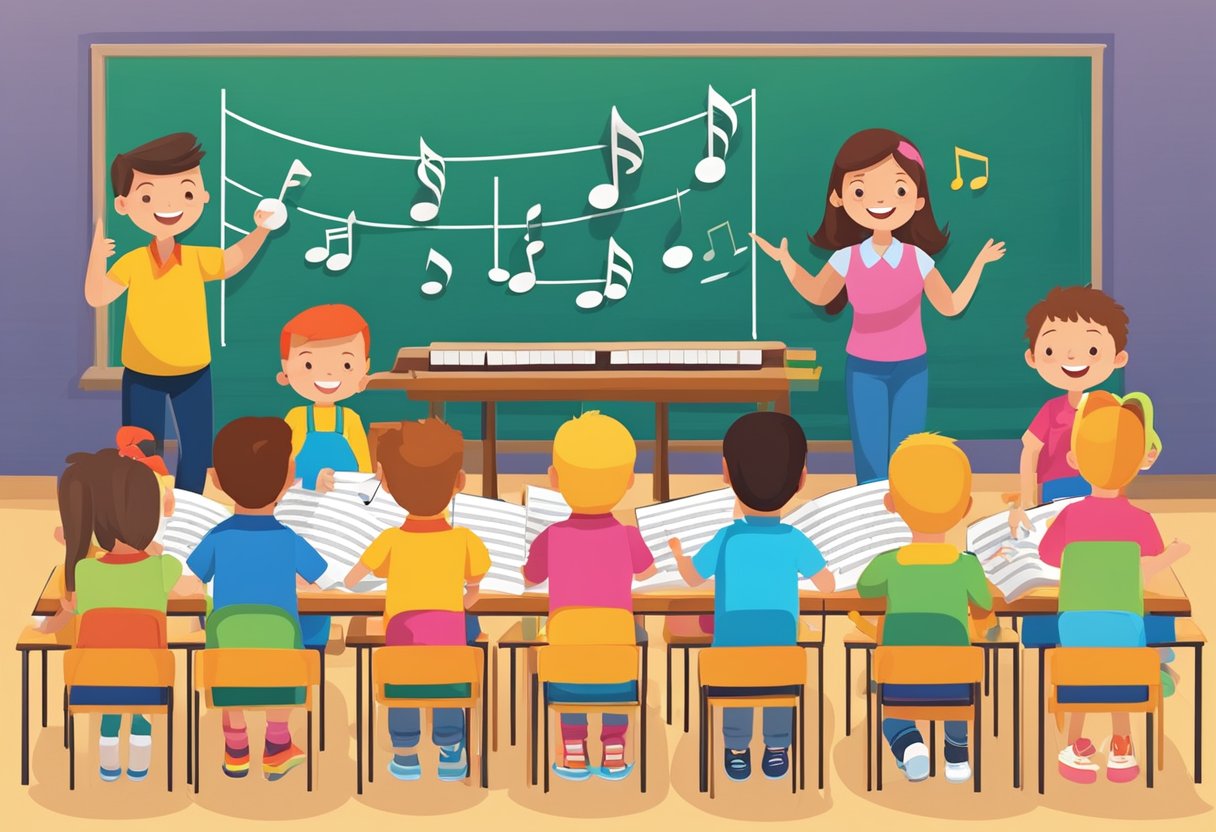
Music Sheet: Children sit at desks, each with a music book
In structuring music education for young children, it is crucial to account for the different speeds at which each child comprehends and masters reading music sheet. Our approach aims to acknowledge and cater to these varied learning paces.
Personalised Practice Sessions
We believe that tailoring practice sessions to suit the child’s individual pace is key. “Each young learner has a unique tempo of understanding; therefore, personalised practice sessions become instrumental in cultivating their music reading abilities,” says Michelle Connolly, founder of LearningMole. Creating custom exercises that align with their current capability ensures steady progress without overwhelming them.
Systematic Learning Approaches
Implementing a systematic approach to learning music sheet ensures a comprehensive understanding for our young students. We progressively build their skills, starting from the most basic concepts and slowly layering on complexity. This structured method fosters a solid foundation, allowing children to gradually internalize musical notation and rhythms at a pace that feels comfortable and natural to them.
Frequently Asked Questions
We’ve compiled some of the most common inquiries we receive about teaching young children to read music sheet and provided clear answers to help you get started.
How can worksheets enhance the learning experience for children beginning to read music sheet?
Worksheets can provide a structured and interactive way for children to practice music reading skills. They often include activities that reinforce note recognition, rhythm counting, and the understanding of musical symbols.
What are some engaging methods to help youngsters learn to read music more effectively?
Incorporating games and technology can make learning to read music more engaging. For instance, musical flashcards, apps, and interactive whiteboard activities keep lessons lively and can aid in faster recognition of notes and rhythms.
At what age are children typically ready to start learning how to read music sheet?
Children are usually ready to learn to read music sheet around the age of five or six, when they have begun to develop the ability to concentrate for longer periods and can understand simple mathematical concepts such as counting.
Could you suggest some free resources for teaching children to read music sheet?
Free resources are abundant online. Websites like MakingMusicFun.net offer printable music sheet, worksheets, and lesson plans suitable for children just starting out with music reading.
What’s the most straightforward approach to introduce preschoolers to music notes?
Starting with familiar songs and associating each note with a colour or a character can help preschoolers recognise and remember different notes more easily.
Could you provide any lesson plans focused on teaching music notes to early years?
“You can find a variety of lesson plans tailored to young learners that make music education accessible and fun”, says Michelle Connolly, a seasoned educational consultant. Websites like MusicTheory.net provide valuable tools and activities even for our early years audience.
Maths Circus, an innovative platform we've crafted, presents a captivating realm where children learn mathematics through the exciting theme of a circus. The joy of juggling numbers and solving circus...
Foreword A child may be confident using a smartphone to chat on messaging apps or find videos on YouTube. However, they may not understand why certain content appears on their...
Mammals are animals with a backbone that breathe air through lungs, have hair or fur at some stage of life and feed their young on milk. Scientists sort every mammal...
Norse mythology creatures range from Jörmungandr, a serpent long enough to circle the human world, to Ratatoskr, a gossiping squirrel on a giant tree. This guide explains 13 of them...








Leave a Reply