Teaching with Play-Doh: A Simple Number Recognition Method
Table of Contents
Teaching with Play-Doh: Number recognition is one of the first significant milestones in early maths, and for children aged three to six, getting there through touch, movement, and play is not just more enjoyable; it’s more effective. At LearningMole, the UK educational platform founded by former primary teacher Michelle Connolly, we’ve seen again and again that when young children manipulate physical materials to explore numbers, those concepts stick.
The UK Early Years Foundation Stage (EYFS) framework places mathematical understanding at the heart of early childhood development, and sensory-based learning sits firmly within that approach.
This article introduces the Simple Number Recognition Method using Play-Doh: a four-step process that guides children from forming numerals with their hands to demonstrating genuine number understanding.
Whether you’re a Reception teacher planning hands-on maths sessions, a teaching assistant supporting small groups, or a parent sitting at the kitchen table with a tub of dough and a curious child, this guide gives you a clear, curriculum-aligned structure to work with. LearningMole’s resources are designed to bridge the gap between play and formal learning, and Play-Doh activities sit right at that junction.
The four steps in this method — Roll, Shape, Count, and Smash — are not arbitrary. Each step reflects a distinct stage of number understanding mapped to the EYFS Development Matters guidance and the Year 1 National Curriculum for Number and Place Value. You can read more about LearningMole’s approach to early years maths in our primary maths teaching resources, or explore our broader maths videos for children to support classroom and home learning.
What is the Simple Number Recognition Method?
The Simple Number Recognition Method is a four-step tactile sequence that takes children from physically forming a numeral through to demonstrating that the quantity it represents stays consistent regardless of arrangement. The steps are: Roll (forming the numeral as a Play-Doh snake), Shape (pressing balls into a ten-frame grid), Count (one-to-one correspondence with the balls), and Smash (number conservation check). Together, they move a child from recognising a symbol to understanding what that symbol means.
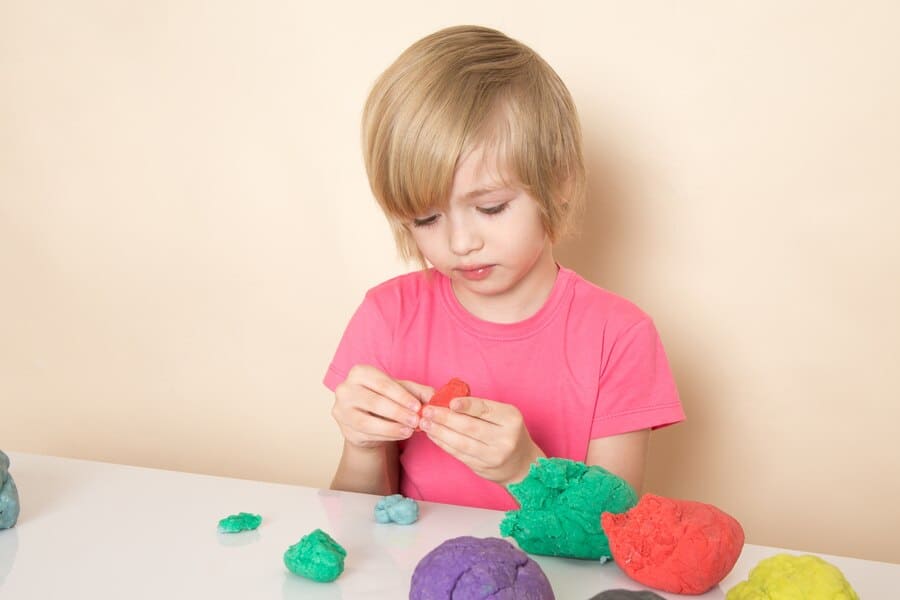
The method works because it reduces the cognitive load on young learners. When a child rolls dough into a snake and bends it into the shape of ‘4’, they’re not just copying a numeral. They’re encoding it through muscle memory, proprioception, and visual processing simultaneously. The abstract symbol becomes something they’ve physically made.
LearningMole’s Michelle Connolly designed this sequence based on her classroom work with early years and KS1 children. “Children learn numbers best when they can make them, not just read them. The moment a child bends a Play-Doh snake into the shape of ‘3’ and then counts out three balls, the connection between symbol and quantity becomes real for them. That’s what we’re working towards.” — Michelle Connolly, Founder of LearningMole and former teacher with over 15 years of classroom experience.
Why Play-Doh is a Power Tool for Early Maths

Play-Doh offers something worksheets cannot: resistance, texture, and physical engagement. Rolling, pressing, and shaping dough requires the same fine motor movements children need for pencil grip, making it genuinely preparatory for written maths, not just a fun add-on. For children in Nursery and Reception, this is not enrichment; it’s foundational.
Developing Fine Motor Skills for Pencil Grip
The pinching, rolling, and pressing involved in Play-Doh activities directly strengthen the small muscles of the hand and fingers. Occupational therapists working with primary-age children frequently recommend dough activities because they help build the tripod grip children need to hold a pencil. A child who has spent time rolling snakes and pressing balls is building hand strength that will support their writing development alongside their maths.
For children with developmental delays or low muscle tone, Play-Doh activities offer a low-pressure, high-repetition way to build strength. LearningMole’s resources for SEN support in the classroom include guidance on adapting tactile learning activities to meet individual needs.
Sensory Learning and Memory Retention
Sensory input strengthens memory encoding in young children. When a child uses multiple senses simultaneously — touch, sight, and movement — their brain forms stronger connections around the concept being learned. This is why a child who has physically made the number 5 with their hands is more likely to recognise and recall it than one who has only seen it on a flashcard.
The ‘heavy work’ component of pressing and smashing dough also provides proprioceptive feedback, which is particularly regulating for children with sensory processing differences, including many children on the autism spectrum. The physical act of squashing Play-Doh after counting is not just satisfying; it reinforces the concept of number conservation through sensory experience.
Step-by-Step: Implementing the Simple Method at Home or School
Watch Michelle Connolly demonstrate this method in action with a child working on the number 4. The video below shows how the steps flow naturally in a real session, with guidance on how to prompt and encourage without taking over.
Step 1: Roll — The Snake (Numeral Formation)
Show the child a numeral card or hold up fingers to indicate the target number. Ask them to roll a long snake from their Play-Doh. Once they have a snake, guide them to bend and shape it into the numeral. For younger children (age 3–4), work on numbers 1 to 5. For children in Reception and Year 1 (age 4–6), extend to 1 to 20 as confidence grows.
Prompt language: “Can you make your snake bend into a 4?” “What does a 3 look like? Show me with your dough.” Don’t worry about perfection. The goal is the encoding process, not calligraphic accuracy.
For children finding numeral formation difficult, laminate number cards with raised outlines and let them trace before attempting free formation.
Step 2: Shape — The Ten Frame (Visual Tracking)
Draw a simple ten-frame on a sheet of paper and laminate it for repeated use, or press lines into a flat piece of dough to create the grid. Ask the child to roll small balls and place one in each box, up to their target number.
The ten-frame structure is significant. It aligns directly with the EYFS requirement for children to understand numbers within 10 and their composition, and it prepares children for the Year 1 National Curriculum expectations on number bonds. When a child places 5 balls in a ten-frame, they can see at a glance that 5 fills half the frame — an early intuition about number relationships.
Age 3–4: Work with a five-frame (five boxes) before progressing to the full ten. Age 5–6: Use the full ten-frame and begin working on numbers up to 20 using a double ten-frame.
Step 3: Count — One-to-One Correspondence
Once the balls are placed, ask the child to count them by touching each one as they say the number aloud. This step addresses one of the most common early maths misconceptions: children who can recite numbers verbally but cannot yet match each spoken word to a distinct object.
Watch for the following: Does the child touch each ball only once? Do they count in the correct sequence without skipping? Do they stop at the right number and state the total? If any of these are uncertain, this is valuable diagnostic information for teachers and parents.
Prompt: “Touch each one as you count. How many have we got?” Allow the child to recount if they’re unsure.
Step 4: Smash — Number Conservation
This is the step most activity guides miss, and it’s one of the most pedagogically significant. Once the child has counted their balls correctly, let them squash them flat with their palm. Then ask: “How many have we got now?”
A child who has not yet grasped number conservation will recount (or guess a different number) when the appearance of the objects changes. A child who understands conservation will confidently say the same number without counting again: “Still 4! I only squashed them, I didn’t add any or take any away.”
This concept, identified by Jean Piaget as a key developmental milestone, sits within the EYFS Early Learning Goal for Number: children should subitise and understand that the number of things does not change if they are rearranged. The Smash step makes this concept tangible and memorable.
Developmental Milestones and Play-Doh Activities by Age

This table maps typical developmental stages to specific Play-Doh number activities. Use it as a planning guide, not a rigid assessment tool. Children develop at different rates, and this is a framework, not a checklist for judgment.
| Age | Number Range | Activity Focus | Ten-Frame | Conservation Check |
|---|---|---|---|---|
| 2–3 years | 1 to 3 | Rolling snakes, counting balls | Five-frame (3 boxes) | Not yet — focus on counting |
| 3–4 years | 1 to 5 | Numeral formation, counting | Five-frame | Simple — ‘same or different?’ |
| 4–5 years (Reception) | 1 to 10 | Full 4-step method | Ten-frame | Yes, with prompting |
| 5–6 years (Year 1) | 1 to 20 | Double ten-frame, subitising | Double ten-frame | Independent conservation |
UK Curriculum Links: EYFS and Key Stage 1
The Simple Number Recognition Method maps directly to the statutory requirements of the UK Early Years Foundation Stage and the National Curriculum for mathematics at Key Stage 1.
Within the EYFS framework, the Early Learning Goal for Number states that children should be able to count objects, actions and sounds; subitise (recognise quantities without counting); link numerals and amounts; compare quantities; and understand that the number of things changes if items are added or removed but stays the same if the set is rearranged or divided. The four steps of the Simple Method address every one of these requirements in a single structured session.
In Year 1 of the National Curriculum, children are expected to count to and across 100, count, read and write numbers to 100 in numerals, and identify one more and one less. The ten-frame step in the Simple Method builds directly towards these expectations by grounding children’s understanding of numbers up to 20 before abstract number lines are introduced. LearningMole’s number and counting videos support these same objectives with visual explanations that children can watch at school or at home.
Store-Bought vs Homemade Play-Doh for Classroom Use
| Factor | Store-Bought | Homemade |
|---|---|---|
| Cost | Higher per tub | Very low (flour, salt, water, oil) |
| Longevity | Stays moist for months if sealed | 1–2 weeks in an airtight container |
| Scent & colour | Consistent, bright colours | Customisable with food colouring and scents |
| Allergy considerations | Check for wheat/gluten content | Fully customisable — use gluten-free flour |
| Sensory texture | Consistent, smooth | Variable — thicker homemade dough is good for heavy work |
Supporting Children with SEND Using Play-Doh Number Activities

Play-Doh number activities are particularly well-suited to children with special educational needs and disabilities (SEND). The sensory feedback, repetitive physical actions, and concrete materials address several common barriers to abstract mathematical learning.
For children with attention difficulties or ADHD, the physical engagement of rolling, pressing, and smashing provides the movement input many children need to sustain focus. The short, structured steps of the Simple Method also give clear beginning and end points, which help children who find open-ended tasks difficult.
For children on the autism spectrum, the predictable sequence of the four steps provides routine, whilst the sensory properties of Play-Doh (particularly the heavy work of pressing and smashing) offer regulating proprioceptive input. Using the same colour dough in each session can also support children who benefit from consistency.
For children with dyslexia or dyscalculia, numeral formation through the body — via muscle memory and touch — is a recognised multisensory approach that builds the numeral-quantity link through multiple channels simultaneously. LearningMole’s resources on inclusive classroom practices offer further strategies for adapting activities to meet diverse needs.
Teaching Resources and Support from LearningMole

LearningMole is a UK educational platform providing curriculum-aligned video resources and teaching materials for primary schools. Founded by Michelle Connolly, a former primary school teacher with over 15 years of classroom experience, LearningMole has produced more than 800 educational videos and 3,300 free resources used by teachers and parents across the UK and beyond.
For teachers planning Play-Doh maths sessions, LearningMole’s maths video library includes content covering number recognition, counting, and early number sense that can be used alongside hands-on activities to reinforce understanding. Video explanations work particularly well as a pre-activity hook or a post-activity consolidation tool.
Parents supporting home learning can access LearningMole’s free maths resources for children to extend Play-Doh activities into on-screen learning. For schools seeking curriculum-aligned resources across all primary subjects, LearningMole’s library covers maths, English, science, and more, all designed by experienced educators to make learning engaging and accessible for children aged 4 to 11.
Explore LearningMole’s full range of primary teaching resources or visit the LearningMole maths video collection to find videos that connect directly to what your children are exploring with Play-Doh.
Frequently Asked Questions

At what age should I start teaching number recognition with Play-Doh?
Children can begin exploratory number activities with Play-Doh from around age two, focusing on simple counting of balls rather than numeral formation. Formal number recognition work (linking numerals to quantities) typically begins from age three to four in Nursery settings. By Reception (age four to five), most children are ready for the full four-step Simple Method. The EYFS framework expects children to have a secure understanding of numbers to 10 by the end of Reception, making this an appropriate age range for the full method.
Which UK curriculum goals does this activity meet?
The Simple Number Recognition Method addresses the EYFS Early Learning Goal for Number, which requires children to count objects, subitise, link numerals to amounts, and understand number conservation. It also supports the Year 1 National Curriculum objectives for Number and Place Value, including counting to and across 100, reading and writing numerals, and representing numbers using objects. The ten-frame step additionally supports early work on number bonds and composition, which are explicit Year 1 and Year 2 curriculum requirements.
What if my child just wants to play and not make numbers?
Free play with dough is a completely valid and important first stage. Children who are new to Play-Doh often need time to explore the material on their own terms before they can engage with structured activities. Rather than redirecting immediately, follow their lead: if they make a snake, say “that looks like a 1!” If they make balls, count them together casually. Over several sessions, introduce the steps gradually. The goal is engagement first, structure second. Pressure to perform structured tasks before readiness can put children off the activity entirely.
How does Play-Doh help with pen control and handwriting?
The pinching, rolling, and pressing movements involved in Play-Doh activities directly strengthen the intrinsic muscles of the hand. These are the same muscles children use to hold a pencil in the correct tripod grip. Occupational therapists regularly recommend dough play as a pre-writing activity because it builds the hand strength and fine motor control children need for writing without the pressure of a formal task. Children who have had regular Play-Doh time often show better pencil control than those who have not.
Can I use this activity for children with SEN or SEND?
Yes, and it’s particularly effective. The multisensory approach means children access number concepts through touch, movement, and sight simultaneously, which supports children with dyslexia, dyscalculia, and learning differences. The proprioceptive ‘heavy work’ of pressing and smashing dough is beneficial for children with sensory processing differences. The predictable four-step sequence supports children who benefit from routine, including many children on the autism spectrum. Adaptations include using a scented dough to add olfactory input, allowing the child to choose their dough colour for greater engagement, and providing physical guides for numeral formation.
What is subitising, and how does Play-Doh help with it?
Subitising is the ability to instantly recognise the quantity of a small set of objects without counting them. It’s a key focus of the current EYFS Development Matters guidance and is recognised as foundational for number sense. When a child places five balls in a ten-frame and then looks at the arrangement without counting, they’re practising subitising. Play-Doh balls arranged in familiar patterns (like the dots on a dice) help children develop this skill. You can actively support subitising by covering the balls briefly, then uncovering and asking “how many?” without allowing time to count.
Do I need to buy specialist Play-Doh or number mats?
No specialist equipment is required. A tub of standard modelling dough and a piece of paper with a ten-frame drawn on it is all you need. Laminating the ten-frame makes it reusable. For number mats, you can create your own by printing a large numeral with a dotted outline on a card and laminating it; the child traces the numeral with their dough snake. If you prefer ready-made materials, LearningMole offers curriculum-aligned resources and teaching materials for EYFS and KS1 that complement hands-on activities.
How can I use video alongside Play-Doh activities?
Video works well as a hook before a Play-Doh session or as a consolidation activity afterwards. Watching a video that shows counting or number recognition gives children a reference point for the abstract concept before they work with it physically. LearningMole’s number and counting videos are designed for primary-aged children and use visual explanations that connect naturally to hands-on learning. You can find them in the LearningMole maths video library, suitable for both classroom use and home learning.
From Play to Pen and Paper
The transition from Play-Doh to pencil and paper is not a leap; it’s a natural progression when the physical groundwork has been laid. Children who have spent time rolling snakes into numerals, counting balls into ten-frames, and confidently declaring “still four!” after a satisfying squash have built genuine number understanding. When they sit down with a pencil and a workbook, the symbols on the page connect to physical memories in their hands and bodies. That’s what makes the difference between rote learning and real understanding.
At LearningMole, we believe that the best early maths teaching treats play as preparation, not as something separate from learning. The Simple Number Recognition Method is practical, curriculum-aligned, and adaptable for home and school. It requires no expensive resources and no specialist training. What it does require is time, engagement, and a willingness to let children make a mess. That is a very small price for the mathematical confidence it builds.
If you found this guide useful, explore LearningMole’s full collection of early years maths resources and number videos for children. LearningMole is a UK educational platform providing curriculum-aligned teaching resources for primary schools, parents, and home educators. All resources are designed by experienced educators and aligned with the UK National Curriculum and EYFS framework.
Have you found this interesting? Come and check our maths articles: Magic Math Tricks, Times Tables Games, Mental Maths, Lego Math, Fun Math Games, Fun Math Game with Treat Incentive and Mental Math Tricks. Click here if you are interested in more videos or resources on learning with Play-Doh.
Why not subscribe to our LearningMole Library for as little as £1.99 per month to access over 1400 fun educational videos.


Leave a Reply