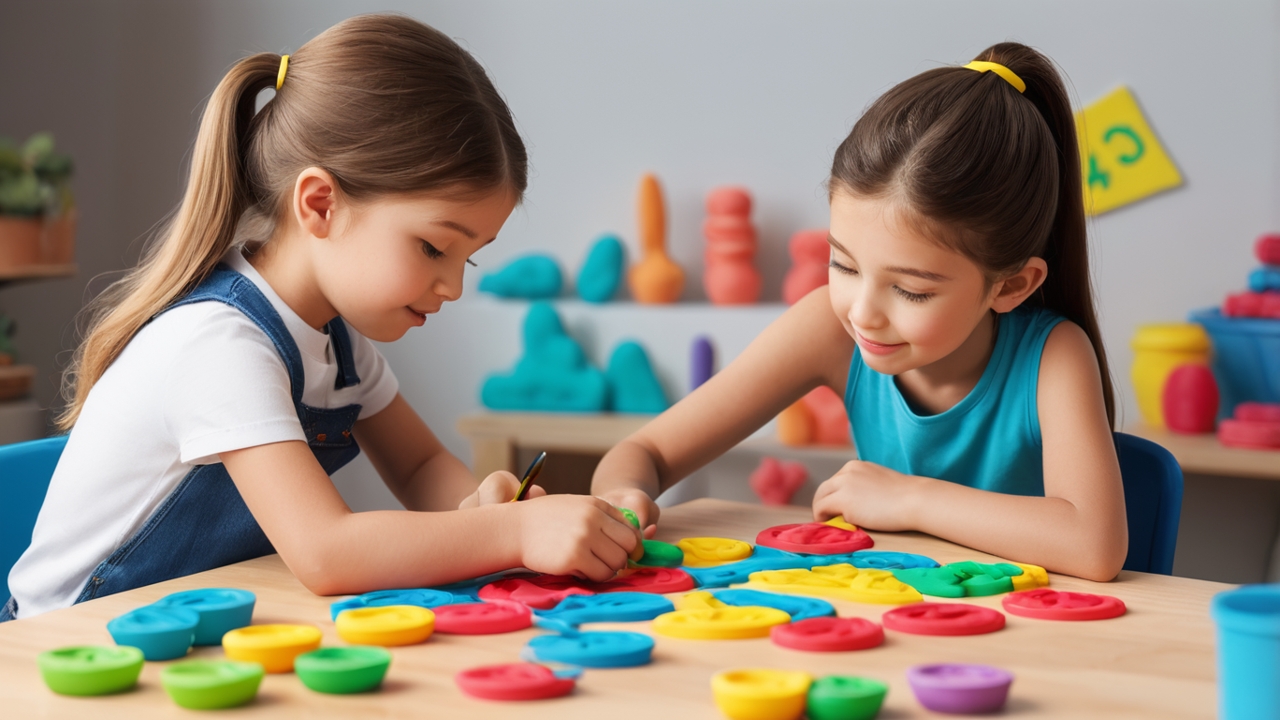
Play-Doh Dazzling Addition: Play-Doh isn’t just for free play – it’s one of the most powerful resources for teaching early addition in UK primary classrooms. When children physically manipulate colourful dough balls to represent numbers, they’re building a concrete understanding that no worksheet can replicate.
The tactile resistance of squishing, rolling, and counting helps cement number bonds in young minds, making abstract mathematical concepts tangible and memorable for children aged 3-7.
UK teachers and parents increasingly recognise that sensory maths activities reduce anxiety and boost engagement, particularly for children who struggle with traditional written methods. LearningMole provides curriculum-aligned educational videos and teaching resources that demonstrate how everyday materials like Play-Doh can transform addition practice into purposeful play.
From EYFS numerical patterns to Year 2 place value, sensory methods support the concrete-pictorial-abstract approach recommended in the National Curriculum.
This article explores practical, classroom-tested strategies for using Play-Doh to teach addition across the early years and Key Stage 1. You’ll discover the ‘Dazzle Smash’ method for addition within 10, part-part-whole mat techniques for number bonds, and advanced approaches for regrouping with tens and ones – content gaps our research shows competitors miss entirely.
The Science of Sensory Maths: Why Play-Doh Works
Children learn addition most effectively when they can see, touch and manipulate mathematical concepts before moving to abstract symbols. The concrete-pictorial-abstract (CPA) approach underpins effective maths teaching in UK primary schools, and Play-Doh provides the ideal concrete stage. When a child rolls three dough balls and adds two more, they’re experiencing addition as a physical action – combining groups to create a larger whole.
“The physical resistance children feel when working with Play-Doh creates proprioceptive feedback that helps cement mathematical concepts in memory. It’s not just play – it’s purposeful learning through the senses,” explains Michelle Connolly, Founder of LearningMole and former teacher with over 15 years of classroom experience.
Research consistently shows that multisensory learning improves retention and understanding. The EYFS Development Matters guidance specifically references manipulatives as essential for developing numerical patterns, whilst the KS1 National Curriculum emphasises using concrete resources before introducing formal calculation methods. Play-Doh ticks every box: it’s affordable, endlessly reusable, and children already love using it.
Sensory maths activities also support children with special educational needs. The tactile nature of Play-Doh provides an alternative entry point for learners who struggle with visual-only instruction, whilst the creative element keeps reluctant mathematicians engaged. When addition feels like play, anxiety drops and confidence grows.
Creating the ‘Dazzle’: Setup and Materials
Transform ordinary Play-Doh activities into ‘dazzling’ sensory experiences that captivate young learners. The ‘dazzle’ factor increases engagement without sacrificing mathematical rigour – you’re not just teaching addition, you’re creating memorable learning moments that children want to repeat.
Making Galaxy Dough
Standard Play-Doh works brilliantly, but ‘Galaxy Dough’ adds extra sensory appeal. Mix biodegradable glitter into your dough (available from educational suppliers) to create shimmering balls that catch the light. Use contrasting colours for different numbers: sparkly blue for tens, gold for ones. Children remember concepts better when paired with distinctive visual features.
Essential Materials
Play-Doh in multiple colours (including sparkly variants)
Part-part-whole mats (laminated A4 sheets with two circles joining into one larger circle)
Glass gems or sequins as ‘add-ins’
Number cards (0-20)
Tens frames printed on card
Small rolling pins or flattening tools
Child-safe sculpting tools for making impressions
Loose Parts Addition
Incorporate ‘loose parts’ – small items like beads, buttons or pebbles – that children can press into their dough creations. This technique, popular in Reggio Emilia-inspired settings, adds fine motor skill development to your maths activity. Create a ‘gemstone shop’ scenario where children must calculate the total cost of dough cakes decorated with different numbers of jewels.
Classroom Organisation Tips
Store dough in airtight containers with silica gel packets to prevent drying. Prepare materials in small baskets for independent activities – each basket contains two colours of dough, a laminated mat, and number cards. This setup supports differentiation because different groups work at their own pace, whilst you support those who need it.
Three Dazzling Addition Methods to Try Today
The ‘Dough Smash’ Method: Addition Within 10
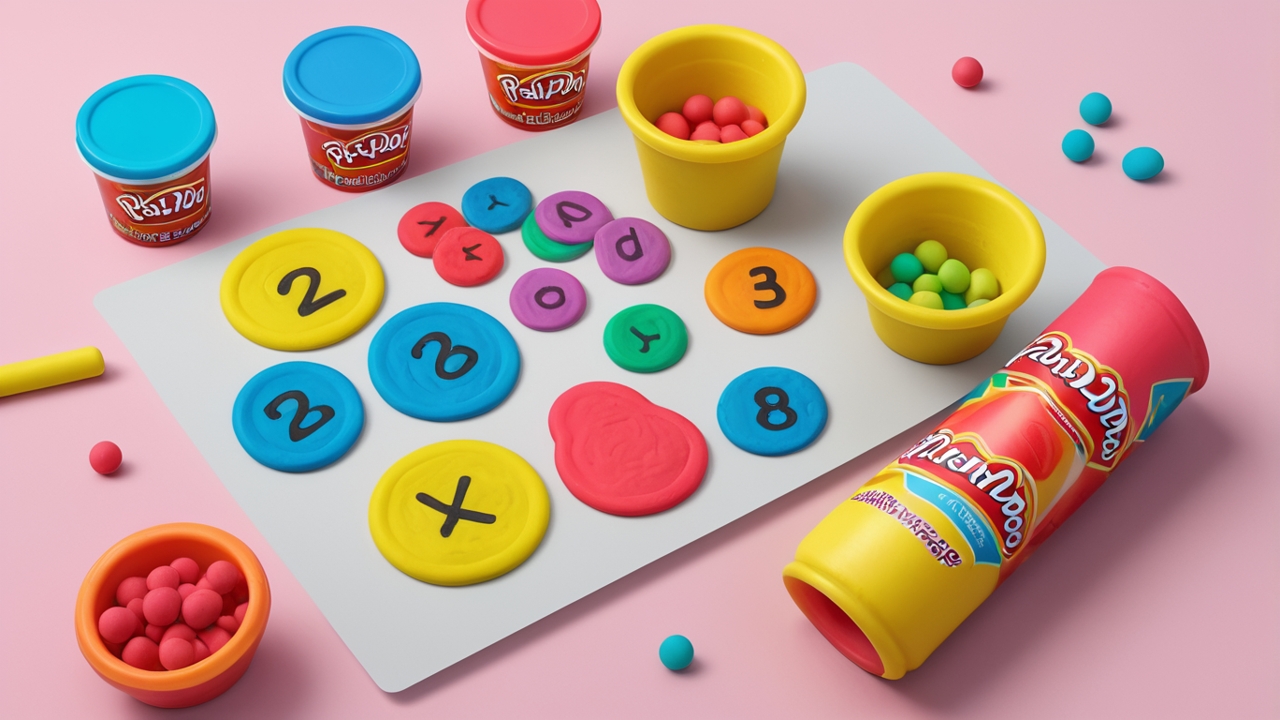
This high-engagement method makes addition physical and memorable. Children roll small dough balls, arrange them according to an equation, then ‘smash’ them together to find the total. The satisfying squish provides instant feedback and keeps learners motivated through multiple practice rounds.
How to Implement:
Give children a number sentence (e.g. 3 + 4)
Ask them to roll three blue balls and four red balls
Have them arrange balls in two distinct groups
Children physically push the groups together and smash them flat
Count the total ‘splatted’ dough pieces to find the answer
The physical act of combining reinforces that addition means ‘joining together’. Use mathematical vocabulary consistently: “You’re combining three and four. What’s the total?” This method works brilliantly for EYFS and Year 1, building confidence with addition within 10 – a key early learning goal.
Differentiation:
Struggling learners: Start by adding 1 or 2 to a single-digit number
Confident learners: Include three addends (e.g. 2 + 3 + 1) or work within 20
Part-Part-Whole: The Dazzle Mat Method
Part-part-whole models help children understand the relationship between numbers in an addition sentence. This approach explicitly shows that numbers can be broken down and recombined – essential groundwork for mental calculation strategies in later years.
Creating Your Mat: Draw or print two smaller circles at the top of an A4 sheet, with lines connecting them to one larger circle below. Laminate for repeated use. Children place dough balls in the top circles (the ‘parts’) then count all balls into the bottom circle (the ‘whole’).
Teaching Sequence:
Start with a total: “We need 8 altogether. This is our whole.”
Place eight dough balls in the bottom circle
Ask: “What are two ways we can split 8 into parts?”
Children move balls into the top circles to show different partitions (6+2, 5+3, 4+4)
Record the number of sentences for each partition
This visual representation makes abstract number bonds concrete. By Year 2, children should recall bonds to 10 and 20 automatically – building fluency starts here with physical manipulation. LearningMole’s addition teaching resources provide video demonstrations and printable mats for classroom use.
Maths Talk Prompts:
“If we have 5 in this part, how many must be in the other part to make 7?”
“Can you find three different ways to partition 9?”
“Which partition would be easiest to calculate in your head?”
Advanced Dazzle: Tens and Ones (Place Value Addition)
Most Play-Doh addition content stops at simple combining. This advanced technique addresses a significant content gap: using dough to visualise regrouping with place value, crucial for Year 1 and Year 2 progression.
Setting Up:
Use two contrasting colours: blue for tens, yellow for ones
Roll tens as long as ‘sausages’ or thick cylinders
Keep ones as small individual balls
Work on a place value mat with ‘tens’ and ‘ones’ columns
Teaching Regrouping: Present 7 + 5 using Play-Doh. Children create seven yellow balls and five yellow balls. When they combine and count to 12, demonstrate exchanging ten individual balls for one blue tens ‘sausage’ and keeping two yellow ones separate. This physical exchange makes the concept of ‘carrying’ in column addition visible and logical.
“Place value is where many children stumble in Year 2. When they’ve physically transformed ten ones into one ten using Play-Doh, the concept clicks in a way that drawings alone can’t achieve,” notes Michelle Connolly.
Year 2 Applications:
Adding two-digit numbers without regrouping (e.g. 23 + 14)
Adding with regrouping across the tens boundary (e.g. 27 + 15)
Understanding why we write calculations in columns
This method extends Play-Doh’s usefulness well beyond EYFS, providing vital conceptual support for formal written methods. It bridges the gap between concrete counting and abstract calculation – precisely what the National Curriculum’s CPA approach recommends.
Linking to the UK Curriculum: EYFS and KS1 Standards
Sensory addition activities aren’t just engaging – they’re curriculum-aligned teaching that develops essential mathematical understanding.
EYFS Development Matters (Reception)
Numerical Patterns:
Automatically recall number bonds for numbers 0-10
Select, rotate and manipulate shapes to develop spatial reasoning
Compare numbers and quantities
Understand the ‘one more than/one less than’ relationship
Play-Doh activities directly support these goals. The Dough Smash method builds automatic recall through repeated physical practice. Manipulating dough develops the spatial reasoning that underpins later geometry. Comparing groups of dough balls makes quantity comparison concrete.
KS1 National Curriculum: Year 1
Number – Addition and Subtraction:
Read, write and interpret mathematical statements involving addition (+) and equals (=) signs
Represent and use number bonds within 20
Add one-digit and two-digit numbers to 20, including zero
Solve one-step problems involving addition, using concrete objects and pictorial representations
The part-part-whole mat method explicitly teaches number bonds, whilst all three techniques use concrete objects (dough) before moving to pictorial and abstract stages. Children solve real problems (“If I make 4 dough cakes and you make 3, how many do we have for the gem shop?”) in engaging contexts.
KS1 National Curriculum: Year 2
Number – Addition and Subtraction:
Recall and use addition facts to 20 fluently
Derive related facts up to 100
Add numbers using concrete objects, pictorial representations, and mentally
Recognise and use the inverse relationship between addition and subtraction
The advanced tens and ones method prepares children for adding two-digit numbers. Creating physical groups of ten supports understanding of place value, essential for Year 2 calculation methods. The flexibility of Play-Doh (easily regrouped, combined, separated) helps children grasp that addition and subtraction are inverse operations.
Assessment for Learning
Use Play-Doh activities for formative assessment. Observe which children:
Count accurately
Recognise number patterns without counting
Partition numbers flexibly
Self-correct when combining groups
Use appropriate mathematical vocabulary
These observations inform your next steps and differentiation strategies more effectively than a written test for young learners.
Teaching Resources and Support from LearningMole
Transform these activities into consistent classroom practice with ready-made resources designed by experienced educators.
Video Demonstrations
LearningMole’s YouTube channel provides curriculum-aligned videos showing addition strategies in action. Visual demonstrations help both teachers and parents understand effective implementation. Children benefit from watching peer models using the techniques before trying them themselves.
Downloadable Mats and Resources
Access printable part-part-whole mats, tens frames, and number bond flashcards through LearningMole’s teaching materials. These professionally designed resources save preparation time and ensure visual consistency across your maths teaching.
Subscription Benefits
With a LearningMole subscription, teachers gain access to:
Over 800 educational videos covering EYFS to KS2
Downloadable activity sheets for hands-on learning
Curriculum-aligned content for maths, English, science and more
Regular updates with fresh teaching ideas
Parent-friendly explanations for home learning support
The platform serves both classroom teachers seeking ready-made resources and parents supporting learning at home. All content aligns with UK curriculum requirements whilst maintaining the engaging, playful approach that keeps children motivated.
Free Resources
LearningMole provides 3,300+ free resources, including video content, activity ideas and teaching tips. The commitment to accessible education means quality materials are available whether you’re a parent home educating, a teacher exploring new approaches, or a teaching assistant running intervention groups.
“Quality teaching resources shouldn’t be a luxury. Every teacher and parent deserves access to materials that actually work in real classrooms with real children,” says Michelle Connolly.
FAQ: Practical Tips for Teachers and Parents
How do you teach addition using Play-Doh?
Create physical representations of numbers using dough balls or shapes. Children combine groups of dough pieces to find totals, seeing addition as a concrete action of ‘putting together’. Start with very small numbers (adding 1 or 2), then gradually increase. Always verbalise what’s happening using mathematical language: “We’re combining three and two to find the total.”
What is the ‘Dough Smash’ method?
The Dough Smash is a high-engagement counting game where children roll dough balls to represent numbers, arrange them according to an addition sentence, then physically smash the groups together and count the result. The satisfying tactile feedback keeps children motivated through multiple practice rounds. This method works particularly well for EYFS and Year 1, building confidence with addition within 10.
Is Play-Doh suitable for teaching addition to Year 2 children?
Absolutely. Whilst many teachers reserve Play-Doh for Reception and Year 1, it’s excellent for Year 2 place value work. Use different coloured dough to represent tens and ones – this makes regrouping visible when adding two-digit numbers. Small balls represent individual ones, whilst long sausages or thick cylinders represent tens. Children physically exchange ten ones for one ten, making abstract column addition concrete and logical.
How do I make ‘Dazzling’ Play-Doh for maths activities?
Add biodegradable glitter to standard Play-Doh to create ‘Galaxy Dough’ that children find extra appealing. Mix in the glitter whilst kneading, or purchase pre-made sparkle dough from educational suppliers. Use contrasting sparkly colours for different number values (e.g. sparkly blue for tens, gold for ones). The visual distinctiveness helps children remember concepts and adds excitement without sacrificing mathematical rigour.
What are ‘loose parts’ in maths, and how do they work with Play-Doh?
Loose parts are small items like beads, sequins, pebbles or buttons that children can manipulate during learning activities. Press loose parts into Play-Doh to create patterns, count sets, or represent numbers. For instance, a dough cake decorated with 3 gems plus another with 5 gems creates an addition problem. This approach, inspired by Reggio Emilia philosophy, develops fine motor skills alongside mathematical understanding.
Where can I find addition mats for Play-Doh activities?
LearningMole provides downloadable part-part-whole, tens-frame, and place-value mats through its resource library. Many are available free, whilst subscribers access the complete collection. Alternatively, create your own by drawing two small circles at the top of card connecting to one larger circle below, then laminating for repeated use. Keep designs simple so the maths stays clear.
How does this support children with special educational needs?
Play-Doh addition offers multiple benefits for SEND learners. The multisensory approach provides alternative access for children who struggle with visual-only instruction. The open-ended nature reduces anxiety for perfectionists – there’s no ‘wrong’ way to roll a ball. Tactile manipulation supports children with attention difficulties who need movement during learning. Physical objects make abstract concepts concrete for children with processing challenges. Consider inclusive classroom practices when planning.
Can parents use these methods at home?
These activities work brilliantly at home with minimal setup. You need only Play-Doh and a clear surface. Parents can support school learning by reinforcing number bonds through the Dough Smash method or exploring partitioning with part-part-whole arrangements. LearningMole’s parent guidance resources explain techniques in accessible language without educational jargon, making home support effective and stress-free.
Conclusion
Teaching addition with Play-Doh transforms abstract mathematical concepts into tangible, memorable experiences for young learners. The three methods explored – Dough Smash for addition within 10, part-part-whole for number bonds, and tens and ones for place value – provide progression from EYFS through Year 2, all using one versatile resource.
The ‘dazzle’ factor isn’t about entertainment alone. Sparkly dough, loose parts and engaging scenarios capture attention, but the real magic happens when children’s hands physically combine groups and their brains make the connection between concrete action and abstract addition. This is purposeful play grounded in educational research and curriculum requirements. When teachers and parents give children time to explore mathematical concepts through quality sensory activities, they build understanding that endures.
LearningMole supports UK educators with curriculum-aligned videos, downloadable resources and teaching strategies that work in real classrooms. Whether you’re a teacher planning your EYFS provision, a Year 1 teacher seeking fresh approaches to addition, or a parent wanting to support learning at home, these Play-Doh methods offer practical, tested techniques that genuinely improve children’s mathematical confidence and capability.
Explore LearningMole’s Addition Resources
Ready-made teaching materials save preparation time whilst ensuring quality learning. LearningMole provides curriculum-aligned videos, downloadable activity sheets, and expert guidance for teaching addition across early years and Key Stage 1.
Maths Circus, an innovative platform we've crafted, presents a captivating realm where children learn mathematics through the exciting theme of a circus. The joy of juggling numbers and solving circus...
Article Summary What this article covers: Twenty-eight polar animals sorted properly by pole, with 21 from the Arctic, 5 from the Antarctic and 2 found at both, along with the...
Article Summary What this article covers: Five active learning strategies for home education (inquiry-based learning, Socratic questioning, gamification, the concrete-pictorial-abstract approach and teaching back), with zero-preparation ideas for busy parents,...
Article Summary What this article covers: Ten facts about Egypt’s modern history from 1952 to today, including the end of the monarchy, the Suez Crisis, the Aswan High Dam and...






Leave a Reply