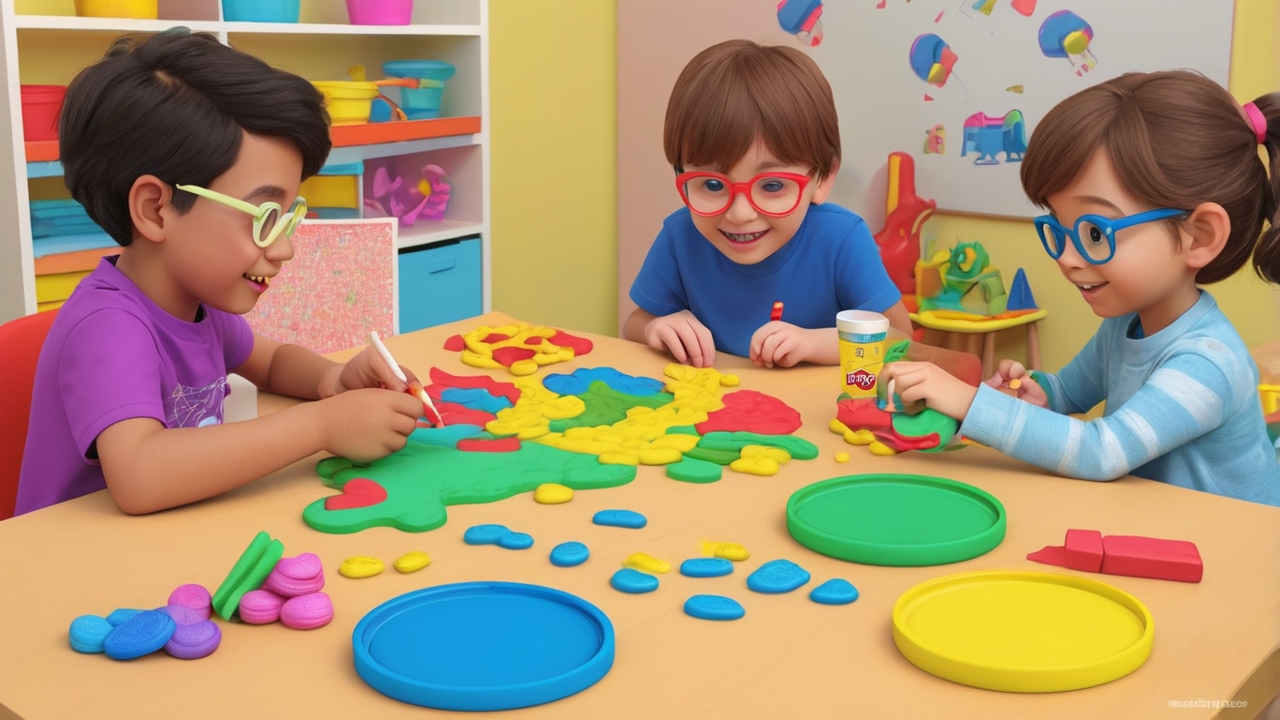
Teaching with Play-Doh: Play-Doh sits on the shelves of most Early Years classrooms, usually brought out for free play or wet-afternoon activities. What it rarely gets credit for is this: when used intentionally, it is one of the most effective maths teaching tools available to primary educators. The material’s physical nature means children can model, adjust, and start again without any sense of failure. There is no wrong answer; they cannot squish flat and rework. That low-stakes quality is exactly what early maths learning needs.
The activities in this guide connect directly to the EYFS Mathematics area of learning and the KS1 National Curriculum in England, covering number, counting, pattern, and early algebraic thinking. They are designed for Reception and Year 1, though several activities extend naturally into Year 2. Each one pairs easily with the kind of guided maths talk that characterises strong classroom practice, giving children vocabulary alongside the physical experience of number.
LearningMole has produced curriculum-aligned teaching resources and educational videos for primary classrooms across the UK, and this guide reflects the same practical approach. Whether you are a class teacher, a teaching assistant leading a small group, or a parent supporting learning at home, the activities here are purposeful, low-cost, and designed to build genuine mathematical understanding rather than superficial engagement.
Why Play-Doh is a Power Tool for Early Numeracy
Tactile manipulation gives children a concrete starting point before they move to pictorial and abstract representations. The Concrete, Pictorial, Abstract (CPA) approach, well-established in UK primary maths teaching and central to the mastery curriculum, depends on children handling real objects before they are asked to interpret diagrams or work with symbols. Play-Doh is one of the most flexible concrete materials available because it can be reshaped instantly.
There is also a significant fine motor benefit. Rolling, pinching, and pressing dough strengthens the hand muscles children need for writing and drawing. This makes Play-Doh activities doubly useful in EYFS settings, where fine motor development sits alongside early mathematics as a curriculum priority.
The sensory dimension matters too. Children who find formal maths activities anxiety-inducing often engage readily with dough because it does not look like a test. Removing the fear of being wrong creates the conditions where genuine exploration and learning can happen.
Learning Benefit
What It Supports in the EYFS/KS1 Curriculum
Concrete manipulation
Number and Place Value (CPA approach)
Fine motor development
Physical Development (EYFS), writing readiness
Low-stakes trial and error
Mathematical reasoning and problem solving
Sensory engagement
Attention and engagement, particularly for SEND pupils
Maths talk opportunities
Communication and Language (EYFS), mathematical vocabulary (KS1)
Aligning Play-Doh Activities with the UK National Curriculum
In the EYFS Statutory Framework, the Mathematics area of learning covers two components: Number (cardinality, counting, subitising, number bonds) and Numerical Patterns (sequences, pattern recognition, comparison). Play-Doh activities address both directly.
At KS1, the Year 1 Programme of Study covers number and place value, addition and subtraction, and geometry (properties of shapes). The activities in this guide map to number and place value most closely, with pattern-making activities laying the groundwork for the algebraic thinking that appears formally in KS2.
Ofsted’s research reviews on mathematics note that children benefit from regular opportunities to use concrete manipulatives alongside structured mathematical talk. Play-Doh activities work best when accompanied by deliberate questioning: “How many dough balls have you made? Can you tell without counting? What comes next in your pattern? How do you know?”
Mastery in Numeracy: Beyond Basic Counting
Subitising: Seeing Numbers in the Dough
Subitising is the ability to recognise a small quantity instantly, without counting. It is a foundational number skill that research consistently links to later arithmetic fluency. Most young children can subitise quantities up to about five once they have had sufficient practice.
Play-Doh makes subitising practice natural and concrete. Ask children to roll a specific number of small dough balls and arrange them in patterns that mirror dice faces: three in a triangle, four in a square, five with one in the centre. When you hide the arrangement briefly and ask “how many?”, you are training the perceptual grouping that underpins subitising.
The key teaching move is to encourage children to say the number immediately rather than pointing and counting. “Don’t count, just look. How many are there?” Gradually increase the time you hide the collection, reducing it as children become more fluent.
Suggested activity: Create a simple “dough dice” by rolling six balls and arranging them as on a standard dice face. Ask children to copy the arrangement, then roll one of the balls away and ask how many remain. Extend by asking children to show you “one more than four” or “two fewer than six.”
Number Bonds and Part-Whole Models
Number bonds to ten are a KS1 curriculum requirement, and children often struggle with the abstract concept that 7 and 3 are “the same as” 10. Play-Doh gives them a way to see and feel this relationship.
Roll a single dough ball to represent a number, such as 5. Ask the child to split it into two pieces. What are the two parts? Roll them back together. Split it a different way. This physical splitting and reuniting makes the part-whole relationship visible and reversible.
Extend this into a simple part-whole model by pressing three balls of one colour and two of another into a single flat disc. “We have three red and two blue. How many altogether? If I hide the blue ones, how many are hiding?”
“One of the most effective things a teacher can do with early numbers is make the structure of numbers visible and touchable. When children physically split and rejoin dough, they are not just counting, they are understanding that numbers are made of other numbers. That is the beginning of algebraic thinking.”
Michelle Connolly, Founder of LearningMole and a former primary school teacher with over 15 years of classroom experience
Mastering Repeating Patterns: A Step-by-Step Progression
Pattern recognition is not an extra-curricular craft activity. It is the foundation of algebraic thinking. When a child identifies the rule in a repeating sequence, they are doing exactly what mathematicians do when they describe a formula. The vocabulary matters: sequence, repeat, unit of repeat, rule. Use these words consistently with children from Reception onwards.
Level 1: Simple AB Patterns (The Pattern Snake)
Start with two colours. Ask children to make a long “snake” by alternating dough balls of two colours: red, blue, red, blue. This is an AB pattern, and it is the starting point for all pattern work.
The teaching sequence matters: Copy, Extend, Create. First, you make the pattern, and the child copies it. Second, you start a pattern, and the child extends it. Third, the child creates their own. Move through these stages in order. Children who skip straight to “creating” often produce something they call a pattern, but cannot explain the rule, which means genuine understanding is not yet secure.
Once the snake is built, ask: “What is the rule for your pattern? What would come next if the snake kept going? What would the tenth ball be?” That last question is a significant extension for Reception and Year 1 children, but many are capable of it, and it builds powerful mathematical reasoning.
Level 2: Adding Complexity (AAB, ABB, and ABC Patterns)
Once AB patterns are secure, introduce AAB and ABB. These are harder because the unit of repetition is less immediately obvious. An AAB pattern might be: red, red, blue, red, red, blue. Ask children to build this and then identify where the pattern “resets.” This is where the concept of the unit of repeat becomes useful. Pinch together the smallest repeating chunk: red, red, blue. That is the unit. Everything else is just that unit copied.
The Pattern Thief game works well at this level. Build a pattern of eight to ten balls, ask the child to close their eyes, and remove one ball. They open their eyes and must identify what is missing using the pattern rule. This requires them to hold the rule in working memory, which is cognitively demanding and genuinely useful for mathematical development.
ABC patterns introduce three elements and require children to track a longer cycle. By the time a child can reliably build, extend, and explain an ABC pattern, they have the conceptual foundation for sequences that will appear throughout the primary mathematics curriculum.
Stage
Pattern Type
Example
Teaching Focus
Beginner
AB
Red, Blue, Red, Blue
Copy and extend
Intermediate
AAB / ABB
Red, Red, Blue / Red, Blue, Blue
Identify the unit of repeat
Advanced
ABC
Red, Blue, Green, Red, Blue, Green
Explain the rule, predict far terms
Level 3: 2D and 3D Patterns with Loose Parts
Extend the pattern work into two dimensions by pressing dough flat and using loose parts such as shells, buttons, LEGO bricks, or forks to stamp a pattern into the surface. Arrange objects in rows that follow a rule: large shell, small shell, large shell.
Three-dimensional pattern work is possible, too. Stack dough balls vertically in alternating colours to build a tower pattern. This spatial dimension of pattern connects to the geometry strand of the curriculum and develops spatial reasoning alongside number.
Creative Tools for Pattern Printing and Texture
Pressing objects into flattened dough creates printed patterns and introduces children to the idea that patterns can be made through impression as well as placement.
Tools that work well include forks (parallel lines), shells (radial patterns), Lego bricks (grid patterns), pine cones (curved impressions), and pencil ends (circular dots). Each creates a different visual rhythm. Ask children to name the pattern they have made: is it a repeating stamp, an alternating impression, or a random texture? The act of categorising is itself mathematical.
For numeracy, use printed patterns to represent data. If the class voted for their favourite fruit, make one stamp per vote in a row. This is a physical tally chart and an early form of data handling. Comparing the lengths of rows introduces comparison and the language of “more than,” “fewer than,” and “the same as.”
Teaching Resources and Support
LearningMole provides curriculum-aligned video resources that support early maths teaching across EYFS and KS1. The primary maths resources on LearningMole include video explanations of counting, number bonds, and pattern work designed for classroom use and home learning.
For hands-on dough activities that connect to the wider Play-Doh series, explore Counting with Play-Doh, Play-Doh Number Recognition, Matching Games with Play-Doh, and Play-Doh Maths Games for Addition. Together, these articles form a practical sequence for introducing number concepts through dough-based play.
Frequently Asked Questions
How do patterns in Play-Doh help with maths?
Pattern recognition is a core component of mathematical thinking, not a peripheral activity. When children build, extend, and explain repeating patterns, they are developing the ability to identify rules and make predictions. This is the foundation of algebraic reasoning, which appears formally in the KS2 curriculum but begins in Reception through exactly this kind of physical play. The act of identifying what comes next in a sequence, and explaining why, builds the logical structure that underpins arithmetic, geometry, and data handling throughout primary school.
What is the difference between an AB and an ABC pattern?
An AB pattern has two elements in its repeating unit: red, blue, red, blue. An ABC pattern has three: red, blue, green, red, blue, green. The number of letters indicates how many different elements are in the smallest repeating chunk. AAB is still a two-element pattern (red and blue), but the repeat unit is three items long: red, red, blue. Teaching children to identify the unit of repeat, rather than just the individual colours or shapes, is the key step toward deeper pattern understanding.
How can I teach subitising with Play-Doh?
Roll small dough balls and arrange them in spatial patterns that mirror the faces of a die. Show the arrangement briefly, cover it, and ask children how many they saw. The goal is to recognise quantity instantly without counting. Start with quantities of 2 to 4, where subitising is easiest, then gradually extend to 5 and 6. Arranging balls in structured groupings (two rows of two, three in a line) helps children build the perceptual anchors they need for instant recognition. Regular short practice is more effective than occasional longer sessions.
Is Play-Doh suitable for KS1 numeracy?
Yes, and it is often underused at this stage. KS1 children benefit from concrete manipulation for number bonds, place value, and early multiplication (arrays). Rolling a specific number of balls and arranging them into equal rows is a direct introduction to the concept of multiplication as repeated grouping. Splitting a quantity into two equal parts introduces halving. The hands-on quality of dough keeps engagement high while providing the concrete foundation that makes abstract number work more secure.
What are loose parts, and how do they help with patterns?
Loose parts are small natural or found objects, such as shells, buttons, pebbles, pine cones, and LEGO bricks, used alongside dough for stamping and arranging. They introduce texture, size, and shape as pattern variables beyond colour alone. A child who can build a pattern using only colour is using one attribute; a child who can build a pattern using size and texture alongside colour is thinking with multiple attributes simultaneously. This multi-attribute thinking is mathematically richer and connects to the classification work children do in science and data handling.
At what age should a child recognise a repeating pattern?
Children typically begin to notice and copy simple AB patterns from around age three to four in the Nursery year. Reception children (age four to five) are expected to recognise, copy, and continue a repeating pattern and to begin identifying the rule. By the end of Year 1 (age five to six), most children should be able to create their own patterns and explain the unit of repeat. If a child in Year 1 can only copy a pattern but cannot extend or explain it, they may need more concrete work with physical objects before moving to pictorial or abstract representations.
Where can I find printable Play-Doh activity mats for the UK curriculum?
LearningMole’s resources include materials designed for EYFS and KS1 maths activities. Visit the primary maths section on LearningMole for curriculum-aligned resources. The wider LearningMole library, available through the subscription, includes over 1,400 videos and supporting materials aligned with the UK National Curriculum.
How does Play-Doh support children with SEND in maths lessons?
Sensory and tactile materials like Play-Doh are particularly valuable for pupils with sensory processing differences, dyslexia, or anxiety around formal maths tasks. The absence of a permanent answer reduces the fear of being wrong; anything can be reshaped. For children with fine motor difficulties, the dough’s resistance provides proprioceptive feedback that supports hand strength and control during the mathematical activity. Differentiation is straightforward: the same dough activity can be used at different levels of complexity, from simple AB patterns at the entry level to multi-attribute ABB and ABC patterns for children working above expected attainment.
Conclusion
Play-Doh activities work best when they are planned with the same rigour as any other maths lesson. That means a clear learning intention, deliberate maths talk, and a progression from copying to extending to creating. Without that structure, dough play remains craft; with it, it becomes some of the richest mathematical learning in the school day.
The activities in this guide cover subitising, number bonds, repeating patterns, and early data handling, all grounded in the EYFS Statutory Framework and the KS1 National Curriculum. LearningMole’s primary maths resources offer video support for each of these concepts, giving teachers and parents a way to extend the learning beyond the classroom table.
If you are new to using Play-Doh for structured maths teaching, start with the AB pattern snake and the number bond split-and-rejoin activity. Both are simple to set up, require no printed materials, and generate the kind of mathematical conversation that reveals exactly what children understand. From there, the progression to AAB patterns, subitising collections, and loose parts work follows naturally.
Maths Circus, an innovative platform we've crafted, presents a captivating realm where children learn mathematics through the exciting theme of a circus. The joy of juggling numbers and solving circus...
Wolfgang Amadeus Mozart (1756 to 1791) was an Austrian Classical-period composer who wrote more than 600 works, including operas, symphonies, and piano concertos, in a life of only 35 years....
Cooks prepare, cook and present food for other people, working in restaurants, schools, hospitals, hotels, care homes and cafés. Their day covers washing and chopping ingredients, cooking dishes at the...
Actors use their voice, their body and their imagination to turn the words of a script into a believable person that an audience can follow, whether that audience is sitting...





Leave a Reply