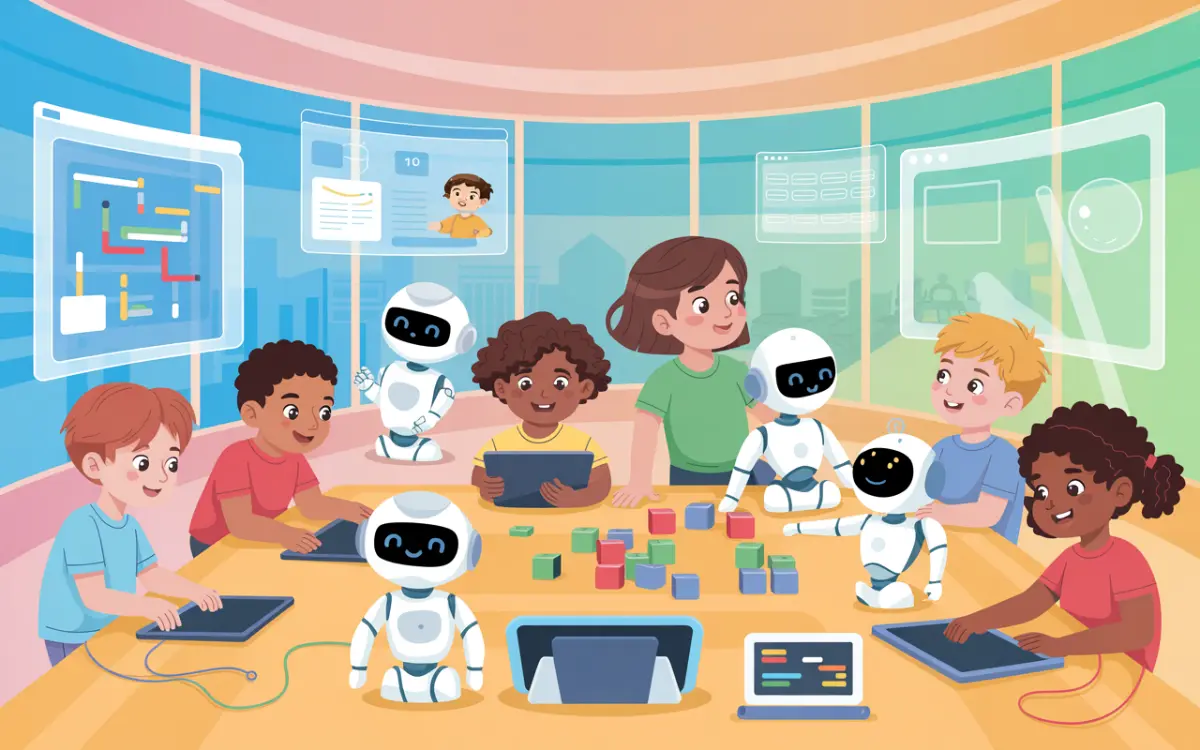
The advent of artificial intelligence is reshaping how we educate the next generation. As AI becomes increasingly integrated into daily life, preparing children for this technological future has never been more crucial. By familiarising young learners with AI concepts, we equip them with essential knowledge whilst fostering the skills needed to thrive in an automated world.
The integration of AI into educational settings represents more than just technological advancement—it signifies a fundamental shift in how children learn, interact, and develop critical thinking skills. From intelligent tutoring systems that adapt to individual learning styles to AI-powered educational games that make complex concepts accessible, technology is transforming the classroom experience in unprecedented ways.
Our responsibility extends beyond mere introduction. We must nurture understanding and guide children to use AI ethically and creatively. As Michelle Connolly, founder of LearningMole, states: “Embracing AI doesn’t mean losing our humanity; it means enhancing it by teaching our children the value of innovation alongside compassion.” This balanced approach ensures that as children become technologically proficient, they also develop the moral compass necessary to use these powerful tools responsibly.
By integrating AI into childhood education, we can inspire a generation that not only commands technology but also questions and shapes it. We are tasked with creating learning environments that blend AI with traditional teaching methods to unlock the full potential of every child, preparing them for careers that may not even exist yet.
The Evolution of Artificial Intelligence Technology
Artificial intelligence has transitioned from theoretical concepts to a driving force in modern society. Understanding this evolution helps contextualise AI’s significance for young learners and demonstrates the rapid pace of technological change that today’s children will navigate throughout their lives.
Historical Perspectives on Artificial Intelligence Development
The journey of artificial intelligence began with visionary thinking and bold questions about the nature of intelligence itself. Alan Turing planted the seed in 1950 by asking, “Can machines think?” His groundbreaking work laid foundations for machine learning, a revolutionary concept allowing machines to learn from data rather than simply following pre-programmed instructions.
Early AI research focused on solving specific problems like chess-playing and natural language understanding through rule-based methods. These pioneering systems, whilst limited by today’s standards, demonstrated that machines could perform tasks previously thought to require human intelligence. Researchers painstakingly coded rules and logic trees, creating systems that could make decisions within narrowly defined parameters.
During the 1980s, expert systems emerged, emulating human expert decision-making in specialised fields such as medical diagnosis and financial analysis. These systems represented significant advances, incorporating knowledge bases and inference engines that could reason through complex problems. However, they struggled with tasks outside narrow domains, highlighting the challenge of creating truly flexible artificial intelligence. The brittleness of these early systems—their inability to handle unexpected situations—taught valuable lessons about the complexity of human cognition.
The limitations of early AI led to periods dubbed “AI winters,” when funding dried up and enthusiasm waned. Yet these setbacks proved crucial for the field’s development, forcing researchers to confront fundamental questions about learning, reasoning, and generalisation that would ultimately lead to breakthrough approaches.
Modern Artificial Intelligence Advancements
The 21st century brought an AI renaissance that has revolutionised virtually every aspect of modern life. Deep learning, powered by neural networks inspired by the human brain’s structure, emerged as a game-changer capable of processing vast data amounts, recognising complex patterns, and making decisions with minimal human intervention.
This technology now powers voice assistants that understand natural speech, predictive text that anticipates our words, recommendation systems that suggest content aligned with our preferences, and self-driving vehicles that navigate complex traffic situations. The unprecedented access to data, combined with dramatic increases in computational power and increasingly sophisticated algorithms, has enabled AI systems to achieve and sometimes surpass human-level performance in specific tasks.
Computer vision systems can now identify objects in images with remarkable accuracy, natural language processing enables machines to understand and generate human-like text, and reinforcement learning allows AI to master complex games and control systems through trial and error. These advances aren’t merely academic achievements—they’re transforming industries from healthcare to transportation, from education to entertainment.
Michelle Connolly observes: “AI is evolving at a breathtaking pace, revolutionising how we educate our children. It’s essential that we leverage these advancements to enhance learning experiences, ensuring students are well-prepared for the world of tomorrow.” This perspective emphasises the urgency of incorporating AI literacy into education at all levels.
AI in Childhood Education Systems
AI significantly influences pedagogy through individualised learning experiences that were impossible with traditional educational methods. Modern AI systems can identify each student’s learning patterns, strengths, and improvement areas to tailor educational content accordingly, creating truly personalised learning pathways.
These intelligent systems analyse how quickly students grasp concepts, which types of explanations resonate best, and where misconceptions arise. Natural Language Processing tools can adjust reading material difficulty to match children’s proficiency levels, ensuring they’re challenged without being overwhelmed. This adaptive approach keeps students in what educators call the “zone of proximal development”—that sweet spot where learning is both challenging and achievable.
The real-time feedback provided by AI systems helps teachers identify struggling students immediately rather than waiting for test results. This proactive approach to intervention can prevent small misunderstandings from becoming major knowledge gaps, ultimately improving educational outcomes for all learners.
AI Tools Transforming Classrooms
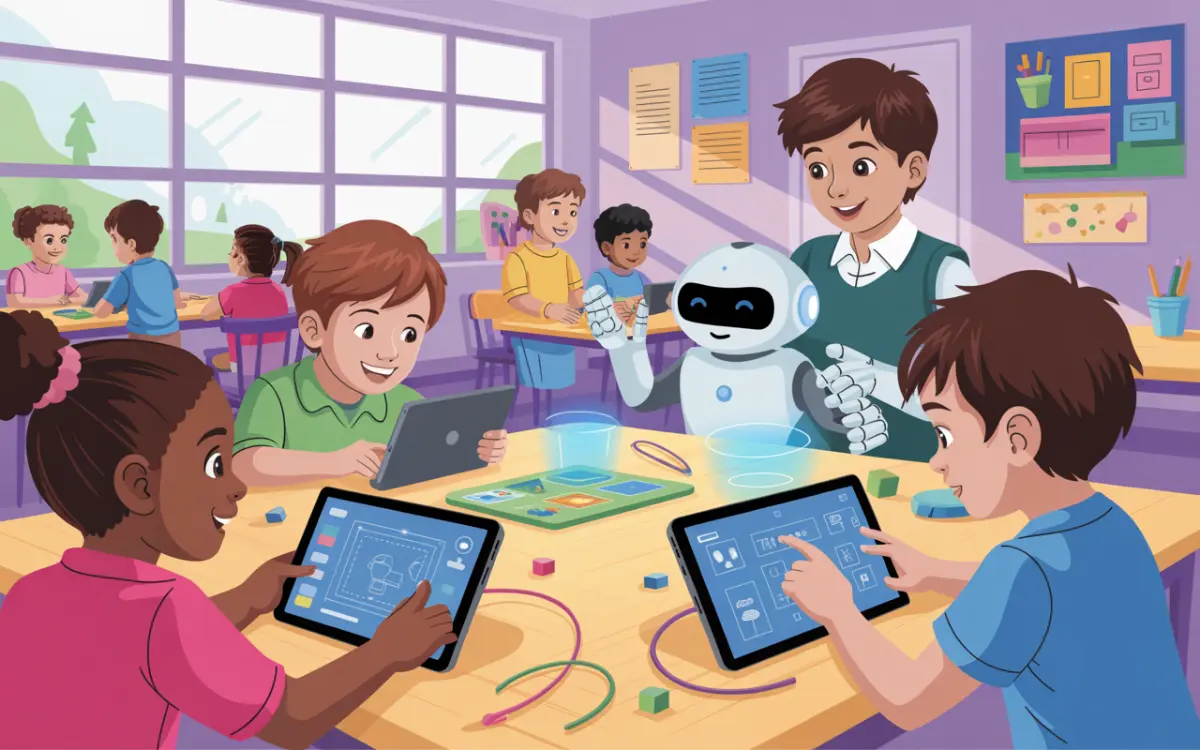
Within the four walls of our classrooms, AI tools are becoming increasingly prevalent, fundamentally changing the teaching and learning dynamic. Educational chatbots provide instant feedback and support, acting as personal tutors available 24/7 to answer questions and guide students through difficult concepts. These AI assistants never tire, never lose patience, and can explain concepts in multiple ways until understanding clicks.
Programmes like Scratch invite students to engage with coding and computer science in interactive, playful manners, igniting passion for STEM subjects through project-based learning. These platforms use visual programming languages that make abstract coding concepts concrete and accessible even to young children. Students can see immediate results of their code, creating animations, games, and interactive stories that bring their ideas to life.
Intelligent tutoring systems can diagnose specific misconceptions and provide targeted practice exercises, while AI-powered assessment tools can evaluate not just whether answers are correct but also the reasoning process students used to arrive at their conclusions. This deeper insight into student thinking helps teachers address fundamental misunderstandings rather than just surface-level errors.
Virtual and augmented reality experiences, often enhanced by AI, allow students to explore historical sites, conduct virtual science experiments, or practise language skills in simulated real-world environments. These immersive experiences make learning memorable and engaging whilst developing spatial reasoning and problem-solving skills.
Curriculum Development for AI Integration
As educators, we recognise the importance of nurturing skills that align with an AI-rich future. Curriculum development involves integrating AI education into subjects like mathematics and science whilst incorporating elements of speech recognition, computer vision, and coding that help students understand how AI systems work.
This integration shouldn’t be limited to computer science classes. AI concepts can enrich mathematics lessons through discussions of probability and statistics that underpin machine learning, enhance science classes through exploration of neural networks inspired by biological systems, and even inform arts education as students explore AI-generated art and music.
Michelle Connolly remarks: “Implementing AI into the curriculum isn’t just about teaching technical skills; it’s about fostering a mindset ready to adapt and innovate in an AI-driven world.” This holistic approach ensures students develop both the technical competencies and the critical thinking skills necessary to thrive alongside AI systems.
Curriculum developers must also address ethical considerations surrounding AI, helping students grapple with questions about privacy, bias, transparency, and the societal impacts of automation. These discussions prepare students not just to use AI but to shape its development and deployment in ways that benefit society.
Enhancing Creativity Through AI
AI technology serves as a catalyst for children’s creativity by providing interactive, stimulating environments that challenge logic and problem-solving abilities in ways traditional tools cannot. Rather than replacing human creativity, AI amplifies it by handling routine tasks and providing new possibilities for expression.
Educational platforms offer environments where children can transform abstract ideas into tangible creative projects. AI-powered design tools can suggest variations on children’s artwork, music composition software can harmonise melodies, and creative writing assistants can help overcome writer’s block whilst maintaining the child’s unique voice.
The key lies in positioning AI as a collaborative partner in the creative process rather than a replacement for human imagination. When children understand AI as a tool that extends their capabilities—much like a paintbrush extends a painter’s ability to create—they can leverage these technologies whilst maintaining ownership of their creative vision.
Creativity-oriented AI applications adapt to individual learning paces and styles, helping children grasp logic whilst refining creative thoughts into innovative actions. These systems can provide scaffolding for complex creative tasks, breaking them into manageable steps whilst encouraging experimentation and iteration.
Michelle Connolly notes: “AI doesn’t just teach children; it unlocks their potential to innovate.” This perspective recognises that creativity emerges from the interplay between constraints and possibilities, and AI can provide both—setting boundaries that focus creative effort whilst opening new avenues for exploration.
By embracing the interplay between creativity and artificial intelligence, we’re setting foundations for our youth that marry arts and sciences in previously unimagined ways, nurturing tomorrow’s innovators who will solve problems we can’t yet anticipate.
Preparing for AI-Driven Careers
Equipping children with skills for AI-influenced careers requires fostering excellent problem-solving abilities and solid programming foundations. The career landscape of tomorrow will demand workers who can collaborate effectively with AI systems, understand their capabilities and limitations, and identify opportunities for AI application.
This preparation involves more than just coding skills—though those remain important. Children need to develop computational thinking, the ability to break complex problems into manageable components, recognise patterns, and design systematic solutions. These skills transfer across domains, proving valuable whether students ultimately pursue careers in technology or other fields.
Michelle Connolly states: “It’s about integrating AI education early on to prepare students for the future.” By introducing coding and AI technology concepts in friendly, engaging manners, we can create seamless transitions for students into AI-driven careers. Early exposure demystifies technology and builds confidence, showing children that they can be creators rather than merely consumers of technology.
Project-based learning experiences that incorporate AI—such as training simple machine learning models or programming robots—provide concrete understanding of how these systems function. When children see their code controlling a physical robot or their trained model making accurate predictions, abstract concepts become tangible and exciting.
Understanding the Changing Job Landscape
The job landscape is undoubtedly transforming due to AI and automation, with some positions becoming obsolete whilst new career opportunities emerge in AI fields. Rather than viewing this change with alarm, we should embrace it as an opportunity to encourage critical thinking and adaptive learning among children.
Roles involving routine, repetitive tasks face automation, but this shift frees humans to focus on work requiring creativity, emotional intelligence, complex problem-solving, and interpersonal skills—areas where humans excel. New careers are emerging in AI system design, training, and maintenance, as well as in fields we can’t yet imagine.
Children entering today’s educational system will likely change careers multiple times throughout their lives, making adaptability and continuous learning more valuable than mastery of any specific skill set. We must foster resilience and growth mindsets, teaching children that abilities can be developed through dedication and hard work.
Michelle Connolly adds: “Young learners should see AI as a tool that can unlock countless opportunities.” This optimistic yet realistic perspective helps children approach the AI-enhanced future with confidence rather than apprehension. By understanding AI’s capabilities and limitations, children can position themselves to work alongside these systems effectively.
The ethical dimensions of AI deployment—questions about fairness, transparency, and accountability—also create career opportunities for those who can navigate technical and human considerations, designing systems that serve society’s interests whilst respecting individual rights.
Developing Essential Skills
Teaching critical thinking and problem-solving is essential for preparing children for futures with artificial intelligence. Our education systems must focus on developing these skills to enable children to navigate complex AI-related scenarios, from evaluating AI-generated information to identifying appropriate applications for AI tools.
Critical thinking in an AI context involves questioning assumptions, evaluating evidence, recognising bias in data and algorithms, and understanding the limitations of AI systems. Children need to develop healthy scepticism about technology, neither accepting AI outputs uncritically nor dismissing AI’s potential contributions.
Education should include opportunities for children to analyse problems from multiple perspectives, formulate probing questions, and develop creative solutions that might combine human insight with AI capabilities. This approach is well-aligned with what LearningMole offers, particularly through hands-on STEM activities where concepts are truly experienced rather than merely discussed.
Michelle Connolly observes: “Critical thinking in an AI world is not just about algorithms and coding; it’s about nurturing a mindset that questions, adapts, and innovates.” This mindset recognises that the most powerful solutions often emerge from thoughtful human-AI collaboration rather than from either alone.
Soft Skills Development
Moving to soft skills such as communication, persistence, and empathy, which remain key to personal and professional success in an AI-enhanced world. These skills enhance human-AI interaction and foster collaborative environments where technology amplifies human capabilities rather than replacing them.
Communication skills become even more critical as workers must explain technical concepts to non-technical stakeholders, collaborate across disciplines, and articulate the value and limitations of AI systems. The ability to translate between technical and human contexts will prove invaluable in AI-augmented workplaces.
Persistence and resilience matter because working with AI often involves experimentation and iteration. Machine learning models require training, testing, and refinement; solutions emerge through trial and error. Children who develop persistence view setbacks as learning opportunities rather than failures.
Empathy allows us to design AI systems that serve diverse users’ needs, anticipate unintended consequences, and ensure technology enhances rather than diminishes human dignity. Understanding others’ perspectives helps identify potential harms from AI deployment and design more inclusive systems.
Our recommendations for curriculum design include activities requiring teamwork, offering challenges that build resilience, and drawing on personal experiences that nurture empathy. LearningMole recognises the importance of such skills, especially in creating content for children with special educational needs, thus promoting inclusivity and emotional intelligence.
At LearningMole, we believe in challenging and engaging children not just academically but also on personal growth levels, enhancing their ability to progress in AI-integrated futures whilst maintaining their essential humanity.
AI Technologies for Kids
In today’s digital landscape, acquainting our children with AI technologies that can nurture their curiosity and pave the way for technologically adept futures proves paramount. These tools range from virtual assistants aiding learning to engaging AI-powered games making education fun and interactive.
Virtual Assistants and Learning
Virtual assistants like Alexa and Siri are revolutionising how children interact with technology, offering new modalities for information access and skill development. Our little ones now grow up with the ability to receive homework help and learn about the world through simple voice commands, making information more accessible than ever before.
These conversational interfaces teach children about natural language interaction with technology whilst providing immediate answers to questions. When a child asks about planetary systems, historical events, or mathematical concepts, instant responses satisfy curiosity and encourage further inquiry.
YouTube and similar platforms provide plethoras of educational content which, when used responsibly, can be significant tools in teaching various subjects. High-quality educational videos explain complex concepts through visualisation and demonstration, complementing traditional instruction methods. However, we must safeguard children’s privacy whilst they explore these applications, ensuring secure digital environments.
Content filtering and parental controls help ensure children access age-appropriate material, whilst time limits prevent excessive screen time. Teaching children to evaluate information critically—considering sources and cross-referencing facts—develops media literacy essential in information-saturated environments.
Michelle Connolly believes: “AI technology has the potential to transform traditional learning, making education more accessible and customised to individual learning styles.” This customisation allows children who struggle with conventional teaching methods to access content in formats that resonate with their learning preferences.
Gaming and AI
AI has infused new life into gaming realms for children, creating experiences that educate whilst entertaining. From puzzles that adapt to children’s learning paces to adventures teaching coding fundamentals, AI applications in games are as vast as they are intriguing.
Educational games use AI to provide appropriately challenging experiences—adjusting difficulty as children improve, offering hints when students struggle, and celebrating successes to maintain motivation. This dynamic difficulty adjustment keeps children engaged without frustration, maintaining optimal challenge levels for learning.
Incorporating AI into games provides engaging platforms for children to develop strategic thinking and problem-solving skills. Games requiring players to programme AI characters or predict AI behaviours teach computational thinking through play, making abstract concepts concrete and enjoyable.
We hold fast to principles that technology use should always aim to benefit children’s educational development and equip them with skills they’ll need in futures. Our approach to AI in gaming is mindful of balances between entertainment and education, crafting experiences as enriching as they are enjoyable.
Multiplayer games incorporating AI opponents or teammates teach children about collaboration with AI systems, preparing them for workplaces where human-AI teams will be commonplace. These experiences help children develop intuitions about AI capabilities and limitations through direct interaction.
The Digital Assistant Paradigm
In children’s education and technology worlds, the rise of digital assistants like Alexa and Siri has brought about new ways of interactive learning that fundamentally change how children access and process information.
Understanding Virtual Assistants
Virtual assistants have revolutionised device interaction methods, serving as gateways to vast information repositories accessible through natural conversation. Tools such as facial recognition and speech recognition are integral to their functionality, enabling personalised experiences that adapt to individual users.
These AIs, powered by extensive datasets, enable personalised experiences beyond simple question-answering. They can remember preferences, learn from interactions, and provide contextually relevant information. For example, children can ask “What’s the largest planet in the solar system?” and receive immediate responses, making learning more engaging and spontaneous.
The conversational nature of these interfaces makes technology more accessible to young children still developing reading and writing skills. Voice interaction removes literacy barriers, allowing even pre-readers to engage with educational content and satisfy their natural curiosity.
However, content accuracy provided by these assistants remains crucial for educational applications. As Michelle Connolly states: “The quality of data and the way AI like ChatGPT processes this data is key to ensuring that the learning experience is beneficial.” Inaccurate information can reinforce misconceptions, making quality control essential.
Understanding how these systems work—including their limitations—helps children develop appropriate scepticism about AI-generated content. Teaching children that AI assistants sometimes make mistakes or “hallucinate” information prepares them to verify important facts through multiple sources.
Privacy and Usage Concerns
When it comes to children’s use of digital assistants, privacy concerns demand careful attention and proactive management. It’s our responsibility to safeguard their data, protecting against both malicious actors and unintended data exposure.
Careful management of privacy settings is vital to protect against unwanted data collection through features like facial and speech recognition. Many devices collect data to improve services, but this data collection raises questions about who accesses children’s information and how it’s used.
Understanding terms of service and privacy policies—though often lengthy and complex—helps parents make informed decisions about which services to allow. Creating separate profiles for children with appropriate restrictions limits data collection and prevents inadvertent purchases or access to inappropriate content.
By tuning settings and understanding service terms, we can alleviate many privacy concerns and create safer environments. We need to educate children about privacy importance and staying safe online, reinforcing messages that not all content is appropriate and personal information should be protected.
Michelle Connolly emphasises: “Through proper guidance and education about online safety, we equip our children with the necessary tools to navigate this digital era.” This education includes discussing why privacy matters, what information should remain private, and how to recognise and respond to privacy violations.
Teaching children to think critically about what they share, whom they trust online, and how their digital footprints might affect their futures develops digital citizenship skills essential in increasingly connected worlds.
Ethical Aspects of AI
Ethical considerations in AI prove paramount, especially when involving children whose developing minds and limited life experience make them particularly vulnerable to technology’s impacts. As we navigate this terrain, questions around privacy, algorithmic transparency, and responsible AI use stand out as salient concern points.
AI, Privacy, and Children
When AI interfaces with children’s lives, privacy becomes a bedrock issue demanding rigorous attention and constant vigilance. The collection, storage, and utilisation of data from children’s interactions with technology can lead to profound ethical implications affecting both immediate experiences and long-term outcomes.
We must ensure AI systems safeguard children’s privacy by implementing robust data protection measures including encryption, data minimisation, and clear retention policies. Children’s data should be collected only when necessary, stored securely, and deleted when no longer needed.
The challenge intensifies because children may not fully understand privacy implications or consequences of sharing personal information. They might not recognise when data collection occurs or how shared information could be used in ways they wouldn’t approve. Therefore, privacy protections for children must be stronger than those for adults, accounting for their developing capacity for informed consent.
Michelle Connolly, a seasoned educator with profound understanding of ethical teaching landscapes, states: “In our digital classrooms, the sanctity of a child’s personal information is as crucial as the education itself.” This perspective recognises that protecting privacy isn’t merely about compliance with regulations—it’s about respecting children’s dignity and autonomy.
Legislation such as the Children’s Online Privacy Protection Act in the United States and similar laws worldwide establish minimum standards, but best practices often exceed legal requirements. Educational institutions and technology providers should prioritise children’s interests, designing systems with privacy built in from the ground up rather than added as an afterthought.
Algorithmic Transparency
The call for transparency in algorithms is about deciphering the AI ‘black box’ to ensure that educators, parents, and even the children themselves can trust the technology they’re using. Algorithms underpinning AI must not be arcane or mysterious but should be open for scrutiny and explanation.
When AI systems make decisions affecting children—such as recommending educational content, evaluating performance, or predicting learning trajectories—stakeholders deserve to understand how these decisions are made. This transparency builds trust and allows for accountability when systems err or produce biased outcomes.
We advocate for approaches where algorithmic decisions are explainable and justifiable, with clear documentation of how systems reach conclusions. When AI recommends certain learning materials, for instance, teachers and parents should be able to understand the reasoning behind these recommendations.
Michelle Connolly believes: “Making algorithms transparent is akin to keeping the classroom door open, inviting trust and confidence in the educational tools we use.” This openness also enables identification and correction of biases that might disadvantage certain groups of students.
Algorithmic transparency serves educational purposes as well. When children understand how AI systems make decisions, they develop more sophisticated mental models of technology, moving beyond viewing AI as magic to understanding it as a tool created by humans and subject to human values and limitations.
Teaching children about algorithmic decision-making—through age-appropriate explanations and hands-on experiences training simple AI models—demystifies technology and empowers them to be informed critics and creators of AI systems rather than passive consumers.
Conclusion
Preparing children for an AI-powered future requires comprehensive approaches combining technical knowledge with ethical understanding, creativity with critical thinking, and human skills with technological literacy. By integrating AI education early whilst fostering creativity, problem-solving, and essential soft skills, we equip young learners to not merely consume technology but question, shape, and innovate with it responsibly and effectively.
Through proper guidance, transparent practices, and continuous curriculum evolution that keeps pace with technological change, we can ensure children thrive in AI-integrated worlds whilst maintaining their humanity, creativity, and ethical grounding. The goal isn’t to produce young technicians but rather to nurture adaptable, thoughtful individuals who can harness AI’s power whilst remaining grounded in human values of compassion, equity, and wisdom.
As we stand at this pivotal moment in educational history, our choices about how we introduce children to AI will shape not just their futures but the future of AI itself. By raising a generation that understands both AI’s potential and its limitations, that can code and critique, that combines technical skills with ethical reasoning, we create the foundation for a future where AI genuinely serves humanity’s best interests.
Maths Circus, an innovative platform we've crafted, presents a captivating realm where children learn mathematics through the exciting theme of a circus. The joy of juggling numbers and solving circus...
Singers use their voices as musical instruments to perform songs in theatres, recording studios, choirs and at events. Most of their working day, though, is spent practising, learning music and...
Article summary What this article covers: How primary teachers can use online assessment tools such as live quizzes, polling, digital exit tickets and digital portfolios to check understanding, give faster...
Article summary What this article covers: The role of AI in education for primary-aged children in the UK, including what artificial intelligence is, how schools in England use it, the...





Leave a Reply