Symmetry is a fundamental concept in geometry that contributes to the balance and harmony of shapes, occurring all around us in nature, art, and everyday objects. It represents the proportion that leads to beauty and structure in both natural and human-made environments. At its core, symmetry in geometry relates to the exact correspondence in size and shape of parts of a whole that are arranged around an axis or a centre point. It is the mirror-like reflection that divides a shape into identical halves, enhancing not just aesthetic appeal but also our understanding of mathematical concepts.
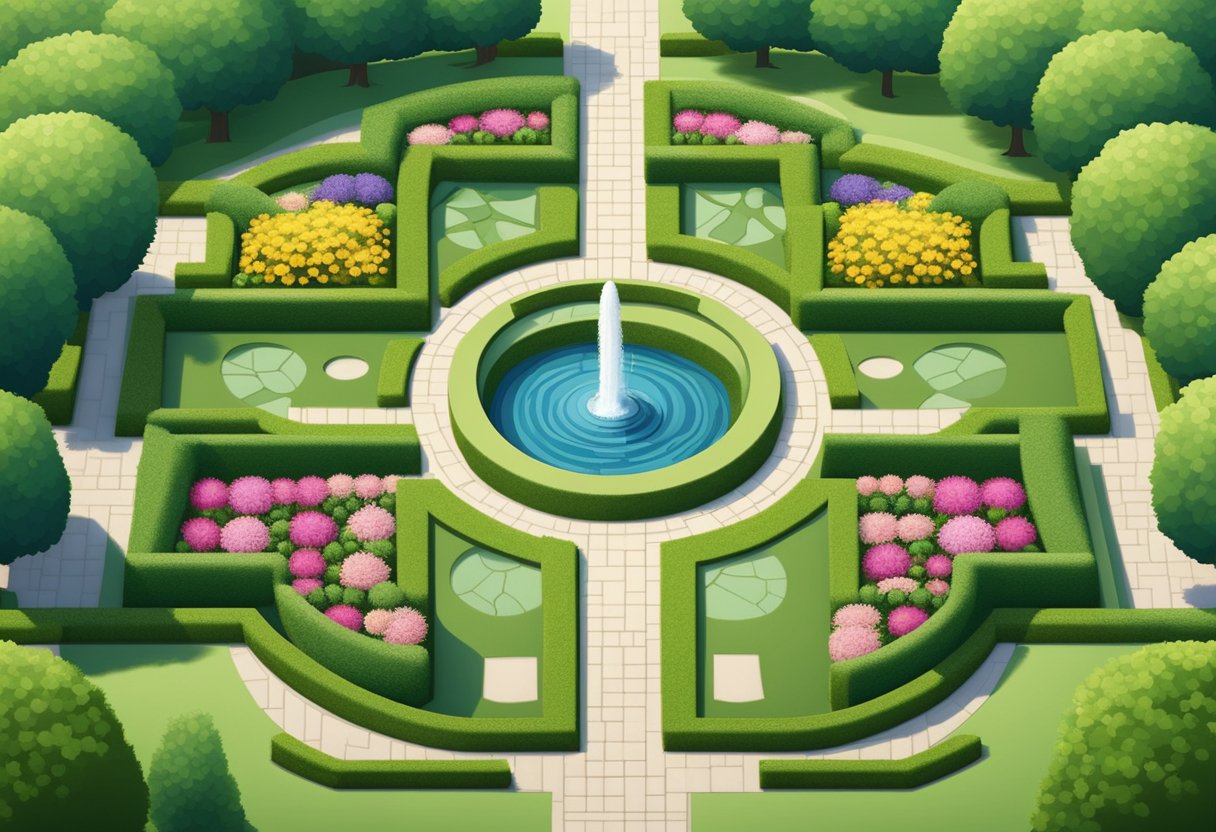
Symmetry in Shapes: A beautiful garden
The investigation of symmetry within basic shapes reveals various types of symmetry, including reflective, rotational, and translational. Lines of symmetry, or axes of symmetry, dissect shapes into mirrored parts, each reflecting the other perfectly. Points of symmetry, on the other hand, indicate the centre around which a shape can be rotated to coincide with itself at various angles. These geometrical understandings extend into more advanced symmetrical structures found in cultural designs and sophisticated mathematics, evidencing the profound relationship between symmetry, balance, and geometry.
Fundamentals of Symmetry
Symmetry is an essential concept in geometry used to describe a balanced and proportionate arrangement of elements within a shape or design. We observe symmetry in various forms, which significantly impacts our understanding of geometric figures.
Types of Symmetry:
Reflection Symmetry (Mirror Symmetry): When we split a shape into two parts with a line of symmetry, each part mirrors the other. Think of looking at your reflection in a pond; one side is an exact copy of the other.
Rotational Symmetry: A shape exhibits rotational symmetry if it can be rotated around a central point and still look the same. For instance, rotating a square 90 degrees around its centre leaves the square unchanged.
Translation Symmetry: This occurs when a shape can be moved or “translated” along a path without altering its appearance. Envision sliding a pattern along a wall; the design repeats without changing its look.
Point Symmetry: This happens when every part of a shape has a matching part at the same distance from the central point but in the opposite direction. It’s like flipping a shape entirely over.
We often relate symmetry to aesthetic beauty, finding symmetric patterns especially pleasing. Our appreciation for balance and harmony is evident in evident in architecture, art, and nature. Symmetry is not just for visual satisfaction; it has practical applications in physics, biology, and engineering. Understanding the principles of symmetry enables us to analyze patterns, solve problems more efficiently, and even articulate our understanding of the universe.
Symmetry in Basic Shapes
Symmetry is all around us, within our man-made designs and nature’s own patterns. In geometry, we witness symmetry in various shapes, each with its unique attributes. It’s fascinating to see how different shapes exhibit different types of symmetry.
Symmetry in Polygons
When we look at regular polygons, symmetry manifests in both line symmetry and rotational symmetry. A regular polygon, by definition, has all sides and angles equal, such as the regular pentagon or regular hexagon, which both have as many lines of symmetry as they have sides. The humble square boasts four lines of symmetry, whereas a rectangle has two. Subsequently, triangles also come in forms such as equilateral, with three lines of symmetry, and isosceles, with one. The more irregular scalene triangle typically has no lines of symmetry unless it’s precisely measured.
Symmetry in Circles
The circle stands put in geometry; it has infinite lines of symmetry. Every line that passes through its centre point divides the circle into two perfect mirror images. This property gives the circle a sense of unrivalled balance among shapes in geometry and art.
Unique Symmetrical Figures
Looking beyond standard geometric figures, there are shapes like the heart and the butterfly that display line symmetry. These figures, often found in nature and art, capture our imagination by mirroring one half to the other along a single line. Whether it is a butterfly’s wings or a heart’s curves, symmetry brings a visual harmony that is innately pleasing to us.
In summary, we find symmetry a recurring theme across various shapes, from the structured realms of polygons to the circular infinity and the organic uniqueness of nature-inspired figures. Each showcases balance in its own right, aligning closely with our innate sense of aesthetic and structure.
Lines and Points of Symmetry
In exploring the world of geometry, we find that symmetry plays a pivotal role in the balance and aesthetics of shapes. Here, we uncover the harmonious presence of lines and points of symmetry that make this possible.
Exploring Lines of Symmetry
A line of symmetry is an imaginary line where, if we were to fold our shape along it, both halves would match perfectly. It’s fascinating to observe that shapes can have one or multiple lines of symmetry, which can run vertically, horizontally, or diagonally across the shape.
For instance, a rectangle has two lines of symmetry: one vertical, dividing it into two equal parts, and one horizontal. On the other hand, a circle boasts an infinite number of lines of symmetry, as it can be folded across any diameter and still present two identical halves.
Significance of the Axis of Symmetry
Each line of symmetry can also be referred to as an axis of symmetry, highlighting its role as a central reference point around which the shape is balanced. This axis is key when we consider the aesthetics of a design or the fundamentals of a geometric figure.
It’s a concept that’s visible in the reflection of an image, essentially creating a mirror image along the axis of symmetry. For shapes with an odd number of symmetrical lines, such as a pentagon, there is typically one axis that stands out as the primary among them, commonly seen in its vertical alignment.
Points and Center of Symmetry
In addition to lines, we must consider the centre of symmetry—a central point in a shape that is equidistant from all its outer edges. Not every shape has a centre of symmetry, but for those that do, like a square, any line drawn through the centre point will be a line of symmetry. Moving outwards from this central point, each segment reflects the other, and this balance is the cornerstone to the concept of point symmetry, where every part has a matching point at equal distances from the central location.
In understanding these principles, we see the beauty and balance inherent in geometry. Shapes are not merely random collections of lines and points; they’re data speaking a visual language, telling us about balance, form, and the architecture of space around us. Through these symmetries, we discover the subtle art of geometric perfection.
Symmetry in Art and Nature
Symmetry is a harmonious concept that surrounds us in both the natural world and in the realms of art and architecture. It’s the balance that elements exhibit on either side of an axis, creating patterns that are pleasing to the eye and convey a sense of order.
In nature, symmetry is often observed in the bilateral forms of leaves, the intricate patterns on butterfly wings, or the radial symmetry of a starfish. It brings coherence to the chaos of the natural world, creating designs that are inherently attractive to humans.
Artists and architects have long taken inspiration from this natural symmetry. Whether it’s through the balanced facade of a building or the meticulous arrangement of elements in a painting, symmetry has always played a pivotal role in aesthetics. In art, it contributes to composition, drawing the viewer’s eye and evoking a feeling of tranquillity and completeness.
Patterns and designs found in art often mimic those from nature, reinforcing the connection between the two. For instance, the spirals in a nautilus shell are replicated in scrollwork or motifs across diverse cultures. Similarly, architects have applied symmetry to structure their creations, bringing stability and beauty to the skyline.
Here are a few key points to remember about symmetry in art and nature:
Nature’s Designs: Symmetry is inherent in the world around us, providing core patterns from which we draw inspiration.
Cultural Significance: Symmetry plays a significant role in designs across different cultures, often symbolising balance and harmony.
Architectural Foundation: Many buildings utilise symmetry, enhancing their visual appeal and providing structural benefits.
We find that delving into the geometric principles behind symmetry unveils a world where art and nature intersect seamlessly, fostering an understanding that everything is interconnected.
Mathematical Concepts of Symmetry
In geometry, we often iscuss symmetry as a key property of shapes and structures. Essentially, symmetry refers to the balanced and proportionate arrangement of parts on opposite sides of a dividing line or around a centre point. Engaging with this concept helps us understand how mathematics can describe and classify the beauty and order found in the natural and designed world.
There are several types of symmetrical transformations that we might encounter:
Reflective Symmetry involves a ‘mirror line’, and one half of the shape is the reflection of the other half.
Rotational Symmetry implies that when a shape is turned around a central point, known as the ‘centre of rotation’, it looks the same at certain angles. For example, a regular pentagon has rotational symmetry of order 5, meaning it looks the same after a rotation of 72 degrees (360°/5).
Translational Symmetry occurs when a shape can be moved (translated) without rotation to a different position and still look the same.
We use various formulas and calculations to unveil the deeper mathematical relationships within symmetry. These might include angle measures to determine the correct degrees at which symmetry holds true for a given shape. We also might consider the order of symmetry, referring to the number of times a shape fits onto itself during a 360-degree rotation.
Symmetry is a question of aesthetics and a fundamental aspect of our understanding of geometry. By studying symmetry, we enrich our comprehension of how geometric figures can be classified, understood, and constructed. These balance and regularity principles are foundational in simple mathematical exercises and complex architectural designs. Our recognition of symmetry is an acknowledgement of the inherent order within our environment.
Geometric Transformations
We’ll be exploring how shapes and figures undergo various geometric transformations. Specifically, we’ll focus on how objects are moved, flipped, and slid to create symmetry, and the importance of balance within these transformations.
Reflection and Mirror Symmetry
When a figure is flipped across a line, creating a mirror image, we call this a reflection. This line acts as the mirror and is central to achieving mirror symmetry. The original and reflected figures are congruent, meaning they are the same size and shape, demonstrating how reflection preserves the properties of the geometric object.
Rotation and Symmetry Order
Rotation involves turning a figure around a fixed point, known as the centre of rotation. The amount of turn is measured in degrees, and the order of symmetry refers to the number of times the figure matches the original position during a full 360-degree turn. A common example is a wheel, displaying rotational symmetry; if a wheel has an order of 4, it means it looks the same every 90 degrees of rotation.
Translation and Glide Symmetry
Translation moves every point of a figure the same distance in the same direction. When an object is translated, it creates translational symmetry if the moved object can be slid back onto the original without rotation or reflection. Glide symmetry combines translation with reflection. An object with glide symmetry can be reflected over a line and then translated along that line to coincide with its original position.
Symmetry in Everyday Objects
We often encounter an array of symmetrical shapes in the objects that adorn our day-to-day lives. Symmetry, a balance and proportion in dimensions, can be observed in items as common as a piece of furniture or as intricate as a piece of art. This balance is aesthetically pleasing and serves functional purposes in design and structure.
Consider, for example, the symmetrical nature of a dinner fork. The tines are evenly spaced and aligned, indicating a proportionate design, which is essential to the utensil’s function. The balance in its structure allows for a comfortable grip and efficient use.
In our homes, symmetry manifests in the very walls that surround us. Doors are typically symmetrical, with equal halves that create a harmonious entrance. The windows often reflect a similar balance, with equally distributed panes to achieve functionality and design appeal.
Below is a list of everyday objects where symmetry is inherent:
Wall clocks: a perfect circle with a radial symmetry of numbers or marks.
Rugs and carpets: often have symmetrical patterns that enhance their visual appeal.
Clothing: shirts and jackets are frequently designed with a line of symmetry down the middle for visual balance.
By appreciating the symmetrical elements in these objects, we deepen our understanding of geometry’s role in practical design. The proportionate arrangement of parts results in objects that are pleasing to our eyes and serve their purpose more effectively. Symmetry in design contributes to the overall harmony and order in the environment, making our everyday experiences more coherent and intuitive.
Advanced Symmetrical Structures
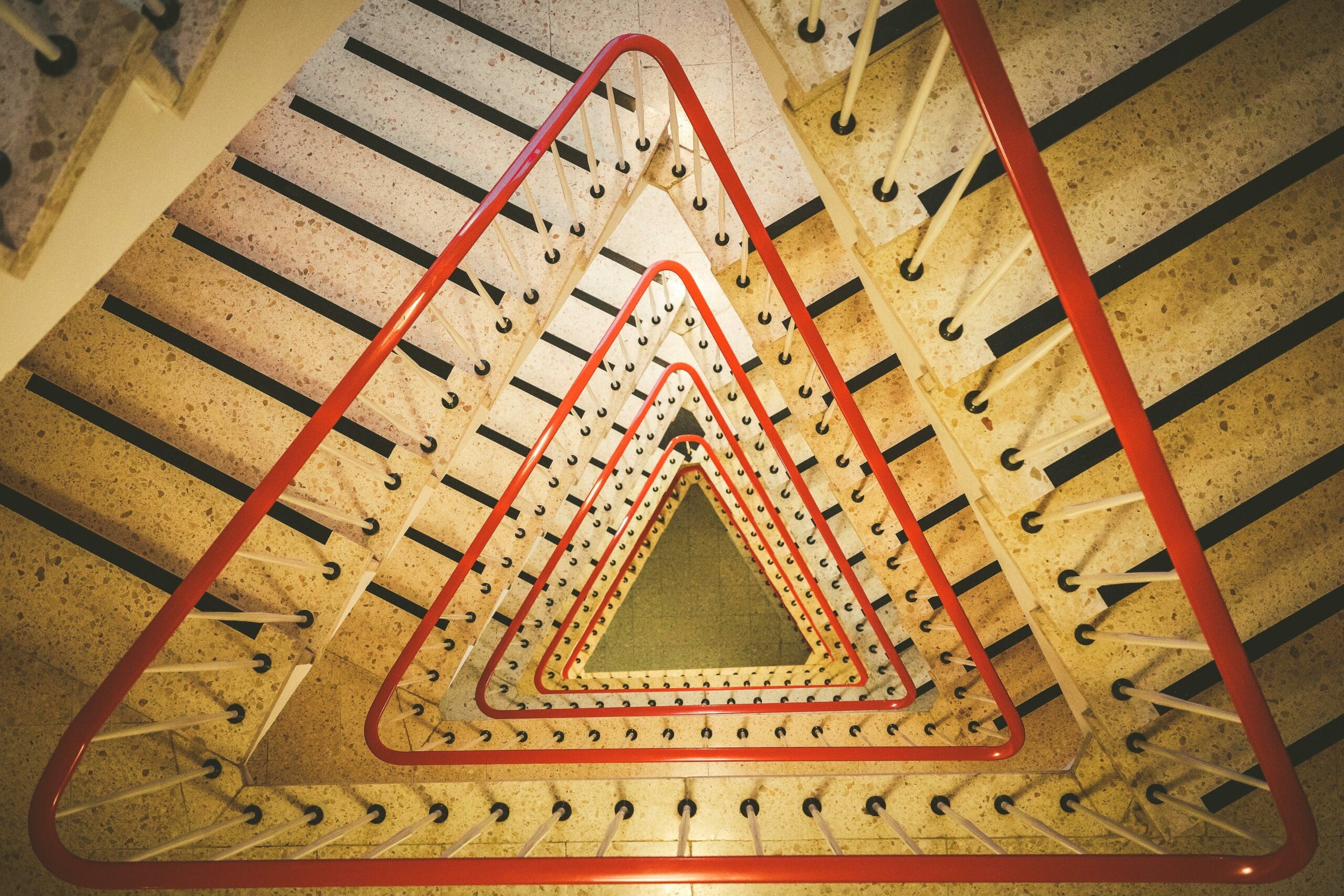
Symmetry in Shapes: Triangular staircase with red handrail
In exploring the complex world of geometry, we often find ourselves fascinated by the intricacies of advanced symmetrical structures. These forms not only depict aesthetic beauty but also embody mathematical precision.
Complex Shapes and Symmetry
When we examine complex shapes, their symmetry reveals a deep interconnectedness with geometry’s foundational principles. Take the quadrilateral family, for example, encompassing a diverse range of shapes from the regular square to the irregular kite. Each member of this family adheres to a set of geometric rules that define its symmetry.
Regular quadrilaterals, such as squares, exhibit a high degree of symmetry, with all sides and angles being congruent. In contrast, an irregular quadrilateral lacks such uniformity yet may still possess lines of symmetry depending on its angles and sides. Meanwhile, the parallelogram and rhombus share a characteristic where opposite sides are congruent and parallel, forming an interesting symmetry through translation and reflection.
Parallelogram: Opposite sides are parallel and equal in length.
Rhombus: All sides are equal in length, forming a “tilted square”.
More intricate shapes, like the isosceles trapezoid showcase symmetry in a less straightforward manner. With only one pair of parallel sides, the isosceles trapezoid is symmetric across its axis of symmetry, which is perpendicular to the bases. The ellipse, another advanced structure, extends the concept of symmetry in a curved form, with two axes intersecting at the shape’s centre.
Italics are used to emphasise specific geometric properties, such as:
An ellipse has two focus points that define its overall symmetry.
A kite may contain two disjoint pairs of congruent adjacent sides.
As we unravel the symmetry in advanced geometrical figures, we enhance our understanding of balance and congruency within the spatial universe around us. Our voyage through these shapes isn’t just one of visual appreciation but is also an analytical journey that taps into the coherence and harmony inherent in the world of mathematics.
Symmetry in Cultural Designs
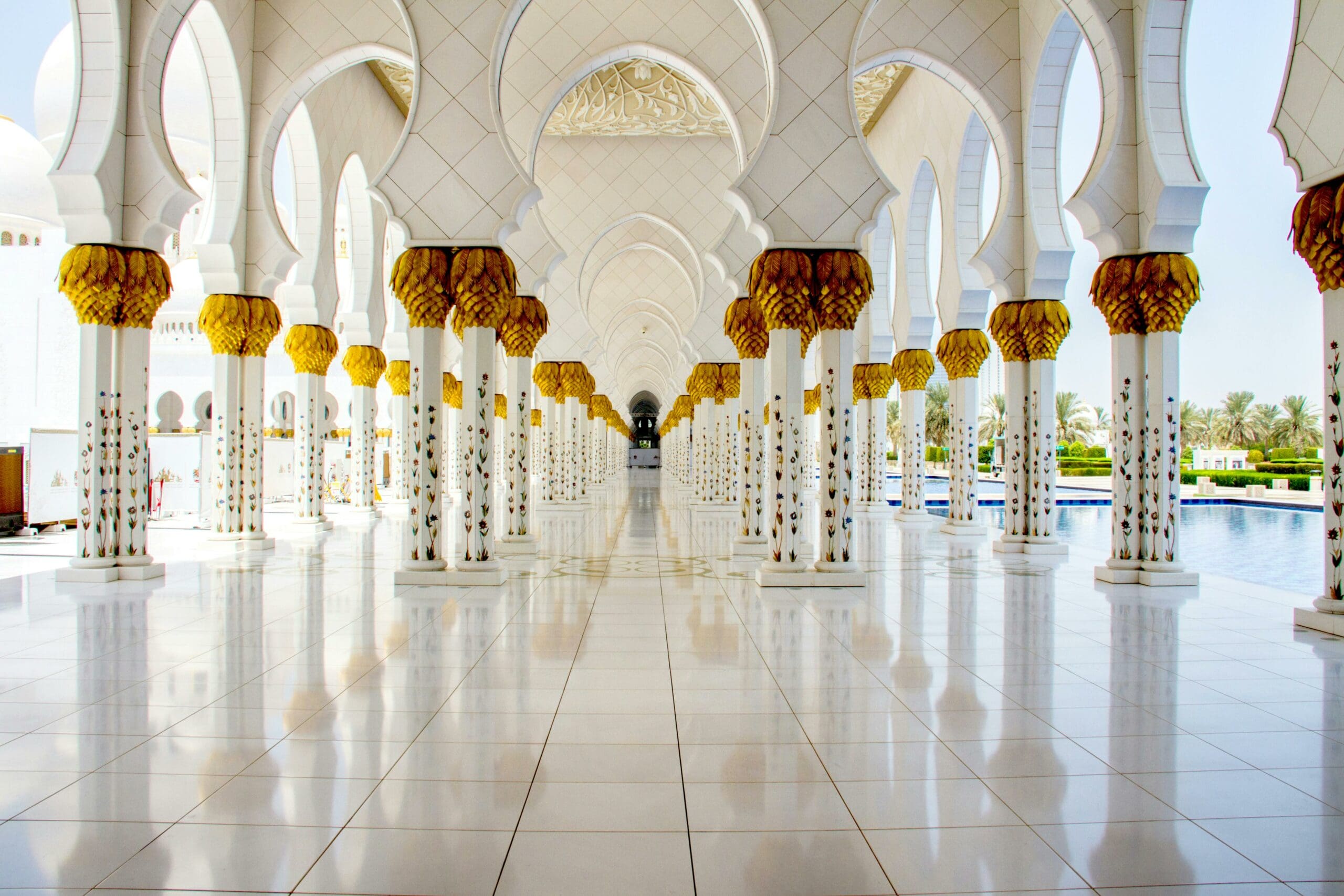
Symmetry in Shapes: Symmetrical pillars
Within the realm of cultural expressions, symmetry serves as a fundamental principle, harmoniously connecting geometry to art and architecture. It reflects a balance that’s not only aesthetic but also imbued with deeper meanings.
Rangoli: Our celebrations incorporate designs such as rangoli, which infuse spaces with vibrant colours arranged into symmetrical patterns. These designs often centre around geometric shapes and embody traditions, invoking a sense of community and spirituality.
Architectural Symmetry: In architecture, symmetry conveys stability and grandeur. Whether it’s in the towering spires of Gothic cathedrals or the disciplined elegance of Renaissance buildings, we find that balanced geometrical proportions are integral to creating visual harmony.
Cross-Cultural Patterns: We observe how cultures worldwide utilise symmetrical patterns—from Islamic art’s intricate tile work to the Celtic cross—which often represent the unity between the physical and the spiritual realms.
Here’s how we can breakdown the core entities in a table for clarity:
Entity
Significance in Symmetry
Rangoli
Cultural symbolism, communal identity
Design
Aesthetic harmony, visual rhythm
Architecture
Structural balance, grandeur
Patterns
Cultural representation, unified beauty
Cross
Spiritual symbolism, cross-cultural reverence
Symmetry in Shapes
Symmetry seamlessly weaves through various forms, from intricate designs to grandiose edifices, creating a visual language that’s universally resonant. It’s remarkable how a concept as mathematical as symmetry can express our deepest cultural values so strongly.
Exploring Symmetry in the Classroom
In our classrooms, we often encounter the captivating concept of symmetry as we glide through the subject of geometry. We see symmetry as a balance in shapes, where one side mirrors the other. This intrinsic quality of figures fascinates the eye and lays the groundwork for deeper mathematical reasoning.
Employing regular polygons such as triangles, squares, and hexagons allows us to illustrate symmetry in a clear and tangible way. When we explore these shapes with our pupils, reflection becomes more than just a term—it becomes a visible and interactive phenomenon. A simple exercise like folding cut-outs of polygons can vividly demonstrate reflective symmetry.
Discuss with the students the properties of the shape that make it symmetric.
When it comes to exploration, our hands-on approach takes students beyond mere observation. We might illustrate a shape’s symmetry using a ruler or a mirror, which helps the class visualise the balance inherent in geometry. This interactive method strengthens their educational experience and mathematical understanding.
Mathematics in education is not just about learning rules and formulas; it’s about nurturing an intuitive grasp of concepts. Symmetry, for its part, is a key to unlocking the beauty and structure of the world around us. Through activities that foster curiosity and involvement, we bring an appreciation and understanding of geometry into the heart of our classrooms.
Frequently Asked Questions
In our exploration of symmetry in geometry, we often come across a set of common questions. Let’s address these queries to enhance our understanding of how symmetry forms the backbone of geometrical balance.
Could you explain the various types of symmetry in mathematics?
In mathematics, symmetry types include reflective symmetry, where one half is the mirror image of the other; rotational symmetry, where a shape looks the same after a certain degree of rotation; and translational symmetry, where a shape can be moved from one position to another while maintaining its appearance.
What are the steps to find the lines of symmetry in an object?
To find lines of symmetry, we follow these steps: Look at the shape or object and imagine folding it in half. If the edges match perfectly and the fold creates identical halves, the fold line is a line of symmetry. Repeat this process to discover all possible lines of symmetry.
In what ways does symmetry contribute to the balance of a geometric figure?
Symmetry contributes to visual balance in a geometric figure by distributing its elements equally around a central axis or point. Balanced shapes are often seen as more aesthetically pleasing. This concept is utilised in many areas, from architecture to graphic design.
Why does symmetry imply balance in geometrical designs?
Symmetry implies balance, as it equates to evenness and harmony in geometrical designs. When each part of a design has a counterpart of equal weight and proportion, it achieves a balance that can be inherently pleasing to the eye and structurally sound.
How is symmetry used practically in mathematical problems?
We apply symmetry practically in resolving mathematical problems by simplifying complex shapes into smaller, symmetric parts. This approach often makes calculations easier and helps in understanding patterns and relationships within the problem, saving us time and effort.
Maths Circus, an innovative platform we've crafted, presents a captivating realm where children learn mathematics through the exciting theme of a circus. The joy of juggling numbers and solving circus...
The Latin alphabet, also called the Roman alphabet, is the most widely used writing system in the world. Used by over 100 languages today, including English, French, Spanish, German and...
Venus, the Hottest Planet: Ask most children which planet is hottest, and they'll say Mercury, it's the closest to the Sun, so the logic seems obvious. But the correct answer...
Imagine looking up from a Dorset beach 190 million years ago and seeing a creature with leathery wings gliding over the waves. Many children would call it a flying dinosaur,...




Leave a Reply