Spelling resources for KS1 and KS2 offer structured word lists, interactive activities, and systematic teaching materials to help children master the National Curriculum spelling requirements from Reception through Year 6. You’ll find everything from phonics-based games and worksheets to digital apps and assessment tools. These support both classroom learning and home practice.
Choosing the right mix of spelling resources for KS1 and KS2 can really change how children engage with words and build their confidence in writing. Michelle Connolly, founder of LearningMole and a former primary teacher with over 15 years of classroom experience, says, “the most effective spelling instruction combines regular practice with engaging activities that connect sounds, patterns and meaning.”
LearningMole, a UK educational platform, creates curriculum-aligned video resources and teaching materials. They focus on primary schools and help teachers and parents support children aged 4-11 across all core subjects.
Whether you teach in a classroom, support learning at home, or work with mixed-ability groups, the right resources boost spelling lessons. Spelling can become more effective and even enjoyable. This guide highlights the essential spelling activities and worksheets that cover phonics, word patterns, common exception words and spelling rules. The aim is to keep children motivated throughout their primary years.
Key Takeaways
Quality spelling resources combine systematic word lists, interactive games and regular practice activities, all matched to National Curriculum requirements.
Effective spelling instruction uses different strategies. These include phonics, pattern recognition, morphology and memorable learning techniques like mnemonics.
Teachers and parents benefit from using a mix of printable worksheets, digital tools and assessment materials to support progress across KS1 and KS2.
Understanding Spelling Resources in KS1 and KS2
Spelling resources give children structured materials and strategies to learn spelling patterns, rules and vocabulary across primary school years. These tools match National Curriculum requirements and adapt to different learning stages.
Definition and Importance of Spelling Resources
Spelling resources include word lists, worksheets, games, interactive activities and systematic programmes that teach spelling skills. Primary English resources for spelling typically focus on common exception words, suffix rules and specific spelling patterns.
These materials give you ready-made content and save planning time. They provide consistency across year groups and help children build confidence with tricky spellings.
Good spelling resources usually include visual aids, memory strategies and repeated practice opportunities. They support independent writing by giving children tools to recall correct spellings.
Many KS2 spelling resources use engaging activities to make learning spelling patterns less tedious.
How Spelling Resources Support the National Curriculum
The National Curriculum sets out specific spelling requirements for each year group from Year 1 through Year 6. Resources designed for teaching spelling need to cover these statutory objectives, including common exception words in KS1 and the statutory word list for KS2.
Quality spelling programmes revisit objectives multiple times in a cycle. This approach helps move spelling knowledge into long-term memory.
Systematic spelling schemes usually structure lessons around the four-part framework: revisit, teach, practise and apply.
Your spelling resources should include assessment tools to track progress against curriculum expectations. They need to cover different spelling domains like prefixes, suffixes, homophones and word families.
Many schemes now use multisensory approaches with songs, rhymes and movement to support diverse learners.
Key Stages Overview: KS1 vs KS2
KS1 spelling builds foundational skills for Year 1 and Year 2 pupils aged 5 to 7. Children learn basic phonics patterns, common exception words and simple spelling rules.
They usually work with shorter word lists and need daily spelling practice closely linked to their phonics teaching.
KS2 covers Years 3 through 6 for children aged 7 to 11. KS2 spelling brings in more complex rules, longer word lists and more sophisticated vocabulary.
Pupils explore word origins, see how prefixes and suffixes change meaning, and master spelling patterns for advanced writing.
Key differences include:
Lesson frequency: KS1 often needs five sessions weekly. KS2 typically requires three.
Word complexity: KS1 covers basic patterns. KS2 tackles multi-syllable words.
Independence: KS1 pupils need more teacher support. KS2 children develop self-correction strategies.
Assessment: KS1 uses simpler tests. KS2 includes error analysis and strategy selection.
Core Spelling Strategies for Effective Learning
Strong spelling strategies help children break down words, remember tricky patterns and catch their own mistakes. These approaches give pupils practical tools for independent writing across all subjects.
Segmenting and Blending Techniques
Segmenting breaks words into smaller sound chunks. Blending puts those sounds back together.
This approach helps children tackle unfamiliar words by focusing on individual phonemes, not memorising the whole word at once.
The “say it, stretch it, write it” method works well for teaching spelling strategies across KS1 and KS2. You get pupils to say the word aloud first, then stretch out each sound slowly, and finally write what they hear.
For example, the word “stop” becomes “s-t-o-p” when segmented.
Sound buttons and sound lines give visual support. Children place dots under single letter sounds like ‘s’ or ‘t’, and lines under digraphs or trigraphs such as ‘sh’ or ‘igh’.
This technique makes the link between sounds and letters clearer for visual learners.
Syllable division helps with longer words that might seem overwhelming. You can teach pupils to clap out syllables or use chin drops to find natural breaks in words like “fan-tas-tic” or “re-mem-ber”.
Mnemonics and Memory Aids
Memory tricks turn difficult spellings into something children can actually remember. Mnemonics work well for words that don’t follow regular phonics patterns or have silent letters.
Make up sentences where each word begins with the letters in order. The classic “big elephants can’t always use small exits” helps pupils remember “because”.
You could ask your class to invent their own mnemonics for National Curriculum words. That makes the learning more memorable.
Common mnemonic examples:
necessary: one collar, two sleeves
rhythm: rhythm helps your two hips move
separate: there’s a rat in separate
Rhymes and songs stick in children’s minds longer than plain rules. Multi-sensory activities that mix saying, singing and moving help embed tricky spellings through different learning pathways.
Visual imagery also helps memory. You might encourage pupils to picture the word “friend” with “i” and “end” highlighted, as a reminder that “a friend stays to the end”.
Proofreading and Editing Techniques
Proofreading spots spelling errors before work gets handed in. Teaching pupils to check their own writing builds independence and helps them notice patterns in their mistakes.
The backwards reading method stops children from reading what they think they wrote. You start at the last word and work towards the beginning, focusing on each word separately.
Effective proofreading checklist:
Circle words that look wrong
Use a spelling dictionary or word bank
Check high-frequency words first
Read aloud slowly
Check one type of error at a time
Finger spacing helps pupils isolate individual words on the page. When children point to each word as they read it back, they spot missing letters or repeated words more easily.
You can create personalised spelling logs where pupils record words they often misspell. This targeted approach means children focus their proofreading energy on their own problem areas.
Essential Spelling Lists and Word Banks
Teachers need structured word lists that match National Curriculum expectations and provide age-appropriate vocabulary for independent practice. The statutory lists form the base, while supplementary banks extend learning beyond core requirements.
National Curriculum Word Lists
The National Curriculum for English sets out specific spelling requirements for each year group across KS1 and KS2. These lists focus on common exception words, homophones and words that follow particular spelling patterns.
Year 1 pupils work with simple common exception words like ‘the’, ‘said’ and ‘here’. Year 2 students move on to words such as ‘door’, ‘floor’ and ‘poor’.
The jump to KS2 introduces more complex patterns and Latin-based spellings.
The words chosen for each year group reflect phonics phases completed and the expected morphological understanding. Year 3 children tackle prefixes and suffixes, while Year 6 pupils master words with Greek and Latin roots.
Statutory Spelling Lists by Year Group
Each year from Year 3 to Year 6 has a statutory spelling list with 100 words that pupils should learn. These lists are in Appendix 1 of the National Curriculum.
Year 3 words include ‘accident’, ‘February’ and ‘promise’. Year 4 has ‘address’, ‘knowledge’ and ‘possible’. By Year 5, children learn ‘accommodate’, ‘conscience’ and ‘rhythm’. Year 6 contains challenging words like ‘awkward’, ‘pronunciation’ and ‘yacht’.
You should teach these words throughout the academic year, not in isolation. Structured spelling schemes for KS1 and KS2 weave statutory words into weekly patterns and rules.
LearningMole offers free curriculum-aligned videos that show spelling strategies for these challenging words across different year groups.
Teachers often find that spreading statutory words across teaching sequences helps children remember them better. You can revisit words in different contexts during the year to reinforce learning.
Supplementary Word Lists for Wider Vocabulary
Beyond statutory requirements, supplementary word banks help pupils build subject-specific vocabulary and broaden their written expression. These lists might include technical terms for science, geographical vocabulary or descriptive language for creative writing.
You can create topic-specific word banks that link to your current curriculum themes. A Year 3 class studying ancient Egypt might learn ‘pharaoh’, ‘pyramid’ and ‘sarcophagus’ alongside their weekly spelling pattern.
Schemes like PlanIt provide extra word lists organised by topic and difficulty level. SpellingFrame lets you choose custom word lists based on specific spelling rules for targeted practice.
Subject-specific vocabulary banks support children’s writing across the curriculum. You could display word banks on working walls or give individual copies in writing journals for easy reference during lessons.
Exploring Spelling Patterns and Rules
When children learn spelling patterns, they start to predict how to spell new words. If they understand spelling rules, they can make more accurate choices.
Some words just don’t follow the usual patterns, so children have to memorise them.
Common Spelling Patterns in KS1 and KS2
Children see the same letter combinations crop up again and again throughout primary school. In KS1, they get to grips with basics like the magic ‘e’ that turns ‘cap’ into ‘cape’. Double consonants, for example in ‘letter’ or ‘butter’, come up a lot too.
They work with consonant digraphs such as ‘ch’, ‘sh’, ‘th’, and vowel digraphs like ‘ai’, ‘ee’, ‘oa’.
KS2 pupils build on this and tackle more complex patterns. They notice that different letter combinations can make the same sound. For example: ‘igh’ in ‘night’, ‘i-e’ in ‘time’, and ‘y’ in ‘fly’. The spelling patterns and rules approach encourages children to spot these links across lots of words.
Common spelling patterns by key stage:
KS1 Patterns
KS2 Patterns
-ff, -ll, -ss, -zz
-tion, -sion, -ssion
-ck, -tch
-cious, -tious
ai, ee, igh, oa, oo
-ous, -eous
ar, or, ur, ow, oi
silent letters (k, w, b)
Fundamental Spelling Rules and Their Application
When you add suffixes, certain rules help avoid spelling mistakes. If you add ‘-ing’, ‘-ed’, ‘-er’, or ‘-est’ to a short word with a single vowel and one consonant, you double the last consonant. So, ‘hop’ becomes ‘hopping’, and ‘sad’ becomes ‘sadder’.
The ‘drop the e’ rule is another big one. When a word ends in ‘e’ and you add a vowel suffix, you remove the ‘e’ first. ‘Make’ turns into ‘making’, ‘shine’ becomes ‘shiny’. But if you add a consonant suffix like ‘-ment’ or ‘-ness’, you keep the ‘e’, so ‘amaze’ becomes ‘amazement’.
Words ending in ‘y’ can be tricky. If a consonant comes before the ‘y’, you change ‘y’ to ‘i’ before adding most suffixes except ‘-ing’. For example, ‘carry’ becomes ‘carried’, but ‘carrying’ stays the same. If a vowel comes before the ‘y’, just add the suffix: ‘play’ becomes ‘played’. Effective spelling strategies mix these rules with regular practice.
Exception Words and Irregular Spellings
Some exception words just don’t follow the usual patterns, so children have to memorise them. Year 1 pupils learn words like ‘the’, ‘said’, ‘was’, and ‘you’. Year 2 adds words such as ‘door’, ‘floor’, ‘find’, and ‘child’. These tricky words pop up all the time in writing, so learning them early really helps.
KS2 exception words get tougher. In Years 3 and 4, children learn ‘answer’, ‘February’, ‘separate’, and ‘knowledge’. Years 5 and 6 bring in words like ‘accommodate’, ‘conscience’, ‘restaurant’, and ‘rhythm’. LearningMole has video resources that break down these tough spellings with both visuals and sound.
Strategies for learning exception words:
Write the word several times, using different colours for the difficult bits
Make up memorable sentences with the word’s letters
Draw pictures linked to the word’s meaning
Practise with the look, cover, write, check method
Group words by similar tricky patterns
Morphology: Understanding Roots, Prefixes and Suffixes
Morphology lets children break big words into smaller parts so they can figure out what they mean and how to spell them. When pupils learn how to build words using roots, prefixes, and suffixes, they become better at decoding tricky vocabulary in all subjects.
Root Words and Their Families
A root word stands on its own. Words like ‘help’, ‘play’, and ‘care’ are all root words. If you show children root words, they start to see how one simple word can grow into a whole family.
Take ‘help’. You get helpful, helpless, unhelpful, and helping. Each new word keeps the main idea but adds a twist. This helps with both reading and spelling, especially in KS1 and KS2.
Teaching morphology boosts pupils’ confidence with longer words. When they spot that ‘biology’, ‘antibiotic’, and ‘biography’ share the root ‘bio’, they can use what they know to spell other words. This pattern spotting becomes even more useful in upper KS2.
Using Prefixes and Suffixes to Build Words
Prefixes go at the start of root words, and suffixes go at the end. Common prefixes like ‘un-‘, ‘re-‘, ‘dis-‘, and ‘pre-‘ change the meaning. For example, ‘un-‘ turns ‘happy’ into ‘unhappy’, or ‘lock’ into ‘unlock’.
Suffixes often shift a word’s job in a sentence. Add ‘-ness’ to ‘sad’, you get ‘sadness’, turning an adjective into a noun. The ‘-ly’ suffix changes adjectives into adverbs, so ‘quick’ becomes ‘quickly’. Year 2 pupils usually begin with simple inflectional endings like ‘-s’, ‘-es’, ‘-ed’, and ‘-ing’.
LearningMole has free videos showing how prefixes and suffixes work in real examples. Try hands-on morphology activities where children use cards to build words from roots, prefixes, and suffixes. This hands-on work helps them see that words often follow patterns, so they don’t have to memorise every spelling.
Phonics and Sound–Letter Correspondence
Phonics teaches children how spoken sounds match up with written letters. This skill lays the groundwork for spelling with confidence. When pupils map phonemes to graphemes, they move from reading simple words to spelling trickier vocabulary.
Phoneme–Grapheme Mapping
Phoneme–grapheme mapping helps children connect each sound in a word to the right letters or letter groups. A phoneme is a single sound, while a grapheme is the letter or group of letters that shows that sound.
You can teach this by asking pupils to break words into individual sounds. Take ‘ship’: children split it into /sh/ /i/ /p/. Then, they match each sound to its grapheme: ‘sh’, ‘i’, and ‘p’.
Sound–letter correspondence builds up step by step. Start with single letters in Phase 2, then move to digraphs like ‘ch’ and ‘th’ in Phase 3.
Try using magnetic letters or letter tiles for mapping. Children can move the pieces around to build words, which really helps them see how sounds and spellings connect.
Progression from Phonics to Spelling
As children get better at phonics, they move from sounding out words for reading to spelling them on their own. This change happens slowly across KS1 and KS2.
In Year 1, pupils use phonics activities by grade level to spell simple CVC words and common digraphs. By Year 2, they tackle different ways to spell the same sound, like ‘ai’, ‘ay’, and ‘a-e’ for the long /a/ sound.
Year 3 and 4 pupils start learning spelling patterns that go beyond the basics. They look at word families, prefixes, suffixes, and spelling rules. Still, their early phonics work keeps helping them.
Key progression stages:
Reception: Oral blending and simple CVC words
Year 1: Digraphs, trigraphs and Phase 5 alternatives
Year 2: Longer words and common exception words
KS2: Morphology, etymology and spelling conventions
Using Phonics in KS1 Spelling
Daily phonics lessons in KS1 should always include spelling. Segment words out loud before writing them, so children link the sounds to the letters.
Dictation exercises are great for practising phonics in spelling. Say a sentence with the target graphemes and let pupils write it down. You’ll see if they remember the right spelling patterns.
Sound mats and grapheme charts are handy for children to check while they write. Put these around the classroom so pupils can look up spellings when they get stuck.
Some words just don’t fit the usual phonics rules. Tricky words Jolly Phonics resources help children learn these exception words, which they need to memorise.
Games make phonics spelling practice more fun. Try word building races where children spell words with given phonemes, or phonics bingo using graphemes instead of numbers.
Engaging Spelling Activities for the Classroom
When spelling practice is enjoyable, children remember words better and feel more confident about writing. Games, puzzles, and group tasks turn spelling into something children actually look forward to.
Interactive Spelling Games
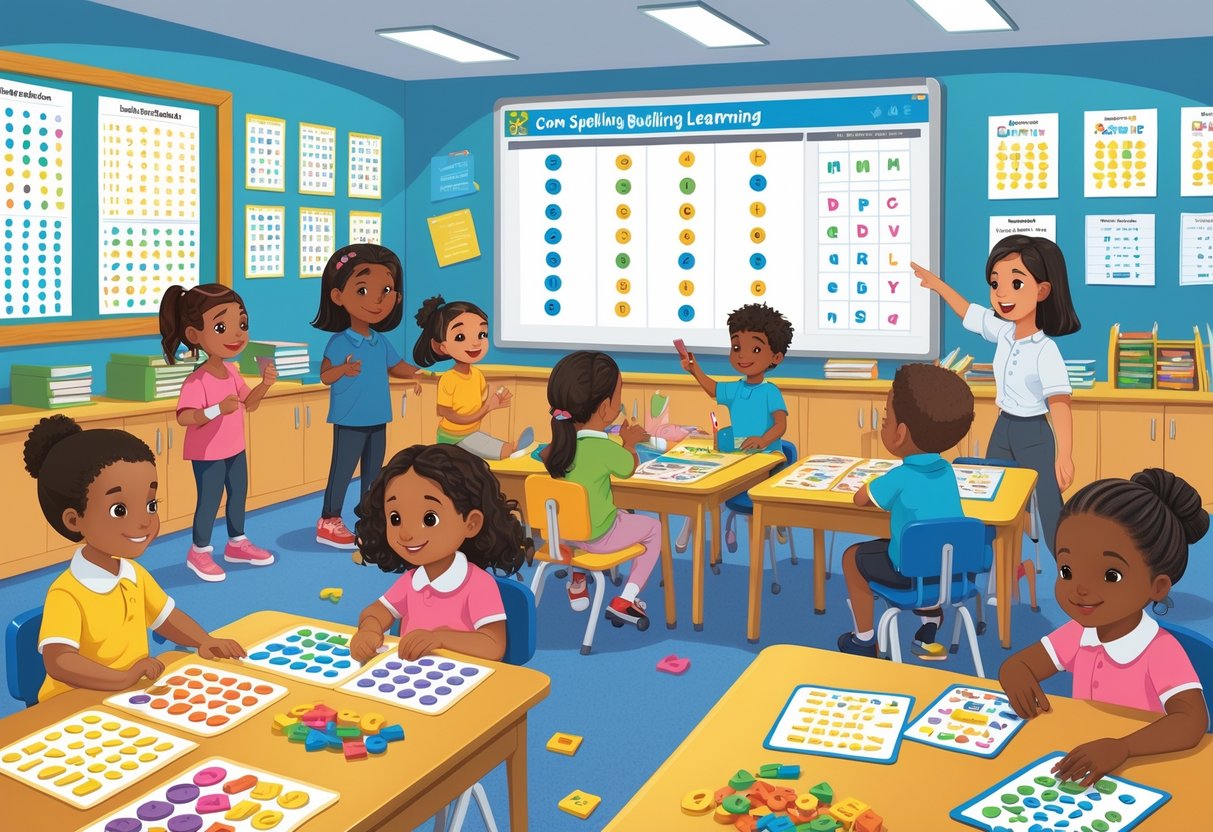
Interactive spelling games make practice lively and interactive. Use digital PowerPoints for the whole class, or set up physical games around the room.
Spelling bingo is a classic for any age. Make bingo cards with your weekly spellings and call out definitions or use the words in sentences. Children tick off the right word when they hear it.
Spelling relay races are another hit. Divide the class into teams. One child from each team runs to the board to write a spelling word. The next teammate can only go once the word is correct.
Hangman is always popular. It gets children thinking about letter patterns and word structure. You can make it easier or harder depending on the year group.
Group Activities and Spelling Challenges
Children learn a lot from working together. Partner activities let stronger spellers help those who need it, and everyone improves.
Try spelling ladders. Pairs take turns adding words that start with the last letter of the previous word. This builds vocabulary and reinforces spelling patterns. You could begin with “cat”, then “tap”, “pen”, and so on.
Word building challenges give children letter cards or magnets to make as many words as they can in a time limit. Change the rules up each round—maybe use a certain vowel sound or stick to a spelling pattern from the National Curriculum.
Rainbow writing is a colourful group task. Children write their words several times, using different coloured pencils for each letter. This repetition helps muscle memory and keeps things interesting.
Dictation and Word Hunt Tasks
Dictation helps children use spelling in real sentences. Read sentences aloud with your target spelling words and ask pupils to write them. This mimics the kind of writing they’ll do in other subjects.
Start with simple sentences for KS1, then move to longer ones for KS2. Check the work together and talk through any tricky bits.
Word hunts get children up and moving while practising spellings. Hide word cards around the classroom or even outside. Pupils look for the cards and write down each word they find.
You can link word hunts to your topic. If you’re teaching about Romans, hide words like ‘centurion’ or ‘gladiator’ for children to discover and spell.
Word Searches and Puzzles
Word searches can stand alone as activities or work well as homework. They help children spot spelling patterns by showing words in lots of directions.
You can create spelling activities and games that fit your class’s current spelling list. Crossword puzzles bring an extra challenge and make children think about word meanings as well as spellings.
This approach strengthens both vocabulary and spelling at the same time. Anagram challenges work well for older KS2 pupils.
Jumble up spelling words and let children unscramble them. Pupils have to pay attention to each letter in every word.
LearningMole has free spelling videos and printable resources, including puzzle-based activities for different year groups. Missing letter puzzles, where children fill in blanks, reinforce spelling patterns in a less formal way.
Worksheets, Handwriting and Independent Practice
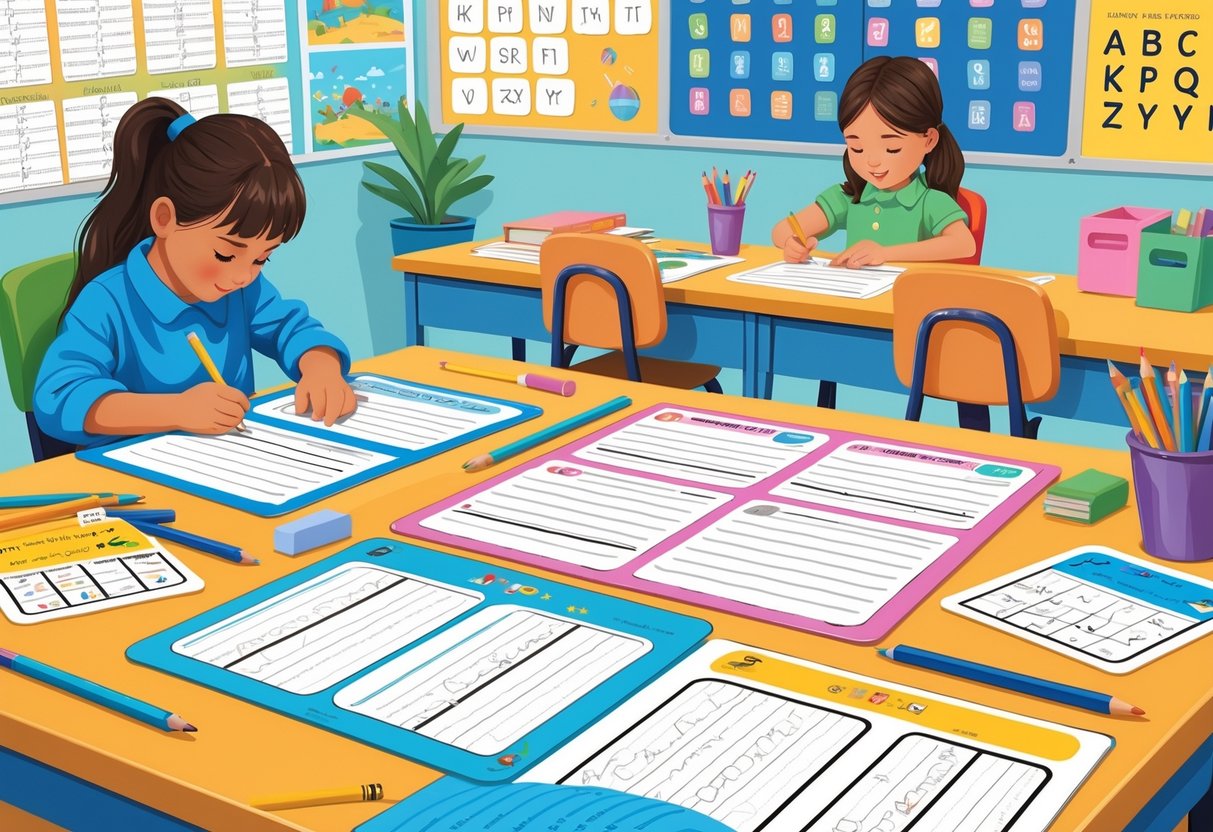
Worksheets give children structured chances to practise spelling patterns and rules. Handwriting practice sheets help them form letters correctly and develop a smooth writing style.
Both tools support independent learning at school and at home.
Printable Spelling Worksheets
Spelling worksheets give children repeated practice with words for Key Stage 1 and Key Stage 2. These sheets usually include fill-in-the-blanks, word sorting by spelling pattern, and sentence writing.
Many spelling worksheets for KS1 and KS2 include word pattern activities, dictation, and interactive tasks that reinforce specific rules. Choose worksheets that match the spelling goals for your class.
For Year 2, this could mean practising common exception words. In Year 5, you might focus on prefixes and suffixes.
Handwriting Practice Sheets
Handwriting practice sheets help children develop neat, readable writing while reinforcing spelling. Handwriting sheets for KS1 often combine letter formation with key spelling words.
Look for sheets that show how to form each letter, with clear starting points and arrows. Year 1 children usually focus on single letters, while Year 3 pupils work on joined handwriting.
Home Practice and Revision
Independent practice at home helps children remember spelling skills from class. Parents can use simple worksheets to review the week’s spelling list or focus on tricky patterns.
Effective home practice activities include:
Writing each word three times
Making sentences with spelling words
Sorting words by their pattern
Filling in cloze sentences with the right spelling
Send home worksheets that parents can use easily, even if they’re not teachers. Simple activities work best, like copying words, covering and writing from memory, or finding rhyming words with the same pattern.
Short, regular practice sessions of 10 to 15 minutes usually work better than longer, occasional ones.
Assessing Progress: Spelling Tests and Reviews
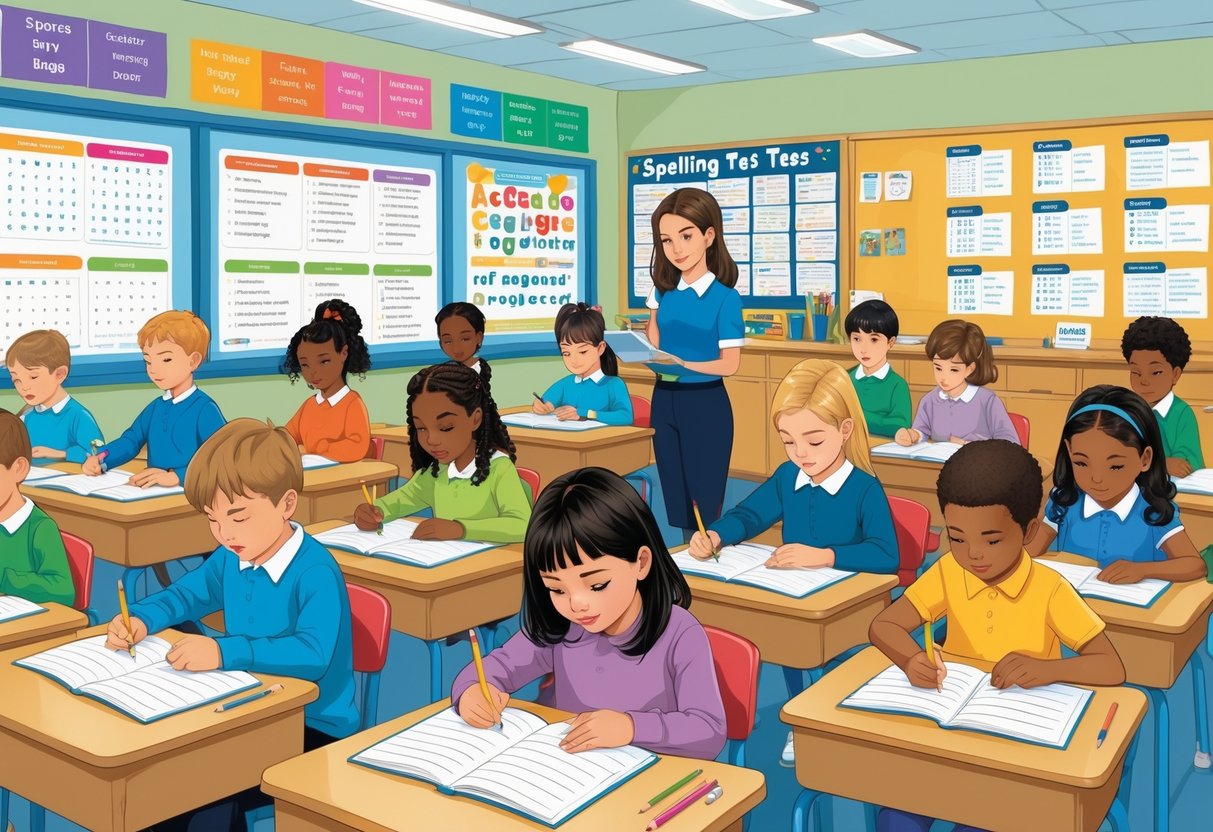
Regular spelling tests show how well pupils understand spelling patterns and remember new words. Try mixing formal tests with self-assessment activities for a clearer picture of each child’s progress.
Designing Effective Spelling Tests
Spelling test templates make it easy to organise weekly assessments. Create tests that match your current teaching focus, like Year 2 homophones or Year 5 suffixes.
Keep tests short and specific. Ten to fifteen words usually work for most age groups.
Choose words that reflect recent learning, not just random vocabulary. Include a mix of old and new patterns to check both memory and understanding.
Say each word clearly and use it in a sentence. This helps children understand context and reduces confusion, especially with homophones.
Give children enough time to write each word, maybe five to ten seconds per word. Mark tests quickly and talk about common mistakes with the class.
Look for patterns in errors, not just the number of wrong answers. If lots of pupils find a rule difficult, focus more teaching on that area.
Self-Assessment and Peer Review
Children learn more when they check their own spelling work. Teach them the look, say, cover, write, check method for independent practice.
They look at the correct spelling, say it aloud, cover it, write from memory, then check their attempt. Peer marking builds awareness too.
Pair pupils carefully so they feel comfortable correcting each other. Give them a word list or display words on the board for reference.
Create simple checklists for pupils to review their writing. Ask questions like “Have I checked words I’m unsure about?” and “Did I use my spelling journal for tricky words?”
These prompts help children take responsibility for their accuracy.
Record results so you can spot patterns over time. Simple spreadsheets work well, with columns for test dates and rows for each spelling pattern.
Highlight areas where pupils struggle so you can plan future lessons.
Key information to track:
Words spelled right on the first try
Common error patterns, like vowel mix-ups or suffix mistakes
Progress with statutory word lists for each year
Use of spelling rules in independent writing
Share progress with parents during termly updates. Focus on what children have achieved, like “Yasmin now spells words with the ‘tion’ suffix confidently.”
This helps families see what their child has learned and where they might need more practice.
Online and Printable Spelling Support Resources
Teachers and parents can find a wide variety of digital tools and downloadable materials to support spelling practice at home and in class. Many platforms offer interactive tests and traditional worksheets for specific spelling rules from the National Curriculum.
Top Online Spelling Tools and Websites
SpellingFrame stands out as a structured online platform. Pick a year group and spelling rule to access targeted word lists.
You can view, print or test words online with interactive exercises for patterns like adding suffixes or practising homophones. LearningMole provides curriculum-aligned videos and activities for KS1 and KS2 spelling, made by teachers for both classroom and home.
The platform includes free videos explaining spelling patterns and practice materials. Interactive online tests often have audio support, so children can hear the word or the full sentence.
This helps those who find reading tricky focus on spelling. Many sites also offer games that make practice more engaging, especially for younger children.
Downloadable Resources for KS1 and KS2
Printable spelling worksheets from teacher resource sites come with answer sheets and clear instructions for home use.
You’ll find activities for Year 2 homophones like there/their/they’re or here/hear, using pattern recognition and sentence exercises. Years 3 to 6 materials often have challenge sheets with multiple activity types.
Proof-reading tasks ask pupils to spot spelling, punctuation and grammar mistakes in longer texts. Some resources use themed graphics, like doughnuts, to teach tricky letter patterns such as ‘ough’ and its different sounds.
Educational resources usually combine explanations of spelling rules with worksheets that move from simple pattern spotting to creative sentence writing. Teachers can pick materials that fit each year’s requirements.
Cookies and Online Learning Considerations
Most educational websites use cookies to track progress and personalise learning. These small files remember which spelling rules a child has practised and their test scores.
Check cookie settings on any platform before children use it. Many sites need parental consent for data collection at home.
Some platforms offer cookie-free versions with fewer features but still give basic spelling practice without tracking. Schools usually manage cookie permissions through their IT systems.
Parents working on spelling practice at home should check each site’s policy and adjust privacy settings as needed.
Tips for Teachers and Parents Supporting Spelling
Building spelling skills takes patience, the right mindset and flexible approaches that suit each child. Success comes from celebrating progress, adapting methods to individual learning styles and building habits that last beyond primary school.
Encouraging a Positive Attitude Towards Spelling
You can turn spelling into an enjoyable challenge by celebrating small wins and taking away the pressure. Focus on effort and improvement, not just test scores, when children try difficult words.
Create a relaxed atmosphere in spelling lessons where mistakes help children learn. Many teachers have success with games and activities that make practice feel less like a chore.
Try word hunts, spelling bingo or team challenges for a bit of fun. Effective spelling strategies often mix multi-sensory activities with phonics.
This lets children connect with words in different ways, not just through memorisation. Try not to compare children with their peers.
Track individual progress over time so each child sees their own improvement. A personal spelling journal gives children a place to record words they’ve mastered, which can boost confidence.
When children see spelling as a skill they can build, they’re more likely to keep trying even when it’s tough.
Customising Resources for Individual Needs
Different children need different approaches, so adapt resources to match learning styles and abilities. Some children learn best by seeing patterns, others by writing words, or saying them out loud.
Common approaches for different learners:
Visual learners: Colour-coded rules, word walls, highlighting patterns
Auditory learners: Rhymes, songs, breaking words into syllables
Kinaesthetic learners: Writing in sand, air writing, building words with tiles
You can find custom word lists by year group and spelling rule to target tricky areas. For Year 2 pupils, focus on common homophones like there/their/they’re or to/too/two.
LearningMole offers free curriculum-aligned videos that explain spelling patterns and phonics rules in different ways. These support home learning or extra practice.
Keep an eye on which strategies help each child most and adjust as needed. What works for one Year 4 pupil learning suffixes might not suit another.
Fostering Lifelong Spelling Confidence
If you want children to build lasting spelling skills, show them strategies they can use on their own when they hit tricky words. Break words into syllables, spot familiar patterns and use phonics knowledge to tackle tough spellings.
Teach children to develop self-correction habits by practising proofreading. Try asking them to read their writing backwards, word by word. This simple trick helps them catch mistakes they’d usually miss.
Encourage them to circle any word they feel unsure about. They can check those later with a dictionary or an adult.
Give children chances to use new spelling words in their writing, not just in spelling tests. When they use these words in stories or factual writing, they remember them better.
Reading regularly also boosts spelling skills. Children naturally pick up correct word patterns from books.
Show children why spelling matters in real life. Chat about how spelling affects things like emails, job applications or even text messages.
When you admit that everyone misspells words sometimes and that checking is normal, you help children feel less anxious about mistakes. This builds their confidence and resilience.
Frequently Asked Questions
Teachers and parents often want practical advice on finding the right resources and tracking progress when teaching spelling to KS1 and KS2 pupils. Free worksheets, online activities and complete programmes can all support spelling development across the primary years.
What are some effective free printable exercises for KS1 and KS2 spelling practice?
Free spelling worksheets give children a chance to practise and test words from the National Curriculum Spelling List. These worksheets usually include five different activities. Children look at spelling patterns, spot mistakes and use their spellings in real sentences.
You can grab Year 2 spelling pattern word search packs with 25 worksheets. Each worksheet focuses on a different KS1 spelling pattern.
For KS2, Years 3-6 spelling review worksheets cover all the National Curriculum words. Two sets are available, each with three types of spelling challenges. Use them in lessons, as assessments or for homework.
Where can I find comprehensive spelling lists suitable for both KS1 and KS2 students?
The National Curriculum sets out statutory spelling lists for each year group from Year 1 to Year 6. These lists show what children should learn at each stage.
Year 2 includes special common exception words to master before KS1 ends. Years 3 and 4 share a combined list, as do Years 5 and 6, but with trickier words.
Resources specific to spelling word lists help you focus on the right words for each year group.
You can also find word-sorting activities for lower Key Stage 2. These split spellings into Y3 and Y4 patterns. Children discuss and sort word cards by pattern.
Can you recommend any engaging online spelling activities for primary school children?
LearningMole has curriculum-aligned videos supporting spelling across KS1 and KS2. Their free content covers English skills, including phonics and spelling patterns for ages 4-11.
BBC Bitesize offers KS1 spelling resources for adults, children, parents and teachers. Activities work at home or in class. Interactive tasks keep kids interested and help them build spelling confidence.
How can I track and measure the spelling progress of students at the KS1 and KS2 levels?
Regular spelling assessments help you see which patterns and rules children know. Weekly spelling tests are common, but they work best alongside writing tasks where children use their spellings in context.
Spelling intervention tools give you heatmaps showing exactly which rules each student understands. This visual info lets you plan support quickly and spot patterns across your class.
Assessment worksheets can help too. These include activities where children find mistakes, finish patterns or use target words in sentences. The different tasks show if children can spot, remember and use their spelling knowledge.
Are there complete spelling programmes available for free download that cover both KS1 and KS2 curricula?
Complete free programmes for every year group are rare. Still, you can put together a broad approach using free resources from several places.
Display packs for Year 2 through Year 6 show spelling patterns with example words and images. Packs include finished posters, blank templates and unlabelled versions for extra challenge. Each year group has its own pack that matches curriculum expectations.
Classroom resources often provide schemes of work alongside worksheets. In KS1, you’ll usually find four spelling sessions a week, each lasting about 20 minutes. This fits well with phonics teaching in most schools.
What interactive spelling games are recommended for consolidating spelling skills in KS1 and KS2 pupils?
Word spinners give children a hands-on way to practise common letter strings in one-syllable words. Kids turn the wheels and watch how different prefixes and suffixes create new words.
The spinners use colour coding to show which vowel each letter string starts with.
Spelling games and strategies can help children build spelling skills and avoid common mistakes. Offline and online games both support learning.
Card-sorting activities ask pupils to group words by spelling patterns. This approach gets them talking and helps them understand spelling rules better.
Crossword worksheets for Years 3-6 focus on spelling patterns and word meanings. These sheets help children use new words more confidently in their writing.
Each crossword sticks to a specific pattern. Answer sheets come with them, so kids can check their own work.
Maths Circus, an innovative platform we've crafted, presents a captivating realm where children learn mathematics through the exciting theme of a circus. The joy of juggling numbers and solving circus...
Mexican traditions blend the customs of ancient Mesoamerican peoples, such as the Aztecs and the Maya, with Catholic festivals brought by Spanish settlers in the sixteenth century. The result is...
The moose (Alces alces) is the largest member of the deer family alive today, and a fully grown bull can stand about 2 metres tall at the shoulder, which makes...






Leave a Reply