The interplay between light and shadows is a captivating subject that reveals much about the physics of light, the structure of objects, and the way our world is visually perceived. Shadows are a constant part of our daily lives, yet they often go unnoticed. The science of shadows is intertwined with various fields, such as physics, art, design, and technology. It helps us understand how shadows are formed, how they change with the position of light sources, and their practical applications in different areas, including sundials, eclipses, and the artistic techniques of chiaroscuro.
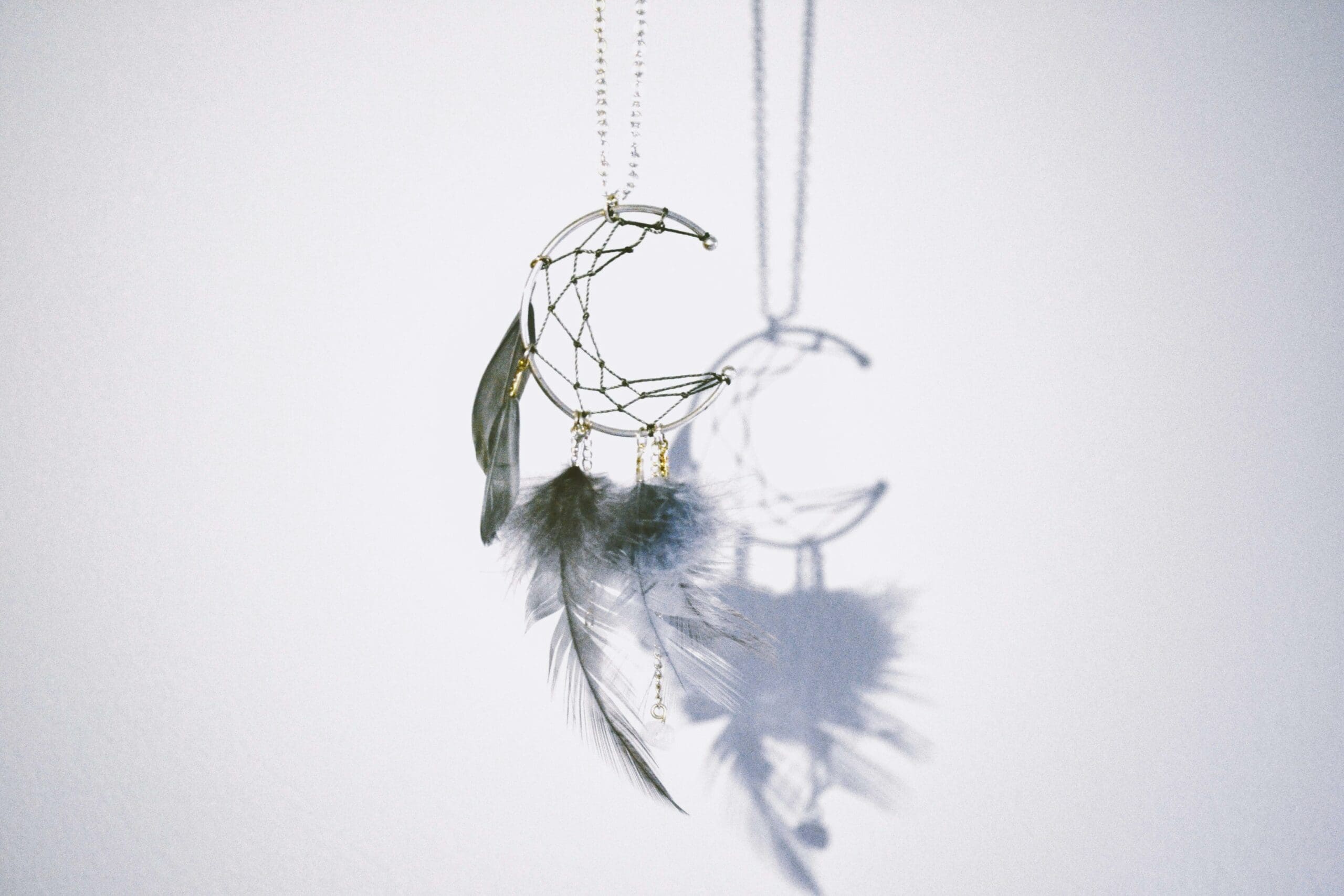
Science of Shadows: Hanging moon-shaped dreamcatcher
Our observation of shadows begins with understanding light itself – the primary reason for shadow formation. Be it the soft shadows cast by the morning light or the long silhouettes in the evening, every shadow tells a story about the angle and intensity of the light source.
This knowledge informs artists and designers in their work and aids scientists and educators in explaining complex concepts. For instance, observing the changing shape and length of a shadow throughout the day can provide insights into the way our planet rotates and moves around the sun.
Understanding Light and Shadows
In unravelling the science behind light and shadows, we observe that light is a form of energy that travels in waves and can be reflected from surfaces. When light from a light source such as the Sun or a lamp encounters an object, it behaves differently depending on the object’s material.
Transparent materials, like glass, allow most light to pass through, resulting in hardly any shadow. Like frosted glass, translucent materials let some light through but scatter it, creating a blurrier shadow. Opaque objects, which do not allow any light to pass through, create the clearest shadows.
The absence of light behind an opaque object is exactly what we perceive as a shadow. The angle and distance of the light source determine a shadow’s shape and size. For instance, light close to the object can produce a large, diffuse shadow, while distant light results in a smaller, sharper silhouette.
Our observations can be broken down into a simple list:
Light: Travels in waves, can be reflected.
Shadows: Formed by the absence of light behind an object.
Light Sources: The origin of light and its influence on shadow properties.
Transparent: Allows light to pass through, with negligible shadow.
Translucent: Allows some light through a soft-edged shadow.
Opaque: Blocks light completely, casting a defined shadow.
We encounter these principles regularly, whether when we see our own shadow on a sunny day or observe the shapes on the wall during a puppet show. Understanding these fundamentals helps us interpret our visual environment better.
The Science of Shadows
In our exploration of shadows, we’ll uncover the physics behind how light interacts with objects to create shadows, how colours play a role and the effects of changing the light’s position and source.
Properties of Light and Shadow Formation
Understanding shadows begins with grasping that light travels in straight lines, and when it encounters an object, it cannot pass through, casting a shadow. This shadow is a silhouette that takes on the shape of the object, mirroring its outline onto a surface opposite the light source. The size and sharpness of the shadow are directly influenced by the angle and position from which light strikes the object.
Reflect plays a role, too. Surfaces that are smooth and reflective can cause light to reflect and alter the visibility or softness of the shadow. An interactive example of shadow formation can be found through understanding how a light source determines the shape of an object’s shadow.
Colour and Light Interaction
Shadows are generally devoid of colour because they are areas from which light is completely absent. However, the surfaces on which shadows fall can sometimes reflect colours back into the shadowed area. The colour of the light source itself can also alter the hue of the shadow, adding a tint to the silhouette. Shadows are not only a lack of light but a complex interaction of light rays and materials.
Influence of Position and Source
The position of a light source changes the angle, length, and shape of a shadow. When light comes from a point source, the shadow is crisper, and as the light source gets wider, the edges of the shadow become blurrier. This is because each point on the light source creates its own shadow, and these overlap to create a soft edge, particularly evident in shadows from extended light sources as detailed in the history of science and conceptual change regarding light.
It’s fascinating how altering just the angle or position of light relative to the object can dramatically change the shadow it casts. It’s a dance between the shape of the object, its place, and where the light decides to fall.
Observing Shadows Throughout the Day
When we observe shadows, we see the beautiful interplay of sunlight and time manifest before our eyes. Our shadows evolve as the day progresses, providing clues to the sun’s position in the sky.
Tracking the Sun’s Movement
Throughout a sunny day, we can use shadows as a natural sundial to track the sun’s movement. At sunrise, the sun’s position at the horizon casts long shadows. As the sun climbs higher in the sky, our shadows shorten, reaching their minimum length when the sun is directly overhead or at its highest point, usually around noon. By tracking the changing shape and length of our shadow, we can estimate the time of day.
Length and Direction of Shadows
The length and direction of a shadow depend on the sun’s angle relative to the object casting the shadow. Early in the morning and late in the afternoon, shadows are longer because the sun is low on the horizon, and light travels across a greater distance.
Conversely, shadows appear much shorter around midday when the sun is high. The direction of a shadow moves in the opposite direction to the sun, so if you stand with your back to the sun in the morning, your shadow will point in front of you, changing direction towards your back as the sun sets.
Shadows in the Natural World
As we observe the natural world, we’ll notice that shadows are not just mere patches of darkness; they’re intricate phenomena that vary with time and celestial mechanics. The way shadows stretch and shift tells us a lot about our environment—from the time of day to the season we’re in.
Seasonal Variations of Shadows
During the year, as the Earth orbits the sun, the angle at which sunlight hits our planet changes. This causes shadows to lengthen in the winter months due to the sun’s lower position in the sky. We might notice that shadows are at their longest and most pronounced during the winter solstice, which is the shortest day of the year.
As the seasons transition to summer, shadows become shorter; during the summer solstice, they are at their shortest. This rhythmic change in shadow length and direction is a simple yet profound demonstration of the Earth’s tilt and its path around the sun.
Shadows Cast by the Moon and Planets
The moon, with its phases and eclipses, also casts shadows upon the Earth, offering us a different kind of light show. A lunar eclipse occurs when the Earth passes directly between the sun and the moon, casting a shadow and causing the moon to darken and sometimes appear red.
Likewise, when we look at the night sky, we can sometimes see shadows cast by other planets in our solar system. For instance, Jupiter’s moons cast tiny shadows on the gas giant’s surface, visible through powerful telescopes. Such shadows, though much fainter than those on Earth, remind us of the universal nature of light and shadow beyond our own world.
Interactions of Colour and Shadow
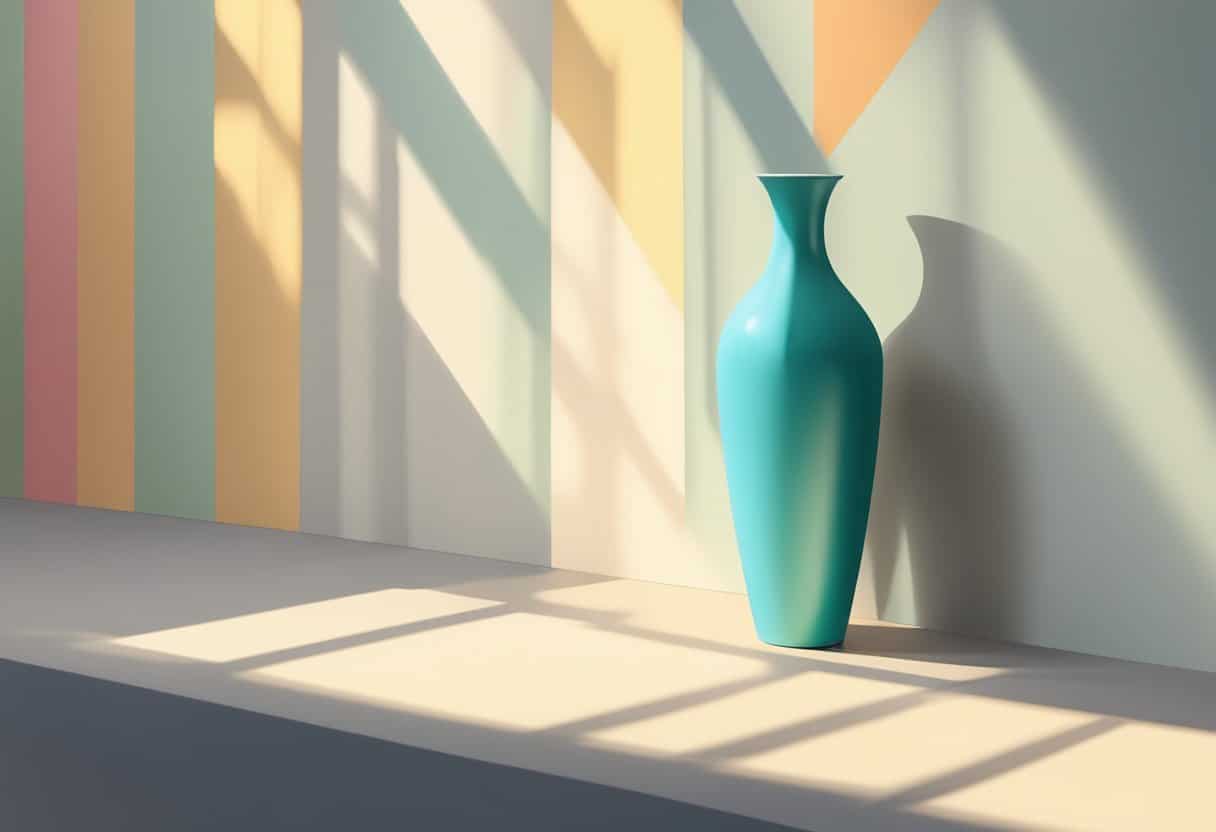
Science of Shadows: Vase
In the play of light and shadow, colours mix, match, and transform in fascinating, predictable and surprising ways.
Creation of Coloured Shadows
When light sources of different colours shine on an object, the shadows cast can contain a spectrum of hues. It’s a curious optic occurrence: cast a red light, and you may see a shadow tinged with green—its complementary colour. Filters play a pivotal role here; passing white light through a coloured filter directly impacts the colour of the shadow produced.
Using Filters and Light
Employing filters of various colours over a light source can dramatically alter the appearance of shadows. For example, a red filter will let through red light while absorbing other colours. When objects intercept this filtered light, it can create coloured shadows with distinct edges and shapes. The interaction between the colour of the filter and the coloured shadows is a fundamental principle in the science of light.
Through these interactions, we unlock a deeper understanding of the interplay between light, colours, and shadows, revealing much about our visual perception and the nature of light itself.
The Role of Shadows in Art and Design
In the realm of art and design, shadows are not mere absences of light but are instrumental in creating depth, contrast, and atmosphere. Shadows are a powerful tool for artists and designers, allowing them to add a sense of realism and volume to their work. Skilfully manipulating shadows can imply texture, shape, and movement, giving life to two-dimensional images.
When it comes to the arts, the interplay of light and shadow can produce dramatic effects. Shadows can soften or harden the contours of an object, and in the deft hands of a shadow maker, they can play with our perceptions and bring layers of meaning to a piece. This contrast that shadows provide is essential in highlighting the parts of an image we want to draw attention to, making them appear to leap off the canvas or screen.
In design, shadows are not limited to visual artistry but are also at play in three-dimensional space. They can be strategically designed to animate and shape space in architecture, adding dynamism to what might otherwise be static environments. The use of light and shadow can also direct focus in interior design, guiding one’s gaze to the architectural elements and furnishings intended to make a statement.
Here are a couple of entities within the spectrum of shadows’ influence in art and design:
Art: Using shadows to create illusionary depth in paintings or drawing attention to certain elements.
Images: Enhancing the contrast and richness of photographs or graphic designs.
Overall, shadows are key in creating a visual rhythm, guiding the eye, and shaping experiences, making them invaluable to the creative process.
Scientific Inquiry and Experiments
As we delve into the science of shadows, understanding the methodological approach through scientific inquiry and experiments is essential. We’ll explore how variables, prediction, and data analysis play pivotal roles in experiments relating to shadows and light.
Conducting Shadow Experiments
When we conduct shadow experiments, we’re engaging in a systematic investigation that allows us to observe the relationship between light, objects, and the shadows they produce. A common experiment may involve varying the variables, such as the light source’s distance and angle relative to an object, to observe changes in shadow length and sharpness. Prior to starting the experiment, we write down our predictions about what we think will happen, which serves as a hypothesis to test against our data.
Materials: Light source, object to cast shadows, measuring tool, paper to record results.
Procedure:
Place the object at a fixed distance from a light source.
Measure the shadow cast.
Vary the light source’s distance and angle.
Note any changes in shadow length and orientation.
Prediction and Data Analysis
After conducting shadow experiments, we focus on the data analysis phase. This is where we compare our initial predictions to what actually occurred during the experiment. We may create graphs or tables to visualise our findings more clearly, helping us identify patterns or correlations between the variables we manipulated and the characteristics of the shadows. The analysis process is crucial, as it allows us to draw meaningful conclusions from our investigation and understand the underlying principles affecting shadow formation.
Data Table Example:
Light Angle (Degrees)
Shadow Length (cm)
45
10
60
8.5
90
5
Science of Shadows
Through rigorous experimentation and meticulous analysis, we strengthen our grasp of scientific principles and enhance our investigative skills.
Educational Perspective on Light and Shadows
In our journey of illuminating young minds, we recognise the profound impact that understanding the science behind light and shadows has on learners’ engagement in STEM. Below, we explore the transformative ways through which education can shape students’ grasp of these essential science concepts.
Teaching the Science Concepts of Shadows
We begin by integrating foundational knowledge from the New Zealand Curriculum to develop a comprehensive understanding of light and shadows. Our learners ask pertinent questions: How does light travel? What causes a shadow to form?
Through these inquiries, we build their science concepts, encouraging investigations into the interplay between light sources, objects, and the resultant shadows. By incorporating play and practical activities, we see concepts like transparency and the shape of shadows come to life, enhancing our students’ learning experiences.
Learning Through Play and Experiments
We strongly believe in the power of play and experiments to cement scientific understanding. In our classrooms, we foster environments where young learners can engage in hands-on activities, crafting experiments that reveal the nuanced relationships between light intensity, object position, and shadow characteristics. Building science concepts through interactive and playful investigations deepens our learners’ knowledge and nurtures their curiosity and critical thinking skills within a STEM context.
Understanding Eclipses
We’re about to explore the fascinating interplay between light and shadows that creates two of the most captivating phenomena observable with the naked eye: solar and lunar eclipses. Eclipses occur due to the alignments of the Earth, Moon, and Sun, producing amazing displays for us on Earth.
Solar and Lunar Eclipses
Solar Eclipses happen when the Moon passes between the Earth and the Sun, casting a shadow over the Earth and sometimes completely blocking the Sun’s light. During a total solar eclipse, the day briefly turns into night as the Moon covers the Sun entirely. On the other hand, a partial solar eclipse is seen when the Moon only partially obscures the Sun, and a ring of fire is visible in an annular eclipse when the Moon is too far to cover the Sun completely.
Lunar Eclipses occur when the Earth is between the Sun and the Moon, and the Earth’s shadow falls on the Moon. A total lunar eclipse is when the Earth completely obscures direct sunlight from reaching the Moon, giving it a reddish colour, often referred to as a ‘blood moon’. A partial lunar eclipse is seen when only a section of the Moon enters Earth’s shadow.
Eclipsing Bodies and Visibility
The visibility of an eclipse depends on the geometrical alignment of the Sun, Moon, and Earth. During a solar eclipse, the alignment must be very precise for the shadow to fall on Earth. It’s a remarkable coincidence that the Sun and Moon appear to be almost the exact same size in our sky, making total solar eclipses possible.
For a lunar eclipse to occur, we require a full moon as well as for the Earth, Sun, and Moon to be nearly in a straight line. Unlike solar eclipses, which can be seen along a narrow path on Earth’s surface, lunar eclipses can be viewed by anyone on the night side of the Earth.
Remember that every eclipse is an opportunity to see the basic principles of light and shadows play out on a cosmic scale. These celestial events demonstrate the predictable yet profound ways in which our solar system’s bodies interact with light, giving us both day and night and, occasionally, these striking astronomical shows.
Practical Applications of Shadows
When we explore the practical use of shadows, we often find ourselves tapping into ancient science concepts as well as implementing cutting-edge building science. With thought-provoking applications in both prediction and architecture, shadows become invaluable tools in our daily lives, especially within the context of the United States’ efforts to refine urban spaces and our navigation techniques.
Shadow-Based Predictions and Navigations
We utilise shadows as a dependable source for prediction and navigational purposes. Historic methods, like the use of sundials, have paved the way for understanding time and the apparent movement of the sun across the sky. Today, in the United States, shadows are critical in assisting pilots and navigators in determining the local solar time and their position.
Consider this simple application: when the shadow of an object is at its shortest, it indicates solar noon. These trace steps help us predict certain natural events with far more precision, providing an easy and resourceful means of orienting ourselves during expeditions or everyday life.
Shadows and Building Science
In building science, architects incorporate the science of shadows into their designs to cater to both aesthetics and function. Effective architectural plans significantly consider how shadows fall on buildings and impact eco-friendly designs. We use detailed tables to calculate the angle of sunlight and predict how shadows cast by structures will interact with their surrounding environment. Here’s how we might depict shadow calculations for a new building:
Time of Year
Sun Angle
Shadow Length (feet)
Winter
Low
Long
Summer
High
Short
Science of Shadows
Through these careful analyses, we optimise natural light within buildings, enhance energy efficiency, and improve occupant comfort. Moreover, we design outdoor spaces to create desirable shadow patterns for recreation and leisure at different times of the day.
Understanding and applying shadow studies is integral to fostering sustainable and comfortable living environments in urban development. Our approach to integrating shadow considerations in architecture elevates the quality of urban life and encapsulates a harmonious balance between man-made structures and natural elements.
Exploring Shadows with Technology
Technology plays a pivotal role in our quest to understand the interplay of light and shadows, offering innovative ways to simulate and visualise these phenomena.
Simulations and Projected Imagery
Through simulations, we use software to model how light waves interact with objects, creating shadows. This technology often involves a screen where the results are displayed, offering a visual representation of shadows in various conditions of light and darkness.
It serves as an effective educational tool, especially when investigating shadows and their properties. Simulated environments enable us to manipulate variables such as light intensity and angles, observing resultant shadow behaviours without needing a physical setup.
Shadow and Light in Modern Media
The portrayal of shadow and light has dramatically evolved in modern media. Films and video games leverage projectors and advanced rendering techniques to create immersive experiences. Projection mapping, for example, uses projectors to cast imagery onto 3D objects, transforming them with light and shadow in real-time.
This technique plays with our alternative conceptions of shadows, often blending reality with illusion. Additionally, in contemporary visual art, artists explore the narrative potential of shadows, using them to elicit emotion or convey deeper stories.
Frequently Asked Questions
In this section, we’ll explore some common inquiries about the science of shadows, referencing how light creates varying shapes through its interaction with objects, as well as some relevant classroom strategies to enrich students’ understanding.
How do light and shadow interact to create shapes?
When light encounters an opaque object, it creates a shadow by blocking the light’s path. This interaction results in a shape on the surface opposite the light source that mirrors the silhouette of the object.
Can you suggest some simple experiments to demonstrate the principles of light and shadow?
Certainly! You can use a light and shadow experiment to understand how the position and distance of a light source relative to an object change the shadow’s size and sharpness.
What role do objects play in the formation of shadows?
Objects are integral in shadow formation. An opaque object blocks part of the light, while the space where the light isn’t blocked remains illuminated, thus creating a shadow.
What are some everyday examples that illustrate the concept of light and shadow?
Examples include the lengthy afternoon shadows caused by the low angle of the sun or the small, faint shadows beneath a tree’s leaves, where tiny gaps between leaves allow some light to pass through.
How do the angles of the light source affect the size and shape of shadows?
The light source’s angle determines a shadow’s length and orientation. A low angle creates long shadows, while a high angle shortens them. If the light is directly above, the shadow will be the smallest.
What are the key principles of shadow study in the context of science education?
These involve understanding the properties of light, the behaviour of shadows with different light sources, and observing shadows to glean scientific facts related to light phenomena.
Maths Circus, an innovative platform we've crafted, presents a captivating realm where children learn mathematics through the exciting theme of a circus. The joy of juggling numbers and solving circus...
Foreword A child may be confident using a smartphone to chat on messaging apps or find videos on YouTube. However, they may not understand why certain content appears on their...
Mammals are animals with a backbone that breathe air through lungs, have hair or fur at some stage of life and feed their young on milk. Scientists sort every mammal...
Norse mythology creatures range from Jörmungandr, a serpent long enough to circle the human world, to Ratatoskr, a gossiping squirrel on a giant tree. This guide explains 13 of them...






Leave a Reply