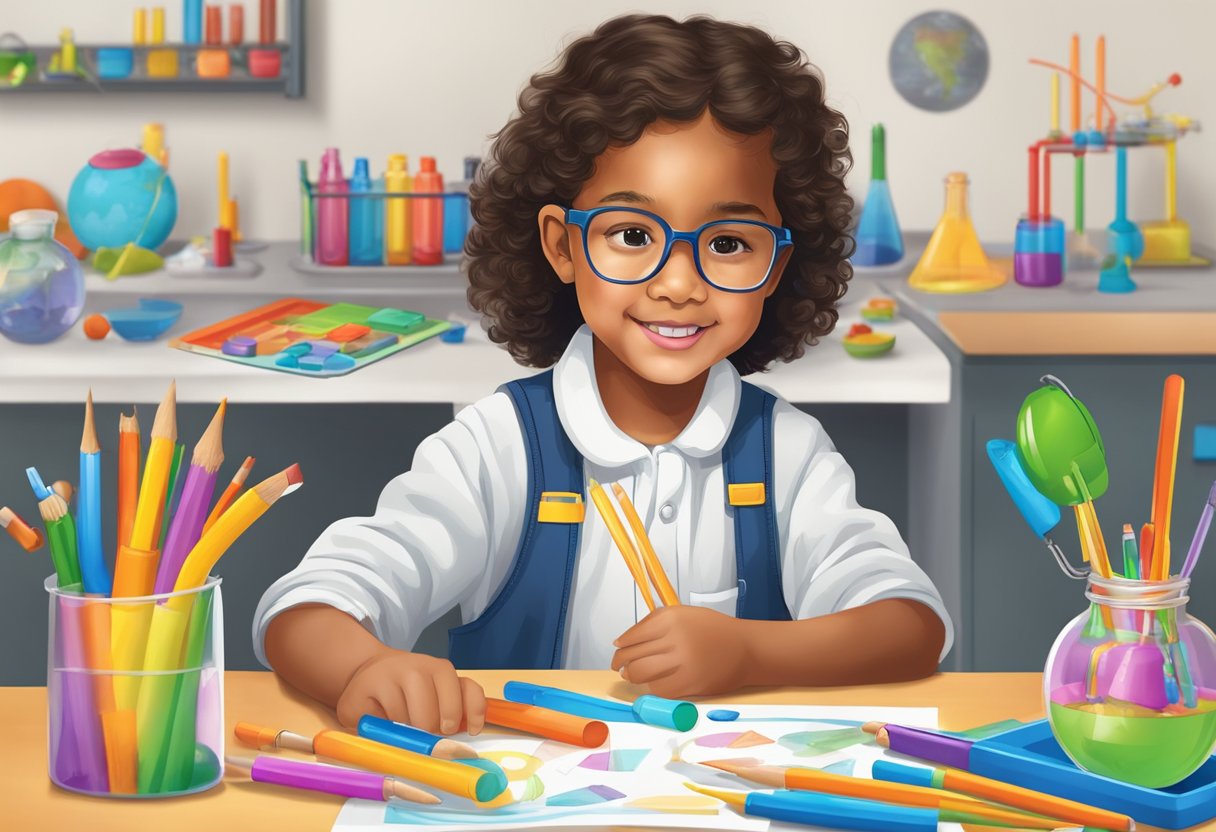
Science Kits for 4-Year-Olds: Four-year-olds are magnificent scientists in their own right. Watch them explore a puddle, examining how their reflection appears and disappears, testing which objects float and which sink, splashing to observe water’s behaviour—and you’re witnessing the scientific method in action. They form hypotheses (“I think this stick will float”), conduct experiments (placing the stick in water), observe results (it floats!), and eagerly try variations (“What about this rock?”).
This natural curiosity represents the same impulse driving professional researchers, and it’s a precious window that deserves nurturing rather than waiting until formal schooling begins. Science kits explicitly designed for 4-year-olds harness this innate inquisitiveness while respecting their developmental capabilities, creating positive early experiences with STEM that can shape their entire educational trajectory.
The benefits of introducing science concepts at age four extend far beyond memorising facts about animals or planets. Early science experiences build observation skills, encourage question-asking, develop vocabulary, strengthen fine motor abilities, teach cause-and-effect reasoning, and, most importantly, establish science as something fun and accessible rather than complicated and intimidating.
Children who explore science through play at the age of four approach kindergarten and elementary school science with enthusiasm and confidence, rather than anxiety. They’ve already learned that they can understand how things work, that their questions matter, and that discovery brings joy. These foundational attitudes about learning prove at least as valuable as any specific knowledge gained.
Understanding the 4-Year-Old Learner
Before selecting science kits for 4-year-olds, understanding their developmental characteristics ensures choosing appropriate materials that engage rather than frustrate. Cognitively, 4-year-olds think very concretely—they understand what they can see, touch, hear, smell, and taste far better than abstract concepts. Telling a 4-year-old that “air is made of molecules” means nothing, but letting them feel air rushing from a balloon as it deflates creates an understanding they can grasp. The best science kits for this age make invisible concepts visible and abstract ideas concrete through direct experience.
Their language skills are expanding rapidly, with typical 4-year-olds understanding about 1,500 words and speaking in complete sentences of 4-6 words. They’re endlessly curious, asking “why” repeatedly as they try to understand their world. This question-asking phase makes four an ideal age for science introduction—they’re already primed for scientific inquiry. However, their understanding of time remains limited (“yesterday” might mean last week or last month), and they think quite literally, so metaphors and analogies often confuse rather than clarify.
Physically, 4-year-olds have developed considerable coordination. They can manipulate objects with increasing precision, pour liquids with moderate accuracy, use child-safe scissors, and work with materials that would have frustrated them at age three. However, very small components still pose challenges, and activities requiring steady hands for extended periods exceed most 4-year-olds’ capabilities. Fine motor skills are still developing, making durability important—components need to withstand the somewhat rough handling typical at this age.
Attention spans at four typically range from 8 to 15 minutes for structured activities, although children can engage for much longer with self-directed play involving topics that fascinate them. This means that science activities should be designed for brief, complete sessions rather than extended experiments that require sustained focus. Multiple short activities are often more effective than one lengthy project.
Safety awareness at this age is emerging but incomplete. Four-year-olds understand basic rules like “don’t put things in your mouth”, but they lack the impulse control and risk assessment to follow these rules without supervision consistently. They need active adult involvement during science activities, both for safety and for maximising learning through conversation and guidance.
What Makes a Good Science Kit for 4-Year-Olds
Selecting quality science kits for preschoolers requires evaluating several crucial factors that differ significantly from the criteria for older children.
Safety as Non-Negotiable Foundation
Safety features must be absolute for 4-year-old science kits. All materials should be non-toxic—if components accidentally enter mouths (and they will, despite rules), they must pose no health risks. Components should be large enough to prevent choking hazards, typically requiring pieces to be larger than a toilet paper tube’s diameter. Sharp edges, points, or small parts that could detach should be completely absent.
Tools included should be genuinely child-safe, not just smaller versions of adult tools. Child-safe magnifying glasses, plastic tweezers, and unbreakable containers work well. Avoid kits requiring batteries accessible to children, heating elements, or any electrical components. Chemical reactions should be limited to the gentlest combinations—vinegar and baking soda represent about as adventurous as chemistry should get at this age.
Adult supervision remains essential regardless of the kit’s safety features. Four-year-olds simply cannot be trusted to remember rules consistently or recognise all potential hazards. The supervision requirement should be stated clearly on packaging and instructions, and kits should be designed assuming an adult will actively participate rather than just observe from across the room.
Instructions Designed for Pre-Readers
Since most 4-year-olds cannot yet read fluently (if at all), instructions must rely heavily on visual communication. The best kits feature large, clear photographs or illustrations showing each step. These images should be simple and uncluttered—a photograph showing the specific action required rather than a busy scene requiring children to identify the relevant detail.
Minimal text should accompany visuals, serving primarily to guide adults who will help children. When text is included, it should use simple vocabulary and short sentences. Numbered steps help adults and children track progress through activities. Some excellent kits include both a detailed parent guide with explanations of scientific concepts and simplified visual instructions children can follow with adult support.
Video tutorials accessible via QR codes or websites provide another layer of support, allowing children to watch demonstrations before attempting activities themselves. The combination of written, visual, and video instructions accommodates different learning styles while ensuring success.
Immediate, Visible Results
Four-year-olds need relatively immediate gratification to maintain engagement. Experiments producing results within minutes work far better than those requiring hours or days of waiting. A seed that sprouts in three days tests the outer limits of a 4-year-old’s patience; one requiring two weeks exceeds it entirely for most children this age.
Results should be clearly observable—colour changes, movement, transformation from one state to another, or creation of something new. Subtle differences or results requiring measurement often go unnoticed by 4-year-olds focused on dramatic, obvious changes. The satisfying fizz of a vinegar and baking soda reaction, the visible separation of colours in chromatography, or the immediate change when ice melts into water all provide the concrete, observable results 4-year-olds can appreciate and learn from.
Types of Science Kits Perfect for 4-Year-Olds
Nature and Living Things Exploration
Nature science kits align perfectly with 4-year-olds’ interests and capabilities. Bug-catching viewers with magnification allow for close observation of insects safely captured outdoors, then released unharmed, teaching both biology and compassion. The best viewers feature dual magnification lenses and secure lids with air holes, allowing children to observe for a few minutes before releasing their specimens.
Plant growing kits work if they feature fast-growing varieties like beans or grass. Children can observe daily changes, watering their plants and watching growth happen in real-time, rather than requiring weeks of patient waiting. Small greenhouse kits with clear covers let children observe roots developing underground alongside visible plant growth, making typically hidden processes observable.
Magnifying glasses represent perhaps the most versatile nature science tool for 4-year-olds. With adult guidance, they can examine leaves, flowers, bark, insects, rocks, fabric, skin—anything that becomes more interesting under magnification. Look for magnifying glasses with large lenses (3-4 inches in diameter) and sturdy handles sized for small hands.
Simple, Safe Chemistry
Chemistry for 4-year-olds focuses on visually engaging, safe reactions using household materials or pre-measured, non-toxic substances. Colour mixing represents perfect 4-year-old chemistry—combining primary colored liquids or adding food colouring to water demonstrates that mixing substances creates something new while teaching colour theory. The best colour mixing kits include clear containers, primary colored liquids, droppers for controlled mixing, and guides showing which combinations create which colours.
Bubble and foam science fascinates this age group. Kits that explore how bubbles form, the shapes they create, and how to make the largest bubbles possible teach about surface tension and air in tangible ways. Foam-producing reactions—created through safe detergent and agitation combinations—demonstrate chemical and physical changes while engaging children’s love of textures and transformations.
Dissolving experiments show that some substances disappear into water while others don’t. Providing sugar, salt, sand, and oil to try dissolving teaches observation and comparison skills while introducing solubility concepts (though children needn’t learn that term). The visual drama of substances vanishing into water or stubbornly remaining separate captures attention while building understanding.
Physics Made Simple
Physics kits for 4-year-olds make forces tangible through play-based exploration. Ramp and rolling object sets let children test how different balls, cars, or cylinders behave on inclines. They discover through trial that steeper ramps make objects roll faster, that heavier objects sometimes behave differently than lighter ones, and that smooth surfaces produce different results than rough ones. These observations help build an intuitive understanding of physics years before they encounter formal physics education.
Magnet exploration kits designed for this age include large, safe magnets plus collections of objects to test—which does the magnet attract and which does it ignore? This sorting activity fosters scientific thinking as children categorise objects (magnetic vs. non-magnetic) based on observed properties. Advanced activities might include using magnets to move objects without touching them or exploring how magnets interact with each other.
Balance and stacking activities teach about the centre of gravity, balance, and stability through hands-on building. While 4-year-olds won’t understand these formal concepts, they develop an intuitive sense of what balances and what topples through experimentation. Kits with various shapes and weights let children discover principles through play.
Setting Up for Science Success with Preschoolers
Creating an Appropriate Science Space
Designating a science-friendly area makes activities easier to manage. This doesn’t require a dedicated room—a corner of the kitchen table, a spot on the floor covered with a plastic tablecloth, or even a section of the bathtub works well. What matters is having a predictable location where experiments happen and where cleanup is straightforward.
Cover surfaces with materials that protect furniture while allowing easy cleanup. Plastic tablecloths, vinyl placemats, large trays with edges, or even cut-open garbage bags spread flat all work. Having defined boundaries helps children understand where materials should stay, containing mess to manageable areas.
Store science materials in accessible containers at child height, allowing children to help with setup and cleanup. Clear plastic bins work well, letting children see contents without opening everything. Label containers with pictures rather than just words—a photograph of magnifying glasses on the container holding magnifying glasses helps pre-readers identify contents and return items to proper places.
Keep cleaning supplies readily available. Paper towels, wet wipes, and a small basin of soapy water for washing hands should be within easy reach. Making cleanup part of the activity rather than a chore teaches responsibility while ensuring materials stay organised for future use.
The Critical Role of Adult Participation
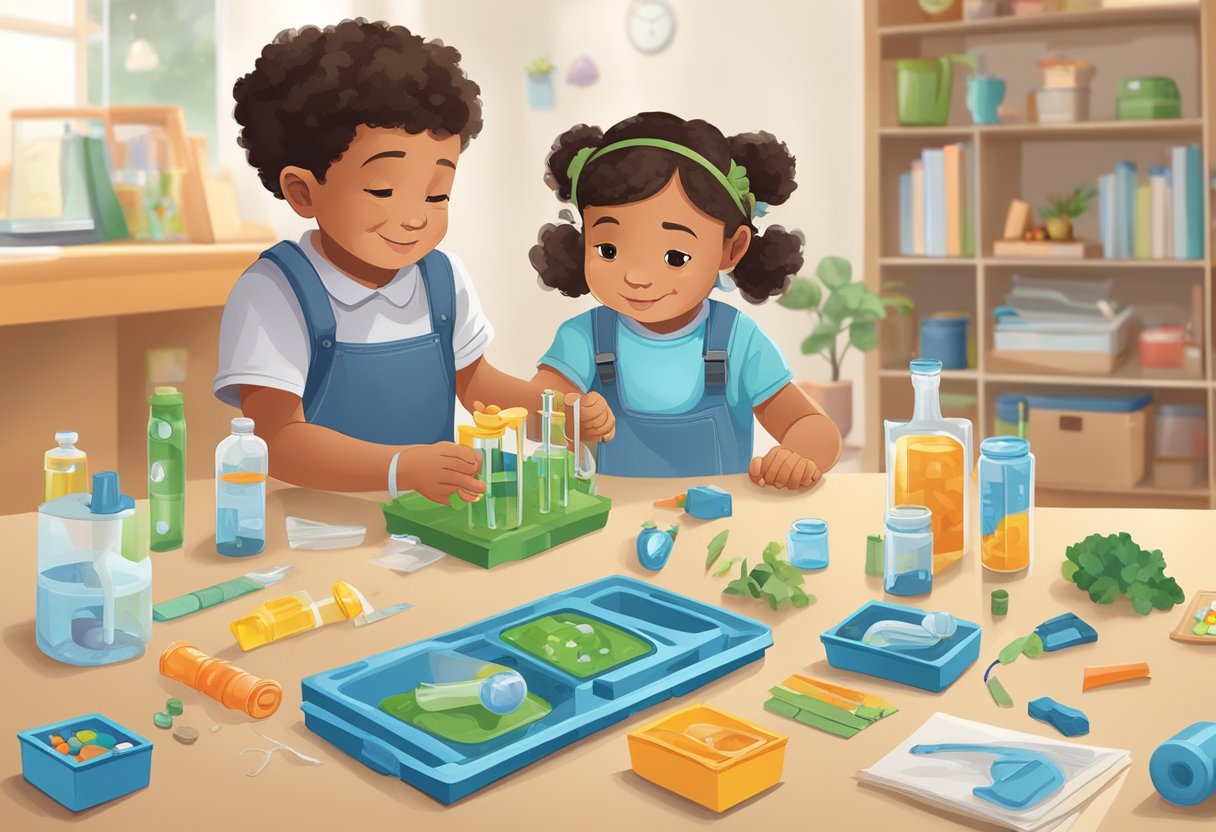
Science activities for 4-year-olds should never be solitary experiences. Adult participation transforms simple activities into rich learning opportunities through conversation, questioning, and shared discovery. The adult’s role isn’t to lecture or control but to guide, observe alongside the child, and help articulate what’s happening.
Asking open-ended questions encourages scientific thinking: “What do you notice?” “What do you think will happen if we add more?” “Why do you think that happened?” These questions prompt observation and reasoning without a single correct answer, which helps children avoid the fear of being wrong. Following the child’s curiosity matters more than completing every planned activity—if they’re fascinated by one aspect of an experiment, explore that deeply rather than rushing through a checklist.
Celebrating observations and attempts matters as much as celebrating correct conclusions. When children notice details—”The blue turned green!”—enthusiastic acknowledgement reinforces that observation itself is valuable. When experiments don’t work as expected, treating this as interesting rather than a failure teaches that unexpected results provide learning opportunities, not disappointments.
Managing frustration requires reading children’s signals. When engagement turns to distress, it’s time to simplify, offer help, or transition to something else. Pushing through frustration rarely produces learning at this age—it just creates negative associations with science activities.
Benefits Beyond Science Knowledge
While science concepts matter, the broader skills developed through early science experiences prove equally valuable. Observation skills sharpen as children learn to notice details, changes, and patterns. These skills transfer to reading readiness (noticing letter differences), math (identifying patterns), and social-emotional learning (reading facial expressions and body language).
Language development accelerates through science activities rich with new vocabulary and concepts to describe. Words like “dissolve,” “attract,” “observe,” “experiment,” and “discover” expand verbal repertoires alongside descriptive terms for properties, actions, and observations. Explaining what they notice and predicting what might happen builds narrative and reasoning language crucial for literacy development.
Fine motor skills are strengthened through the use of science tools—manipulating droppers, using tweezers to pick up specimens, pouring liquids carefully, or adjusting the focus of magnifying glasses. These same skills support writing readiness, self-care tasks like buttoning and zipping, and art activities.
Patience and persistence develop as children work through multi-step activities, wait for results, or try again when first attempts don’t work as expected. These executive function skills predict school success more reliably than early academic knowledge, making them valuable outcomes of science exploration.
Common Challenges and Solutions
Managing Short Attention Spans
Rather than fighting 4-year-olds’ natural attention limitations, design science experiences around them. Plan for 10-15 minute activities rather than hour-long sessions. Have multiple activities prepared so when interest in one wanes, you can smoothly transition to another. Better to have three 10-minute experiments over three days than force one 30-minute session that becomes a battle.
Stop while children still want more, rather than continuing until they’re completely done. This “ending on a high note” approach keeps them excited about science rather than viewing it as something tedious that goes on too long. They’ll return more eagerly to activities associated with fun that ended before they were tired of it.
Cleanup and Mess Management
Accept that mess and science often go together, but a manageable mess differs from chaos. Clearly defined workspaces, protective coverings, and immediate cleanup of spills contain disorder to reasonable levels. Make cleanup part of the activity rather than a separate chore—sorting materials back into containers can itself be a categorisation activity.
Use materials that wash easily. Washable paints, food colouring that rinses away, and activities using water rather than permanent substances allow cleanup without stress. Having a cleanup routine—”When we’re done, we wash our hands, dry the table, and put materials away”—teaches responsibility while normalising cleanup as part of the process.
Conclusion
Science kits and activities for 4-year-olds plant seeds that may not flower for years but establish roots that support lifelong learning. When we provide age-appropriate science experiences during the preschool years, we’re not just teaching facts about mixing colours or growing plants—we’re teaching that the world is knowable, that their questions matter, that observation and experimentation reveal understanding, and that science is something they can do. These messages shape how children approach formal science education in elementary school and beyond.
The investment required is modest—basic science materials cost less than many toys while providing richer developmental benefits. The time commitment is manageable, with most activities taking 10-15 minutes. And the payoff is immeasurable: children who explore science joyfully at age four enter kindergarten with curiosity intact, confidence in their ability to figure things out, and enthusiasm for learning that carries them through challenges ahead.
Start simple. Choose one activity or kit that matches your 4-year-old’s current interests—whether that’s bugs, plants, mixing colours, or making things move. Set aside a morning or afternoon to explore together. Follow their lead, ask questions, share their excitement about discoveries, and don’t worry about covering every planned activity. The goal isn’t completing a curriculum but fostering wonder, building positive associations with scientific thinking, and spending quality time exploring together.
The world is full of wonders waiting to be discovered, and four-year-olds are perfectly positioned to begin that journey of discovery. With the right tools, supportive guidance, and freedom to explore, these young scientists will amaze you with their observations, delight you with their questions, and remind you that approaching the world with curiosity and wonder is one of childhood’s greatest gifts—one we can nurture, celebrate, and help carry forward into their futures. So gather some materials, clear a space, and start exploring. The laboratory of learning awaits, and your 4-year-old scientist is ready to begin.
Maths Circus, an innovative platform we've crafted, presents a captivating realm where children learn mathematics through the exciting theme of a circus. The joy of juggling numbers and solving circus...
Article Summary What this article covers: How UK teachers and parents can choose educational blogs that are worth following, with a simple vetting checklist and what to look for in...
Every continent has its own shape and its own record-breaking features. That is why explaining continents to kids is such a good way into world geography. In UK primary schools,...
Article Summary What this article covers: Facts about Mars for kids, including why it is red, its mountains, canyons, atmosphere, seasons and two moons, the rover missions exploring it today...








Leave a Reply