Prepositions of Place: In, on, at
Prepositions of place are used to refer to a place where something or someone is located. They usually come before a noun. They are specifically used to describe a place. There are three basic prepositions of place, however, they can be used to discuss an almost endless number of places:
Preposition Number 1: In
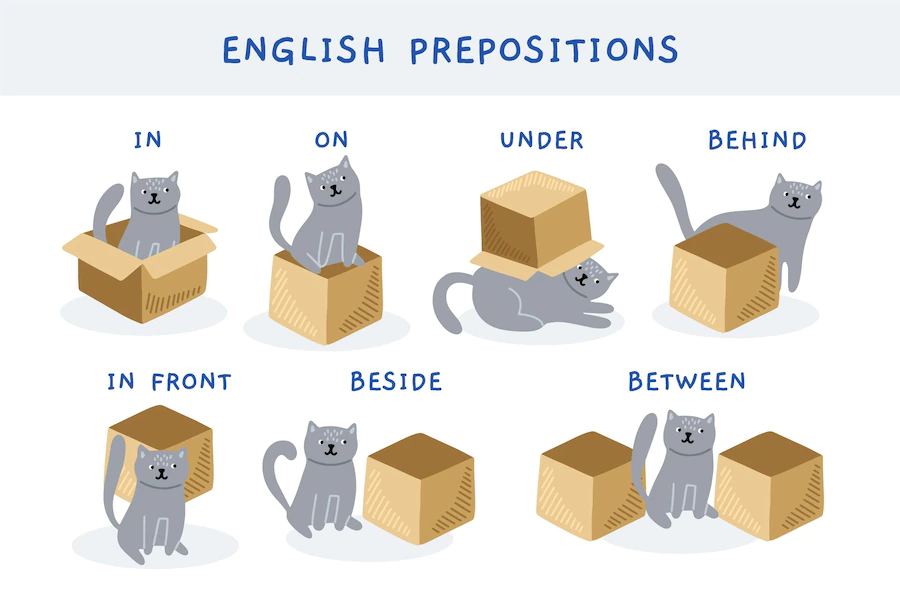
If something is contained inside a box or a wide flat area, we use ‘in’:
In the newspaper
In a cup
In a bottle
In bed
In London
In a book
In a field
In my stomach
In a house
In a drawer
In a bag
In a car
In river
In a sea
In a lake
In England
In Egypt
In the fridge
In the living room
In the kitchen
I n the garden
In the box
In the microwave
VIDEO
Preposition Number 2: On
If something is on a line or a horizontal or vertical surface, we use ‘on’ :
On the table
On the wall
On the floor
On the window
On the face
On the plate
On the page
On the sofa
On the chair
On the bag
On the river
On the bottle
On the bike
On his/her foot
On the desk
On the fridge
On the laptop
On the curtain
On the blanket
On the box
Preposition Number 3: At
If something is at a point, (it could be a building) we use ‘at’ :
At the airport
At the door
At the cinema
At the bus station
At the train station
At the bottom
At the top
At the front
At university
At school
At hospital
At club
At college
At home
At the top of the page
At the corner
At the end of the road
At the door
At the crossroads
At the front desk
At the back
At the shop
At the market
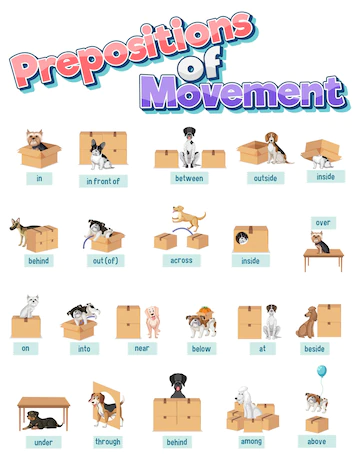
Here’s a list of other prepositions of place with some examples:
Preposition Use Sentences
above higher than something
The clock hung above the T.V
across from one side to the other side
Kids shouldn’t go across this road.
There is a bridge across the river.
after one follows the other
The father ran after his kids
against directed towards sth.
The snake moved against the door.
along in a line; from one point to another
They’re walking along the beach.
among a group
He likes being among people.
around in a circular way
We’re sitting around the heater.
behind the back of
The cinema is behind the supermarket.
below lower than sth.
The mineral is below surface level
beside next to
The police station is beside the bus stop.
between sth./sb. is on each side
The chair is between the desk and the sofa.
by near
He lives in the house by the sea.
close to near
Our house is close to the supermarket.
down from high to low
They came down the hill.
from the place where it starts
I’m from Japan.
in front of the part that is in the direction it faces
The T.V is in front of the sofa.
the inside opposite of outside
Stay inside the car.
into entering sth.
You should go into the tunnel.
near close to
The fire station is near the supermarket.
next to beside
Our house is next to the bank.
off away from sth.
The dog jumped off the roof.
onto moving to a place
The dog jumped onto the roof.
opposite on the other side
Our house is opposite the cinema.
out of leaving sth.
The dog jumped out of the window.
the outside opposite of inside
I’ll wait outside.
over above sth./sb.
The dog jumped over the wall.
past going near sth./sb.
I went past the post office.
round in a circle
We’re sitting around the speakers.
through going from one point to the other point
You shouldn’t walk through the jungle.
to towards sth./sb.
I like going to Canada.
Can you come to me?
I’ve never been to Africa.
towards in the direction of sth.
We ran towards the pool.
under below sth.
The pen is under the table.
up from low to high
He climbed up the mountain.
Practice: Write Down The Correct Preposition.
Sign your name _______ the dotted line.
A- After b- behind c- on
When we flew _______ the clouds, we could see the earth’s surface.
A- over b- in c- below
Can I sit _______ you at the movie theatre?
A- Around b- beside c- inside
The kids are playing _______ in the backyard.
A- at b- on c- in
Your glasses are right _______ you.
A- in front of b- on top of c-in behind
You can pick up your keys _______ the front desk.
A- in b- at the cover
Let’s meet _______ the front door.
A- in b- at c-below
There’s a helicopter hovering _______ our house.
A- above b- on c- under
Didn’t you park your car _______ mine?
A- on top of b- at c- behind
Please stay _______ the police caution tape.
A- behind b-above cover
There are two students ________ the class. A- next b- in c-on The oranges are not in the basket. They are _______ the table. A- in b- between c- on My pencil is __________ the books and the notebooks. A- between b- in c- on The red car is ________ of the house. A- behind b- in front c- next to There isn’t anything __________ my pocket. A- between b- next to c- in Some students are waiting in _______ the classroom. A- next to b- front of c- between under Our house is ________ to the supermarket. A- in b- on C- next
Oh my God! I saw a mouse __________ the sofa. A- behind b- in c-next There is a big supermarket _______ the park. A- on b- near c- in front
20. The children are playing _______ the garden. A- on b- between c- in
Why not subscribe to our LearningMole Library for as little as £1.99 per month to access over 1300 fun educational videos.
Leave a Reply