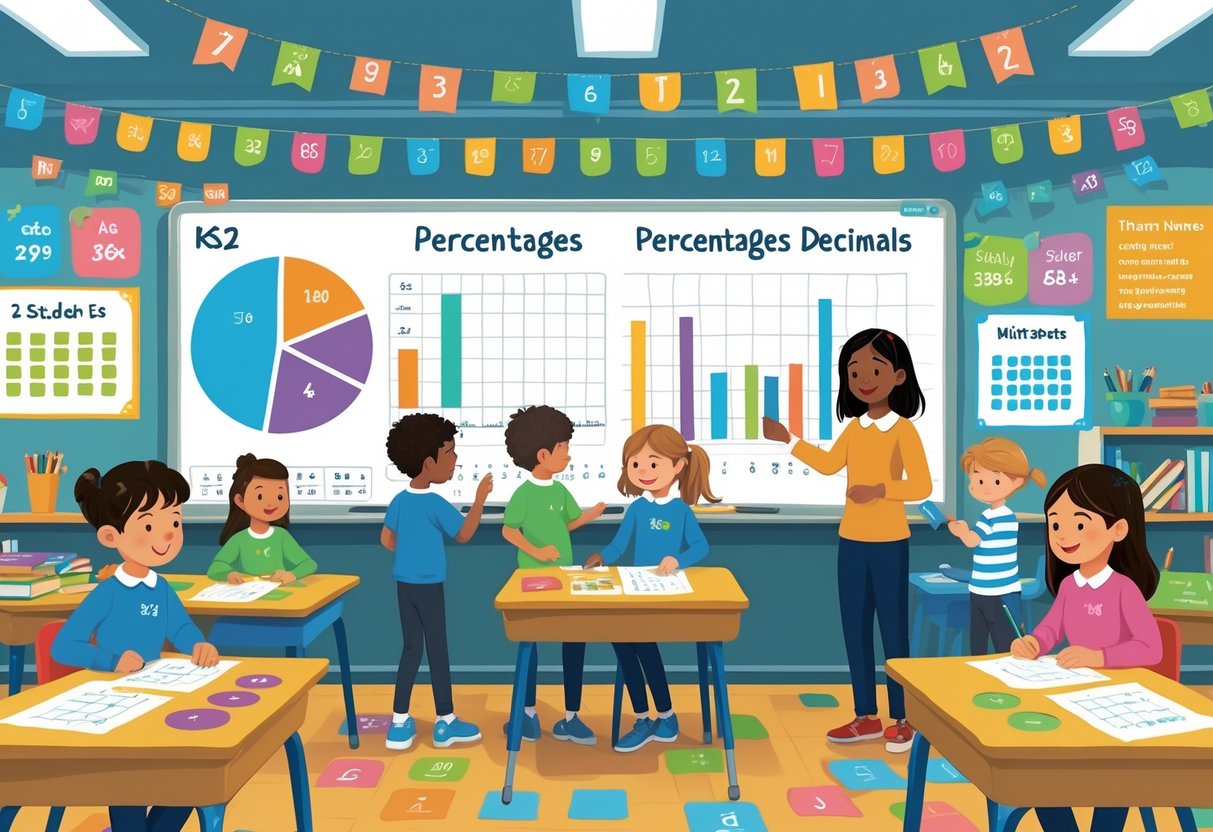
Teaching percentages and decimals at KS2 works best with clear, structured resources that help pupils switch between different numerical forms, compare values and solve real-life problems.KS2 fractions, decimals and percentages worksheets cover this key strand of the National Curriculum for Years 3 to 6. LearningMole, a UK platform started by Michelle Connolly, shares curriculum-aligned resources that make these tricky concepts a bit more approachable for primary learners.
Michelle Connolly, a former primary teacher with over 15 years’ experience, says, “Visual models and hands-on activities really change how children understand the links between percentages, decimals and fractions. When pupils see these connections, their confidence grows and they’re ready for more challenging maths.”
Pupils need to see how percentages relate to hundredths, how decimals show parts of a whole, and how to move between these forms smoothly. The right mix of worksheets, interactive activities and practice problems helps children build these skills gradually from Year 3 basics up to Year 6 SATs prep.
Key Takeaways
Converting between percentages, decimals and fractions builds vital numeracy skills across Years 3 to 6.
Visual resources and structured worksheets help pupils understand part-whole relationships and use them in real problems.
Regular practice with different activities gets children ready for KS2 assessments while building genuine maths confidence.
Key Concepts: Percentages, Decimals and Fractions
Percentages show parts out of 100. Decimals show values between whole numbers using a point. Fractions express parts of a whole with a numerator and denominator.
You can switch between these three concepts. They’re all connected, even if they look different.
Understanding Percentages in Everyday Life
You spot percentages every day in shops, on food labels, even in the news. The word ‘percent’ comes from the Latin ‘per centum’, meaning ‘out of 100’.
If you see 50%, that’s 50 parts out of 100. Percentages make proportions clearer. When your teacher says you scored 75% on a test, you know that’s three quarters right.
Shops use percentages for discounts. A 20% sale tells you how much you’ll save.
The National Curriculum asks Year 5 and Year 6 pupils to use percentages with fractions and decimals. You’ll see that 100% means the whole, 50% is half, and 25% is a quarter. It helps to remember 10%, 20%, 25%, 50% and 75%—those pop up all the time.
LearningMole has free video lessons with real examples, from working out sale prices to reading sports stats.
Explaining Decimals and Their Uses
Decimals use a point to split whole numbers from parts. The decimal point lets you write numbers between whole numbers, like 3.5 or 12.75.
Each spot after the decimal point stands for tenths, hundredths, thousandths and so on. You use decimals with money. £4.50 means 4 pounds and 50 pence—those pence are hundredths of a pound.
Decimals also pop up in measurements, like 1.5 metres or 2.75 litres.
Key decimal place values:
First after the point: tenths (0.1)
Second: hundredths (0.01)
Third: thousandths (0.001)
Switching between decimals and percentages is pretty easy. You multiply a decimal by 100 to get a percentage. For example, 0.25 turns into 25%. To go back, divide the percentage by 100.
Introduction to Fractions for KS2
Fractions show parts of a whole with two numbers. The denominator (bottom) tells you the number of equal parts. The numerator (top) shows how many you have.
You need to see that fractions and percentages express the same idea but look different. For example, 1/2 is 50%, and 1/4 is 25%. Knowing these equivalents helps you move between representations.
Year 5 and Year 6 pupils use proper fractions (like 3/4), improper fractions (like 5/4), and mixed numbers (like 1 1/4). You also practise simplifying fractions by dividing both numbers by the same value.
Understanding equivalent fractions is key. For example, 2/4, 3/6, and 5/10 all equal 1/2.
Teachers often use fraction bars or pie charts to show how fractions relate to whole amounts.
Fundamental Skills with Percentages for KS2
Percentages show parts of a whole split into 100 equal pieces. Understanding this idea helps pupils solve percentage problems through primary school.
Children need to know what percentages mean, spot common values, and picture them with concrete representations.
What Does Percent Mean?
“Percent” comes from the Latin “per centum,” or “out of 100.” If you see 25%, that’s 25 parts out of 100.
This links straight to fractions and decimals. A percentage is just another way to show a fraction with 100 as the denominator. For example, 30% is 30/100, or 0.30 as a decimal.
Children often get percentages more easily when they think about money. Since £1 is 100 pence, 45% of £1 is 45p. That makes the idea more real.
Identifying Common Percentage Values
Some percentages come up a lot in maths and life. You should help children learn these key values: 50% is one half, 25% is one quarter, and 75% is three quarters.
Also, 10% is one tenth. That makes working out percentages easier, as you can find 10% and multiply or divide to get other amounts.
Practise these conversions often. When children know that 100% is the whole and 0% is nothing, they can check if their answers make sense. These benchmarks also help with mental maths for quick calculations.
Visualising Percentages with Shapes and Number Lines
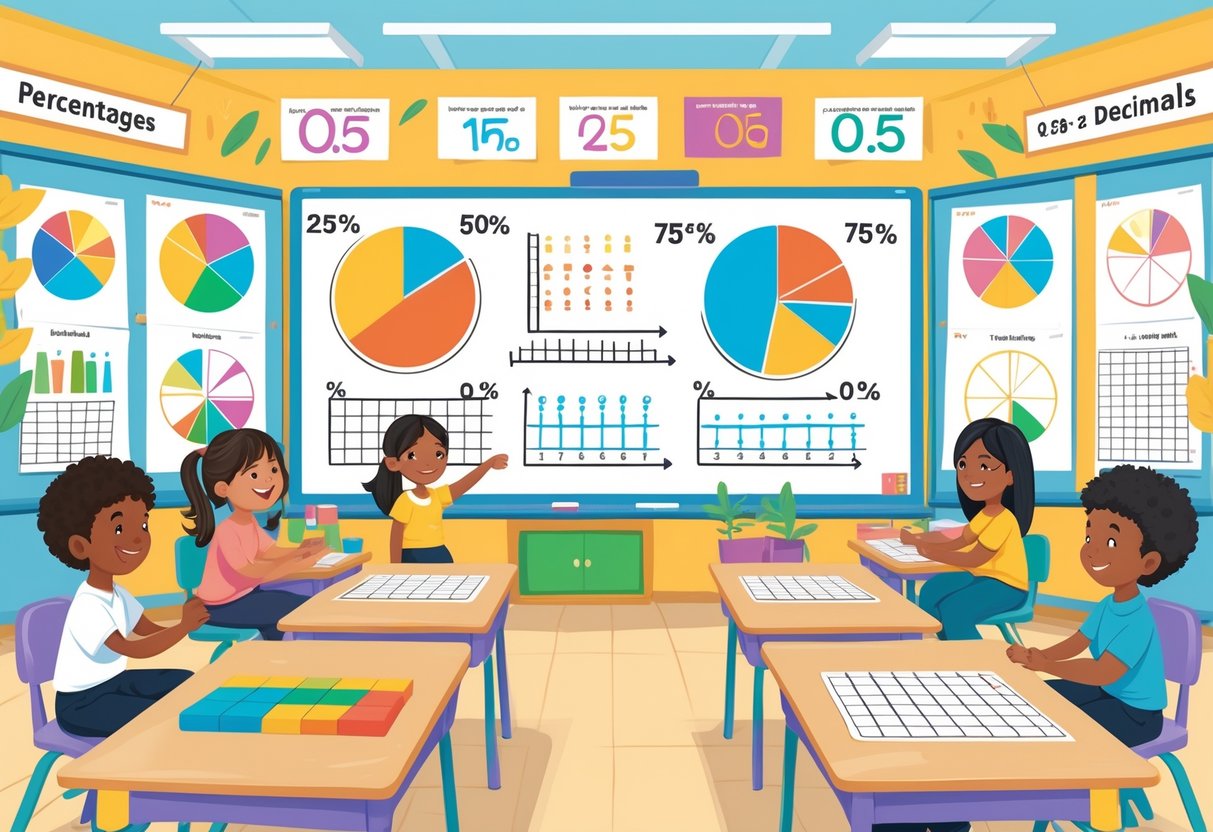
Visuals help children grasp what percentages really mean. Hundred squares work well, with each small square as 1%. Shading and counting makes it clear.
Number lines show how percentages link to whole numbers and fractions. You can mark 0%, 25%, 50%, 75%, and 100% to compare sizes. Pie charts split into 100 sections also help.
Bar models and fraction walls support understanding too. When children colour 60 squares out of 100, they see what 60% looks like.
LearningMole shares free videos showing these visual ways to teach percentages across KS2.
Teachers often use several representations at once. A child might shade a hundred square, mark the value on a number line, and write it as a fraction and decimal to make the links clear.
Decimals in the KS2 Maths Curriculum
Children in Years 3 to 6 build their understanding of decimals bit by bit. They start with tenths and hundredths, then move to thousandths. They learn to read, write and compare decimal numbers, and connect them to fractions and percentages.
Decimal Notation and Place Value
Pupils need to know that decimals show parts of whole numbers using place value columns. In Year 4, children spot tenths and hundredths, learning that 0.3 means three tenths, while 0.25 means 25 hundredths.
The decimal point splits whole numbers from the parts. Each spot to the right gets smaller: tenths, hundredths, then thousandths.
Teaching decimals at KS2 means showing how place value works on both sides of the decimal point. You can use charts labelled ones, tenths, hundredths and thousandths.
This helps children see that 0.4 is bigger than 0.04, since the 4 sits in different places.
Changing fractions to decimals gets easier when children understand place value. For example, 3/10 turns into 0.3, and 25/100 is 0.25.
Children need to say decimal numbers correctly. 3.7 is “three point seven,” not “three and seven tenths,” though knowing the fraction helps.
KS2 maths resources for decimals include activities where pupils match decimal notation to words. Year 5 children write decimals up to three places, such as 0.125 or 2.456.
They also convert between forms: 0.75 can be 75/100 or simplified to 3/4.
Teaching should stress that zeros can change a number’s value depending on their spot. For example, 0.05 has a zero in the tenths column, which matters. Writing decimals in expanded form helps: 2.34 is 2 + 0.3 + 0.04.
Decimals and percentages link up naturally. 0.5 is 50%, and 0.25 is 25%. This is especially useful in Year 6 when pupils work on percentage calculations.
Rounding and Ordering Decimals
Ordering decimals means paying close attention to place value, not just the number of digits. 0.8 is bigger than 0.375, even though 375 looks larger.
You can help children compare decimals by lining up the decimal points and checking digits from left to right. Adding zeros makes comparing easier: 0.6 and 0.65 become 0.60 and 0.65.
Rounding decimals works a lot like rounding whole numbers. Year 5 pupils round decimals to the nearest whole number or to one decimal place. For example, 3.47 rounds to 3 for the nearest whole, or 3.5 for one decimal place.
LearningMole has free videos with practical examples of ordering and rounding decimals, using real-life contexts like money and measurements. Number lines really help show where decimals fit compared to each other and to whole numbers.
Converting Between Percentages, Decimals and Fractions
When you learn to switch between percentages, decimals and fractions, you get a better feel for how these forms show the same value in different ways. The main trick is to spot patterns, like dividing by 100 to get from percentages to decimals, or changing the denominator to 100 when moving between fractions and percentages.
Changing Percentages to Decimals
To turn a percentage into a decimal, just divide by 100. Since ‘per cent’ means ‘out of 100’, 45% becomes 45 divided by 100, which gives 0.45.
For whole number percentages, you move the decimal two places to the left. So, 78% becomes 0.78, and 5% turns into 0.05. You need that zero before the 5 to fill the empty spot.
Percentages over 100 become decimals greater than 1. If you convert 150% to a decimal, you get 1.5, because 150 divided by 100 is 1.5.
To turn a fraction into a percentage, multiply it by 100. Take ¾ for example. You do ¾ times 100, which is 75, so ¾ is 75%.
Some fractions are easier to convert because their denominators fit neatly into 100. The fraction ¼ becomes 25% since 100 divided by 4 is 25. In the same way, 1/5 equals 20% and 1/10 equals 10%.
When the denominator doesn’t fit nicely into 100, convert the fraction to a decimal first, then multiply by 100. For example, ⅓ becomes 0.333… as a decimal, then about 33.3% as a percentage.
You can turn any decimal into a fraction by looking at its place value. The decimal 0.7 means 7 tenths, so you write it as 7/10.
The decimal 0.35 stands for 35 hundredths, which is 35/100, and that simplifies down to 7/20.
To turn a fraction into a decimal, just divide the numerator by the denominator. For example, ⅝ is 5 divided by 8, which is 0.625.
Some fractions, like ⅓, create recurring decimals. ⅓ equals 0.333… and it just keeps going.
You’ll see these common equivalents a lot in Key Stage 2 maths:
Fraction
Decimal
Percentage
½
0.5
50%
¼
0.25
25%
¾
0.75
75%
1/10
0.1
10%
LearningMole gives free video tutorials that walk you through these conversions step by step. These videos really help you picture how decimals and fractions connect.
Comparing and Ordering Fractions, Percentages and Decimals
If you want to compare values, it’s much easier when you convert everything to the same form. By Year 5 or Year 6, most pupils can swap between all three before putting them in order.
Methods for Comparing Different Representations
When you compare fractions, decimals and percentages, pick one form and convert everything to it. The simplest way is usually to turn fractions into decimals by dividing the top number by the bottom number.
Say you have 3/5, 0.7 and 65%. You can turn all of them into decimals: 3/5 is 0.6, 0.7 stays as 0.7, and 65% is 0.65. Now it’s obvious that 0.7 is the largest.
Or, you might prefer percentages. Multiply decimals by 100 to get percentages. For fractions, divide the numerator by the denominator, then multiply by 100. So, 3/5 becomes 60%, giving you 60%, 70% and 65% to compare.
Year 5 pupils often find percentages easier, since they’re just whole numbers. Teachers like to make conversion tables so children can see equivalent values side by side.
The National Curriculum expects children to know common equivalents like 1/2 = 0.5 = 50% by heart.
Ordering Values from Least to Greatest
Start by turning all the numbers into the same form. Write them out in a list, then sort them into order.
When you solve percentage problems, you usually need three main skills. You need to find what percentage of a number is, work out increases and decreases, and calculate how much something has changed.
These calculations show up all the time in Year 5 and Year 6 maths, and they tie straight into the UK National Curriculum for ratio and proportion.
Finding a Percentage of a Number
To find a percentage of a number, change the percentage into a decimal first. Divide the percentage by 100. For example, 25% turns into 0.25, and 40% becomes 0.4.
Multiply the decimal by the number you’re working with. If you want 30% of 80, you do 0.3 times 80, which is 24.
You can use fractions too. Since 50% is one half, you find 50% of 120 by doing 120 divided by 2, which is 60. For 25%, which is one quarter, 25% of 80 is 80 divided by 4, so 20.
You might also find 10% first, then use it to get other percentages. To get 10% of a number, just divide by 10. If you need 30% of 60, find 10% (which is 6), then multiply by 3 to get 18.
A percentage increase means you add extra value to the original amount. Work it out by finding the percentage of the number, then adding it to the original.
If a £50 toy goes up by 20%, you work out 20% of £50 (which is £10), then add it to get £60.
A percentage decrease is the same, but you subtract instead. If a £40 book is 25% off, you find 25% of £40 (which is £10) and take it away to get £30.
Many Year 6 pupils meet these kinds of questions when learning about sales and discounts.
You can speed things up by using multipliers. For a 20% increase, multiply by 1.2 (because 100% plus 20% is 120%, or 1.2). For a 30% decrease, multiply by 0.7 (since 100% minus 30% is 70%, or 0.7).
Calculating Percentage Change
Percentage change shows how much something has grown or shrunk compared to its starting value. The formula is: (new amount – original amount) divided by original amount, then times 100.
This sort of percentage problem comes up a lot in KS2 reasoning questions.
If a plant grows from 20 cm to 25 cm, the change is 5 cm. Divide 5 by the original height (20) to get 0.25, then multiply by 100 for a 25% increase.
If the new amount is smaller, you get a percentage decrease.
Teachers often use real-life examples like population changes, price drops or sports stats to make these calculations more meaningful.
You might compare how much a football team’s goals have gone up from last season, or work out the percentage fall in rainfall between two months.
The materials come with answer sheets and you can adapt them for different year groups in KS2.
Best Percents Worksheets for the Classroom
You can grab comprehensive percentage worksheets from Cazoom Maths that focus on specific skills for Years 3 to 6. These resources help pupils get confident converting between fractions, decimals and percentages, and using these skills in practical problems.
Many worksheets start with pictures. Some show 25%, 50%, 75% and 100% using shapes and diagrams. Others look at 10%, 20%, 80% and 90% to widen understanding.
LearningMole has curriculum-friendly videos that go well with worksheet practice. Their percentage tutorials can help explain ideas before pupils start the written work.
When you choose percents worksheets for your class, try to pick ones with real-life problems. Worksheets about shopping, discounts or measurement conversions make the maths feel more real for children.
Answer Sheets and Self-Assessment Tips
Most good worksheet packs include answer sheets. You can use them for quick marking, or hand them out for pupils to check their own work during independent practice.
Encourage your class to check their answers with the solutions. This builds confidence and helps children spot where they need more help.
You might ask pupils to highlight tricky questions before looking at the answers.
Some teachers like to do peer-marking with answer sheets. Pupils swap books and check each other’s work, which often leads to some good maths chat.
This works especially well for percentage problems that can be solved in more than one way.
Keep answer sheets separate from the main worksheets when you photocopy them. Laminating them can make them last longer, especially for maths interventions or homework clubs.
Targeted Resources for Years 3–6
Year 3, 4, 5 and 6 worksheets should match National Curriculum expectations for each age group. Year 3 children usually start with simple percentages like 50% and 25%. Year 6 pupils tackle more complex calculations.
Suggested progression by year:
Year Group
Focus Areas
Year 3
Recognising 50%, 25%, 75%, 100% of shapes and quantities
Year 4
Finding 10% and multiples of 10%, simple equivalents with fractions
Year 5
Calculating percentages of amounts, converting between forms
Year 6
Percentage increase and decrease, solving multi-step percentage problems
Try printing different levels of difficulty for mixed-ability classes. This way, you can challenge everyone without making separate lesson plans.
Fun Maths Challenge Games for Practising Skills
Games and activities turn percentages and decimals practice into something enjoyable. Children can build confidence with these tricky concepts. Teachers can choose from digital games, printable worksheets and hands-on activities that suit Years 3 to 6.
LearningMole offers free video tutorials explaining decimal operations step by step. These work well for whole-class teaching or independent learning stations. The resources fit the National Curriculum and suit pupils in Years 4 to 6.
Monty’s Maths Wall gives a range of mathematical skills practice in one game, including multiplication, fractions and percentages. This mixed practice lets children apply their knowledge across different maths areas.
Popular game formats include:
Bingo games for converting percentages to fractions
Matching activities linking decimals to their percentage equivalents
Timed challenges to build mental maths speed
Interactive quizzes with immediate feedback
Themed Worksheets and Activities
Teachers often use themed worksheets to add a bit of seasonal fun to maths practice. A Chinese New Year fractions worksheet can mix cultural learning with maths skills, keeping children interested in February.
You’ll find free worksheets and games organised by topic covering halves, quarters, decimals and percentages from Key Stage 1 through Key Stage 2. These include estimation activities where children shade more than half or less than a quarter of shapes.
Effective worksheet types:
True or false activities about shaded fractions
Grid colouring tasks showing quarters and halves in different ways
Mixed fluency sheets with multiple representations
Sorting exercises grouping whole, half, quarter or neither
Teaching percentages and decimals works best when you match activities to each child’s level. Regular practice helps children grow in confidence.
These strategies support both classroom teachers and parents.
Differentiating Activities for Mixed Abilities
Support all learners by offering different entry points to the same problem. For Year 5 children just starting with percentages, use fraction walls and Cuisenaire rods to make connections visual and concrete.
More confident Year 6 pupils benefit from multi-step problems mixing percentages with measures or money. Give these children real-world scenarios like working out sale discounts or VAT on restaurant bills.
Scaffold tasks using these ideas:
Provide partially completed bar models for children who need extra support
Give extension pupils percentages like 17% or 23% that don’t convert easily to simple fractions
Challenge groups can explore what happens when percentages go over 100. This links well to ratio work in upper Key Stage 2.
Encouraging Independent Practice
Regular short practice sessions build fluency better than the odd long worksheet. Set up a routine where children spend 10 minutes a day on percentage and decimal conversions using online games and interactive activities.
Create independence through:
Self-checking answer cards showing working out, not just the final answer
Partner work where children explain their method before checking
LearningMole videos that pupils can pause and rewatch as needed
Weekly challenges on classroom displays or home learning boards
Encourage children to make up their own percentage problems using pocket money, screen time or sports stats. This ownership makes practice feel more meaningful. Children often become more confident when they design questions for classmates.
Using Resources to Prepare for KS2 SATs
Year 6 pupils get the most out of a mix of practice materials that mirror the actual test format. Revision in fractions, decimals and percentages builds accuracy and speed. Mixing up practice methods can help reduce exam nerves.
Revision Strategies for Fractions, Decimals and Percentages
Topic-focused SATs questions help you spot which areas need more work before the exams. These booklets include fully-worked solutions you can display on a whiteboard to make feedback quicker.
Pupils should practise converting between fractions, decimals and percentages regularly. Fractions, decimals and percentages worksheets with 52 KS2 SATs questions give realistic exam practice. Use these alongside interactive activities to keep revision interesting.
Effective revision techniques include:
Working through past papers under timed conditions
Focusing on arithmetic drills to build speed
Using reasoning activities for problem-solving skills
Reviewing mistakes with worked solutions
LearningMole offers curriculum-aligned videos that explain conversion methods step by step. These videos help pupils who need visual explanations before trying questions themselves. You could also try investigation activities like fish tank fraction problems to apply concepts in new contexts.
Maximising Confidence Ahead of Exams
Confidence comes from more than just practice. Create a revision schedule that mixes up activities to prevent burnout and keep things moving forward.
KS2 SATs preparation resources should include past papers, topic-based practice and revision games. Games make fraction practice stick without feeling like boring revision. Interactive activities help pupils who find worksheets tough.
Try these confidence-building approaches:
Begin each session with easier questions to build momentum
Celebrate progress in specific skills, not just total scores
Use a variety of question formats so nothing feels too surprising on exam day
Schedule short, frequent practice sessions instead of long cramming
Differentiate by providing worksheets that fit different learning styles. Some pupils need more visual support, while others prefer word problems that use percentages in real life. Regular low-stakes quizzes help you track progress without adding stress.
Frequently Asked Questions
Teachers and parents often want practical strategies, engaging activities, and reliable resources that fit the National Curriculum.
What are some effective ways to teach fractions, decimals, and percentages to Year 5 students?
Visual models really help when introducing these ideas to Year 5 pupils. Use hundred squares for percentages, number lines for decimals, and fraction walls to show equivalents.
Real-world contexts make abstract ideas clearer. Shopping scenarios help students grasp percentage discounts, while cooking activities introduce fractions and decimals naturally.
Fraction-decimal-percentage conversions work best when taught together. This approach lets students see the links between the three and strengthens their understanding.
Can you suggest any fun activities to help Key Stage 2 pupils understand decimals?
Place value games using digit cards encourage pupils to create and compare decimal numbers. Challenge them to make the largest or smallest decimal with a set of digits. It’s a simple way to build confidence with decimal notation.
Money activities give a familiar context for decimal work. Pupils can work out change, compare prices, and use amounts with tenths and hundredths.
Decimal number lines on the classroom floor let children physically place themselves between whole numbers. This kinaesthetic method helps them see the size and place of decimal values.
Where can I find worksheets for Year 6 focusing on the conversion between fractions, decimals, and percentages?
LearningMole features free curriculum-aligned videos that show conversion methods step by step. The platform includes downloadable materials supporting the video lessons for Year 6 SATs revision.
How can I explain the relationship between fractions, decimals, and percentages to KS2 students?
Start with the idea that all three show parts of a whole. Say “50% means 50 out of 100, which is the same as 50/100 or 0.5” to make an immediate connection.
Hundred squares give the clearest visual link. Pupils can shade parts to show fractions, count shaded squares as percentages, and write the shaded part as a decimal.
Teaching percentages at KS2 using a maths mastery approach builds understanding through concrete examples before moving to abstract calculations. This method helps pupils realise these are just different ways to show the same value.
What resources are available for Year 3 students to learn about percentages?
Teachers often use simple percentage activities for Year 3, like finding 50% or 10% of amounts with practical materials. These hands-on tasks get students ready for tougher percentage work in Years 4, 5 and 6.
Percentages KS2 primary resources provide differentiated materials, so you can pick challenge levels that fit your class. The games and teaching packs keep early percentage lessons accessible and, honestly, a bit more fun.
Are there any practical decimal activities suitable for KS2 pupils?
Measuring activities bring decimals to life when students pick up rulers, scales, or measuring jugs. They might jot down heights in metres and centimetres as decimal numbers, like 1.35m, which ties the maths to something real.
Shopping role-play gives pupils a reason to work with decimals in pounds and pence. Set up a classroom shop and let them calculate totals, work out change, or compare prices with decimal values. It’s a simple idea, but it gets them thinking.
Maths Circus, an innovative platform we've crafted, presents a captivating realm where children learn mathematics through the exciting theme of a circus. The joy of juggling numbers and solving circus...
Article Summary What this article covers: Twenty-eight polar animals sorted properly by pole, with 21 from the Arctic, 5 from the Antarctic and 2 found at both, along with the...
Article Summary What this article covers: Five active learning strategies for home education (inquiry-based learning, Socratic questioning, gamification, the concrete-pictorial-abstract approach and teaching back), with zero-preparation ideas for busy parents,...
Article Summary What this article covers: Ten facts about Egypt’s modern history from 1952 to today, including the end of the monarchy, the Suez Crisis, the Aswan High Dam and...






Leave a Reply