Numicon Activities: Numicon is one of the few physical maths resources that works as well in a muddy outdoor tray as it does on a classroom table. Developed by Oxford University Press, the system uses flat plastic shapes with holes, each representing a number from one to ten and colour-coded to match.
For children in Nursery and Reception, Numicon provides something no number line or flashcard can: a shape they can hold, feel, and compare in their hands before any written numeral comes near the lesson. LearningMole, the UK educational platform founded by former primary teacher Michelle Connolly, regularly recommends Numicon as a cornerstone of early maths mastery because it makes abstract number relationships concrete in a way that sticks.
What makes Numicon particularly valuable in the Early Years Foundation Stage is its direct alignment with the 2024 EYFS Statutory Framework’s mathematics goals. The framework asks that children develop subitising skills (recognising quantities without counting), understand the composition of numbers, and build secure numerical pattern awareness.
Numicon’s colour-coded shapes do exactly that. A child who can feel the difference between the five-shape and the seven-shape in a sensory bag is building haptic number sense that underpins everything from addition in Year 1 to multiplication in Year 3. The research base for this concrete-first approach, often called the Concrete-Pictorial-Abstract or CPA method, is well-established in primary mathematics education across the UK National Curriculum.
This guide sets out three high-impact Numicon activities for preschool children, each explicitly mapped to EYFS mathematics goals, followed by practical classroom adaptations, guidance on inclusive use for children with SEND, and answers to the questions teachers and parents most commonly ask. Whether you are a Reception teacher building continuous provision, a nursery practitioner looking for sensory maths ideas, or a parent working with Numicon at home, you will find activities here that go beyond the standard hole-counting exercises and focus on genuine early mathematical thinking.
Why Numicon Supports Early Maths Mastery
Numicon works because it makes numbers visible and tangible at the same time. Each shape’s pattern of holes encodes its value; once the shape becomes familiar, children do not need to count the holes every time. That moment of recognition, when a child sees the five-shape and knows it without counting, is subitising. It is one of the most important early number skills, and Numicon builds it almost accidentally through play.
The shapes are also weighted proportionally. A ten-shape weighs the same as two five-shapes. A six-shape and a four-shape placed side by side are exactly the same height as a ten-shape. These physical relationships embed number bond understanding before any written equation appears. When Michelle Connolly and the LearningMole team recommend physical maths resources for EYFS settings, Numicon consistently sits at the top of the list for exactly this reason: it teaches relationships, not just values.
The CPA (Concrete-Pictorial-Abstract) approach, central to the UK’s maths mastery curriculum, treats physical resources as the essential first step. Children handle real objects, build mental images from those experiences, and only then move to written symbols. Numicon sits firmly at the Concrete stage. Rushing children to numerals before they have handled and compared the shapes is the most common mistake practitioners make with Numicon, and it is worth resisting the temptation.
Beyond its pedagogical value, Numicon is also practical for busy EYFS settings. The shapes are durable, washable, and work in sand trays, water play, modelling dough, and outdoor mud kitchens. They travel from continuous provision to guided teaching without any reconfiguration.
Numicon Colour and Value Reference:
Numicon Shape
Official Colour
Number Value
EYFS Focus Area
1-shape
Pink
1
Counting, one-to-one correspondence
2-shape
Yellow
2
Pairs, doubling
3-shape
Blue
3
Subitising, odd numbers
4-shape
Green
4
Even numbers, addition
5-shape
Orange
5
Number bonds to 5
6-shape
Dark green
6
Odd/even patterns
7-shape
Red
7
Subitising larger groups
8-shape
Brown
8
Number bonds to 10
9-shape
Purple
9
Near-10 strategies
10-shape
Dark blue
10
Number bonds to 10, place value foundations
Mapping Numicon to the 2024 EYFS Framework
The 2024 EYFS Statutory Framework identifies two key areas within the Mathematics early learning goal: Number and Numerical Patterns. Numicon activities address both directly, which is why Early Years practitioners in UK settings have adopted it so widely.
Under the Number goal, children are expected to have a deep understanding of numbers to 10, including the composition of each number. They should also subitise up to five and automatically recall number bonds to 5 and some to 10. Every Numicon activity in this guide targets one or more of these goals specifically.
Under the Numerical Patterns goal, children should be able to verbally count beyond 20, recognise the pattern of the counting system, and compare quantities using language such as more or fewer. The shape-ordering and outdoor matching activities below build this directly.
Activity-to-EYFS Goal Mapping:
Numicon Activity
EYFS Mathematics Area
Key Skill Developed
Recommended Age
Feely Bag Challenge
Number – Subitising
Haptic number recognition
3–5 years
Playdough Printing
Number – Composition
Part-whole understanding
3–5 years
Outdoor Nature Match
Numerical Patterns
One-to-one correspondence
3–6 years
Shape Ordering
Numerical Patterns
Ordering by value
4–6 years
Number Bond Snatch
Number – Relationships
Complementary pairs to 10
5–7 years
Feely Bag + Numeral Cards
Number – Cardinality
Symbol-quantity mapping
4–6 years
Activity 1: The Feely Bag Sensory Challenge (Subitising)
This is the activity that most effectively develops subitising in preschool children, and it is one that competitors consistently overlook in favour of simpler hole-counting tasks. The goal is to encourage haptic perception: learning numbers through touch rather than sight.
What you need
One opaque bag or pillowcase
Numicon shapes 1 through 10 (or 1 through 5 for younger children)
Matching numeral cards (optional extension)
How to run it
Place a selection of Numicon shapes inside the bag. Ask the child to reach in and feel for a specific shape without looking. Start by naming the number: “Can you find the five-shape?” As children grow more confident, ask them to pull out any shape, feel it, and tell you what number they think it is before looking. The number of holes and the overall shape profile make each piece distinctive to the touch.
The critical teaching move is to resist asking children to count the holes. Instead, ask: “What does it feel like? Is it bumpy along the bottom or flat? Does it feel wide or narrow?” This language builds the spatial number sense that is the real goal. When children can identify the seven-shape by touch, they are developing the same mental number images that help them instantly recognise seven objects in a group later in school.
Adaptations
For 3-year-olds: Use only shapes one to five. Ask them to find a named shape rather than identify an unknown one.
For 5-year-olds: Add numeral cards face down. Pull a card, then find the matching shape by touch.
For outdoor settings: Bury the shapes in a sand or mud tray. Children excavate and identify before checking.
For children with visual impairments: This activity naturally centres touch; pair with verbal descriptions of hole patterns to build mathematical language.
This activity addresses the number composition goal from the EYFS framework, specifically the understanding that each number can be broken into smaller parts. It also produces a tactile and visual record that children can return to, making it one of the best Numicon activities for preschool continuous provision areas.
What you need
Playdough (homemade or commercial)
Numicon shapes 1 through 10
A flat rolling surface
How to run it
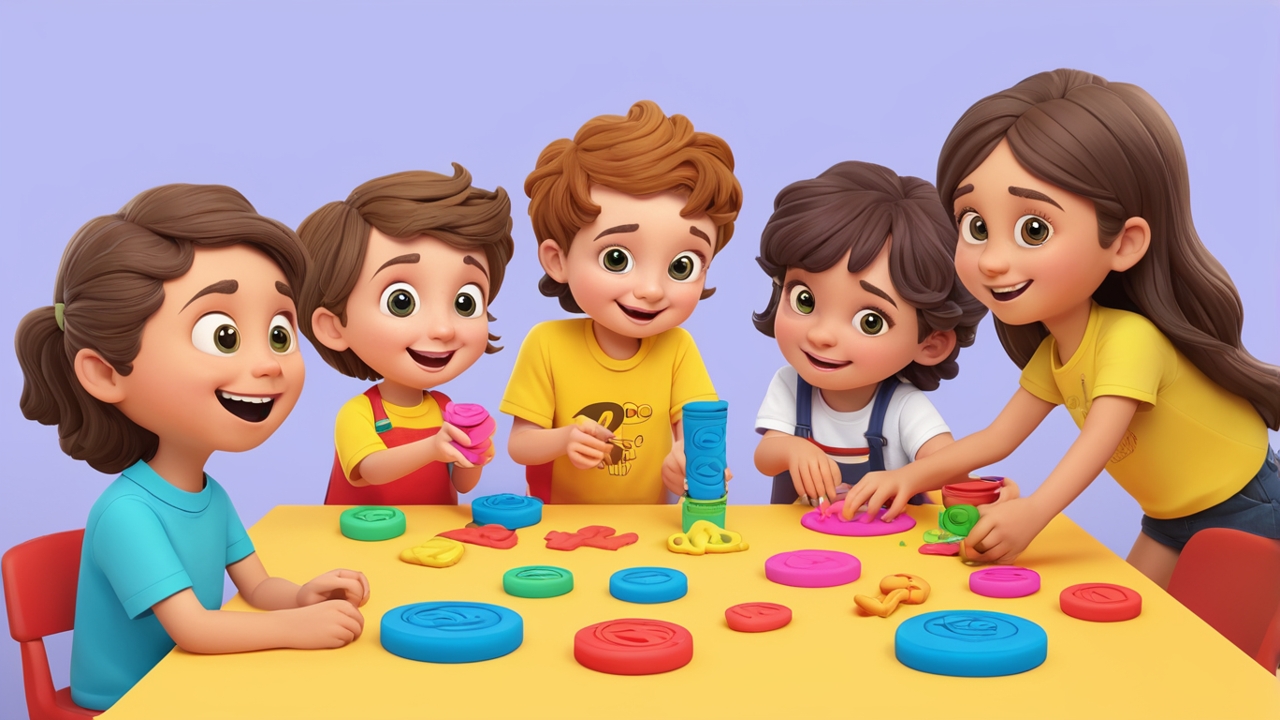
Roll out a piece of playdough and press a Numicon shape into it to leave a clear impression. Then ask the child to fill in the impression using smaller Numicon shapes. Which shapes fit inside the eight-hole print? Two fours? A five and a three? A six and a two? Each successful combination is a concrete demonstration of number composition that will form the mental model children use for addition later.
The “biscuit making” framing works especially well for nursery-aged children. Tell them they are making Numicon biscuits and need to decorate each one. Use small balls of playdough, raisins, or buttons to fill the holes in the printed shape. Counting the decorations as they go in reinforces one-to-one correspondence naturally within the activity.
Extending the activity
Once children are confident with the printing, introduce a simple challenge: make a big print with the ten-shape, then find as many different ways as possible to fill all ten holes using other shapes. Record each combination with a photograph for the child’s learning journey. This is an early introduction to systematic thinking, and most five-year-olds find the “how many ways?” challenge genuinely motivating.
Home adaptation
Parents at home without a Numicon baseboard can use a muffin tin as a substitute. Place the shapes into the cups to show their relative sizes, then remove them and ask children to put them back in the right holes. It is not a perfect substitute, but it introduces the concept of fitting number shapes into spaces in a way that works on a kitchen table.
Activity 3: Outdoor Nature Match (Numerical Patterns)
Most Numicon guidance focuses on tabletop work. This activity takes the shapes outside, connecting them to the outdoor learning and forest school provision that is central to good EYFS practice across UK nurseries and Reception classes. The Outdoor Learning approach is also a content gap in most existing Numicon resources, making this section a genuinely useful addition.
What you need
A selection of Numicon shapes (laminate them or use the actual shapes in dry weather)
A natural outdoor environment: garden, yard, playground, or forest school area
A simple recording sheet (optional: draw outlines of shapes, children tick when found)
How to run it
Give each child one Numicon shape. Their task is to find natural objects from the environment to fill each hole in their shape exactly: one stone per hole, one leaf per hole, one stick per hole. A child with the seven-shape needs to find seven objects. A child with the three-shape needs three.
The activity builds one-to-one correspondence (one object per hole) as well as number awareness in an outdoor context. In a mud kitchen, the challenge becomes filling shapes with mud using a spoon: how many spoonfuls fill the five shapes? It scales naturally to different outdoor environments.
For older Reception children, the activity extends to comparison: “Your shape needs more objects than mine. How many more?” This is direct preparation for the comparison language in the EYFS Numerical Patterns goal and introduces informal subtraction thinking.
Forest school adaptation
In a forest school setting, use natural materials as counters: acorns, pine cones, pebbles, and seed pods. Place a Numicon shape on the ground and challenge children to find materials to fill it using only what they can find within a defined area. The constraint of searching makes the quantity goal more meaningful: the child has to hold the quantity in their head while searching.
Adapting Numicon for SEND and Inclusive EYFS Classrooms
Numicon’s tactile, visual design makes it naturally inclusive for children with a range of learning needs. Its effectiveness in supporting children with SEND is one of the strongest arguments for its place in every EYFS setting, not just those with high numbers of children requiring additional support.
Dyscalculia and number processing difficulties
Children with dyscalculia often struggle to connect numerals to quantities because the symbol is arbitrary and carries no visual information about its size. Numicon solves this directly: the seven-shape is physically larger than the three-shape. The child does not need to memorise that 7 is more than 3; they can see and feel it. Regular Numicon handling builds the number sense that children with dyscalculia find hardest to develop through symbol-based instruction.
Visual impairments
The Feely Bag activity described above is the natural starting point for children with visual impairments. The distinct tactile profile of each shape (varying width, total holes, and overall footprint) means they can be identified by touch with practice. Pair the shapes with verbal descriptions: “The five-shape has a flat bottom row of three holes and two holes above.” Building this language supports the child’s mathematical understanding and develops their ability to describe quantities to others.
Autism and sensory processing
The consistent colour coding and shape identity of Numicon suits children who need predictability in learning materials. The shapes do not change: the pink one-shape is always pink, always one hole, always the smallest. For children who find open-ended tasks difficult, Numicon activities with clear goals (find the three-shape, fill the ten-shape) provide the structure they need while still targeting genuine mathematical learning.
Children with fine motor difficulties
The large holes in the Numicon shapes make them easier for children with fine motor difficulties to handle than small cubes or counters. The shapes can be grasped and placed without the pincer grip required for counting manipulatives like beads or buttons. For children working on motor development alongside early maths, this is a practical advantage worth noting in planning.
“When children work with Numicon, something clicks at the sensory level before it clicks at the conceptual level. They feel the seven-shape and know it’s bigger than the five-shape before they can tell you why. That physical knowing is the foundation on which everything else builds. Our job in Early Years is to give that foundation as much time as it needs.” Michelle Connolly, Founder of LearningMole and former teacher with over 15 years of classroom experience
Teaching Resources and Support
LearningMole provides curriculum-aligned educational videos and teaching resources for UK primary settings, including Early Years content that supports maths mastery approaches like CPA. Teachers and parents can access free video content on LearningMole’s YouTube channel, featuring visual demonstrations of early number concepts that complement hands-on Numicon work in the classroom and at home.
For EYFS practitioners planning maths continuous provision, LearningMole’s resources cover key topics such as counting, number bonds, and early addition and subtraction, all aligned with the UK National Curriculum and the 2024 EYFS Statutory Framework. The platform’s approach, developed by Michelle Connolly from her years of classroom teaching, emphasises visual and practical learning as the route into abstract mathematical understanding.
Frequently Asked Questions
At what age is Numicon best suited?
Numicon is designed for children aged 3 to 7, making it ideal for preschool, nursery, and KS1 settings. The earliest activities, particularly sensory exploration and sensory bag play, can begin with children as young as 2.5 to 3 years when supervised. For Key Stage 1 children who are finding number concepts difficult, Numicon remains effective well beyond Reception, including as a support tool in Year 2 and Year 3. LearningMole’s early maths resources cover this full age range with activities that match each stage of the EYFS and KS1 national curriculum.
How does Numicon help with subitising?
Subitising is the ability to recognise a quantity without counting each item individually. Numicon builds subitising by training children to recognise each shape’s visual and tactile profile as a whole, rather than counting its holes one by one. After regular handling, children begin to see the five-shape and know it is five, the same way they recognise familiar faces without inspecting each feature separately. This is exactly the kind of automatic number sense the 2024 EYFS Mathematics early learning goal is asking for when it specifies that children should “subitise” to five.
Can Numicon be used for addition and subtraction in preschool?
Yes, though the framing matters. For preschool children, addition is best introduced through physical combining rather than written equations. Place a three-shape and a four-shape side by side and ask: which bigger shape are they the same height as? That discovery of the seven-shape is addition without a number sentence anywhere near it. The Playdough Printing activity described in this guide takes the same approach to number composition, and it naturally leads into subtraction thinking when children ask what is left after removing one shape from a combination.
Why do the Numicon shapes have different colours?
The colour coding serves two purposes. First, it gives children a visual shortcut during early handling: the child who cannot yet reliably identify the shape by its hole pattern can still recognise that the orange one is always five. Second, it helps children notice patterns across the number system. Odd and even numbers have distinct colour groupings in the Numicon system, which makes the visual pattern of odd and even numbers visible before children have the language to describe it. Over time, children associate the colour, the shape, and the number simultaneously, building multiple retrieval routes for the same information.
What if I don’t have the official Numicon baseboard?
The baseboard is useful but not essential, particularly for preschool activities. A sheet of A3 paper with shape outlines drawn on it works for matching activities. A muffin tin works for comparing sizes. Sand trays and mud kitchens do not need a baseboard at all. The Feely Bag activity requires only an opaque bag. If budget is a constraint, prioritise buying the shape set itself and improvise the baseboard with materials already in your setting.
Does Numicon support children with dyscalculia?
Numicon is one of the most cited hands-on resources for children with dyscalculia precisely because it makes number size physically real. Children with dyscalculia frequently struggle with the arbitrary nature of numerals, where the symbol 7 gives no information about being larger than 3. The Numicon seven-shape is physically bigger and heavier than the three-shape. That direct sensory experience of relative size builds the number sense that children with dyscalculia find hardest to develop through conventional instruction. Early intervention with concrete resources like Numicon in EYFS can significantly reduce the difficulty these children experience when they encounter abstract number work later.
How do I introduce Numicon to a child who has never seen it before?
Start with free exploration and no mathematical goals at all. Put the shapes in a tray and let the child handle them, sort them, and make patterns with them. Most children notice the size progression naturally and begin ordering them without being asked. After two or three sessions of free play, introduce the Feely Bag or Playdough Printing activities. Framing the shapes as numbers too early, before the child has built a physical relationship with them, is the most common introduction mistake. The mathematical knowledge should emerge from familiarity with the objects, not from being told what they mean.
Can parents use Numicon effectively at home?
Numicon works well at home, though parents do not need to replicate classroom-style teaching. The most effective home use is play-based: the Feely Bag activity needs only the shape set and any opaque bag. Playdough printing is a kitchen table activity. Outdoor nature matching can be done in any garden. LearningMole’s home learning resources support parents in extending school maths at home without turning the kitchen into a classroom. The key message for parents is that Numicon play for 10 minutes three or four times a week, framed as a game rather than a lesson, is more effective than formal number practice with a child who is not yet ready for abstract work.
Conclusion
Numicon’s strength is not in the activities themselves but in what those activities do to children’s relationship with number. The shapes make abstract values concrete, visible, and measurable. A child who has spent three months playing with Numicon in continuous provision arrives at formal number work with genuine numerical intuition rather than a set of memorised procedures.
That is the goal of the EYFS mathematics framework, and it is the reason Numicon has become standard equipment in UK nurseries and Reception classes. LearningMole’s approach to early maths builds on exactly this principle: sensory, physical experience comes first, and abstract symbols follow when the foundation is solid.
The three activities in this guide, the Feely Bag sensory challenge, Numicon playdough printing, and outdoor nature matching, are not the only Numicon activities worth using, but they are the ones that map most directly to the EYFS goals that matter most at preschool age. Subitising, number composition, and numerical pattern recognition are the skills that predict later mathematical success most reliably. These activities target all three in ways that feel like play to children and like purposeful teaching to practitioners.
Whether you are working in a nursery setting, a Reception classroom, a forest school, or at a kitchen table at home, Numicon offers a practical route into the mathematics that the national curriculum builds on throughout primary school. The key is to stay in the concrete stage long enough. Let children know the shapes before asking them to use them. Let them feel the difference between seven and five before telling them that 7 minus 5 equals 2. That patience, which experienced early years practitioners will recognise as one of the hardest skills to maintain under timetable pressure, is also where the deepest learning happens.
Maths Circus, an innovative platform we've crafted, presents a captivating realm where children learn mathematics through the exciting theme of a circus. The joy of juggling numbers and solving circus...
Mexican traditions blend the customs of ancient Mesoamerican peoples, such as the Aztecs and the Maya, with Catholic festivals brought by Spanish settlers in the sixteenth century. The result is...
The moose (Alces alces) is the largest member of the deer family alive today, and a fully grown bull can stand about 2 metres tall at the shoulder, which makes...






Leave a Reply