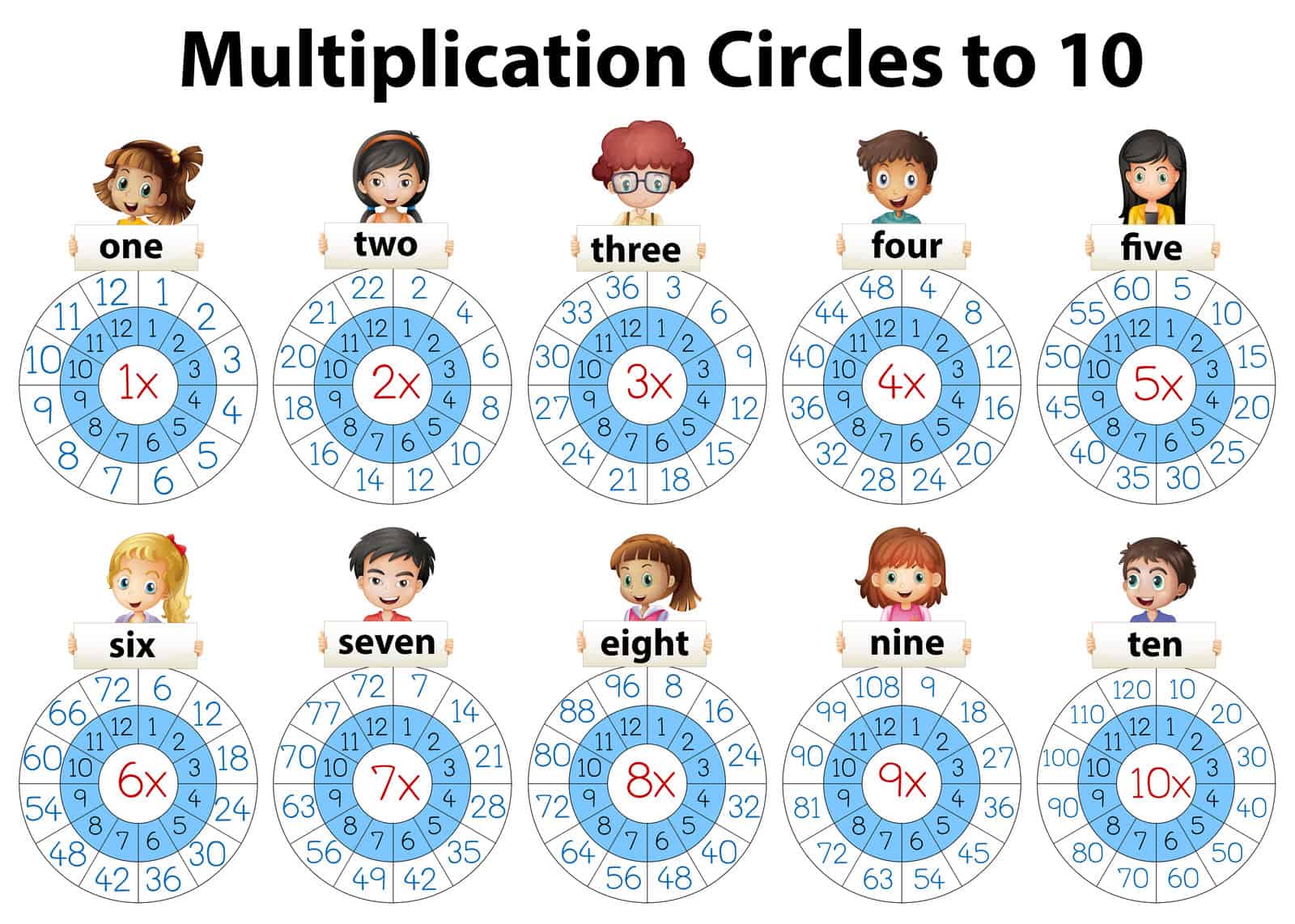
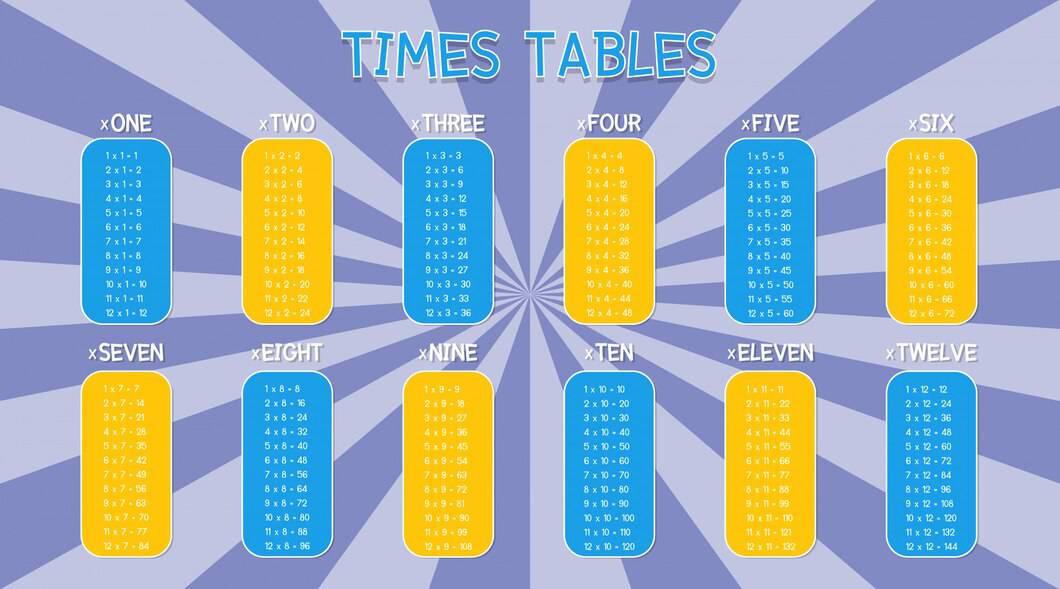
Multiplication Tables: 2 Magical Ways for Kids
Table of Contents
Most children hit a wall with multiplication tables somewhere around Year 3 or 4. They can count in twos and fives without much trouble, but the 7s, 8s, and 9s start to feel like a different language entirely. Parents sit at kitchen tables trying to help, and frustration builds on both sides. The good news is that two specific techniques — the 9s Finger Trick and the Magic Grid for the 3s and 7s — cut through that frustration in a way that rote repetition simply does not.
These are not shortcuts or cheats. They are mental scaffolds, the same kind of structured thinking that UK primary teachers use in the classroom every day. The UK National Curriculum expects children to have secure recall of all multiplication tables up to 12×12 by the end of Year 4, and both of these methods build towards that goal by giving children a reliable mental process to fall back on when memory alone is not yet strong enough.
LearningMole, a UK educational platform founded by former primary teacher Michelle Connolly, has produced curriculum-aligned maths resources specifically designed to make times tables accessible for children aged 5 to 11. This guide explains both magical methods in full, connects them to the Year 4 Multiplication Tables Check (MTC), and gives teachers and parents practical steps to use them at home and in the classroom.
Why ‘Magic’ is the Secret to Maths Confidence

Maths anxiety is real, and it often starts with multiplication. When a child is asked to recall 7 x 8 on the spot and cannot, the embarrassment of that moment can colour their relationship with maths for years. Research from the Education Endowment Foundation consistently shows that conceptual understanding, not rote memorisation, produces more durable learning outcomes.
The word ‘magic’ in teaching terms means: a pattern so reliable that it feels almost too good to be true. When a child discovers that they can always work out any 9-times-table answer using only their fingers, or that a simple 3×3 grid unlocks the entire 3s and 7s tables, something shifts. Maths stops feeling like a wall and starts feeling like a puzzle with a key.
The technical term for the goal is ‘automaticity’: the point at which a child retrieves a times table answer without conscious effort, the way a fluent reader does not sound out individual letters. These two methods accelerate the journey to automaticity by building pattern recognition alongside memory. The trick becomes unnecessary once the answer is secure, and that is exactly how they are meant to work.
Rote Memorisation vs. the Magic Method
| Rote Memorisation | The Magic Method |
|---|---|
| Repeating facts without meaning | Using a reliable pattern to derive the answer |
| High stress when memory fails | Low stress — child has a fallback process |
| Fast for easy tables (2s, 5s, 10s) | Particularly powerful for hard tables (7s, 8s, 9s) |
| Provides no mental scaffolding | Builds pattern recognition alongside recall |
| Children freeze under timed pressure | Children can reconstruct answers under the MTC timer |
Way 1: The Famous 9s Finger Trick
The 9s Finger Trick works for every multiplication from 1 x 9 through to 10 x 9, and it requires nothing more than two hands. Children find it genuinely surprising the first time they try it, which is exactly the reaction you want; surprise means a memory has been formed.
How to Set It Up
Ask the child to hold both hands out in front of them, palms facing down, fingers spread. Number each finger from left to right: the leftmost finger (left pinky) is 1, the next is 2, and so on across to the right pinky, which is 10.
How to Use It
- Choose the number to multiply by 9. Say the child wants to work out 7 x 9.
- Fold down the 7th finger (the index finger of the right hand).
- Count the fingers to the LEFT of the folded finger. There are 6. That is the TENS digit.
- Count the fingers to the RIGHT of the folded finger. There are 3. That is the ONE’s digit.
- The answer is 63. Every time.
This works because the 9-times table follows a consistent pattern: the tens digit increases by one with each step (0, 1, 2, 3…) while the ones digit decreases by one (9, 8, 7, 6…). The two digits always add up to 9. The finger trick makes this pattern physical and visible.
Quick check: The digits in every 9-times-table answer always add up to 9. 2 x 9 = 18 (1 + 8 = 9). 6 x 9 = 54 (5 + 4 = 9). 9 x 9 = 81 (8 + 1 = 9). If a child’s answer doesn’t pass this check, they know immediately to try again.
The Magic Bonus: 7 x 8
The most commonly missed question in the UK Year 4 MTC is 7 x 8 = 56. One reliable way to remember it: the numbers 5, 6, 7, 8 are in sequence. 56 = 7 x 8. Say it as a rhythm, ‘five six seven eight’, and the answer sticks.
Way 2: The Magic Tic-Tac-Toe Grid for the 3s and 7s

The 3s and 7s are two of the tables children find hardest. The Magic Grid (sometimes called the Keypad Grid) provides a visual structure that makes both of them straightforward. This method is less well-known in UK classrooms than the finger trick, which means it is genuinely underused, and children who learn it feel like they have discovered something other children do not know.
Drawing the Grid
Draw a 3×3 grid, like a noughts-and-crosses board. Fill in the numbers 1 to 9, reading across from left to right, top to bottom, exactly like the number pad on a phone or calculator:
| 1 | 2 | 3 |
|---|---|---|
| 4 | 5 | 6 |
| 7 | 8 | 9 |
Using the Grid for the 3s
The ones digits of the 3-times-table run down the grid in columns: 3, 6, 9 in column one; 2, 5, 8 in column two; 1, 4, 7 in column three. The tens digits follow a simple pattern that increases by one each time you complete a column.
A simpler entry point: write out 3, 6, 9 / 12, 15, 18 / 21, 24, 27 in the grid cells in order. The child can then read any answer directly from their grid. The act of drawing the grid once or twice builds the pattern in memory, making the grid itself redundant within a few sessions.
Using the Grid for the 7s
The 7-times table uses the same grid, but the ones digits run in a different sequence: 7, 4, 1, 8, 5, 2, 9, 6, 3. This means the answers, in order, are: 7, 14, 21, 28, 35, 42, 49, 56, 63, 70. Children who have practised the grid can reconstruct this sequence quickly even under timed conditions.
For children with dyscalculia or high maths anxiety, the Magic Grid is particularly helpful because it converts a memory task into a visual-spatial task. Drawing the grid engages a different cognitive pathway, which is why some children who struggle with purely auditory or written repetition find the grid approach clicks much faster.
“Every child learns differently, and good teaching resources should support that diversity rather than demanding one-size-fits-all approaches. Visual, auditory, and interactive elements give different learners different entry points.” Michelle Connolly, Founder of LearningMole and former primary teacher with over 15 years of classroom experience
From ‘Magic’ to Mastery: Preparing for the Year 4 MTC

The Year 4 Multiplication Tables Check (MTC) is a statutory assessment introduced by the Department for Education. Children have 6 seconds to answer each of 25 questions covering all tables from 2 to 12. The test is taken online, usually in June of Year 4.
One important point that many articles fail to address: a child cannot complete the finger trick in 6 seconds. By MTC time, the goal is automaticity, instant recall with no calculation needed. The two magic methods are tools for learning, not tools for testing. Their purpose is to give children a reliable way to derive and practise answers until those answers become automatic.
How to Use the Magic Methods to Build MTC Speed
- Weeks 1–2: Use the finger trick and the Magic Grid freely. Let the child derive every answer using the method. Speed does not matter at this stage.
- Weeks 3–4: Start timing practice sessions loosely. Encourage the child to try to remember the answer before resorting to the method. Use the method as a backup, not a first step.
- Weeks 5–6: Introduce 6-second target practice on the specific tables the child finds hardest. By this point, the pattern recognition from the methods should be accelerating recall.
| Stage | Recommended Approach |
|---|---|
| Introducing a new table | Use the magic method freely — let the child explore the pattern |
| Building familiarity | Mix magic method with recall attempts; note which answers come automatically |
| MTC preparation (6–8 weeks before) | Timed practice; magic methods as backup only |
| MTC week | Focus on the specific tables where the child still hesitates |
LearningMole’s KS2 maths resources include curriculum-aligned videos that explain multiplication concepts step by step, with visual demonstrations matched to the National Curriculum progression through Year 2 to Year 6.
Practical Activity: The 60-Second Magic Challenge
This works well as a daily warm-up at home or in class. Ask the child to draw their Magic Grid from memory in under 15 seconds, then fill in either the 3s or 7s answers without looking at their notes. Time the whole exercise. Most children improve significantly within a week, and the visible progress is motivating in itself.
- Day 1–3: Draw the grid, fill in the answers at your own pace.
- Day 4–6: Try to complete the answers within 60 seconds.
- Day 7+: See how many answers you can recall without drawing the grid first.
Teaching Resources and Support

LearningMole provides curriculum-aligned maths videos and resources for primary-aged children that cover multiplication and times tables in engaging, child-friendly ways. Our resources are designed by educators with classroom experience and are mapped to the UK National Curriculum for Years 2 through 6.
For Teachers
Times tables form a core part of KS2 maths planning. LearningMole’s educational videos on multiplication can support whole-class teaching, small group work, or independent learning at home. Each table has its own dedicated resource, making it straightforward to target the specific tables a class or individual child needs to work on.
Visit the individual table pages for the x2, x3, x4, x5, x6, x7, x8, x9, and x10 tables for visual explanations and supporting activities.
For Parents
The two magic methods in this article work well at home because they require no equipment, just hands for the finger trick, and a pencil and paper for the grid. Parents who feel uncertain about maths themselves often find these methods reassuring: there is a clear process to follow, and the child can lead once they have learned it.
LearningMole’s subscription library includes over 1,400 educational videos covering maths, English, science, and more, all aligned with the UK National Curriculum and accessible for children aged 4 to 11. Free content is also available on the LearningMole YouTube channel.
Frequently Asked Questions

What is the magic trick for the 9 times table?
Hold both hands out with fingers spread and palms facing down. Number each finger from left to right, 1 to 10. To find any 9-times-table answer, fold down the finger matching the number you are multiplying by 9. Count the fingers to the left, that is the tens digit. Count the fingers to the right, that is the ones digit. So for 6 x 9, fold finger 6, count 5 fingers to the left and 4 to the right: the answer is 54. This works for every multiplication from 1 x 9 to 10 x 9.
Can a child learn all the multiplication tables in a day?
Not with durable recall, and it would not be helpful to try. In a day, a child can grasp the pattern behind one or two tables, which is meaningfully different from memorising a list of facts. True automaticity, retrieving an answer instantly without working it out, builds over several weeks of regular, short practice sessions. Ten minutes a day is more effective than one hour on a weekend. The magic methods in this article speed up that process by giving children a reliable way to derive and check answers while their memory is still consolidating.
How does the Tic-Tac-Toe grid work for the 7s?
Draw a 3×3 grid and fill it with the numbers 1 to 9 in order, left to right, top to bottom, like a phone keypad. The ones digits of the 7-times-table follow the sequence 7, 4, 1, 8, 5, 2, 9, 6, 3 — which you can trace through the grid in a consistent pattern. Filling in the full 7-times-table answers in the grid cells (7, 14, 21, 28, 35, 42, 49, 56, 63, 70) and practising drawing it from memory is one of the fastest ways to build familiarity with the 7s. Most children need three to five practice sessions before the answers start coming automatically.
Are multiplication tricks allowed in the Year 4 MTC?
Yes. Children are allowed to use any mental strategy during the MTC, including the finger trick or any other method they have been taught. The 6-second time limit per question is the only constraint. In practice, the goal of MTC preparation is to build recall fast enough that mental strategies become unnecessary, but having them as a backup reduces anxiety and helps children who are still building automaticity.
Which multiplication table is hardest for children?
The 7s and 8s are consistently the most challenging, with 7 x 8 = 56 the most commonly missed individual fact in the Year 4 MTC. This is partly because 7 and 8 appear less often in everyday contexts than 2s, 5s, and 10s, which children encounter naturally through money and telling the time. The Magic Grid specifically addresses both the 7s and 3s, making it an efficient focus for children who are stuck on the harder tables.
At what age should a child start learning multiplication tricks?
The UK National Curriculum introduces multiplication concepts in Year 2 (ages 6–7), when children begin learning the 2s, 5s, and 10s tables. The 9s Finger Trick works well from Year 2 onwards, as it only requires a basic understanding of tens and ones. The Magic Grid is best introduced in Year 3 (ages 7–8) when children are working on the 3s and 4s tables and have a firmer grasp of two-digit numbers. Both methods are also useful in Year 4 as MTC preparation.
Where can I find printable resources for multiplication tables?
LearningMole provides individual resource pages for each times table from x2 to x10. These include video explanations and supporting materials aligned with the UK National Curriculum. Visit the LearningMole website and search for the specific table your child is working on. The x3, x7, and x9 pages are particularly relevant alongside the methods in this article.
Conclusion

The two magic methods in this article, the 9s Finger Trick and the Magic Grid for 3s and 7s, work because they give children something to do when memory alone is not yet enough. They replace the panic of a blank mind with a reliable process, and that shift from helplessness to agency is what makes them so effective. Most children who learn both methods show measurable improvement within two weeks of daily practice.
For teachers working towards the Year 4 MTC, the key is to introduce these methods early, ideally in Year 3, and then gradually move children away from using them as MTC preparation intensifies. The methods serve their purpose when they are no longer needed. By the time a child no longer reaches for the finger trick, the 9-times table is secure in memory, and that is exactly the outcome the curriculum requires.
Multiplication confidence built in primary school carries forward into every area of secondary maths. Fractions, ratios, algebra, and percentages all depend on fluent times table recall. Getting this foundation right in KS2 is one of the highest-value investments a teacher or parent can make. LearningMole’s times table resources, developed by educators with real classroom experience, are designed to support that work at every stage.
Explore LearningMole’s Times Tables Resources
LearningMole provides curriculum-aligned maths videos and resources for primary-aged children, covering every times table from x2 to x12.
Whether you are a teacher planning Year 4 MTC preparation, a parent working through the 7s at the kitchen table, or a home educator looking for structured maths support, LearningMole’s resources are mapped to the UK National Curriculum and designed to make times tables genuinely accessible.
x2 Magic Tables | x3 Magic Tables | x4 Magic Tables | x5 Magic Tables | x6 Magic Tables | x7 Magic Tables | x8 Magic Tables | x9 Magic Tables | x10 Magic Tables
Subscribe to the LearningMole Library from £1.99 per month for access to over 1,400 educational videos.


Leave a Reply