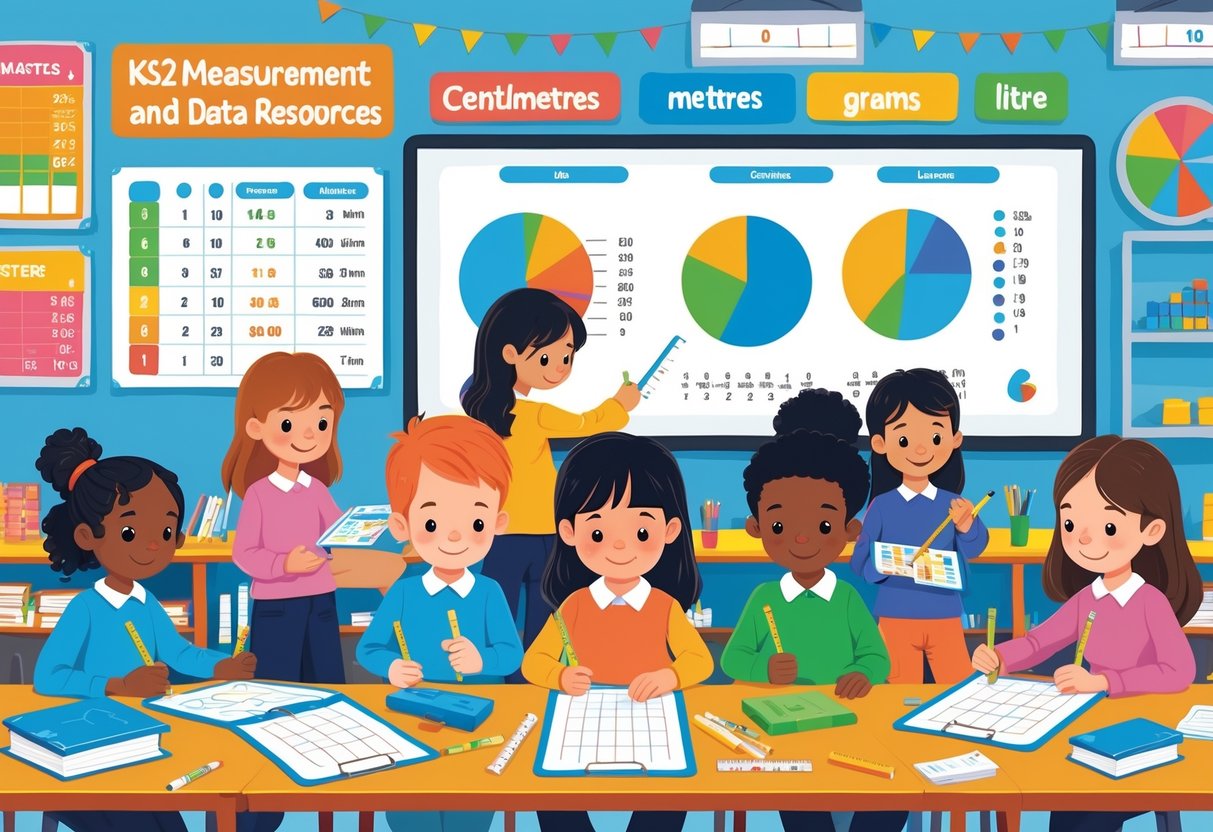
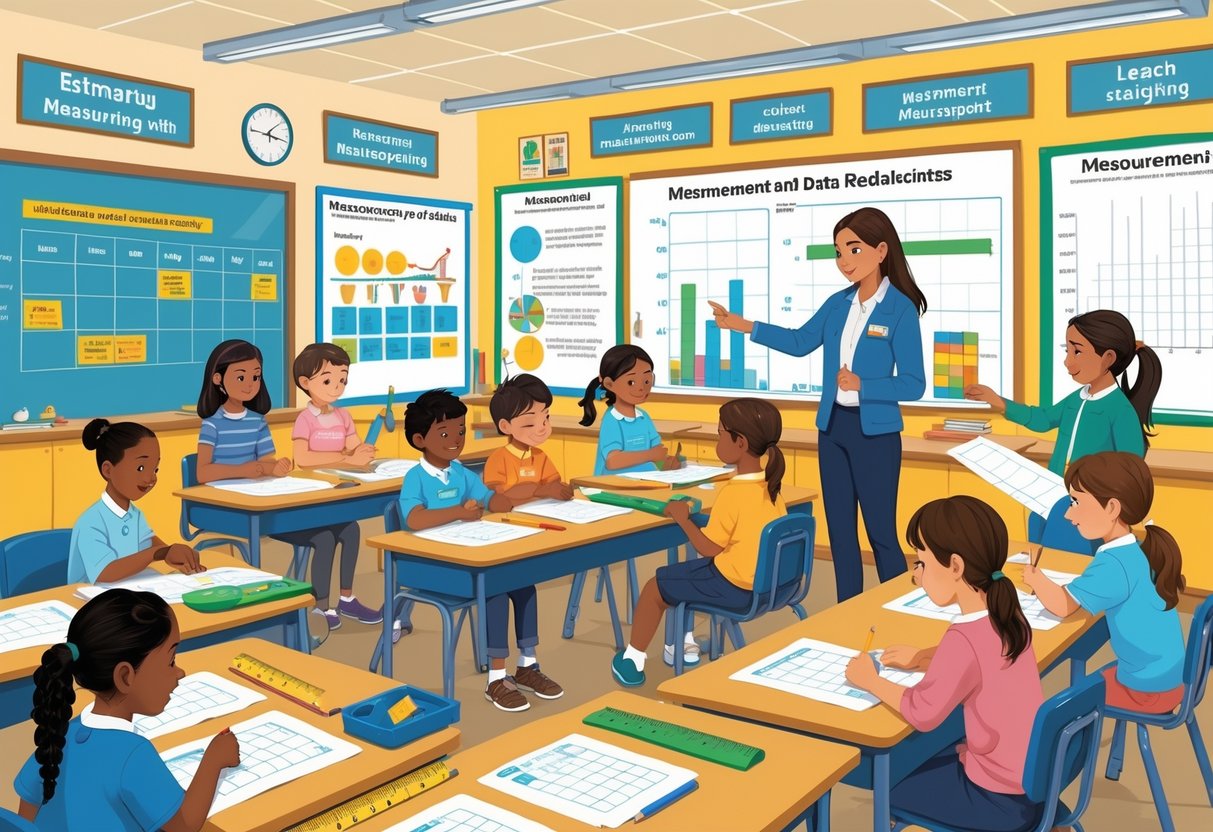
KS2 measurement and data resources bring together worksheets, activities and lesson plans that help pupils aged 7 to 11 learn how to measure length, mass, capacity, time and money, while recording and interpreting data. These measurement resources for KS2 follow the UK National Curriculum and give teachers ready-made materials to save planning time. LearningMole, a UK educational platform started by Michelle Connolly, shares free curriculum-aligned videos and teaching materials to support primary teachers and parents working with children aged 4 to 11.
Michelle Connolly, a former primary teacher with over 15 years of classroom experience, says, “understanding measurements is essential for everyday life, from reading a clock to working out if furniture will fit in a room”. Pupils need to pick up these practical skills using hands-on activities and clear explanations.
The right mix of KS2 maths resources keeps children interested and helps build their confidence with measurements.
You’ll see that teaching measurement to KS1 and KS2 pupils works best if you combine visual aids, practical tasks and regular practice. From estimating lengths to calculating area and working with data tables, these skills connect and grow across Key Stage 2.
The resources on offer now include interactive games, differentiated worksheets and step-by-step lesson plans to support each concept.
Practical measurement skills help pupils with real-life tasks like reading clocks, handling money and understanding units
Good teaching uses hands-on activities, visual aids and differentiated materials to build confidence in all measurement topics
Understanding KS2 Measurement
KS2 measurement builds on early numeracy skills. Pupils start using precise units, learn conversions, and solve practical problems with length, mass, capacity, time and money.
They move from simple comparisons to more involved calculations that get them ready for real-world applications.
Overview of Key Principles
The National Curriculum expects you to teach KS2 measurement through three main ideas: measuring, comparing and calculating. Pupils need to understand standard units such as millimetres, centimetres, metres, kilometres for length, grams and kilograms for mass, and millilitres and litres for capacity.
You’ll focus on accuracy and estimation from Years 3 to 6. Children pick up how to choose tools like rulers, scales and measuring jugs, then read measurements with more precision.
They estimate before measuring, which helps develop number sense and practical judgement.
Converting between units gets more important as pupils move on. They start with easy conversions like centimetres to metres, and then tackle more complicated calculations with mixed units.
You should link these conversions to multiplication and division skills from other KS2 maths topics.
Time and money calculations bring in extra challenges. Pupils use both 12-hour and 24-hour clocks, work out time intervals, and handle pounds and pence in useful, everyday situations.
Importance of Measurement in Everyday Life
Measurement skills matter for life. Pupils need to read times on timetables, work out journey times, and decide when to leave for appointments.
Shopping and cooking depend on measurement knowledge. Pupils measure ingredients, compare prices per unit, calculate discounts, and check if furniture will fit at home.
If a wardrobe is 3 feet wide and the bedroom wall is 100 centimetres, they need conversion skills to know if it fits.
Careers rely on measurement too. Builders measure materials, nurses calculate medication doses, and designers work with exact dimensions.
Even in an office, people need to manage time and budgets.
Sports and fitness activities use measurement as well. Children track distances, monitor height and weight, and follow timed exercises.
These real-life examples make your measurement lessons more engaging and meaningful.
Progression from KS1 to KS2
Pupils come to KS2 with basic comparison skills from Key Stage 1. They can compare lengths and heights using non-standard units, spot coins, and tell time to the hour and half hour.
In Year 3, you move to standard units only. You introduce millimetres, teach that 1,000 millilitres equals 1 litre, and develop time-telling to five-minute intervals.
Children start adding and subtracting measurements with the same units.
Years 4 and 5 bring converting measurements between different units. Pupils solve problems with mixed units, handle multi-step questions, and use decimal notation in measurement.
They read scales more accurately and estimate better.
Pupils work out area, perimeter and volume, handle imperial and metric units, and use measurement skills in science and design technology.
Measurement Worksheets for KS2
Worksheets give pupils structured practice with length, mass, capacity, time and money conversions from Years 3 to 6.
You can get free and premium options with answer sheets, differentiated activities and real-world problem-solving.
Types of Measurement Worksheets
Length worksheets usually cover converting between millimetres, centimetres, metres and kilometres. Pupils practise measuring classroom objects, switching units and comparing distances.
Measurement worksheets for KS2 maths include activities where children measure things like shoes, pencils and chairs to the nearest centimetre or millimetre.
Mass and weight worksheets help children convert between grams, kilograms and tonnes. These often use real-life situations, such as weighing ingredients for recipes or comparing package weights.
Capacity worksheets use millilitres and litres with pouring and measuring activities. Time worksheets move from reading analogue clocks to working out durations and converting between seconds, minutes and hours.
You’ll also spot worksheets that mix measurement types, showing how different units connect.
Converting lengths worksheets range from basic conversions to ordering measurements from smallest to largest.
Differentiated Practice Activities
You need worksheets at different levels to suit your pupils. Basic ones might just ask for a conversion like 3 metres to centimetres, while harder ones include decimals, such as 2.5 kilometres to metres.
Lower ability worksheets often come with visual aids like number lines or conversion charts. Mid-level ones remove these supports and add word problems.
Higher ability worksheets challenge pupils with multi-step problems, making them convert units several times in one question.
Give Year 3 pupils easier conversions between centimetres and metres, while Year 6 pupils tackle more complex, mixed-unit problems.
Some worksheets add extension tasks or challenge questions at the bottom. This lets quick finishers move on without needing a whole new worksheet.
Benefits of Using Worksheets
Worksheets let pupils work at their own speed and revisit tricky ideas by themselves. You can spot which children find certain conversions difficult by checking their answers.
Answer sheets save you marking time and help pupils check their own work. This builds independence and helps them notice mistakes.
Corbettmaths Primary gives worksheets with answer sheets for topics like area, perimeter and metric units for length.
Paper-based practice backs up learning from hands-on measuring. After measuring objects with rulers, pupils can complete conversion worksheets to use what they’ve learned.
Worksheets work well for homework, giving parents clear examples of what their children are learning.
You can use finished worksheets to track progress and spot gaps before formal assessments.
Integrating Worksheets into Lessons
Begin with hands-on measuring before giving out worksheets. Pupils might measure playground equipment, then fill out a worksheet converting those measurements.
Use worksheets as part of a lesson sequence, not just on their own. Demonstrate conversions on the board, let pupils practise with manipulatives, then finish with a worksheet.
LearningMole shares free video resources explaining measurement concepts, which you can pair with worksheets for extra practice.
Mix up worksheet types during a unit. Start with simple conversions, then move to word problems and real-life scenarios.
A converting lengths board game between worksheets can keep pupils interested.
Set time limits for worksheet completion to build fluency. Five minutes for ten conversions encourages quick recall of multiplication facts for unit conversions.
You can also use worksheets for morning starters or intervention groups.
Units of Measurement in KS2
Key Stage 2 pupils learn to use different units of measure and build skills to pick the right units for each task.
They gain confidence switching between measurement systems with regular practice.
Metric and Imperial Units
The metric system sits at the heart of measurement teaching in KS2, as the National Curriculum sets out. Pupils use millimetres, centimetres, metres and kilometres for length.
They work with grams and kilograms for mass, and millilitres and litres for capacity.
Common Metric Units by Category:
Length
Mass
Capacity
Millimetres (mm)
Grams (g)
Millilitres (ml)
Centimetres (cm)
Kilograms (kg)
Litres (l)
Metres (m)
Kilometres (km)
Imperial units come up less often but still matter in real life. Pupils see miles for longer distances, pounds for weight and pints for capacity.
Picking the right units means pupils need to think about size and context. You wouldn’t measure a pencil in kilometres or a road trip in centimetres.
Year 5 and Year 6 pupils practise matching units to objects and situations. A person’s height works best in centimetres or metres.
The weight of a bag of apples fits grams or kilograms. A bottle of juice should use millilitres or litres.
Teachers often find that practical activities help children get this. Pupils estimate measurements first, then check their answers using rulers, scales or measuring jugs.
This hands-on approach builds confidence and helps them develop a sense of reasonable measurements.
Converting measures between different units can really trip up a lot of KS2 students. The main relationships to keep in mind: 1,000 millimetres in a metre, 100 centimetres in a metre, and 1,000 metres in a kilometre.
Year 6 students use decimal notation when they convert measures. They might write 2.5 metres instead of 2 metres 50 centimetres.
Larger to smaller: multiply the number (3 metres = 3 × 100 = 300 centimetres).
Smaller to larger: divide the number (5,000 grams = 5,000 ÷ 1,000 = 5 kilograms).
LearningMole has free video tutorials showing conversion methods with examples. The site also includes activities so children can practise metric conversions at their own speed.
Measuring Length and Height
Learning to measure lengths and heights helps students make sense of size, distance and comparison. At first, children estimate measurements, then move on to using tools like rulers and tape measures.
Practical Measuring Activities
Hands-on measuring gives children confidence before they use formal units. Students can use cubes to measure length of classroom objects and count how many cubes fit along a pencil or book.
This method helps children understand that measuring means finding how many units fit along an object. Teachers often have students measure the same item with different non-standard units to show why standard units are important.
Year 3 pupils usually move from informal units to centimetres and metres. Practical measuring activities work best when children estimate first, then measure to check.
A common approach is to ask students to guess the height of their desk, then measure it.
Recording measurements in tables helps students organise data and spot patterns. They might measure and compare the heights of different plants or the lengths of various shoes.
Using Rulers and Scales
Children need to know where to place the zero point and how to count intervals to read scales accurately. They should line up the zero mark of the ruler with the edge of what they’re measuring, not the end of the ruler.
Measuring accurately using a ruler means reading the scale where the object ends and counting millimetres between centimetre marks if needed.
Many students struggle with this at first. They might not line things up properly or miscount the divisions.
LearningMole provides free videos showing how to read different measuring tools. These can help in class or at home.
Practising with different scales builds flexibility. Children should start with rulers marked in centimetres, then try ones showing both centimetres and millimetres.
Length Word Problems
Solving problems with length measurements takes calculation skills and an understanding of units. Word problems might ask students to find the total length of three ribbons or work out how much taller one sunflower is than another.
Year 4 and 5 pupils face problems that involve converting between millimetres, centimetres and metres. For example, a question might ask how many 15cm pieces you can cut from a 2-metre string. That needs conversion and division.
Real-life scenarios make these problems matter more. You might see questions about measuring sports pitches, working out fabric for curtains, or finding distances on maps.
Students have to decide which operation to use and if they need to convert units before working things out.
Practice with multi-step problems gets children ready for reasoning questions in tests. These can mix length with other measures or ask students to explain their working.
Area and Perimeter of Rectilinear Shapes
Rectilinear shapes have straight sides meeting at right angles, like rectangles joined together. Students learn to find the area (space inside) and perimeter (distance round) of these compound shapes by splitting them into simpler rectangles.
Understanding Area
The area of rectilinear shapes shows how much space the shape covers. You measure area in square units, such as square centimetres (cm²) or square metres (m²).
To work out the area, split the rectilinear shape into rectangles. Multiply the length by the width for each rectangle, then add all the areas together.
You can also count unit squares if the shape is on grid paper. Each little square stands for one square unit. Just count the squares inside the shape’s outline.
This method suits Year 4 students who are just getting to grips with 2D shapes and area.
Calculating Perimeter
Perimeter is the total distance around the outside edge of a rectilinear shape. Add up the length of every outer side to get the perimeter, using units like centimetres or metres.
Working with rectilinear figures means you need to spot all the outer edges. Mark each side as you count so you don’t miss one or count it twice.
Sometimes, sides are shared between rectangles inside the shape, but only the outer boundary counts.
You can find missing sides by checking the opposite ones. In rectilinear shapes, parallel sides add up to the same total. If one side is 8 cm and part of the opposite side is 5 cm, the missing bit must be 3 cm.
Working with Grid Paper
Grid paper makes it easier to see and calculate both area and perimeter. Each square stands for one unit, so you can count and measure without tricky maths.
For area, count every square that’s fully inside the boundaries. Counting squares on rectangular grids gives a clear way to understand area before you use formulas. Colouring or shading the squares can help you keep track.
For perimeter, just count the edges around the outside. Each side of a grid square is one unit. Run your finger round the outline and count each length as you go.
This hands-on way of working builds confidence with measurement before you move to more abstract methods.
Capacity, Volume, and Mass
https://www.youtube.com/watch?v=GKCE8ohIBqE
KS2 students need practical skills with different measures, including knowing how much liquid a container holds, the space an object takes up, and how heavy things are. These ideas build on each other from Year 3 to Year 6.
The main units are millilitres (ml) and litres (l). Remind children that 1,000 millilitres make 1 litre.
Real containers like water bottles, jugs and measuring cylinders help children understand capacity. Teaching capacity in KS2 means students estimate, then check the actual measure.
Pupils should practise reading scales and converting between units, for example, changing 2.5 litres into 2,500 millilitres.
Understanding Volume
Volume is the amount of space a 3D object takes up. It’s different from capacity, which is all about containers and liquids.
Year 5 and 6 pupils work out volume in cubic centimetres (cm³) and cubic metres (m³). A cube with 1cm sides has a volume of 1cm³.
To find the volume of a cuboid, multiply length × width × height. Resources for teaching volume often include activities where students build shapes from cubes.
This hands-on method helps them picture volume. Children also learn that 1cm³ equals 1ml, so they can link volume to capacity.
Comparing and Measuring Mass
Mass tells you how much matter is in an object. Students measure mass in grams (g), kilograms (kg), and sometimes tonnes (t) for very heavy things.
The National Curriculum expects children to read scales correctly and convert between units. They learn that 1,000 grams equals 1 kilogram.
Pupils should estimate mass by comparing items they know. For example, ask them to hold an object and compare it to a bag of sugar (1kg) or a paperclip (about 1g).
Teaching Time: Clocks and Intervals
Children learn to read both analogue and digital clocks, work out time intervals, and solve problems with different clock types. These skills build step by step, starting with basic clock reading and moving to duration calculations.
Reading Analogue and Digital Clocks
Analogue clocks need children to understand how the hour and minute hands work together. The shorter hand shows the hour, the longer one shows the minutes.
Each number on the clock face stands for five minutes when you count with the minute hand.
Digital clocks show the time in numbers, with hours and minutes separated by a colon. 12-hour digital clocks use AM or PM for morning or afternoon. 24-hour clocks keep going after 12, so 1:00 PM is 13:00.
Year 3 pupils start by reading analogue clocks to the nearest five minutes. By Year 4, they read time to the nearest minute on both analogue and digital clocks.
Children need to recognise key vocabulary like o’clock, quarter past, half past, and quarter to. These terms link to fractions of an hour, which helps connect time to other maths ideas.
Quarter past three means 15 minutes after 3:00. Half past shows 30 minutes after the hour.
Many pupils find it tricky to switch between 12-hour and 24-hour formats. You add 12 to any PM time after 12:59 to get the 24-hour version.
For example, 3:30 PM turns into 15:30 in 24-hour time.
LearningMole has free video lessons that show clock reading techniques with visual examples. Teachers say that mixing physical clock models with digital practice gives children more ways to grasp time concepts.
Worksheets let children practise clock reading skills. Good ones include drawing hands on blank clock faces, matching analogue to digital times, and switching between 12-hour and 24-hour formats.
You can adjust worksheet difficulty for mixed-ability classes. Some children use clocks marked with five-minute intervals, while others work with unmarked faces.
Challenge worksheets add word problems that mix time reading with real-life situations. A question might ask when a film finishes if it starts at 2:45 PM and lasts 105 minutes.
Calculating Durations
Children work out how much time passes between two points in duration problems. This skill builds on adding and subtracting but needs an understanding that 60 minutes make an hour.
Calculations that cross hour boundaries often catch children out. If a journey starts at 10:45 and takes 30 minutes, they need to realise it ends at 11:15, not 10:75.
Using number lines helps children see these jumps across the hour.
Time interval problems show up in timetables, cooking, and journey planning. Breaking complex durations into smaller chunks helps.
To find the time between 9:40 AM and 2:15 PM, children might count 20 minutes to 10:00 AM, add 4 hours to 2:00 PM, then add another 15 minutes.
Money and Measurement Word Problems
Children need to use maths skills in real-life situations with money and measurements. Money word problems help students practise calculations and problem-solving that they’ll use for years.
Solving Money Problems
Basic money problems ask you to work out totals, find change, or spot differences between amounts. Children need to understand pence and pounds, and how to write amounts using the £ symbol and decimal points.
Start with simple addition, like adding up the cost of three items. Move to subtraction to find change from a purchase.
Mental maths strategies help. Rounding to the nearest pound first makes sums easier, and converting amounts to pence removes decimal points.
Money in Real-Life Contexts
Shopping problems work well because children see them all the time. They might compare prices, work out which deal is better, or plan what to buy with a set budget.
Menus, catalogues, and ticket prices give real examples for practice. Children can add up the cost of a family meal, work out savings in a sale, or check if they have enough for what they want.
Measurement problems in KS2 often mix money with weight or volume. A question might ask for the cost per kilogram or price for different amounts.
Estimating and measuring help pupils grasp real-world quantities. Recording data in tables teaches them to organise information and spot patterns.
The Role of Estimation
Estimation builds number sense and helps pupils check if their answers make sense. When you teach estimating and measuring in Year 3, pupils try to guess a value close to the real amount before measuring.
Letting pupils hold an object with a known mass in one hand and an unknown object in the other gives them a feel for heavier, lighter, or about the same.
Estimation skills improve when pupils regularly compare guesses with real measurements. If a pupil guesses a book weighs 500g but it weighs 200g, that feedback helps them adjust next time.
The difference between estimated and actual values shows if their number sense is growing.
Collecting and Using Data
KS2 data collection means measuring length, mass, capacity, and time. Pupils need hands-on time with rulers, scales, and jugs to build accuracy.
Building upon KS1 learning, you can run sessions where pupils measure real objects in class. They might measure pencil length, fruit mass, or container capacity.
When pupils collect their own data, they see why accuracy matters. Often, one pupil reads the scale and another records the number.
Recording Results in Tables
Tables show information in rows and columns so data is easier to read. Pupils should read table headings carefully and put numbers in the right places.
A mass table might have three columns: Object, Estimated Mass, and Actual Mass. This setup lets pupils compare guesses with real results and spot patterns.
LearningMole has free videos that show how to set up tables for different measurements, including steps for Year 3 and Year 4.
You can extend table work by asking pupils to order objects from lightest to heaviest or find the difference between their estimate and the real value. These tasks build both measurement and arithmetic skills.
Engaging KS2 Measurement Activities
Children learn measurement best when they can touch, move, and explore real things. Active tasks help pupils understand length, weight, capacity, and time in ways that stick.
Hands-On Group Challenges
Group activities turn measurement into teamwork. Set up stations where pupils measure objects using rulers, tape measures, and trundle wheels.
One popular task gives groups containers to estimate, then measure capacity with water or rice.
Measuring ingredients precisely links maths to cooking. Pupils follow simple recipes, weighing flour or measuring milk to practise with scales and jugs.
Another challenge asks teams to measure and record furniture or playground equipment. They then calculate perimeter and area, and compare results with other groups.
This builds measuring skills and mathematical reasoning.
Games and Interactive Resources
Interactive games make measurement practice more fun and build accuracy. Online activities let children drag objects to balance scales or match measurements to units.
Board games work well too. Try a measurement quiz trail where pupils answer questions to move around the board.
Physical games like ‘measurement scavenger hunts‘ get children moving as they find objects of certain lengths or weights.
Digital tools allow pupils to practise at their own speed. Lots of resources for teaching maths include visual demonstrations that help with ideas like volume and mass.
Real-World Maths Projects
Real projects show why measurement matters outside school. You might ask pupils to design and build a small cardboard box to set dimensions, which needs careful measuring and cutting.
Garden projects are great too. Children can measure plots, figure out how much compost they need, or track plant growth over time with rulers and charts.
These tasks pull together measurement skills in one activity.
Planning a class event gives more practice. Pupils might measure ingredients for a bake sale, calculate how much squash to make for 60 people, or work out how to seat everyone with the tables they have.
Teachers and parents often wonder how to find the best measurement and data resources for different year groups and goals. Here are some answers about worksheets, activities, and teaching materials for KS2.
What engaging worksheets can help Year 3 pupils learn about length measurements?
Look for worksheets using real objects to measure with rulers or tape measures. Activities comparing classmates’ heights or measuring classroom furniture help pupils understand centimetres and metres in real life.
LearningMole has free video tutorials showing measuring techniques and printable activities for Year 3. Worksheets with visual aids and step-by-step instructions offer extra support for those who need it.
Where can I find comprehensive PDF resources dedicated to KS2 measurement and data?
You’ll find plenty of downloadable PDF resources for KS2 measurement and data handling on several platforms. The BBC Bitesize measures section shares free learning materials with simple explanations for Years 3 to 6.
You can grab measurement worksheets and activities covering length, mass, capacity, time and money conversion. Many sites offer different levels, so you can suit resources to each pupil’s needs.
For data handling, primary resources for data handling and statistics include pictograms, bar charts and tally chart activities. These PDFs usually come with answer sheets, which makes marking a bit easier.
Can you suggest some practical measurement lessons suitable for Year 6 students?
Year 6 pupils benefit from lessons with multi-step problems and real-world challenges. Try designing tasks where children calculate area and perimeter of irregular shapes or deal with metric and imperial conversions.
Set up investigations where pupils measure ingredients for recipes and adjust quantities up or down. This links measurement to cooking and helps reinforce ratio and proportion skills.
Reading scales works well when you bring in measuring cylinders with tricky intervals. Ask pupils to measure and compare capacities of different containers. They can record their results in tables or simple graphs.
What are some fun units of measurement activities for primary school children?
Children love hands-on activities that get them moving. Organise a measuring scavenger hunt where pupils find objects of certain lengths or weights around the classroom or outside.
Set up stations for estimating and measuring items using different units. Maybe one for length in millimetres, another for mass in grams, and a third for capacity in millilitres.
Bingo games where children match measurements to units keep them interested and help them practise. Physical activities like measuring jump or throw distances mix PE with maths, which is always a win.
How does introducing measurement activities benefit early years’ development?
Early measurement activities build core maths skills that children carry with them. Young learners develop spatial awareness and comparison skills when they sort objects by size or height.
Using non-standard units, like building blocks or hand spans, helps children understand measurement before they use formal units. This makes tricky ideas feel more approachable.
Measuring activities also support language growth as children learn words like longer, shorter, heavier and lighter. These early experiences set them up for more formal measurement work in KS1 and KS2.
Could you recommend an interactive converting measurements activity for upper KS2?
Upper KS2 pupils usually enjoy digital games that give instant feedback on conversion tasks. Games that use real-life scenarios and ask them to convert between millimetres, centimetres and metres seem to grab the attention of Year 5 and 6 learners.
You could try card matching games where children pair up equivalent measurements. For example, give them 250 cm, 2.5 m and 2500 mm to match up.
High-achieving Year 6 pupils often like a challenge, especially if they’re getting ready for secondary school. Try using cooking or construction examples where they have to convert between grams and kilograms or litres and millilitres as they solve problems.
Maths Circus, an innovative platform we've crafted, presents a captivating realm where children learn mathematics through the exciting theme of a circus. The joy of juggling numbers and solving circus...
The 9 times table multiplication has a reputation for being tricky, yet it holds more mathematical magic than any other table in the primary curriculum. Every answer follows two neat...
Article Summary What this article covers: Ten differences between river otters and sea otters, from size, fur and swimming style to diet, tool use and family life, plus which otter...
Article Summary What this article covers: The nine main types of natural disasters, how each one works and how they are measured, which hazards genuinely affect the UK, and how...





Leave a Reply