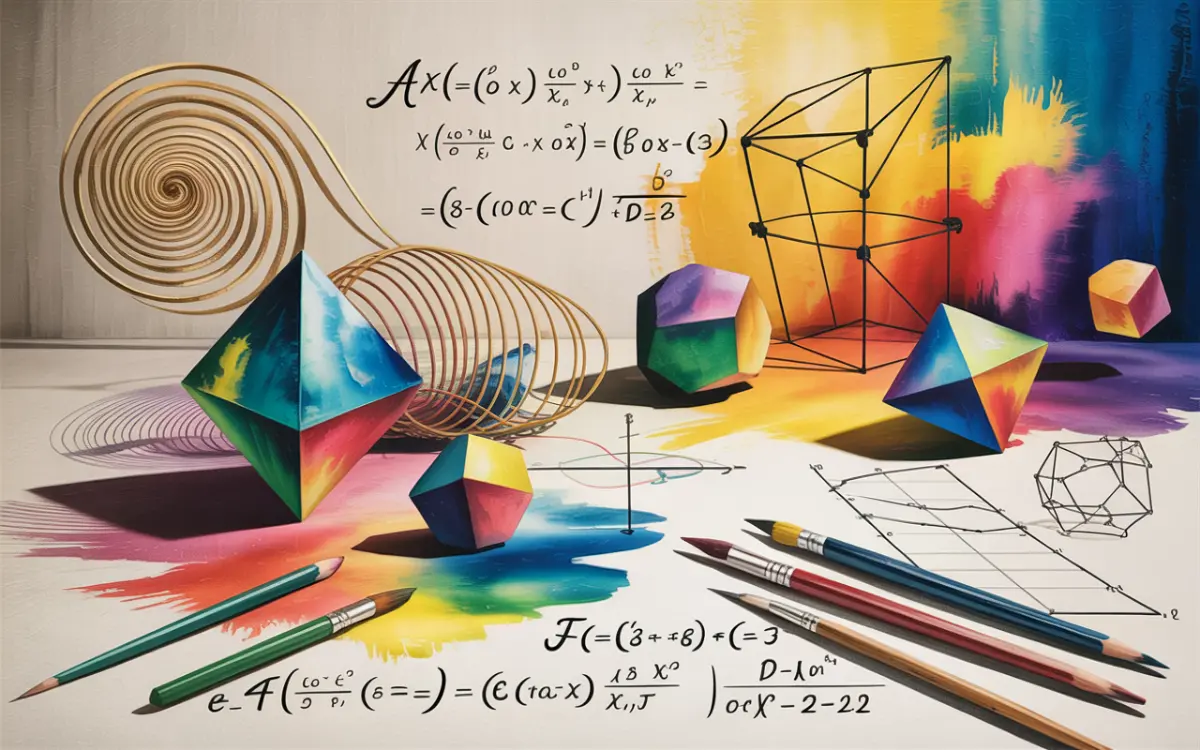
Mathematics and art may seem like distinct fields, but a closer look reveals their fascinating intersection. At the heart of this convergence is the concept that mathematical principles can deepen our appreciation and understanding of artistic creation. Art museums offer a unique space where you can explore this connection through the precise patterns of geometry and the strategic use of colour.
You can witness math in museums. You’re not just looking at beautiful objects; you are witnessing a silent dialogue between two disciplines that have shaped cultures and civilisations. Exhibitions dedicated to this subject provide educational programmes that offer insights into the artistic process, often with a mathematical perspective. Discovering the role of mathematics in art can transform your museum experience, elevating it from mere observation to an interactive learning journey.
The Intersection of Mathematics and Art
Within the tapestry of human culture, mathematics has long intertwined with art, lending its principles to create balance, proportion, and symmetry in visual aesthetics. From the exacting geometry present in Renaissance masterpieces to the abstract expressions of contemporary art, mathematical knowledge has been a silent yet foundational partner in the journey of artistic endeavour.
Historical Context in Art
Historically, art has embraced mathematics to achieve visual harmony. During the Renaissance, artists like Leonardo da Vinci employed geometric techniques to compose their works, leading to paintings that showcased not only beauty but also mathematical precision. The implementation of perspective and proportion in paintings such as the ‘Last Supper’ exemplify this union, where mathematical ratios define spatial composition, bringing a sense of realism and depth to the canvas.
Geometry and symmetry found their way into the intricate patterns of Islamic art as well. Here, intricate patterns and symmetry served not just aesthetic purposes, but also conveyed philosophical and religious principles without depicting human or animal forms, as per cultural guidelines of the time. The mathematical precision required to create these complex tessellations demonstrates the sophisticated understanding of geometry possessed by Islamic artists.
Contemporary Explorations
In the contemporary realm, artists continue to explore mathematical concepts, often pushing boundaries of understanding and perception. Mathematics is utilised to explore balance and symmetry in more abstract manners. For example, the use of knot theory emerges in sculptures and installations that provoke viewers to consider the complexity of three-dimensional space.
Art institutions, such as the Museum of Mathematics, offer interactive experiences that expound on the connections between maths and art. These venues provide visitors with a real-world understanding of concepts like topology, which can be seen in paintings that explore the geometry of patterns without intersections. Through both historical and contemporary lenses, mathematics and art demonstrate a rich dialogue, mutually enriching and expanding the boundaries of what can be created and understood.
Artistic Creation
The interplay between mathematics and art enhances our understanding of creativity and structure in both fields. This section highlights how mathematical principles are fundamental to artistic design, resulting in visually striking creations that offer more than meets the eye.
Geometry and Symmetry in Design
Geometry serves as the backbone of many artistic creations, where artists utilise shapes to form the basis of their designs. Symmetry, a concept deeply rooted in geometry, often manifests itself in artworks, bringing a sense of harmony and balance. Structures within paintings or sculptures that echo each other on either side of an axis demonstrate how artists leverage symmetry to appeal to our innate sense of order.
Artists throughout history have understood that geometric shapes possess inherent visual power. Circles suggest completeness and unity, whilst triangles can convey stability or tension depending on their orientation. Squares and rectangles provide structure and formality. By combining these basic geometric elements, artists create compositions that resonate with viewers on both conscious and subconscious levels.
Proportion and Balance in Composition
Striking the right proportion and balance in art is key to achieving a composition that is pleasing to the eye. The Golden Ratio, for example, is a mathematical principle often employed in art to create aesthetically pleasing proportions, which can be observed in various historical artworks. By applying these proportions, artists ensure that each part of their creation relates harmoniously to the whole, whether in a single piece or a broader structural design.
The Golden Ratio, approximately 1.618, appears throughout nature and has been used by artists for centuries. From the Parthenon in ancient Greece to Leonardo da Vinci’s “Vitruvian Man”, this mathematical constant has guided the creation of works that feel naturally balanced and visually satisfying. Modern artists continue to employ this principle, whether consciously or intuitively, to create compositions that captivate viewers.
Patterns and Repeating Forms
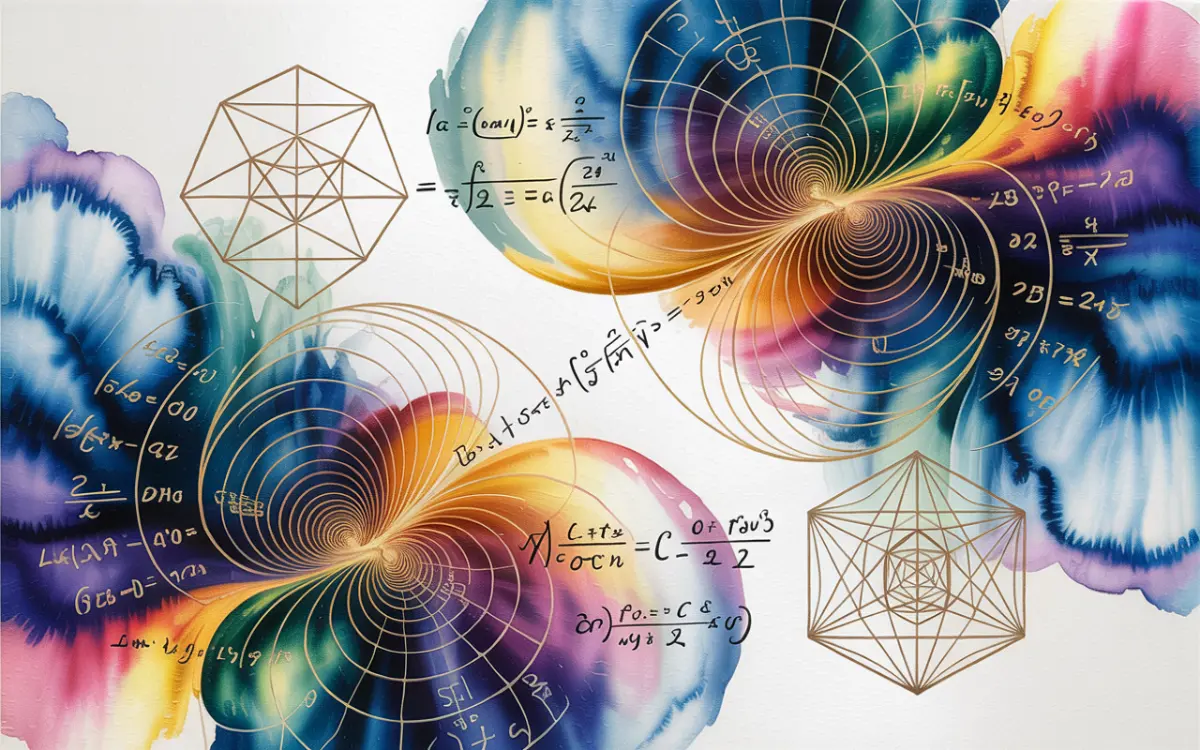
Patterns and repeating forms are omnipresent in art and are instrumental in generating visual rhythm and cohesion. These patterns can be based on simple mathematical ideas, like tiling and tessellations, or more complex fractal structures that artists use to convey a sense of infinity. This repetitive use of form draws your attention and guides your eye across the artwork, providing structure through predictable repetition, whilst allowing for creative expression within the constraints they impose.
Fractals, with their self-similar patterns at different scales, have become particularly popular in contemporary digital art. These mathematical constructs mirror patterns found in nature—from coastlines to snowflakes—and allow artists to create works that feel both familiar and otherworldly. The mathematical precision underlying these patterns enables artists to explore infinite complexity within finite spaces.
Educational Programmes and Exhibitions
Museums blend the world of mathematics with art through educational programmes and captivating exhibitions. These initiatives offer interactive experiences that can enhance your understanding and enjoyment of both subjects, making abstract mathematical concepts tangible and accessible.
Mathematics-Focused Art Exhibitions
Mathematics-focused art exhibitions provide a unique opportunity to see how mathematical concepts shape artworks and inspire creativity. Museums may curate exhibitions that display the curriculum of early 21st-century mathematics exhibitions, examining the link between maths and aesthetics. These exhibitions invite you to observe patterns and structures that you might not have considered before, showing how deeply maths is intertwined with the visual arts.
Such exhibitions often feature interactive elements that allow visitors to engage directly with mathematical concepts. Touch screens might demonstrate how fractal patterns develop, whilst physical manipulatives let visitors create their own tessellations. This hands-on approach transforms abstract mathematical ideas into concrete experiences that resonate with visitors of all ages and backgrounds.
Educational Outreach and School Programmes
Museums often develop educational outreach programmes designed to align with the mathematics curriculum in schools. These programmes may include field trips that provide hands-on activities for students to engage with mathematical concepts outside the classroom. Augmented reality technology is sometimes utilised in mathematics exhibitions to deliver an immersive learning experience. Teachers can integrate these outings into their syllabus, offering a memorable field trip that enriches the students’ educational journey through the exploration of maths in the context of art.
These programmes serve multiple purposes: they make mathematics more accessible and engaging for students who might struggle with traditional classroom approaches, they demonstrate real-world applications of mathematical concepts, and they foster interdisciplinary thinking that connects different areas of study. By experiencing mathematics through art, students develop a more holistic understanding of both disciplines.
Art Museums as Spaces for Learning
Art museums offer unparalleled opportunities for educational enrichment, extending beyond traditional confines to foster interactive learning environments. They serve as platforms for learning where maths and art intersect, allowing patrons to experience how numerical concepts can illuminate artistic masterpieces.
Art Museums and Public Accessibility
Art museums have increasingly become accessible spaces, inviting a diverse array of visitors to explore the connections between mathematics and art. These institutions often provide hands-on exhibits and interactive guidance, allowing you to engage with artwork through a mathematical lens. Symmetry and geometry can reveal the underpinnings of a sculpture, whilst mathematical principles can explain the balance and proportion found in paintings.
Modern museums recognise that different visitors learn in different ways. Some prefer guided tours with expert explanations, whilst others favour self-directed exploration with informative plaques and digital guides. Many museums now offer multiple modes of engagement, from traditional audio tours to smartphone apps that provide augmented reality experiences, ensuring that every visitor can access mathematical and artistic concepts in ways that resonate with their learning style.
Collaborative Projects Between Mathematicians and Artists
In the realm of collaborative projects, mathematicians and artists work hand-in-hand to bring forth exhibitions that blend numerical precision with creative expression. These partnerships result in exhibits that challenge our understanding of both disciplines. Through these projects, artists might use algorithmic or fractal principles to create their work, whilst mathematicians employ visual arts to demonstrate complex mathematical ideas.
Such collaborations break down traditional academic silos and demonstrate that creativity and analytical thinking are not opposing forces but complementary aspects of human intelligence. When mathematicians and artists collaborate, they create works that are both aesthetically compelling and intellectually rigorous, offering viewers new ways of understanding both fields. These partnerships also inspire younger generations to see that careers in STEM fields can be creative and that artistic pursuits can be intellectually demanding.
Understanding Geometry Through Art
Discovering the relationship between geometry and art can enhance your appreciation for both disciplines. When you wander through an art museum, you’re not just looking at beautiful art; you are also observing fundamental principles of geometry in practice, from the most basic shapes to complex three-dimensional forms.
Geometry, at its core, is about the properties and relations of points, lines, surfaces, and solids. In visual arts, these elements form the basis of nearly every piece. Artists use geometry to structure their works, employing various shapes and forms to compose a harmonious final image. The use of line and shape is pivotal in directing viewer attention and creating visual flow.
Straight, curved, and diagonal lines control the flow of your vision and guide your focus around the artwork. Shapes, both geometric and organic, can dominate a piece or play a more subtle role in its thematic expression. Artists manipulate these elements to create rhythm, a sort of visual symmetry, or deliberately disrupt it to evoke certain feelings. Understanding these geometric foundations helps viewers appreciate the deliberate choices artists make in composing their works.
Space in art can be interpreted in different ways. There’s the physical space occupied by a three-dimensional object, but there’s also the illusion of space on a two-dimensional plane, achieved through perspective drawing. This creates a sense of depth and position, allowing flat images to spring to life and giving a geometric framework to the composition. Renaissance artists pioneered techniques of linear perspective, using mathematical principles to create convincing illusions of three-dimensional space on flat surfaces.
The Role of Colour and Visualisation in Art
In museums, you often witness the vivid interplay between maths and art, noting how colour and visualisation can express beauty and form intricate connections. These relationships offer fresh perspectives on both subjects, demonstrating that even something as seemingly subjective as colour has mathematical underpinnings.
Colour Theory and Mathematics
Colour theory is the cornerstone of understanding how different hues interact, and mathematics provides a structure for this understanding. Colour harmony represents a pleasing balance, which is defined by a set of formulas and principles, much like equations in mathematics. It uses the colour wheel to explain how different colours relate to each other and can be combined effectively.
Complementary colours are directly opposite each other on the wheel, creating maximum contrast and vibrancy when used together. Analogous colours sit next to each other, producing harmonious and calming effects. Triadic colour schemes use three colours equally spaced around the wheel, creating balanced yet vibrant compositions. These mathematical relationships help artists make informed decisions about colour selection that enhance their intended emotional impact.
Visualising Mathematical Concepts Through Art
Visualisation is a powerful method to convey mathematical concepts through images, transforming abstract ideas into tangible forms. Sculptures can visualise complex mathematical ideas such as symmetry or topology. Paintings often employ geometric structures to lead your eye and establish a sense of perspective, making invisible mathematical relationships visible and comprehensible.
Artists working with mathematical visualisation create bridges between abstract numerical concepts and sensory experience. A sculpture might represent a complex topological surface, making visible a shape that exists in higher dimensions. A painting might illustrate the behaviour of mathematical functions through colour and form. These visual representations make mathematics accessible to people who might find traditional mathematical notation intimidating or opaque.
The Maths of Art Curation and Gallery Design
In the realm of art curation and gallery design, mathematics plays a critical role in creating order and enhancing the visitor’s experience. The careful application of mathematical principles supports both the aesthetic appeal and the functional structure of exhibitions, ensuring that artworks are displayed to maximum effect.
Maths in Curation
When you curate an art exhibition, the role of mathematics is paramount in establishing a coherent narrative. You must consider the sequence of artworks, ensuring that each piece leads logically to the next, creating a visual story that guides visitors through the gallery space. Utilising mathematical models for artwork placement can help in achieving a balanced distribution, ensuring each piece receives the attention it deserves.
Curators consider factors such as visual weight, colour relationships, and thematic connections when arranging exhibitions. The golden ratio might inform decisions about wall space allocation, whilst principles of balance ensure that no single area of the gallery feels overcrowded or empty. These mathematical considerations, though often invisible to visitors, significantly impact their experience and engagement with the artworks.
Maths in Spatial Design of Galleries
The spatial design of a gallery is another area where mathematics is essential. You use geometry to define the layout, manipulating shapes and lines to create a flow that directs visitors through the exhibition. Understanding dimensions and scale ensures that each artwork is given adequate space, preventing overcrowding and allowing art to be appreciated independently.
Gallery designers must consider sightlines, traffic patterns, and viewing distances when planning exhibition spaces. Mathematical analysis helps predict how visitors will move through spaces and where bottlenecks might occur. Lighting angles and intensity are calculated to eliminate glare whilst properly illuminating artworks. These mathematical considerations ensure that the physical space enhances rather than detracts from the artistic experience.
Teaching Mathematics Through Art
Integrating art into the teaching of mathematics offers innovative approaches for making abstract concepts more tangible. When you introduce students to the intricate patterns of the Renaissance or the symmetry in visual arts, you’re providing them with a rich, contextualised learning experience that connects mathematical principles to creative expression.
Education through art connects mathematical principles with the creativity of the world around us, allowing for more flexible communication that can be particularly conducive to diverse educational needs. For young learners, exploring basic shapes and patterns through artwork or creating tessellations with colourful tiles makes geometry concrete and engaging. These hands-on activities help children understand mathematical concepts through manipulation and visual observation.
For secondary students, analysing the geometry in architectural designs or identifying fractals in natural forms and art pieces connects mathematical concepts to real-world applications. These activities demonstrate that mathematics isn’t merely abstract manipulation of numbers but a tool for understanding and creating beauty in the world around us. Students begin to see mathematics as a language for describing patterns and relationships that exist throughout nature and human culture.
At university level, studying the Golden Ratio in art and nature or examining topological concepts in contemporary sculptures challenges students to think deeply about advanced mathematical ideas. These explorations encourage interdisciplinary thinking and demonstrate that mathematics has applications far beyond traditional STEM fields. Art provides a context for exploring sophisticated mathematical concepts that might otherwise seem abstract and disconnected from human experience.
Conclusion
The relationship between mathematics and art runs deeper than most people realise, forming a rich dialogue that has shaped human creativity for millennia. From the geometric precision of Renaissance paintings to the fractal complexity of digital art, mathematical principles provide the invisible scaffolding that supports artistic expression. Museums serve as vital spaces where this intersection becomes visible and accessible to all.
By recognising the mathematical foundations in art, we enhance our appreciation for both disciplines. We see that mathematics is not merely a tool for calculation but a language for describing beauty, pattern, and harmony. Similarly, we understand that art is not purely subjective expression but often involves careful planning, proportion, and structure grounded in mathematical principles.
Educational programmes that highlight these connections serve multiple purposes: they make mathematics more engaging for students who struggle with traditional approaches, they provide artists with new tools and frameworks for creation, and they demonstrate to all visitors that human knowledge is interconnected rather than compartmentalised. The next time you visit a museum, take a moment to look beyond the surface beauty and consider the mathematical principles at work. You’ll discover a hidden layer of meaning that enriches your understanding and appreciation of both art and mathematics, revealing the profound ways in which these disciplines illuminate each other and enhance our human experience.
Maths Circus, an innovative platform we've crafted, presents a captivating realm where children learn mathematics through the exciting theme of a circus. The joy of juggling numbers and solving circus...
Feedback with digital portfolios works best in primary schools when teachers keep comments brief and expect every child to act on them. A voice note of about a minute on...
Singers use their voices as musical instruments to perform songs in theatres, recording studios, choirs and at events. Most of their working day, though, is spent practising, learning music and...
Article summary What this article covers: How primary teachers can use online assessment tools such as live quizzes, polling, digital exit tickets and digital portfolios to check understanding, give faster...






Leave a Reply