Math Games for Kids: ‘If this is the answer?’ KS1 & KS2 Brilliant Games

Avatar of Michelle Connolly
Updated on: Educator Review By: Michelle Connolly

Math Games for Kids: Ever felt like math lessons are just a never-ending cycle of “What is $10 – 4$?” or “What is $5 \times 3$?” It’s time to flip the script! “If This is the Answer…” is the ultimate “reverse” math game that turns students into the teachers. Instead of hunting for a single result, kids are given the destination first and must build the road to get there. It’s a brilliant way to spark creativity, as there isn’t just one right path—there are infinite possibilities waiting to be discovered.

Math Games for Kids

Whether you are working with KS1 learners just discovering the magic of number bonds or KS2 pros diving into fractions and square numbers, this game scales perfectly to any skill level. For younger children, the number 10 might lead to $7 + 3$; for older kids, that same 10 could be the result of $\sqrt{100}$ or $(50 \div 10) + 5$. This flexibility makes it a powerhouse for the classroom or the kitchen table, encouraging kids to dig deep into their “maths toolbox” to find the most impressive way to reach the target.

To take the excitement even further, “If This is the Answer…” works brilliantly as a high-energy group competition. By introducing a timer or a “points for complexity” system, you can transform a quiet study session into a buzzing brainstorm. You might award one point for a simple addition, but five points for an equation that uses three different operations or a sneaky fraction. This gamified approach pushes KS2 students to move beyond their comfort zone and experiment with the advanced concepts they’ve been learning, all while trying to outwit their friends or siblings.

Finally, this game serves as a fantastic “warm-up” for the brain before tackling more formal assessments. Because it is open-ended, it helps kids develop mathematical stamina—the ability to keep trying different combinations until they find one that fits. It shifts the mindset from “I can’t do this” to “How else can I do this?” By the time they finish a round of “If This is the Answer…”, their minds are primed, their confidence is high, and they’re ready to see math not as a chore, but as a giant, solvable puzzle.

What Makes This Game Work

Math Games for Kids

The ‘If This is the Answer, What is the Question?’ approach flips traditional maths teaching. Instead of presenting children with a calculation to solve, you give them the answer and ask them to work backwards. This single change transforms maths from a passive exercise into active thinking.

When a teacher writes “10” on the board and asks, “If this is the answer, what could the question be?”, children immediately start exploring possibilities. A Year 1 child might suggest “5 + 5” or “8 + 2”. A Year 6 child could propose “(100 ÷ 10) × 1” or “The square root of 100”. The same answer generates vastly different mathematical thinking depending on where each child sits in their learning.

This matters because the UK National Curriculum emphasises problem-solving and reasoning alongside calculation skills. The Department for Education expects children to “solve problems by applying their mathematics to a variety of routine and non-routine problems with increasing sophistication.” Working backwards from answers directly addresses this requirement.

Why Reverse Thinking Builds Understanding

Traditional maths worksheets often create a narrow path: see the question, apply the method, find the answer. Children can follow this path without truly understanding what the numbers represent or how operations relate to each other. The reverse approach forces understanding.

Consider the difference. A worksheet might ask: “What is 6 + 4?” The child recalls that adding these numbers gives 10. They write the answer and move on. Learning happens, but it’s limited.

The reverse question—”If the answer is 10, what is the question?”—requires different thinking. The child must understand that:

  • Addition combines numbers to make totals
  • Different number pairs can create the same total
  • Subtraction reverses addition
  • Multiplication and division also produce specific answers
  • Real-world contexts involve these operations

Children learn maths properly when they can explain relationships between numbers, not just perform calculations,” explains Michelle Connolly. “The ‘If This is the Answer?’ game builds that explanatory thinking naturally.”

The Low Floor, High Ceiling Principle

Educational researchers describe effective tasks as having a “low floor and high ceiling”. This means every child can access the activity (low floor) while the most confident mathematicians still find a challenge (high ceiling).

The ‘If This is the Answer?’ game perfectly demonstrates this principle. Give any primary class the answer “12” and watch what happens:

Early Key Stage 1 responses:

  • 10 + 2
  • 6 + 6
  • 3 + 3 + 3 + 3

Later Key Stage 2 responses:

  • (3 × 4) + (2 – 2)
  • Half of 24
  • The number of months in a year
  • 60 ÷ 5
  • 2³ + 4

Every child contributes successfully. Nobody sits excluded from the activity because it’s “too hard”. Meanwhile, high-attaining mathematicians stretch themselves without the teacher creating separate worksheets.

LearningMole’s educational videos demonstrate this progression visually, showing how the same answer generates different thinking across year groups. Teachers can use these resources during whole-class teaching or for children working independently.

Playing the Game Effectively

Math Games for Kids

Success with this game depends on good setup and clear progression. Here’s how to implement it effectively in classrooms and at home.

Getting Started: The First Five Minutes

Step 1: Choose an Appropriate Starting Answer

Select a number that matches your children’s current learning. For Year 1, single-digit numbers or early teens work well. Year 6 children can handle decimals, fractions, or larger whole numbers.

Starting suggestions:

  • KS1 (Years 1-2): Numbers to 20, or even simpler (5, 10)
  • Lower KS2 (Years 3-4): Multiples of 10, numbers to 100, simple fractions like ½
  • Upper KS2 (Years 5-6): Decimals (0.5, 2.75), larger numbers, percentages

Step 2: Display the Answer Clearly

Write the answer in a prominent spot—centre of the whiteboard, a large number on paper at home, or on a tablet screen. Make it impossible to miss.

Step 3: Give Thinking Time

Don’t rush to collect answers. Silent thinking time (30-60 seconds) allows all children to formulate at least one response. This particularly supports children who process more slowly or need time to build confidence before sharing.

Step 4: Gather Initial Responses

Start collecting questions. Write them down where everyone can see them. This validates all contributions and shows the variety of possible approaches.

Making the Activity Rich: Beyond Simple Addition

Once children grasp the basic idea, deepen their mathematical thinking by introducing constraints or specific requirements.

The Operation Challenge

Specify which operation children must use in their question:

  • “If the answer is 20, what’s a subtraction question?”
  • “If the answer is 50, what’s a division question?”
  • “If the answer is ¾, what’s a multiplication question?”

This forces children to work with operations they might otherwise avoid, strengthening skills across all four operations.

The Multi-Step Extension

Require questions that use more than one operation:

  • “If the answer is 15, create a question using both addition and multiplication”
  • “If the answer is 100, use at least three different operations”

This builds understanding of operation order (BODMAS/BIDMAS) and creates more complex mathematical thinking.

The Real-World Connection

Ask for questions that relate to real situations:

  • “If the answer is £5, what could the question be about shopping?”
  • “If the answer is 30 minutes, what could the question be about time?”
  • “If the answer is 8, what could the question be about spiders?” (legs on a spider)

This demonstrates that maths exists outside textbooks and helps children see practical applications.

The Constraint Game

Set specific rules that limit what children can use:

  • “The answer is 24, but you cannot use multiplication”
  • “The answer is 50, but you must use at least one decimal”
  • “The answer is 12, but all numbers in your question must be different”

These constraints push children into unfamiliar territory and prevent them from staying in their comfort zones.

Supporting Different Learners

The beauty of this game lies in its natural differentiation, but teachers can add specific scaffolds for children who need them.

For children who struggle:

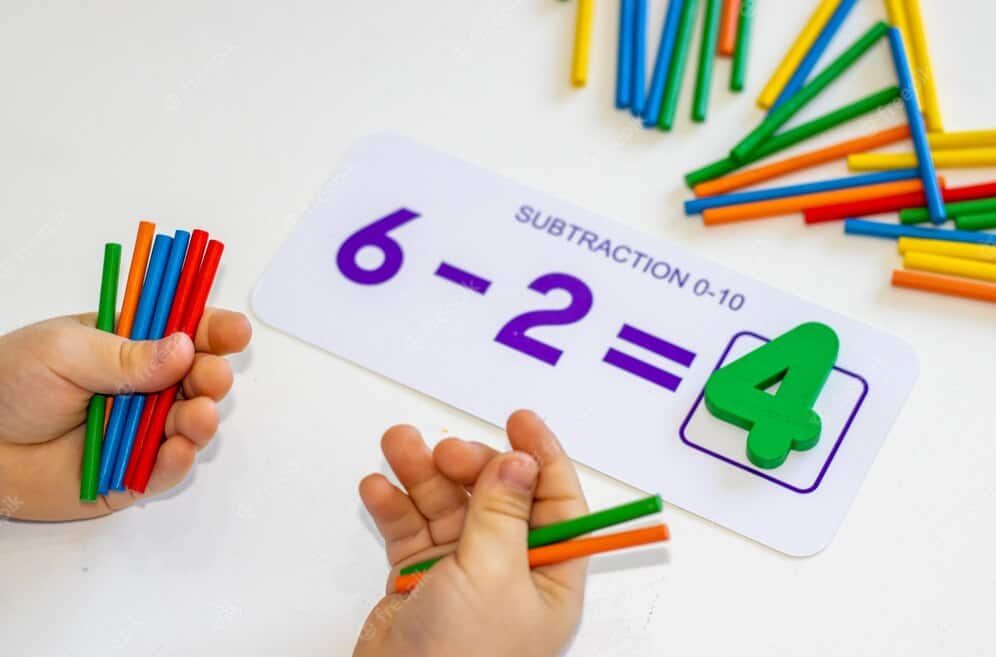
  • Provide concrete materials (counters, numicon, base-ten blocks) representing the answer
  • Use number lines to show different ways to reach the answer
  • Give sentence starters: “My question is ___ + ___” or “I used subtraction: ___ – ___ = ___”
  • Work in pairs so children can discuss ideas before sharing
  • Start with very small numbers (answers below 10)

For children with SEND:

  • Use visual representations throughout
  • Allow physical manipulation of objects to explore the answer
  • Provide a “question bank” showing different operation symbols
  • Accept drawings or diagrams as valid questions
  • Celebrate any engagement, not just complex responses

For EAL learners:

  • Display operation vocabulary with symbols (addition +, subtraction -, etc.)
  • Use visual examples before expecting verbal responses
  • Allow responses in the child’s first language initially
  • Pair with a maths-confident buddy for language support
  • Focus on mathematical thinking over perfect English expression

For high-attaining mathematicians:

  • Introduce algebraic thinking (“If the answer is 20, what is x + y?”)
  • Challenge with negative numbers or square roots
  • Require proof or explanation of why their question works
  • Ask them to create questions that deliberately confuse others
  • Extend to geometry (angles, shapes, area) or data handling

LearningMole’s video resources show these differentiation strategies in action, demonstrating how the same basic game adapts for different learning needs.

Curriculum Connections and Progression

The ‘If This is the Answer?’ game directly supports National Curriculum objectives throughout primary school. Understanding these connections helps teachers use the game strategically.

Key Stage 1 Objectives

Year 1 Mathematics:

  • Read, write and interpret mathematical statements involving addition (+), subtraction (−) and equals (=) signs
  • Represent and use number bonds and related subtraction facts within 20
  • Add and subtract one-digit and two-digit numbers to 20

How the game addresses these: When children create questions for answers like 10 or 15, they’re actively working with number bonds. They discover that 7 + 3 = 10 and 10 – 3 = 7 represent the same mathematical relationship. This is precisely the “related facts” understanding the curriculum requires.

Year 2 Mathematics:

  • Recall and use multiplication and division facts for 2, 5 and 10 multiplication tables
  • Show that the addition of two numbers can be done in any order (commutative), and subtraction cannot
  • Recognise and use the inverse relationship between addition and subtraction

How the game addresses these: Setting an answer like 10 and asking for multiplication questions helps children recall “2 × 5” and “10 × 1. When they suggest both “6 + 4” and “4 + 6” as answers to 10, they’re discovering commutativity. The game naturally reveals inverse relationships as children move between “8 + 2 = 10” and “10 – 2 = 8”.

Key Stage 2 Progression

Year 3 & 4 Mathematics:

  • Solve problems, including missing number problems, involving multiplication and division
  • Add and subtract numbers with up to 4 digits using the formal written methods
  • Recognise and write decimal equivalents of any number of tenths or hundredths

How the game addresses these: The ‘If This is the Answer?’ format is essentially a missing number problem where all numbers are missing except the answer. Setting answers like 0.5 or 0.25 requires children to work with decimal equivalents (½ = 0.5, ¼ = 0.25), directly supporting this objective.

Year 5 & 6 Mathematics:

  • Use their knowledge of the order of operations to carry out calculations involving the four operations
  • Multiply and divide numbers mentally, drawing upon known facts
  • Solve problems involving the calculation and conversion of units of measure

How the game addresses these: Upper KS2 children can create questions that deliberately require BODMAS/BIDMAS application, such as “(5 + 3) × 2 = 16”. Measurement answers (1 metre, 1000 millimetres) prompt conversion thinking.

Reasoning and Problem-Solving Throughout

Every National Curriculum year group includes aims for reasoning and problem-solving. The ‘If This is the Answer?’ game addresses these aims directly because:

  • Children must reason about which operations produce specific answers
  • They solve the problem of creating valid mathematical statements
  • They explain their thinking when sharing questions
  • They evaluate whether others’ questions are mathematically correct
  • They make connections between different operations and number relationships

This positions the game as far more than a time-filler. Used regularly, it builds precisely the mathematical thinking the curriculum values.

Classroom and Home Strategies

Math Games for Kids

The game works equally well in formal classroom settings and informal home learning. Here’s how to maximise its effectiveness in each context.

Classroom Implementation

As a Lesson Starter (5-10 minutes): Write an answer on the board as children enter. By the time the lesson officially begins, most children have already thought of several questions. This settles the class, activates mathematical thinking, and creates an inclusive start where everyone can contribute.

As a Main Activity (20-30 minutes): Structure a full lesson around increasingly complex answers:

  1. Start with a simple answer that everyone can access
  2. Collect and categorise responses (addition, subtraction, multiplication, division, real-world)
  3. Introduce a more challenging answer with a constraint
  4. Children work independently or in pairs to generate multiple questions
  5. Share and discuss the most interesting or unusual solutions

As a Plenary (5 minutes): End a calculation-heavy lesson by giving children the final answer from one of the questions they solved. “You worked out that 45 + 28 = 73. Now, if 73 is the answer, what other questions could we ask?” This reinforces learning and shows connections.

As Assessment: Give an answer and ask children to create:

  • An additional question
  • A subtraction question
  • A multiplication question
  • A division question
  • A real-world question

This quickly reveals who understands each operation and who needs more support.

For Intervention Groups: Use the game to build confidence in children who struggle with maths:

  • Very small target answers (answers below 5)
  • Accept any correct response enthusiastically
  • Concrete materials are always available
  • Gradually increase answer size as confidence grows

Home Learning Applications

Parents can use this game without any special resources or mathematical expertise.

During Daily Routines:

While preparing meals:

  • “We need 4 eggs for this recipe. If 4 is the answer, what’s the question?” (2 + 2, 8 ÷ 2, etc.)

During car journeys:

  • “We’ve been driving for 30 minutes. If 30 is the answer, what could the question be?”

At bedtime:

  • “You’re 7 years old. If 7 is the answer, what’s the question?” (3 + 4, 14 ÷ 2, days in a week)

Supporting Homework:

When children bring home maths homework, flip some questions:

  • Instead of just solving “6 × 7”, also ask: “If 42 is the answer, what multiplication question works?”
  • After completing “15 – 8 = 7”, ask: “If 7 is the answer, what other subtraction questions could you write?”

This doubles the mathematical thinking from the same homework sheet.

Building Number Confidence:

For children who worry about maths, this game removes the fear of “getting it wrong”. There are dozens of correct answers. The child who suggests “5 + 5 = 10” is just as correct as the child who suggests “2 × 5 = 10”. Both children experience success.

“Parents don’t need to become maths teachers,” notes Michelle Connolly. “They just need to show interest and celebrate their children’s thinking. This game makes that easy.”

Using LearningMole Resources

LearningMole provides curriculum-aligned video resources that demonstrate the ‘If This is the Answer?’ approach with clear visual examples. These videos work well for:

Whole-Class Teaching: Display the video during the lesson introduction to show children how the game works. Pause at key points to discuss what’s happening.

Independent Learning: Children can watch videos individually or in small groups, seeing multiple examples of question creation before attempting their own.

Home Learning: Parents can watch with their children to understand the approach, then practise together using household numbers and situations.

Revision and Reinforcement: Videos provide consistent explanations that children can revisit when they need reminders about how different operations work.

With over 3,300 educational resources aligned to the UK National Curriculum, LearningMole supports both teachers planning lessons and parents helping with home learning. The video format makes mathematical concepts visible, which particularly helps children who learn better visually than through written explanations alone.

Cross-Curricular Applications

The ‘If This is the Answer?’ principle extends beyond pure mathematics.

Science:

  • “If the answer is 100°C, what’s the question?” (boiling point of water)
  • If the answer is 8, what’s the question?” (planets in the solar system, legs on a spider)

History:

  • “If the answer is 1066, what’s the question?” (Battle of Hastings)
  • “If the answer is 6, what’s the question?” (wives of Henry VIII)

Geography:

  • “If the answer is 7, what’s the question?” (continents)
  • “If the answer is Mount Everest, what’s the question?”

These connections show children that reverse thinking applies across all learning, not just in maths lessons.

Variations and Extensions

Math Games for Kids

Once children master the basic game, try these variations to maintain interest and deepen thinking.

The Mistake Hunter

Provide the answer and a deliberately wrong question:

  • “The answer is 24. The question is 12 + 10. What’s wrong?”

Children must identify the error and correct it. This builds critical evaluation skills and requires them to prove their thinking.

The Shape Shifter

Use geometric answers instead of numbers:

  • “The answer is a square. What’s the question?” (What shape has four equal sides? What do you get joining two right-angled triangles?)
  • “The answer is 360 degrees. What’s the question?” (angles in a quadrilateral, degrees in a circle)

The Time Traveller

Focus specifically on time:

  • “The answer is quarter past six. What’s the question?” (What time is it 15 minutes after 6:00? When does a film starting at 5:30 and lasting 45 minutes finish?)

The Measurement Master

Use measurement answers:

  • “The answer is 1 metre. What’s the question?” (How many centimetres in 100cm? What’s the height of a door?)
  • “The answer is 1 litre. What’s the question?” (How much milk is in a standard carton? 1000ml equals what?)

The Fraction Focus

Particularly valuable for upper KS2:

  • “The answer is ½. What’s the question?” (What’s 0.5 as a fraction? What’s 2 divided by 4? What fraction of a pizza remains if you eat half?)

The Percentage Puzzle

For confident Year 6 mathematicians:

  • “The answer is 50%. What’s the question?” (What’s half as a percentage? What percentage is 5 out of 10? What percentage of 200 is 100?)

Teaching Tips for Maximum Impact

Create a Collection Culture

Keep a running list of the most interesting or unusual questions children create. This serves several purposes:

  • Shows children that their contributions matter
  • Provides examples for future games
  • Celebrates creative mathematical thinking
  • Creates a resource for supply teachers or cover lessons

Use Mistakes Productively

When children suggest mathematically incorrect questions, don’t simply mark them wrong. Ask: “Can anyone explain what happened here?” or “How could we adjust this to make it work?”

For example, if a child suggests “5 + 6 = 10” (incorrect), discuss what answer this question actually gives (11) and what question would give 10 (4 + 6 or 5 + 5).

Make Thinking Visible

Record children’s strategies:

  • “Samir used number bonds to create his question”
  • “Aisha noticed she could use division because 24 divides evenly by several numbers”
  • “Jordan found a real-world example using money”

This explicit acknowledgement of different approaches validates varied mathematical thinking.

Build Gradually

Don’t rush to complex answers or unusual operations. Spend time with accessible numbers until all children feel confident. The goal is thinking, not speed.

Connect to Current Learning

If your class is working on multiplication, use answers that lend themselves to multiplication questions. If they’re learning about fractions, choose fractional answers. This reinforces current teaching without creating extra workload.

Encourage Explanation

Ask children to explain how they created their question: “I knew 6 + 6 was 12, so I thought about what other pairs make 12.” This verbalisation strengthens understanding.

Assessment Opportunities

math games for kids

The game provides rich assessment information without formal testing.

What to Observe:

Operation understanding:

  • Do children default to addition only, or use all four operations?
  • Can they work with operations they find harder?

Number sense:

  • Do they recognise when answers are multiples, factors, or special numbers?
  • Can they estimate whether their question produces the given answer?

Problem-solving approach:

  • Do they use systematic methods or trial and error?
  • Can they explain their reasoning?

Confidence indicators:

  • Who contributes eagerly?
  • Who needs encouragement before sharing?
  • Who creates multiple questions versus those who struggle with one?

This information guides future teaching far more effectively than a score on a worksheet.

Recording Evidence

Take photographs of whiteboard collections, keep examples of written questions children create, or note particularly impressive thinking in assessment records. These provide evidence for parents and internal monitoring.

Transform Your Maths Teaching with LearningMole

The ‘If This is the Answer?’ game represents everything effective primary maths teaching should be: accessible for all, challenging for the confident, and focused on understanding rather than just procedures.

LearningMole’s educational videos bring this approach to life with clear visual demonstrations that help both teachers and children see mathematical thinking in action. Whether you’re planning whole-class lessons, supporting small intervention groups, or helping your own children with home learning, our curriculum-aligned resources make quality maths teaching achievable.

With subscription access to our complete library of teaching videos and resources, you’ll find materials covering every National Curriculum objective from EYFS through Key Stage 2. Our content is designed by experienced educators who understand real classrooms and real children.

Explore LearningMole’s teaching resources today: learningmole.com

Subscribe for full access to educational videos: Start strengthening mathematical thinking across your class or at home with resources you can trust.

Leave a Reply

Your email address will not be published. Required fields are marked *