Japanese is the language of Japan, spoken by more than 120 million people, and its speakers call it Nihongo (日本語). It belongs to a small language family called Japonic and is written using three scripts at once: kanji, hiragana and katakana. For UK primary teachers and parents, it’s a rewarding language to share with curious children. Its history shows very clearly how languages grow and change.
The story behind it is a good one. Japanese was spoken for centuries before anyone in Japan wrote it down. When writing finally arrived, it came from China by way of Korea. Japanese speakers then spent hundreds of years reshaping those borrowed characters to fit a language they were never designed for. Court poets, isolated mountain villages and European traders all left their mark along the way.
This guide from LearningMole, the free UK educational platform for children aged 4 to 11, follows five facts that trace how the Japanese language developed. Each stage links to the National Curriculum, especially KS2 languages and Year 6 grammar, and you’ll find classroom activities you can use straight away. If your class has already started on the scripts, our hiragana activities for primary children make a good companion piece.
What Is the Japanese Language?
Japanese is the national language of Japan and the everyday language of almost everyone who lives there. Interestingly, no Japanese law formally names it as the official language. It simply works as one, in government, schools and the media. Outside Japan, you’ll hear it in communities of Japanese heritage, such as those in Brazil and Hawaii.
Languages are grouped into families, a little like animals. Each family is made up of languages that grew from the same ancestor. English, Dutch and German, for example, belong to the West Germanic family. Spanish, French, Italian and Portuguese are Romance languages, because they all developed from Latin, the language of the Romans.
Japanese belongs to the Japonic family, alongside the Ryukyuan languages of the southern islands around Okinawa. Linguists have reconstructed a shared ancestor, called Proto-Japonic, but nobody has proved a link between Japonic and any other language family. That surprises many people, because Japanese borrowed so much from Chinese. Borrowing words doesn’t make two languages relatives, though. English took thousands of words from French without becoming a Romance language.
One difference children can spot quickly is word order. English sentences usually follow subject, verb, object: “The cat chased the mouse.” Japanese puts the verb at the end, so the same idea runs “The cat the mouse chased.” Linguists call this subject-object-verb order.
A Timeline of Japanese Language Development
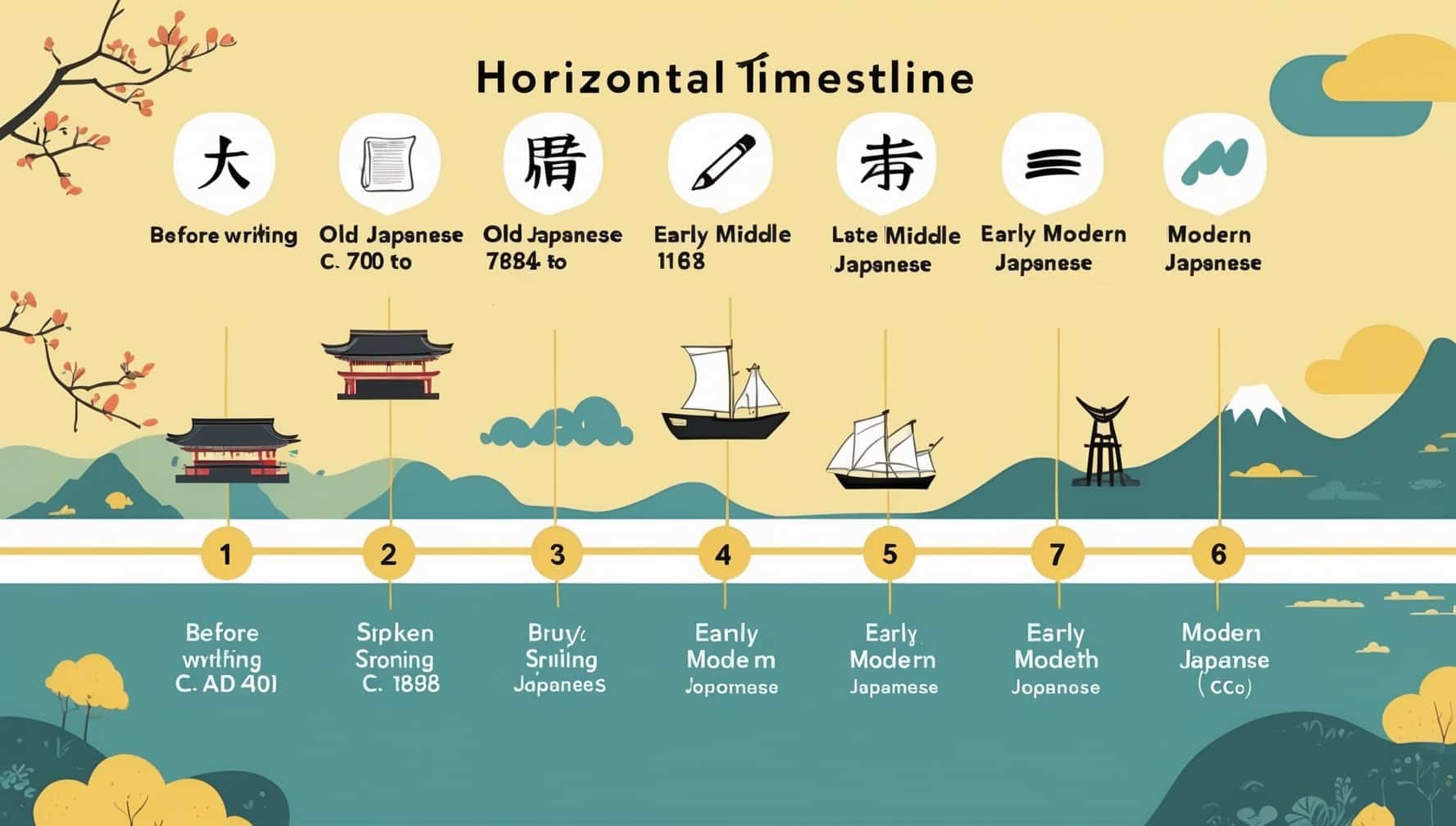
The history of Japanese is usually split into stages, from the unwritten language through Old Japanese to the modern language spoken today. The dates are approximate. Languages change gradually rather than overnight.
Stage
Approximate dates
What changed
Before writing
Before c. AD 400
Japanese was spoken but not written down
Old Japanese
c. 700 to 794 (Nara period)
Earliest surviving texts, using Chinese characters for their sounds
Early Middle Japanese
794 to 1185 (Heian period)
Hiragana and katakana develop; big changes to sounds and syllables
Late Middle Japanese
1185 to c. 1600
Verbs and adjectives change; first European loanwords arrive from Portuguese
Early Modern Japanese
c. 1600 to 1868 (Edo period)
Regional dialects grow stronger; Dutch words arrive through trade
Modern Japanese
1868 to today
Standard Japanese based on Tokyo speech; many new loanwords written in katakana
5 Facts About the History and Development of Japanese
The five facts below follow the language in order, from its unwritten beginnings to the loanwords children can spot on Japanese packaging today.
1. Japanese Was Spoken for Centuries Before It Was Written
Nobody knows exactly how Japanese began, because for most of its history it left no written record. People lived on the Japanese islands for thousands of years with no writing system of their own. Whatever language they used was passed on only through speech.
That’s a useful idea to share with children. Every language starts as speech, and writing is an invention added later. Many languages around the world are still spoken without a standard written form.
Historians can only follow Japanese in detail once writing arrived. Anything earlier has to be pieced together by comparing Japanese with the Ryukyuan languages and working backwards.
2. Chinese Characters Arrived by Way of Korea
Writing reached Japan from China. Scholars from the Korean kingdom of Baekje are traditionally credited with bringing Chinese books to Japan around AD 400. Japanese speakers took up the characters, which they called kanji, meaning “Han characters” or “Chinese characters”.
Chinese characters aren’t an alphabet. Each one stands for a meaning, and sometimes a sound as well. That created a real puzzle. Chinese and Japanese are unrelated languages with different grammar, so the characters didn’t fit Japanese neatly.
Early writers found two workarounds. Sometimes they wrote in Chinese itself. At other times they borrowed characters purely for their sound, ignoring the meaning, to spell out Japanese words. This sound-based system is called man’yōgana, after the Man’yōshū, a huge collection of poems compiled in the 8th century. The Kojiki, completed in AD 712, is the oldest surviving book written in Japan.
Children who know LearningMole’s guide to the Chinese writing system will recognise many kanji straight away, though Japanese often reads them differently.
3. Hiragana Grew Up in the Heian Court
Hiragana developed during the Heian period (794 to 1185), when writers simplified man’yōgana into quick, flowing shapes. Writing complex characters just to spell out sounds was slow. Simpler shapes made writing much faster.
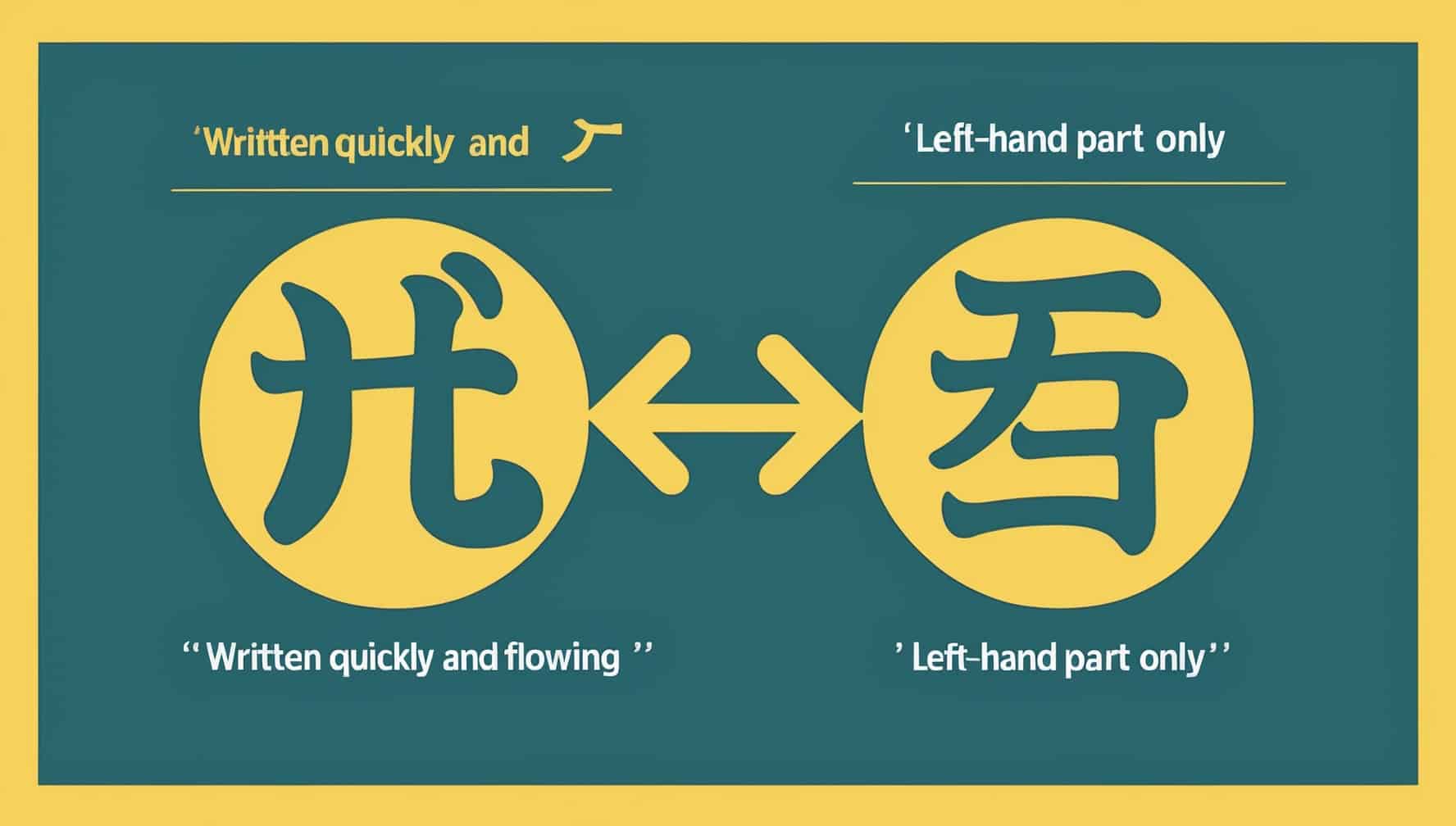
You can see the change in a single character. The Chinese character 加 was borrowed for the sound “ka”. Written quickly in a cursive style, it became the hiragana か. Take just its left-hand part and you get the katakana カ. Both scripts come from the same original, simplified in two different ways.
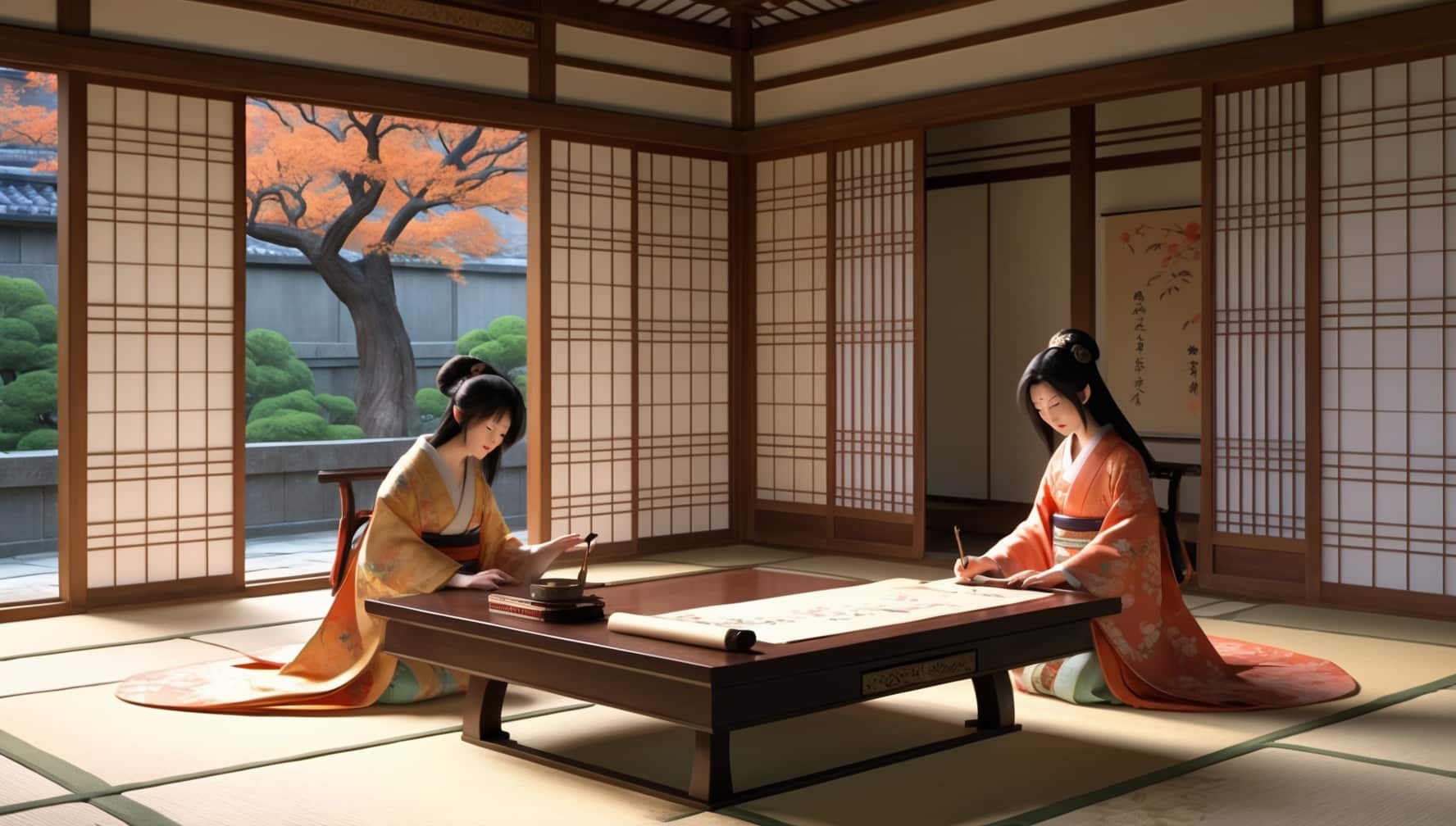
Hiragana was closely linked with women at the Heian court, and it was sometimes called onnade, or “women’s hand”. Men used formal Chinese writing for official records, while many court women wrote poetry, letters and diaries in hiragana. The most famous result is The Tale of Genji, written by Murasaki Shikibu in the early 11th century. It’s often described as one of the world’s earliest novels.
Men used hiragana too. Around AD 935, the poet Ki no Tsurayuki wrote the Tosa Diary in hiragana and told it as though he were a woman. KS2 pupils usually have plenty to say about why he might have done that.
Katakana developed in the same period, largely among Buddhist monks. They wrote small, angular pieces of characters as notes to help them read Chinese texts aloud.
4. Mountains, Islands and the Edo Period Shaped Japan’s Dialects
Japan has many strong regional dialects because its communities were cut off from one another for centuries. Some are so different that speakers from distant regions can struggle to understand each other.
A dialect is a local version of a language, with its own pronunciation and words. You might think of it as a code that belongs to one area. Dialects form when groups of people live apart for a long time. Without easy transport, words and accents stayed in one place and changed in their own way.
Japan’s geography made this separation especially strong. The country is an archipelago, a chain of islands, and a 2023 recount by the Geospatial Information Authority of Japan counted 14,125 of them. Much of the land is mountainous too. Communities were separated by sea, and even neighbouring valleys on the same island could be hard to travel between.
History added to the effect. During the Edo period (1603 to 1868), Japan was divided into domains ruled by local lords, and checkpoints controlled travel between them. From the 1630s until the 1850s, the government also strictly limited contact with other countries, a policy later known as sakoku. Local ways of speaking had centuries to drift apart.
“Japan’s dialects give children a lovely way into geography. When pupils see on a map how mountains and the sea kept villages apart, they work out for themselves why people started speaking differently.”
Michelle Connolly, LearningMole founder, has over 15 years of experience as a primary school teacher.
Japan’s leaders eventually wanted one shared way of speaking for the whole country. From the late 19th century, a standard form of Japanese based on the speech of Tokyo was taught in schools. Radio and, later, television spread it further, and some smaller local dialects have faded as a result. Regional speech is still very much alive, though. The Kansai dialect of Osaka and Kyoto is heard often on Japanese television, especially in comedy.
This short video gives pupils a chance to hear how Japanese dialects differ, and it works well alongside a map of Japan’s regions:
5. Japanese Keeps Borrowing Words From Around the World
Japanese has always taken in words from other languages, and today it writes most new borrowings in katakana. These borrowed words are called gairaigo, or loanwords.
Chinese came first and had the biggest influence. Sino-Japanese words, built from Chinese roots, make up around half the entries in a typical Japanese dictionary. In everyday conversation, native Japanese words are used more often.
European words started arriving in the 16th century, when Portuguese traders and missionaries reached Japan. The Japanese word pan, meaning bread, comes from Portuguese. During the Edo period, the Dutch were the only Europeans allowed to trade with Japan, and words such as biiru (beer) came from Dutch. After 1868, Japan borrowed from many more languages. German supplied words used in medicine, such as karute (a patient’s medical record). French and Italian added words linked to art, music and food, and English has supplied thousands more.
Modern Japanese also makes up its own “English” words, known as wasei-eigo. Sarariiman (salaryman) means an office worker, and pasokon, short for “personal computer”, is a word English speakers never use. Many loanwords get shortened, too. Terebi means television, and aisu often means ice cream.
Word type
Japanese name
Where it comes from
Example
Native Japanese words
Wago
The original Japanese language
yama (mountain)
Sino-Japanese words
Kango
Chinese roots
gakkō (school)
Loanwords
Gairaigo
Mostly European languages
terebi (television)
Mixed words
Konshugo
A mix of the types above
shokupan (sliced bread): Chinese-based shoku plus Portuguese pan
Japanese is also rich in words that copy sounds and feelings. Wan wan is a dog’s bark, and kira kira describes something sparkling. Most of these are native Japanese words, and children tend to love them. Food words make another great starting point. LearningMole’s guide to food culture in Japan is full of dishes and ingredients to talk about.
How Does Japanese Use Three Writing Systems in One Sentence?
Japanese uses kanji for the main meanings of words, hiragana for grammar and native words, and katakana for loanwords. All three often appear in a single sentence. Hiragana and katakana are syllabaries rather than alphabets. Each character stands for a whole syllable, not a single letter sound.
In English, the letter “s” represents one sound. Japanese has no single character for “s”. Instead, it has separate characters for sa, shi, su, se, and so.
Hiragana and katakana each have 46 basic characters covering the same set of sounds. Five are vowels (a, i, u, e, o), one is the consonant n, and the rest combine a consonant with a vowel. Small marks added to a character create extra sounds, so “ka” (か) becomes “ga” (が).
Kanji work differently. A kanji carries meaning, and a word can be written with one kanji or several. Large dictionaries list around 50,000 kanji, but the Japanese government’s list of kanji for everyday use contains 2,136. Children in Japan learn 1,026 of these during primary school.
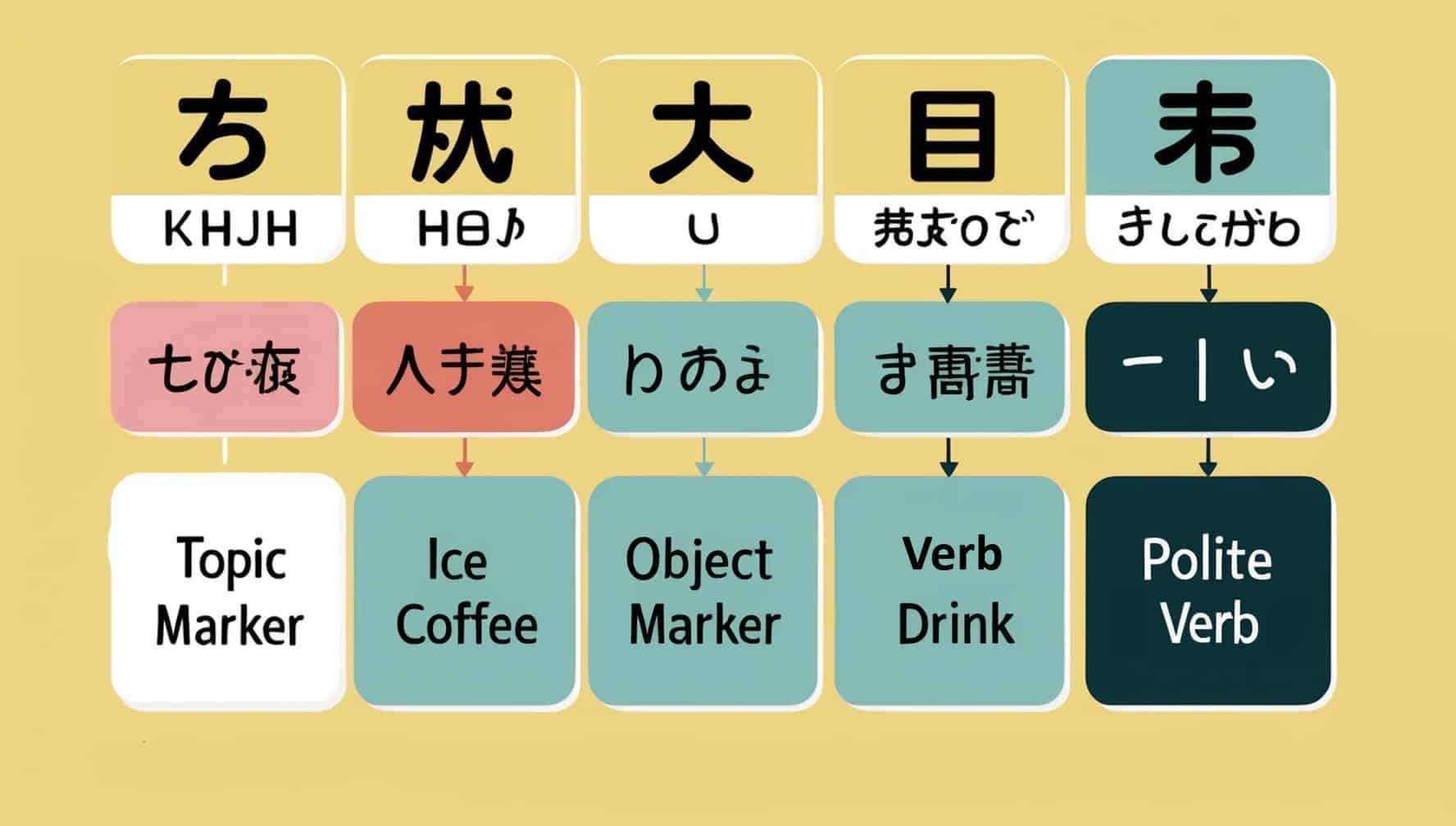
Here’s how the scripts share one everyday sentence:
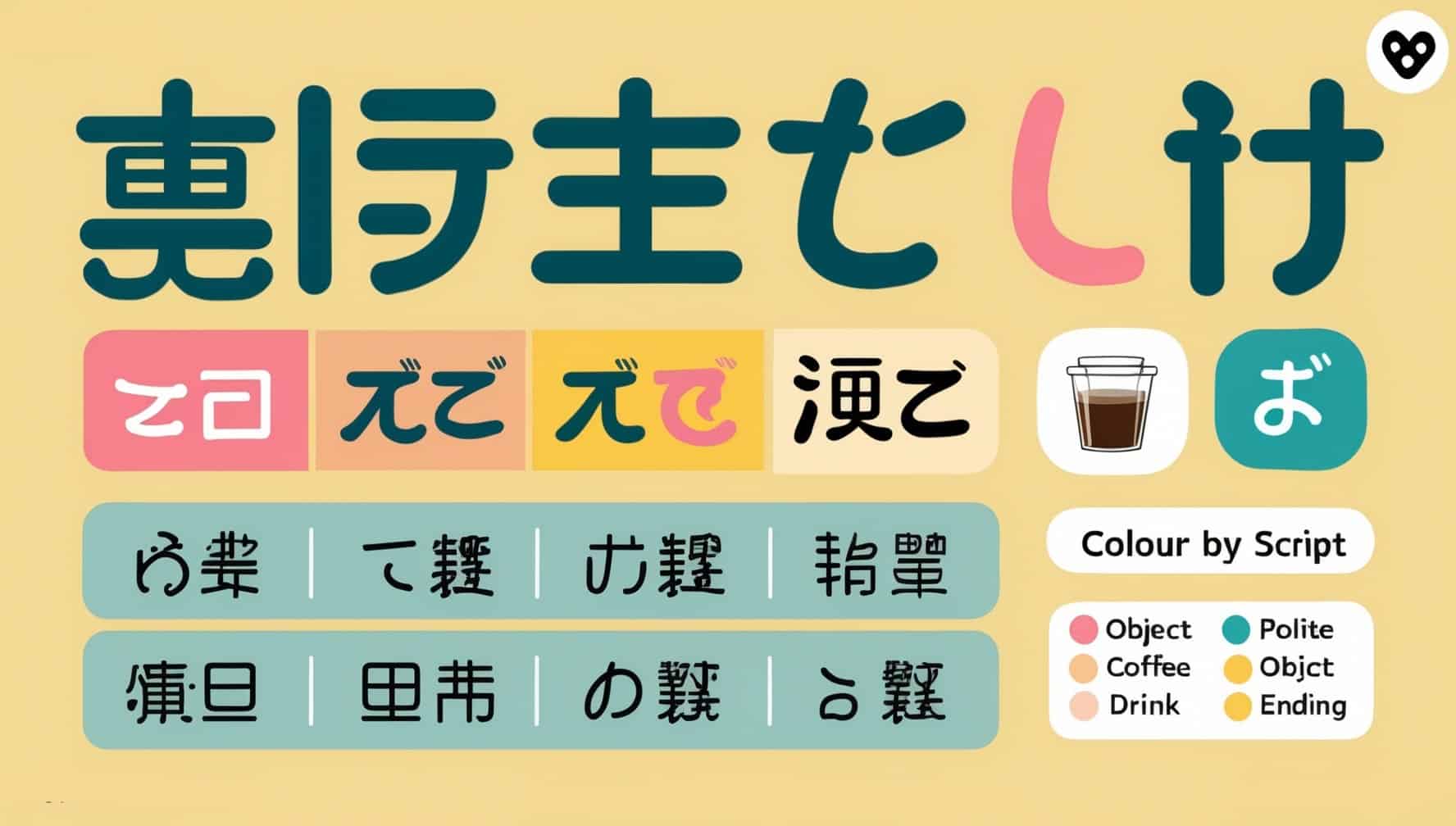
私はアイスコーヒーを飲みます。 Watashi wa aisu kōhī o nomimasu. (I drink iced coffee.)
Part of the sentence
Script
Its job
私 (watashi)
Kanji
Carries the meaning “I”
は (wa)
Hiragana
Grammar particle marking the topic
アイスコーヒー (aisu kōhī)
Katakana
Loanword from English “ice coffee”
を (o)
Hiragana
Grammar particle marking the object
飲 (no)
Kanji
Carries the meaning “drink”
みます (mimasu)
Hiragana
Verb ending showing politeness and tense
Notice that the verb comes last, following subject-object-verb order. Teachers may also spot that は is normally read “ha” and を is normally read “wo”. Both change their sound when they work as grammar particles.
So why not write everything in hiragana? Japanese doesn’t usually put spaces between words. In a long line of hiragana, it can be hard to see where one word ends and the next begins. Kanji solve much of that problem. Because each one carries meaning, readers can pick out the important words at a glance, while the hiragana around them show the grammar.
Books for young children are often written mostly in hiragana, sometimes with spaces added between phrases. For readers still learning kanji, publishers print small hiragana above or beside difficult characters. This reading aid is called furigana.
Script
Where it came from
What it looks like
Main uses
Example
Kanji
Chinese characters, arriving around AD 400
Complex, often many strokes
Main meanings of nouns, verbs and adjectives
山 (yama, mountain)
Hiragana
Cursive man’yōgana, Heian period
Rounded and flowing
Grammar, native words, children’s books, furigana
さくら (sakura, cherry blossom)
Katakana
Parts of characters, Heian period
Angular, with straight strokes
Loanwords, foreign names, sound words, emphasis
バス (basu, bus)
Japanese has a reputation as a hard language for English speakers, mostly because of kanji. Its pronunciation is fairly regular, though, with only five vowel sounds, and many beginners find hiragana quicker to learn than they expect. For hands-on practice, LearningMole’s hiragana activities are a good next step.
How Does Japanese Link to the UK Primary Curriculum?
Japanese fits the National Curriculum in England more closely than many teachers realise. The KS2 languages programme of study allows schools to teach any modern or ancient foreign language, so Japanese is a valid choice.
In English, the Year 6 grammar requirements introduce the terms subject and object. Comparing English and Japanese word order gives pupils a real reason to use those terms, and it makes English grammar easier to see. LearningMole’s classroom activities for teaching grammar pair well with this.
The KS2 history curriculum includes a study of a non-European society around AD 900. Japan isn’t one of the named options, but the Heian court was at its height in that period. That makes it a useful comparison for pupils studying the Maya or early Islamic civilisation. LearningMole’s ancient Japan facts for kids give helpful background. In geography, the dialect story shows clearly how physical features shape the way people live and speak.
Classroom Activity: Kana Detective
Show pupils a set of katakana loanwords with pictures, such as テレビ (terebi), バス (basu), and アイス (aisu). Read the romanised version aloud and ask them to guess the English word. Children soon realise that many katakana words are “hidden English”, and they start listening for how the sounds change. It takes about ten minutes and works well as a lesson starter.
Classroom Activity: Word-Order Swap
Write simple English sentences on strips of card, then cut each one into subject, verb and object. Pupils rebuild the sentences in Japanese order: “The cat the mouse chased” or “I my lunch ate”. Ask what still makes sense and what feels strange. It’s a quick way to check that Year 6 pupils can identify the subject and object in a sentence.
Teaching Resources and Support
LearningMole is a free UK educational platform providing curriculum-aligned teaching resources and videos for children aged 4 to 11. It was founded in Belfast by Michelle Connolly, a former primary school teacher. Everything on LearningMole is free to access, so teachers and families can use every resource at no cost.
At home, small activities work well. Write family members’ names in katakana, count to ten in Japanese together, or hunt for Japanese words on food packaging. LearningMole’s guide to the elements of learning a language has more ideas for keeping language learning relaxed and regular.
Frequently Asked Questions About the Japanese Language
What is the Japanese language called in Japanese?
Japanese speakers call their language Nihongo (日本語). Nihon is the Japanese name for Japan, and go means “language”, so Nihongo simply means “the language of Japan”. The name Nihon is written with kanji meaning “sun” and “origin”, which is why Japan is sometimes called the Land of the Rising Sun. Children often enjoy copying the three kanji of 日本語 as a first taste of Japanese writing.
Why does Japanese have three writing systems?
Japanese had no writing of its own, so it borrowed Chinese characters (kanji) to write meanings. Japanese grammar works very differently from Chinese, and writers needed a way to show word endings and grammar. Over time, they simplified characters into two syllabaries: hiragana, for grammar and native words, and katakana, now used mainly for loanwords and foreign names. Each script has its own job, and together they make written Japanese quick to read.
Is Japanese related to Chinese?
No. Japanese and Chinese belong to completely separate language families. Japanese borrowed Chinese writing and thousands of Chinese-based words from around the 5th century. English did something similar with Latin and French words, without becoming a Romance language. Their grammar is also very different. Japanese puts verbs at the end of sentences, while Chinese usually follows subject-verb-object order, like English.
At what age can children start learning about Japanese?
Children can enjoy Japanese words, songs and counting from Reception onwards. KS2 (ages 7 to 11) is a natural time for a more structured introduction. In England, the KS2 languages curriculum allows any modern or ancient language, so a school could choose Japanese. Many primary teachers use it as a cross-curricular topic instead, linking the scripts to art, dialects to geography and word order to Year 6 grammar.
Why are there no spaces between words in Japanese?
Japanese rarely needs spaces because the switch between scripts shows where words start and end. A kanji often marks the start of an important word, and the hiragana after it shows the grammar. Children’s books written mainly in hiragana sometimes add spaces to help young readers. Without kanji, the word boundaries are much harder to spot.
How many kanji do Japanese children learn at school?
Japanese children learn 1,026 kanji across their six years of primary school. By the end of secondary school, they’re expected to know most of the 2,136 kanji on the government’s list for everyday use. English-speaking children learn only 26 letters, but they spend years mastering spelling patterns. Both systems take time; they simply put the effort in different places.
Where can I find free resources for teaching Japanese language and culture?
LearningMole provides free, curriculum-aligned resources on Japan, including practical hiragana activities and articles on Japanese food, stories and history. There’s also a wider library of free classroom resources. Everything is free to use at school or at home, and you can create a free account to get started.
Bringing the Japanese Language Into Your Classroom
Japanese makes a strong case for teaching children about languages that look nothing like English. Its history ties together geography, trade and writing in a way pupils can follow. A language spoken for centuries without writing borrowed characters from China and reshaped them into two new scripts. It then kept taking in words from Portugal, the Netherlands and far beyond.
The five facts in this guide give pupils something practical to hold on to. Word order helps them understand subject and object in their own language. The kana show that writing systems are human inventions, and the dialects show geography shaping how people speak. You don’t need to speak Japanese yourself to teach any of this. A map, a few katakana cards and the example sentence above are enough to start a good discussion.
LearningMole’s teaching resources are free for teachers, parents and home educators across the UK and beyond. You might be planning a KS2 languages unit, a cross-curricular Japan topic or a rainy-afternoon activity at home. LearningMole has curriculum-aligned videos and materials ready to use for all three, so create your free account today and start exploring.
Maths Circus, an innovative platform we've crafted, presents a captivating realm where children learn mathematics through the exciting theme of a circus. The joy of juggling numbers and solving circus...
Asia Facts: One Interesting Fact About Every Country in Asia Asia is the largest continent on Earth, covering around 30% of the world's land and home to about 4.8 billion...
Feedback with digital portfolios works best in primary schools when teachers keep comments brief and expect every child to act on them. A voice note of about a minute on...
Singers use their voices as musical instruments to perform songs in theatres, recording studios, choirs and at events. Most of their working day, though, is spent practising, learning music and...








Leave a Reply