Parents and teachers can find loads of quality home learning materials for Year 3 and Year 4 children. Both free and paid platforms cover all the core curriculum subjects.
Children aged 7 to 9 really benefit from structured home learning resources that mix hands-on activities, interactive online tools and printable worksheets across maths, English, science and creative subjects. LearningMole, a UK educational platform started by former primary teacher Michelle Connolly, has curriculum-aligned video resources made for this age group.
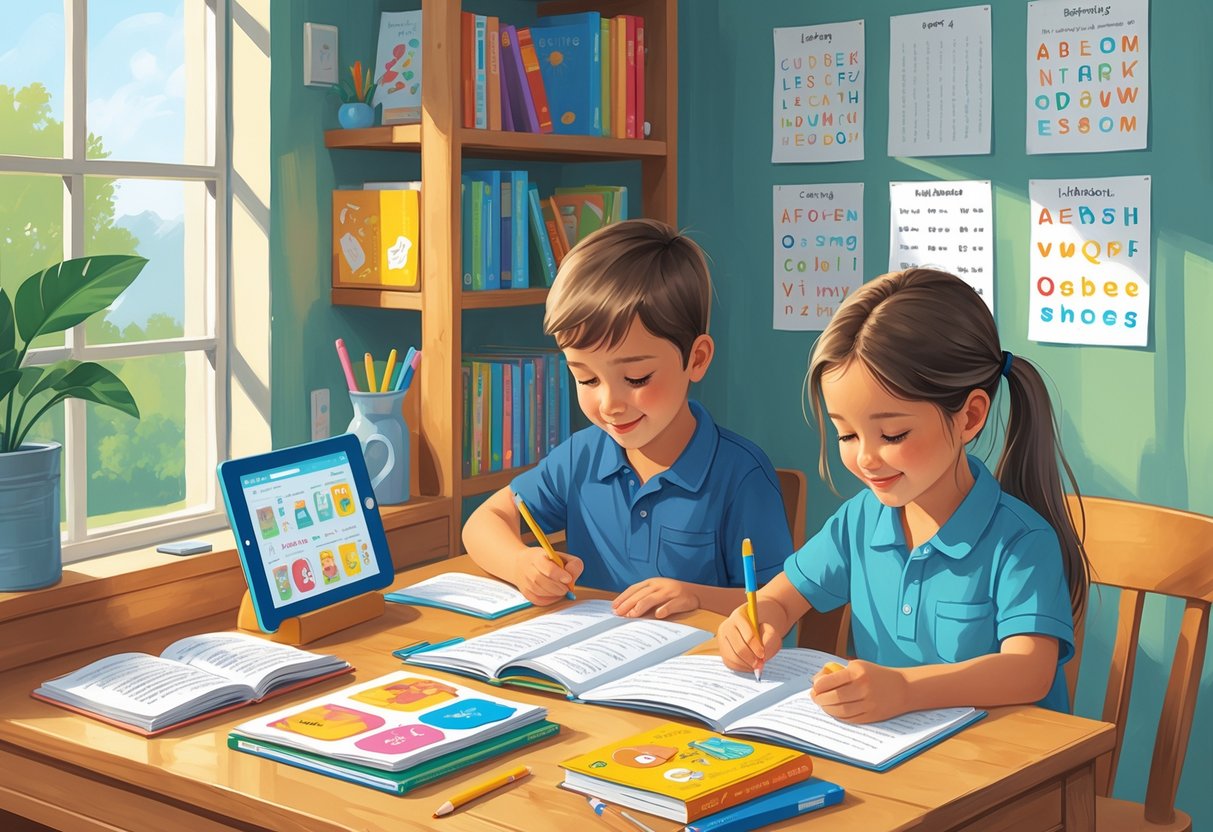
Finding the right balance between screen time and offline activities really helps Year 3 and Year 4 pupils enjoy home learning. Your child needs variety to stay motivated, whether that’s mixing printable worksheets for maths and literacy with movement breaks or swapping independent reading for creative projects.
Michelle Connolly, with over 15 years of classroom experience, says, “the best home learning happens when children can see the purpose behind what they’re doing and feel a sense of achievement along the way.”
You can build a complete home learning programme without spending a penny. Just use the many free activity sheets available for download along with educational videos and games.
Pick resources that fit your child’s current abilities and gently stretch them towards the next stage of the National Curriculum for Key Stage 2.
Key Takeaways
Year 3 and Year 4 home learning works best when you combine free printable resources with interactive online platforms and hands-on activities.
Children stay motivated through variety and clear structure, including breaks for movement and creative tasks.
Quality curriculum-aligned materials are available for free on trusted UK educational websites and platforms.
Getting Started with Home Learning for Year 3 and Year 4
Starting home learning means setting clear routines, finding a dedicated space and creating realistic daily plans that fit your child’s age and ability.
Year 3 and Year 4 children (ages 7-9) need structure, but a bit of flexibility keeps them engaged too.
Key Principles of Effective Learning at Home
Keep sessions short and focused. Year 3 and Year 4 children concentrate best in 20-30 minute blocks with breaks in between. You don’t have to copy a full school day at home.
Break learning into small chunks your child can finish on their own. This builds confidence and helps them learn to work independently.
Prioritise core subjects first. Tackle maths and English in the morning when children feel most alert.
Mix different activities throughout the day. Combine written work with hands-on tasks, movement and creative projects. This variety keeps boredom at bay and suits different learning styles.
Establishing a Productive Learning Environment
Pick a quiet spot with as few distractions as possible where your child can work comfortably. If you don’t have a spare room, the kitchen or dining table works just fine.
Essential items include:
Clear desk or table surface
Comfortable chair at the right height
Good lighting, natural or artificial
Basic stationery (pencils, rubber, ruler, paper)
Storage box for learning materials
Take away phones, tablets and toys from the area during learning time. Your child needs visual space to focus without distractions.
Put up a simple timetable at eye level so your child knows what’s coming next. Visual schedules help children feel secure and build time management skills.
LearningMole has curriculum-aligned videos for maths, English and science that fit well in home settings. You can use these to shape your daily routines.
Recommended Daily Schedules for Home Learners
A typical home learning day for Year 3 and Year 4 should have around 3-4 hours of structured activities. Start with a consistent morning routine, similar to school timing.
Sample daily schedule:
Time
Activity
Duration
9:00-9:30
English (reading or writing)
30 minutes
9:30-10:00
Maths
30 minutes
10:00-10:15
Break
15 minutes
10:15-10:45
Topic work (science, history, geography)
30 minutes
10:45-11:30
Physical activity or creative task
45 minutes
11:30-12:00
Independent reading or online learning
30 minutes
Tweak this framework to fit your family’s needs. Some children do better with shorter, more frequent breaks. Others prefer longer sessions with bigger breaks in between.
Plan for physical activity throughout the day. Year 3 and Year 4 children really need movement to stay focused and healthy while learning at home.
Core English Resources and Activities
Year 3 and Year 4 children need regular practice in reading, writing, grammar and spelling to build their English skills. The right mix of comprehension tasks, creative writing prompts and grammar exercises helps children aged 7-9 develop the language skills set out in the National Curriculum.
Reading Comprehension and Vocabulary Building
Reading comprehension activities should use short texts followed by questions that check understanding at different levels. Try fiction extracts, non-fiction articles and poetry to keep your child interested.
Effective comprehension activities include:
Multiple-choice questions about main ideas and details
Open-ended questions needing written explanations
Vocabulary tasks where children define words from context
Prediction exercises before reading continues
BBC Bitesize offers free comprehension passages matched to Key Stage 2. Many texts have built-in quizzes for instant feedback.
Vocabulary building works best when children meet new words in context, not just lists. Ask your child to keep a word journal with interesting words from their reading. They can write the word, its meaning and use it in a sentence.
Tricky words for phonics still matter at this age. Some children need extra help with common exception words that don’t follow usual spelling rules.
Creative and Extended Writing Tasks
Children in Years 3 and 4 should write regularly in different styles. Story writing is always a hit, but persuasive letters, instructions and non-fiction reports build important skills too.
Weekly writing tasks might include:
Text Type
Example Task
Key Skills
Narrative
Write a story about a lost pet
Character development, dialogue
Instructions
Explain how to make a sandwich
Imperative verbs, time connectives
Persuasive
Convince parents to allow a later bedtime
Modal verbs, rhetorical questions
Report
Describe an animal’s habitat
Present tense, subject-specific vocabulary
Set a timer for 20-30 minutes and let your child write without stopping to correct everything. Focus on ideas first. Editing and spelling can happen in a later session.
Children need to build grammar knowledge gradually, with both explicit teaching and practice in context. Years 3 and 4 cover word classes, sentence types and punctuation rules.
Essential grammar topics include:
Nouns (common, proper, collective)
Adjectives and adverbs
Prepositions and conjunctions
Past and present tense consistency
Fronted adverbials
Short, daily grammar exercises help more than long, occasional sessions. Try giving your child five sentences to correct each morning or a few quick questions on word types.
Spelling practice should focus on spelling patterns, not just random lists. Work on one rule at a time, like adding suffixes or the /i/ sound spelled ‘y’. Test words in sentences so your child understands meaning and spelling together.
Recommended English Platforms
Several online platforms offer structured English learning materials for Year 3 and Year 4. Each has its own strengths, depending on your child’s needs and style.
BBC Bitesize stands out as a comprehensive free option. It covers reading, writing, grammar and spelling with video explanations and interactive activities matched to curriculum goals. Independent learners who like clear instructions often enjoy this platform.
LearningMole gives you curriculum-aligned video resources and teaching materials that make phonics and literacy accessible through engaging visual content. The platform has free videos and some subscription resources for home learning.
Twinkl provides loads of printable worksheets and activities for Year 3 and Year 4. Parents like the ready-to-use format with minimal prep. Many resources are free, though a subscription gives access to everything.
Oak National Academy shares complete lesson sequences with slides, worksheets and quizzes. The structured approach suits families who want a school-like experience at home.
Pick platforms that suit your child’s attention span and learning preferences. Some children love interactive games, while others stick with traditional worksheets.
Essential Maths Support for Years 3 and 4
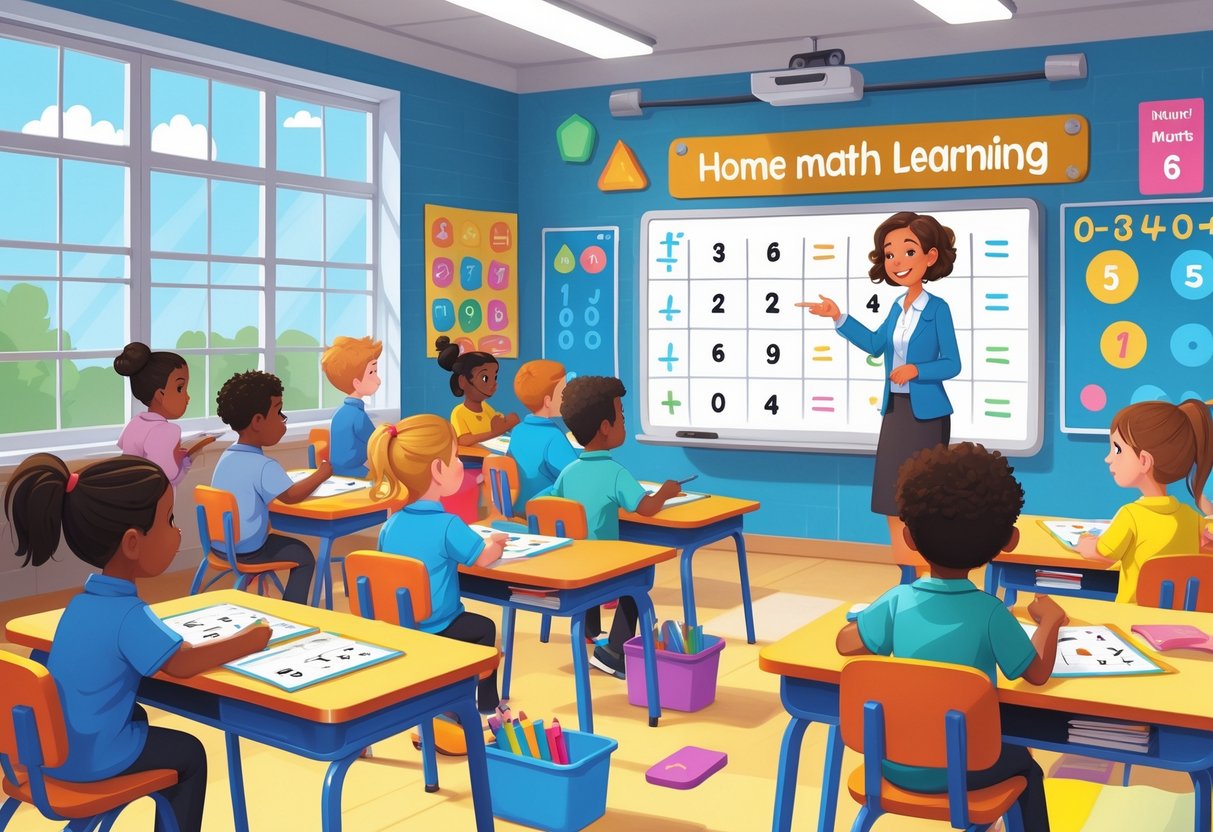
Children in Years 3 and 4 tackle multiplication tables, fractions and place value as things get trickier. They need hands-on practice with both mental calculations and written methods to grow confident across the curriculum.
Key Maths Topics and Concepts
Your child will focus on number and place value as they move from two-digit to three-digit numbers. Understanding place value helps children see how digits change meaning based on their position.
Addition and subtraction become more challenging as children learn column methods with three-digit numbers. They’ll solve missing number problems where the answer doesn’t always follow the equals sign.
Fractions move from concrete objects to more abstract ideas. Your child will learn about unit fractions like 1/4 and 1/2, then explore equivalent fractions. Using real items, like sharing pizza slices, makes these ideas much clearer.
Measurement covers telling time to the nearest minute, using Roman numerals and comparing lengths, mass and volume. Children also study 2D and 3D shapes, learning to spot angles and shape properties.
Statistics work means creating and reading pictograms and bar charts. These skills come up in the curriculum and in everyday life.
Multiplication, Division and Number Facts
Times tables sit at the heart of Years 3 and 4 maths. By the end of Year 3, your child should know the 2, 3, 4, 5, 6, 8, 10 and 11 times tables.
Daily practice beats long sessions every time. Quick-fire questions during everyday activities help children recall facts without thinking twice.
When you’re out shopping, ask your child how many apples you’ll have if you buy three packs of two. Keep it casual and fun.
Children need to grasp inverse operations. If they know 5 × 3 = 15, they also know 3 × 5 = 15, 15 ÷ 3 = 5 and 15 ÷ 5 = 3.
This link makes division facts stick alongside multiplication. It’s a bit like learning both sides of the same coin.
Make practice into games instead of tests. Try bingo with multiplication facts, calling out 6 × 4 and waiting for someone to shout 24.
Sing times tables to tunes your child already loves. It’s surprising how music makes facts memorable.
Interactive Maths Games for Home Use
Online resources give structured practice that matches your child’s level. BBC Bitesize has free videos and activities for the full Year 3 and Year 4 curriculum.
Practical activities work great for learning at home. Measuring ingredients while cooking teaches volume, mass and fractions in real situations.
Growing plants from seeds gives children the chance to measure daily and record data in tables. They see maths in action.
Card games build mental maths skills without feeling like work. Make a pack with numbers 1 to 10 and play multiplication snap, multiplying two cards together.
Try your own treasure hunts around the house using shape clues or measurement challenges. Ask your child to find five objects shorter than 20cm or spot three right angles in the kitchen.
Physical games get kids moving. Draw angles on the pavement with chalk and have your child stand in different spots to show acute, obtuse or right angles.
Science Learning at Home
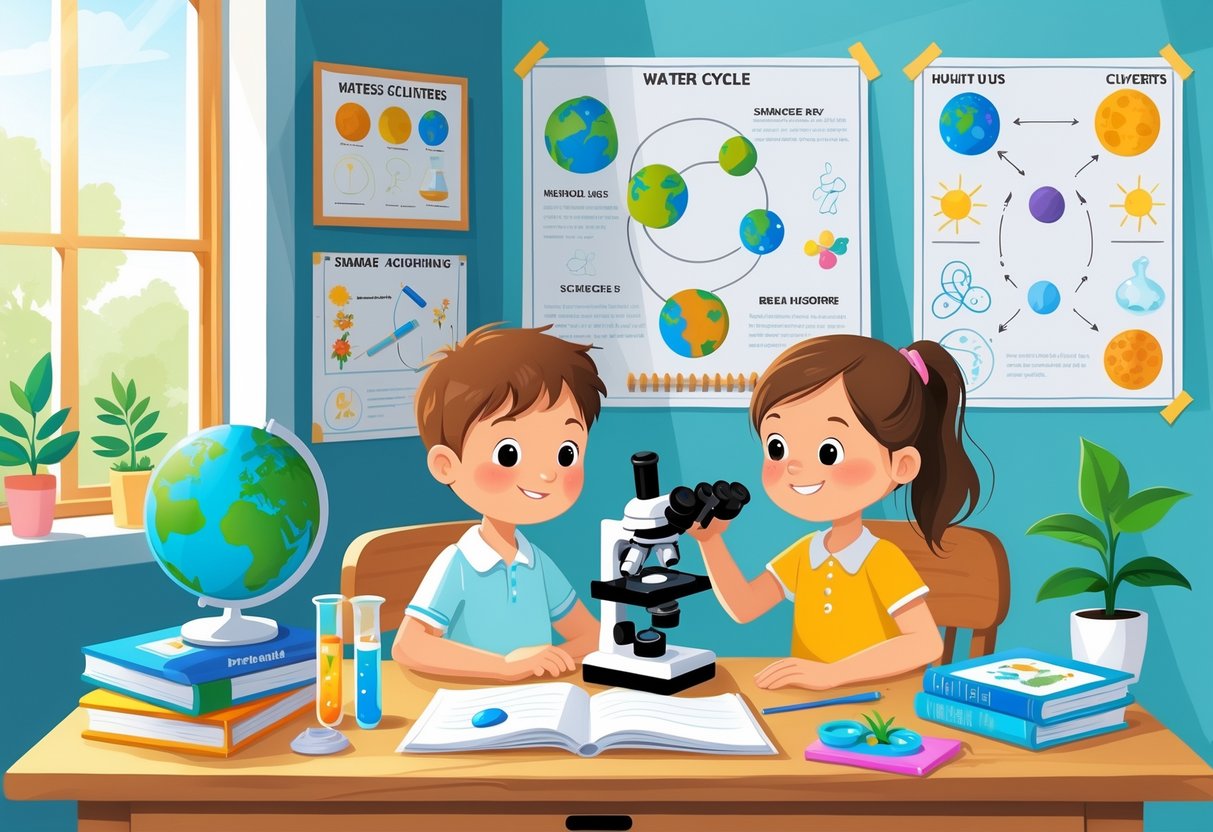
Parents can boost Year 3 and Year 4 science by using simple experiments with household items, free online platforms and by asking the right questions.
Experiments and Hands-On Science
Simple kitchen science works wonders at home. Freeze different liquids in ice cube trays to explore states of matter.
Roll toy cars over different surfaces to see which creates the most friction. Kids love seeing what happens.
Plant investigations fit easily into home routines. Put cress seeds on damp cotton wool and leave them on the windowsill to sprout.
Drop white flowers into food colouring and watch how water travels up the stems. It’s a bit magical.
Make a volcano with bicarbonate of soda and vinegar
Build a simple circuit with batteries and bulbs
Test which materials dissolve in water
Grow bean seeds in clear containers to watch the roots
Test everyday materials to understand properties and changes. Sort objects into magnetic and non-magnetic groups with a fridge magnet.
Explore how volcanoes work by making a model before trying the bubbling eruption.
Useful Online Science Resources
BBC Bitesize gives free videos and activities that match the National Curriculum for Key Stage 2. Topics come in small chunks covering forces, living things and materials.
Oak National Academy has whole lesson sequences with videos, worksheets and quizzes. Each lesson follows a structure that parents can use without teaching experience.
The Primary Science Teaching Trust lists practical activities for home using simple equipment. Most tasks need only paper cups, string and water.
Encouraging Critical Thinking
Ask your child to guess what might happen before any experiment. This builds scientific thinking and links new ideas to what they already know.
Encourage them to spot patterns in results. Try questions like “What do you notice?” or “Why do you think that happened?” instead of yes or no choices.
Let your child record what they see through drawings, simple tables or photos. Year 3 pupils might draw their results, while Year 4 children can make basic bar charts.
Recording helps them remember concepts and spot changes over time. It’s not always neat, but it works.
Talk about variables when testing ideas. If you’re comparing how fast ice melts on different surfaces, discuss keeping everything else the same.
Understanding life cycles of butterflies or other organisms develops observation skills by watching gradual change.
Online history resources make learning about the past feel engaging and accessible. BBC Bitesize has interactive lessons with videos, quizzes and activities your child can do alone.
You’ll find free teaching resources for Years 3 and 4 with ready-made slide decks and worksheets. These cover topics like invasion, migration and settlement, helping children see how Britain’s past shaped the present.
Virtual field trips let your child explore new places from home. Geography skills grow when children use online maps to find countries, cities and landmarks they’re studying.
Year 4 geography resources offer structured units that fit the National Curriculum. Your child can practise reading maps, using compass directions and spotting features like rivers and mountains.
Key Geography Skills to Practise:
Using four-point compass directions (N, S, E, W)
Reading simple grid references
Identifying countries and capital cities of the UK
Understanding types of settlements
Interactive map activities help children build spatial awareness and see how people live in different places. Encourage your child to explore your local area online, then compare it to other regions they study.
Creative Arts and Design for Home Learners
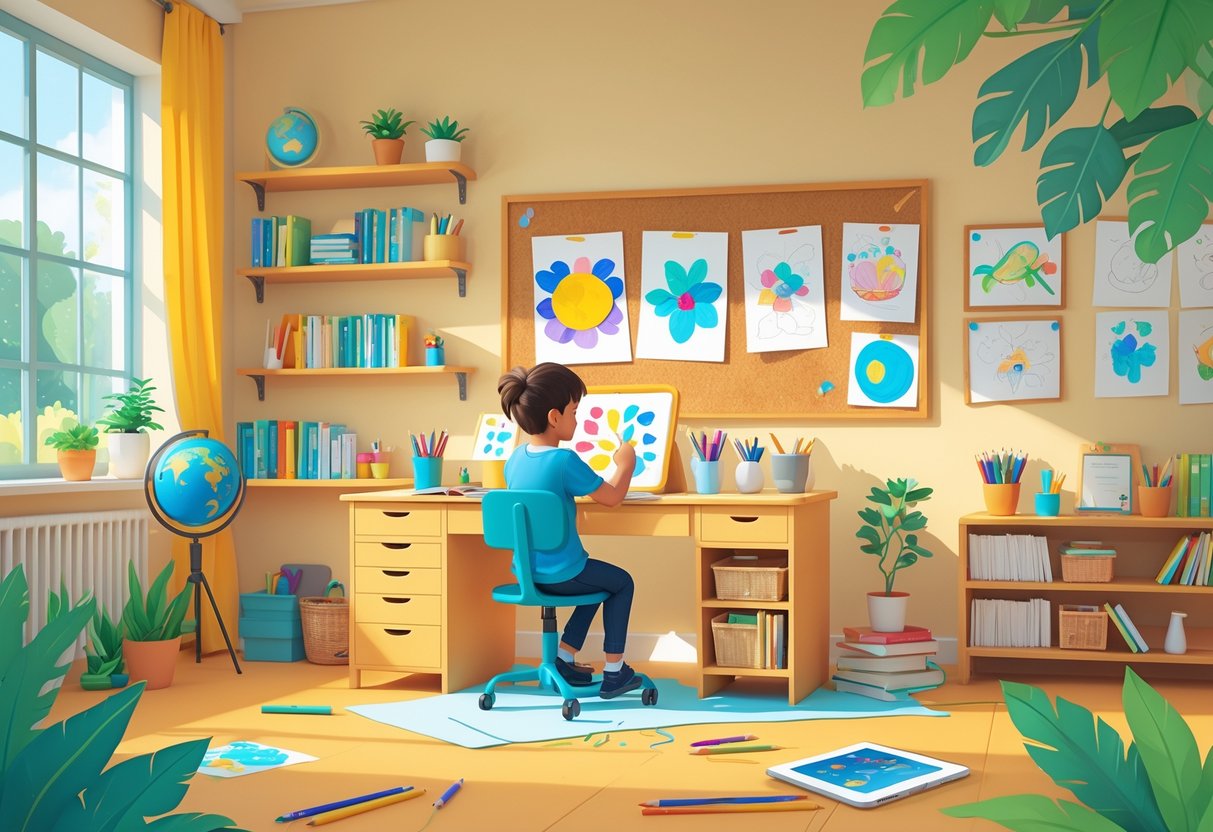
Art, craft, music and drama activities help Year 3 and Year 4 children grow creatively and build fine motor skills and confidence. These subjects offer hands-on learning that fits with academic work at home.
Art and Craft Activities
You can find curriculum-aligned art resources that include school planning and practical activities for home learning. These match National Curriculum requirements for Key Stage 2.
Start with simple drawing and painting projects using materials you already have. Year 3 children enjoy colour mixing, collage and clay modelling.
Year 4 learners can try more advanced techniques like printmaking and textile design. Keep it relaxed, not every project needs to be perfect.
LearningMole shares free video tutorials that show art techniques step by step. Visual guides explain shading, perspective and patterns.
Music and drama support literacy and numeracy while building communication skills. Try rhythm exercises using household items for percussion.
Year 3 children like creating simple plays from familiar stories. They can write scripts, make costumes from old clothes and perform for the family.
Year 4 learners might compose songs or try out new musical styles. Set up a small performance space at home, even just a cleared corner with good lighting.
Record performances so children can watch and improve. Drama activities like role play and improvisation help them express emotions safely.
Try freeze-frame exercises by pausing action scenes from stories. Movement with music develops coordination and rhythm.
Maybe set aside one afternoon a week for arts projects. Keeping it regular helps children look forward to creative time.
Physical Education and Movement
Year 3 and 4 children need regular physical activity to build coordination, strength and teamwork. Circuit training and multiskills activities work well indoors, while outdoor games let children practise movement in all sorts of weather.
Indoor PE and Fitness Ideas
Circuit training keeps children active when you’re stuck indoors. Year 4 circuit training lessons often include stations for jumping, balancing, core strength and cardio.
You can set up simple circuits at home with household items. Try five stations: star jumps, wall sits, plank holds, step-ups on stairs and jogging on the spot.
Children should spend 30 seconds at each station, with 15 seconds to rest. It’s quick, but it works up a sweat.
Physical distanced multiskills activities help children practise movement patterns like throwing, catching and balancing. These skills set the stage for sports later on.
When children get outdoors, they have space to run, jump and play games that boost their fitness. You can tweak activities for any weather, rain or shine.
LearningMole shares free videos packed with outdoor science experiments that get kids moving. Children can investigate forces through games or explore shadows by running and jumping. These activities tie physical play to what they learn in class.
Try tag games, relay races or scavenger hunts that get kids running and changing direction quickly. Ball games build teamwork and hand-eye coordination. Wet weather doesn’t have to stop the fun—kids can jump in puddles or weave obstacle courses around garden furniture.
Weather-Appropriate Ideas:
Sunny days: Sports skills practice, long-distance running games
Cloudy days: Team games, nature walks with movement challenges
Project-based learning at home lets Year 3 and Year 4 pupils dig into topics while picking up skills across different subjects. Theme-based projects and family activities help make learning at home feel more connected to everyday life.
Weekly and Fortnightly Project Themes
Thematic home learning projects cover reading, writing, maths, science and history through one central topic. You can pick themes your child enjoys, like space, ancient civilisations or local wildlife.
A two-week project structure fits well for Years 3 and 4. In week one, children research and gather information. Week two focuses on creative outputs, like making presentations, models or reports.
Popular themes include natural disasters, inventors, and ecosystems. Each theme links to National Curriculum goals across subjects. For instance, a rainforest project might involve writing descriptions, calculating deforested areas, mapping locations and studying food chains.
LearningMole provides free videos for science and maths topics that support project work. You’ll find resources on forces, materials and living things, all connected to themed learning.
Collaborative Family Projects
When families work together on home learning challenges, everyone shares the goal and builds practical skills. Cooking projects teach measurement, fractions and following steps, plus everyone gets to eat the results.
Garden or nature projects fit outdoor learning at home. Growing vegetables teaches observation, data collection and patience. Building a bug hotel involves planning, measuring and understanding habitats.
Creative challenges, like designing board games or building with recycled materials, build problem-solving skills. These activities spark discussion and teamwork. Parents can guide but let children choose materials, designs and methods.
Set aside time for family projects, maybe weekend mornings. Rotate who picks the next project to keep everyone interested.
Recommended Online Platforms and Resources
A number of quality platforms offer structured learning for Year 3 and 4 pupils. These resources match the National Curriculum and offer interactive lessons, printable worksheets and video content.
BBC Bitesize
BBC Bitesize stands out as a trusted home learning platform in the UK. It provides free curriculum-matched content for all core subjects, including maths, English and science for Key Stage 2.
You’ll find interactive games, short videos and quizzes that fit what your child learns at school. The content is sorted by year group, so it’s easy to find materials for Years 3 and 4.
Teachers recommend BBC Bitesize because it breaks tricky topics into smaller bits. Most activities are self-guided, so your child can work independently and build confidence.
Twinkl and Free Printable Worksheets
Twinkl has thousands of printable resources and worksheets matched to the National Curriculum. Some require a subscription, but they offer a good selection of free materials to download and print.
Worksheets cover everything from times tables and comprehension to science investigations. You can search by subject, year or topic to find what you need.
Khan Academy offers high-quality content across subjects, mainly maths and science. The platform adjusts to your child’s pace and tracks progress.
National Geographic Kids brings geography and science alive with videos, quizzes and articles about animals, space and cultures. The content sparks curiosity and supports school topics.
PBS Learning Media has interactive lesson plans and videos aligned to educational standards. These resources suit topics that mix science, history and literacy.
Supporting Children’s Wellbeing and Motivation
Children learn best at home when they feel emotionally supported and keep healthy learning habits. Regular breaks, positive feedback and understanding emotional needs help Year 3 and 4 pupils stay engaged.
Balancing Screen Time and Breaks
Year 3 and 4 children need regular breaks to keep their focus. Aim for 20 to 30 minutes of work, then take a 5 to 10 minute break away from screens.
Physical movement breaks help reset attention. Stretching, jumping jacks or a quick walk in the garden give kids’ eyes a rest and boost energy.
The 20-20-20 rule protects your child’s eyes during screen time. Every 20 minutes, get them to look at something 20 feet away for 20 seconds. This simple habit helps prevent eye strain.
Mix screen-based and hands-on activities during the day. After a maths video, switch to worksheets or use counters or blocks. LearningMole has free videos for maths and science that you can pair with offline activities for variety.
Celebrating Progress and Rewards
Effort matters more than perfect results for Year 3 and 4 learners. Notice when your child tries hard, improves or tackles tough work.
A simple reward system can motivate your child without making things complicated. Sticker charts, marble jars or tallies work well for tracking progress. Let your child help pick rewards, like extra playtime or choosing what’s for dinner.
Effective rewards for home learners:
Extra 15 minutes of free play
Choice of weekend family activity
Special snack or treat
Extra story at bedtime
Small toy or book after a week of effort
Praise specific actions, not just general effort. Try saying, “You worked really hard on that tricky multiplication problem” instead of just “well done”. It helps your child see exactly what they did well.
Emotional Support During Home Learning
Sometimes children feel frustrated, worried or just not interested in home learning. You can help by noticing these feelings and talking about them openly.
Look for signs your child is struggling emotionally. They might avoid work, complain of feeling unwell, get more irritable or pull away from favourite activities. If you spot these early, you can support them before things get worse.
Free wellbeing activities for children aged 3 to 12 help them understand and talk about feelings. Activities like worry jars, feelings charts and coping strategies can work alongside learning.
Simple strategies to support emotional wellbeing:
Start each day with a quick chat about how they’re feeling
Keep a regular routine with clear expectations
Offer choices when you can (which subject to start, where to work)
Stay calm if your child struggles or makes mistakes
If emotional problems continue, contact your child’s class teacher. Teachers often have extra resources and can adapt work to reduce stress.
Frequently Asked Questions
Parents and teachers often ask similar questions when setting up home learning for Years 3 and 4. Online platforms, downloadable materials and interactive tools can all help children aged 7 to 9 learn at home.
What are some effective online platforms offering free educational content for children in Years 3 and 4?
Several platforms provide quality free content for Key Stage 2 learners. LearningMole has curriculum-aligned video resources for maths, English and science that fit the National Curriculum for Years 3 and 4. BBC Bitesize offers free lessons and activities sorted by year and subject.
Times Tables Rock Stars helps children practise multiplication tables through games. Top Marks features a wide range of maths games for skills like place value, addition and subtraction.
How can I access downloadable workbooks or worksheets suitable for students in Years 3 and 4?
Where can I find comprehensive PDF resources for home learning that cater to Year 3 and Year 4 pupils?
Schools often post PDF learning packs on their websites that you can download and print. Year 3 home learning resource packs usually include activities for several subjects with clear instructions.
Many schools created these packs during remote learning, and they’re still available online. These PDFs often cover a week’s worth of English, maths and other curriculum work.
What are the top-rated grammar and reading comprehension resources for Key Stage 2 learners?
EdPlace offers grammar and reading worksheets that follow the National Curriculum for Years 3 and 4. Oxford Owl provides free ebooks and reading activities for this age group.
David Walliams released audio stories that encourage reading and comprehension. Primary science activities for Years 3 and 4 can also help develop reading through topic vocabulary and instructions.
Can you recommend interactive online tools that support the home learning curriculum for Years 3 and Year 4?
Joe Wicks’ workouts and Cosmic Kids Yoga provide physical activities children can follow at home. National Geographic for children mixes reading, science and geography with engaging multimedia.
Are there any reputable websites providing answer sheets to accompany Year 3 and Year 4 homework resources?
Most paid educational platforms, like EdPlace, include answer sheets with their downloadable worksheets. Teachers usually hand out answer keys when they send homework home to parents.
Free resources don’t always come with answers. Still, plenty of platforms add guidance notes for parents.
You can check each resource pack before you download it to see if answer sheets are there. Sometimes you have to hunt around a bit, but it’s worth it.
Maths Circus, an innovative platform we've crafted, presents a captivating realm where children learn mathematics through the exciting theme of a circus. The joy of juggling numbers and solving circus...
The 9 times table multiplication has a reputation for being tricky, yet it holds more mathematical magic than any other table in the primary curriculum. Every answer follows two neat...
Article Summary What this article covers: Ten differences between river otters and sea otters, from size, fur and swimming style to diet, tool use and family life, plus which otter...
Article Summary What this article covers: The nine main types of natural disasters, how each one works and how they are measured, which hazards genuinely affect the UK, and how...




Leave a Reply